
‘Opened my eyes’: How coaching has changed the game for AFLW players Bonnie Toogood, Deanna Berry
Plenty of AFLW players have spent the off-season coaching local footy teams, future AFL draftees and club-run programs. SHANNON GILL looks at the generational change unfolding and its knock-on effect.

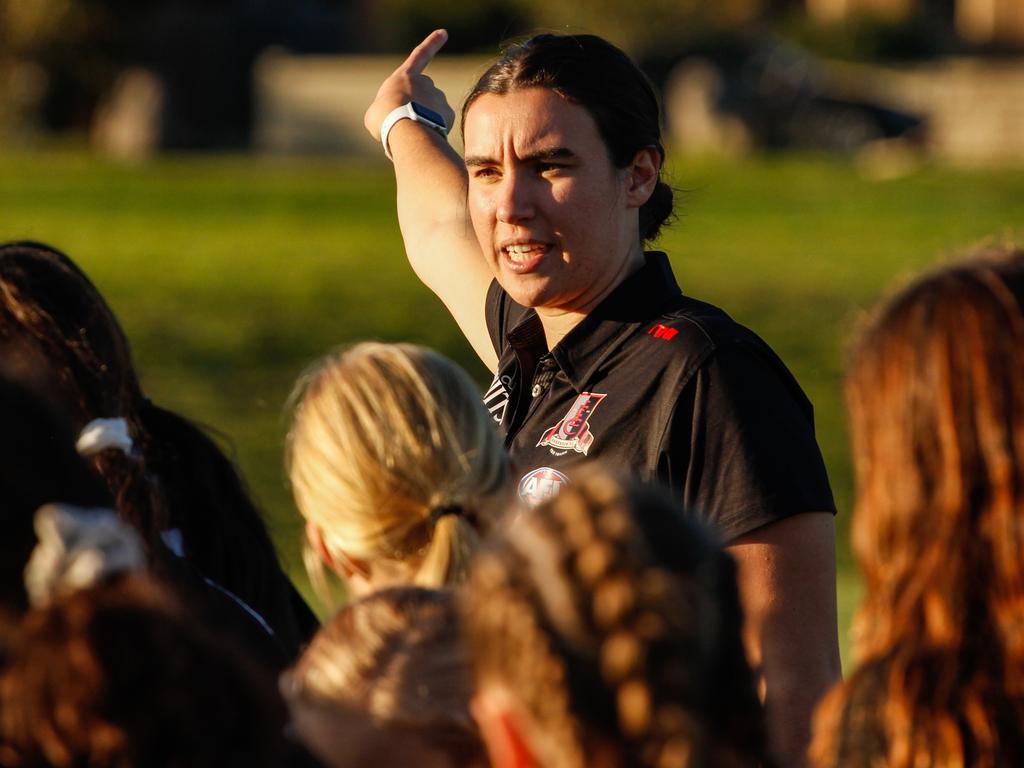
While AFLW players struggle to achieve something like full-time professionalism, Essendon co-captain Bonnie Toogood is one of a growing group attempting to turn a negative into a positive by building the most impressive footy resumes possible.
“It started off as pocket money when I was 15 years old,” Toogood tells CODE Sports.
“But I’ve always coached, first netball and then I started coaching football at my old school. Coaching has always been on the cards.”
The AFLW season starts on Friday night. No less than 16 current players have spent their off-seasons in coaching or development roles across the Under 18 Talent League.
Those numbers swell when it includes part-time coaching and development work at their own AFL clubs or in community leagues. That group includes Demon Tyla Hanks, who at just 23 is coaching both boys and girls Next Generation Academy (NGA) teams at Melbourne.
Quietly, it’s creating generational change in coaching ranks across all levels of the game.

Toogood is the women’s pathway co-ordinator at Essendon, looking after its multicultural, Indigenous and academies programs to get more young talent in the red and black, and is also a support coach at the Calder Cannons Under 18s.
“I put together all the training plans but I can’t help myself, I end up jumping in and coaching too,” she says.
“All the coaching certificates you can get are fantastic but actually having two feet on the ground and getting to observe coaching on the ground, you pick up a lot of tricks.”
Listening to Toogood, she’s confident about where she wants to go in the broader game of football and how she’ll get there. A path that wouldn’t have felt possible for a lot of her predecessors.
“The next step is probably in the Talent League as an assistant or through the VFLW. That would be the next level of ownership in a coaching role, taking charge of systems and detail for a team.”

*****
Western Bulldogs midfielder Deanna Berry is not part of the group of 16 Talent League mentors, but some would argue she has gone a step further.
For the past few years she has made the long and winding drive up to Panton Hill on Melbourne’s northeastern outskirts, where she is an assistant coach looking after the midfield for the Redbacks senior men’s team in the Northern Football League. An offer came up to be involved and her Bulldogs AFLW coach Nathan Burke urged her to take it up.
It may have been unthinkable a generation ago in that sometimes rough and tumble league, but Berry says all the players care about is her footy knowledge.
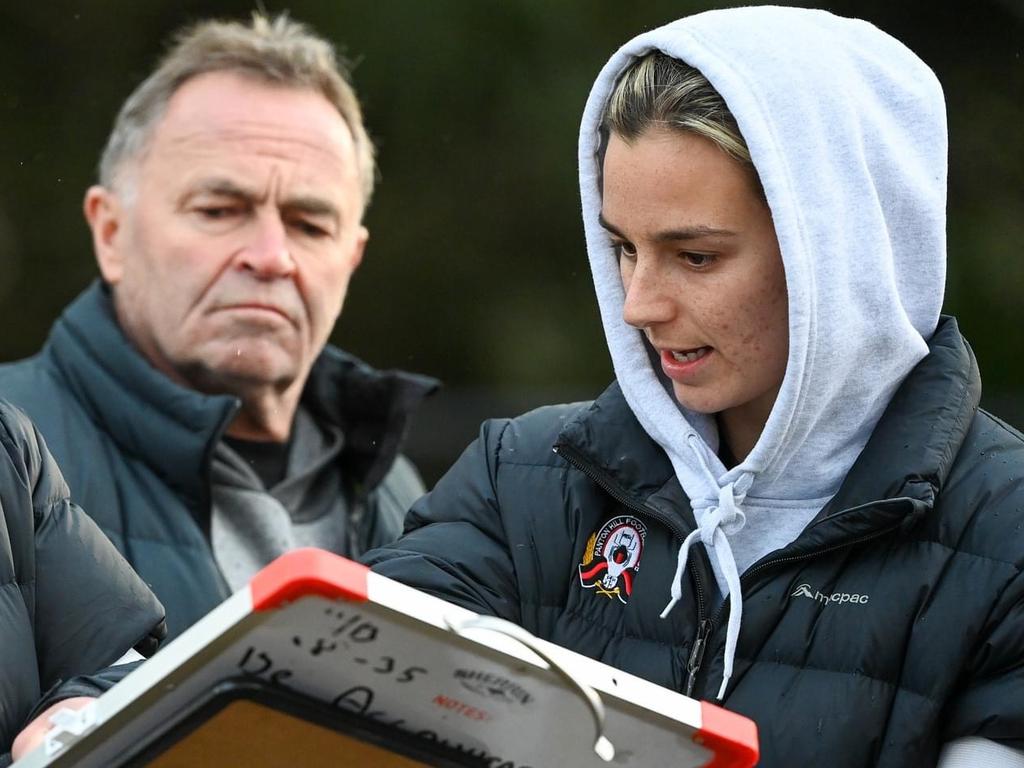
“They’ve all been inviting. Like any coach I had to gain the trust but they know I mean business and they don’t see me as a female, they see me as a coach,” Berry says.
“We always have really good conversations about my footy background and how I can help influence what they do.”
This is not just a part-time job. Berry speaks passionately about the development, recruiting and game style up at the ‘Hill.
“The love and care I have for the guys and progression of the game plan we’ve implemented is really exciting,” she says.
“I just love analysing footy and diving into the opposition game plan.”
Panton Hill’s head coach Simon Amore believes Berry can make a name for herself in coaching, whether it be female or male footy.
“It could be pretty intimidating to walk into a heavily weighted male environment at senior level,” Amore says.
“But she grabbed the respect and attention of the group from the outset. She has genuine care and investment in the players, so combine that with a really, really high football IQ, she has all the traits to coach in her own right. Comfortably.
“She’d be the first person I’d call if I had to hand the coaching reins over.”
*****
Peta Searle broke down barriers when she was appointed to St Kilda’s men’s coaching staff in 2014. Yet in 2023, Daisy Pearce taking on a role at Geelong did not raise eyebrows. Pearce’s sharp analysis has been part of the game for years and it seemed a mere formality that a coaching opportunity would come.
And while those role models are obvious, one of the step changes for female coaching occurred earlier this year when former AFLW player Lauren Morecroft was named head coach of the Eastern Ranges’ Under-18 boys team.
“Personally I‘ve had no negative feedback, I’ve had a respectful group of boys and parents at the Eastern Ranges,” Morecroft says.
“The gender is out of it, the football knowledge is what’s important.”

On draft night there could be up to seven Ranges players, headlined by projected top five pick Nick Watson, join the men’s AFL competition. It’s also worth remembering that Morecroft’s players were generally nine or 10 years old when the AFLW competition started, they only know a world where female football is visible and respected.
In her view, the attitude she sees at Under 18 level will gradually change perceptions across the AFL industry so that gender is irrelevant.
“The more that women take up opportunities in coaching, particularly in the men’s and boys’ space, it will become more prevalent.”
“There’s a place for women in football, whether it’s coaching, administration, analytics, medical, high performance. There’s always females wanting to go for those roles, it’s up to whether clubs are willing to … and I think they are now.”
.@LJMorecroft thinks of herself only as a football coach - but admits her historic latest appointment is a ‘big deal’.
— CODE AFL (@codeaflau) March 23, 2023
âœï¸: @PaulAmy375https://t.co/GD96eLBs1x
****
It‘s prescient that Morecroft says this in a week when the AFL itself has finally made good on its stated view of seeing more women working in football, appointing Laura Kane as executive GM of football.
Clearly it’s the most high-profile female administration appointment the league has made. If a woman is the right person to lead the game’s on-field agenda, there’s no reason that it shouldn’t extend to coaching in clubland.
From Morecroft to Kane, the progression is not lost on Toogood and Berry. Just like playing careers were out of reach for women as recently as a decade ago, a career in the performance side of football seemed a pipe dream too.
“It’s definitely opened my eyes that I want to coach when I finish my career,” Toogood says.
Berry says that once her playing career finishes she’d love to take the reins as a head coach somewhere, adding that her experience has shown the different dynamics that females can add to coaching groups.
“You have different personalities in a team, so having different personalities in coaching groups helps you connect better. It’s the way that footy is changing.”

It also begs the theoretical question: in ten years’ time, when Berry and Toogood may be finished playing and seeking coaching employment they will come with vastly more attractive coaching resumes than male AFL players of the same age, will the industry be free of any barriers?
“I don’t think it’s far away at all,” Toogood says.
“The next wave of AFLW players who retire, we’ll get a lot of coaches who either come back to drive AFLW or work across a men’s program.
“My head coach works within the men’s program, Erin Phillips, Chelsea Randall and Daisy Pearce of course are working across men’s programs. It’s only a matter of time before we see more women in the men’s space, but we’re also going to get a fantastic calibre of coaches in the AFLW coaching ranks too, which is important.”
More Coverage


And while the future investment is clear for these two, there’s also instant benefits that we may see this weekend.
“It helps my playing as well,” Toogood says.
“It’s a two-way street.”

AFLW Phantom Draft: How the top 20 picks could fall, when bids land

Falcon fought to prove draft value – and the personal turmoil that drove it

Future Olympian, teen prodigy: Ava Usher’s bumpy road to AFLW

Late mail: The go-home concerns set to shape AFLW Draft

Analysis: The Tasmanian AFLW Draft prospects ready to step up
