
Fremantle Dockers: Jye Amiss on track to follow Matthew Pavlich and win club goalkicking award in second season
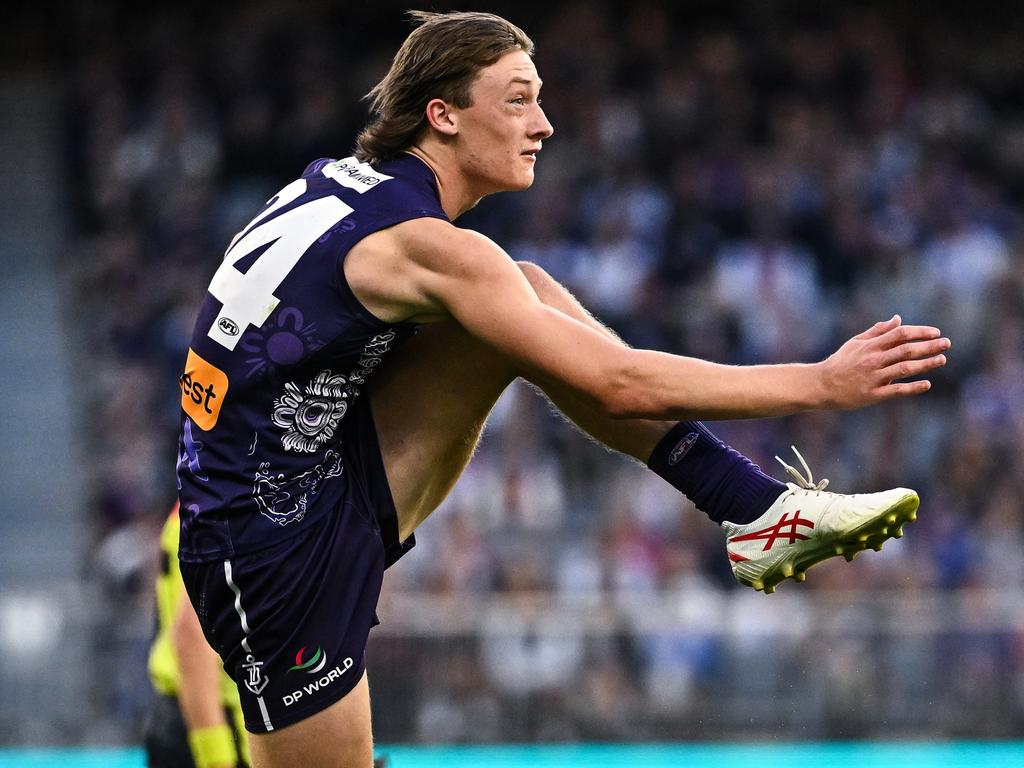
Rising Star or not, there’s a special place in history on offer for young Dockers spearhead Jye Amiss, writes ELIZA REILLY.

Some commentators carefully consider what headlines they’ll create before taking a stance.
Paul Hasleby, by contrast, believes the opinions he forms.
Still, only the most optimistic Walyalup supporter would’ve taken note of Hasleby’s pre-season prediction for emerging Dockers key forward Jye Amiss.
The four-time Glendinning medallist predicted Amiss, in just his second season, would kick 40 goals.
“We talk about this kid like he’s been around for a long time, but in reality, he hasn’t played much footy,” Haselby said in February. “Two or three games last year, he came in for the finals. We know what he did in that first finals. He was brilliant.
“Another pre-season, better ball movement expected by the Fremantle Dockers, a few more options in and around him to take some pressure off.”
It was bold on two accounts.
To begin with, no Docker kicked that many in 2022 when Walyalup returned to finals. Rory Lobb came closest with a tally of 36 before packing his bags for the Western Bulldogs. Lobb was 29, had eight seasons of AFL football under his belt and was the Dockers’ primary target when he kicked his career-high haul.

It was also brave because Amiss had yet to cement a spot in Walyalup’s best 22.
Despite being parachuted into Fremantle’s finals campaign last year, Josh Treacy had overtaken Amiss in the pecking order after a strong pre-season. The Dockers also had to squeeze Matt Taberner, Luke Jackson and Nat Fyfe into their attack.
A sudden oversupply of talls meant Amiss was the one to miss out in round one, punching an early hole in Haselby’s prophecy. But his absence would only last one week.
Brought back into the team in round two in place of Fyfe (injured) and Treacy (omitted), Amiss didn’t set the world alight against North Melbourne. With Walyalup’s midfield-forward connection failing to ignite, the 19 year-old finished with just three disposals and no scoreboard impact.
In the eight games since, Amiss has stamped himself as a star of the now. Not only has he kicked at least a-goal-a-match, he has bagged a trio of three goal games, including Saturday’s treble against Geelong.
Now up to 16 goals, Amiss is an equal leader of Walyalup’s goalkicking alongside Lachie Schultz and Michael Walters and he has kicked more goals than any other of the Rising Star nominees to date.
And if he continues at this rate, 40 goals is suddenly within reach.

With 16 majors in nine games, Amiss is currently sitting on a goals-per-game average of 1.8. That trajectory puts him on track to kick 39 goals with 13 rounds left to play this season.
The last Docker to kick 40 or more goals in a season was Michael Walters in 2019. And in the past decade, there have only been three years a Fremantle player has reached that mark.
The key for Amiss might just be his accuracy. The East Perth product‘s pinpoint approach became apparent in his final year of colts football at the Royals, kicking 51.15 at a 77 per cent accuracy rate.
Against hardened AFL defenders each week, Amiss might not get the same level of opportunities in front of goal but his ability to make them count will play a big part in the pursuit of 40.
Amiss’ goalkicking technique is so renowned he has even offered advice to former skipper Fyfe, who has notoriously struggled in front of the big sticks.
Amiss might have missed out on an AFL Rising Star nomination this week in favour of Hawthorn’s Josh Weddle, but there’s no doubting his importance internally – as much as a campaign is mounting out west.
“(A nomination) would have to be coming,” teammate Jordan Clark said. “He’s an unflappable character, even if he doesn’t get one it won’t bother him at all. I think he’s due! It would be good to see him get one.”
Each of Amiss’ three goals against the Cats drew upon a different skillset.
The first was a powerful contested mark as Geelong defenders Jed Bews and Jake Kolodjashnji cannoned into him. The second was a delightful read of the ball as it dropped out the back of the pack, Amiss stepping inside and into traffic before hooking it home off the left. And the third was a drop punt from outside 50. It’s a key forward tool kit that’s already setting him apart from some of the game‘s generational spearheads.

At that rate of 1.8 goals a game, Amiss is already ahead of modern power forwards Charlie Curnow (0.95), Joe Daniher (1.3), Tom Hawkins (1.3), Josh Kennedy (0.5), Ben King (1.5) and Aaron Naughton (1.4) at the same point in their careers.
Jeremy Cameron (2.95), Jack Darling (2.2) and Lance Franklin (2.2) are the benchmark.
Walyalup knew exactly what they were getting when they drafted Amiss with pick eight in the 2021 AFL draft, its first top 10 key forward since Matthew Pavlich. With time, Amiss will fill those long empty boots.
But what a feather in the cap it would be to match the achievements of Dockers’ doyen and win the club’s goalkicking award in just his second season. Pavlich did it in 2001 and the door is open for Amiss to follow suit more than two decades later.
“I thought I competed well,” a modest Amiss said after helping down Geelong. “I just want to keep building and learning and trying new stuff each week. You want to build consistency and a good connection with everyone else in the forward group. The last couple of weeks, we’re really starting to gel.”

The two reasons Young thinks his injury woes are behind him

‘It was a shock’: Cox still seeking answers after Pies blindside

SSP watch: VFL star, ex-Docker battle for Hawks spot

The truth about how Longmuir’s ‘employment agreement’ could end

Reality TV icons, coaches: Where original AFLW Dockers are now
