
How a stacked 2002 VFL grand final between Geelong and Port Melbourne launched Cats dynasty
Gary Ablett Jnr was just one star in an incredible Geelong side that faced Port Melbourne in the 2002 VFL grand final. What happened that day ushered in a mighty Cats era, writes PAUL AMY.

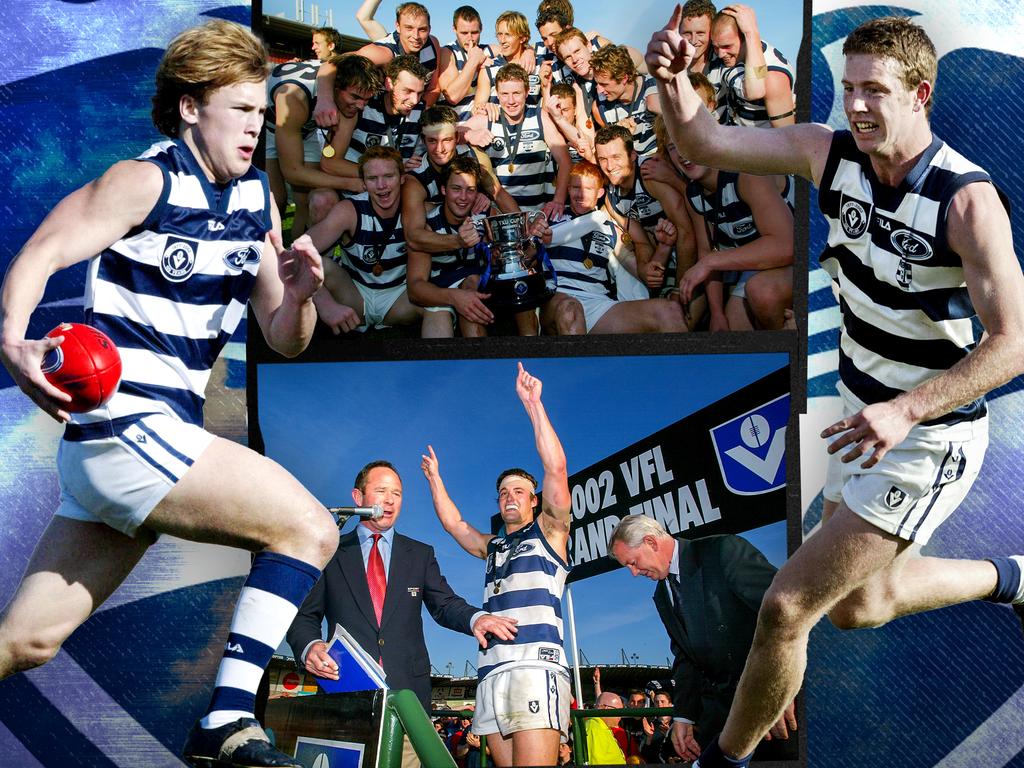
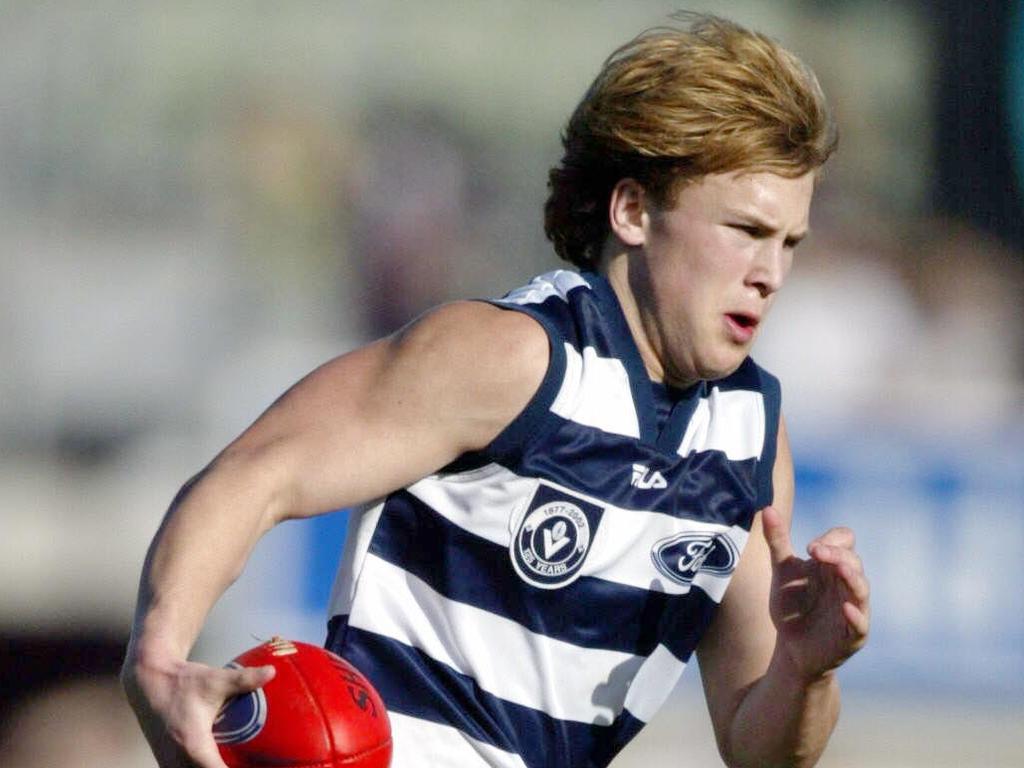
The first minute of play and Gary Ablett Jnr sees space at centre half-forward.
He fills it with a lightning lead and teammate David Mensch, swinging onto his right foot on the Princes Park wing, honours it with a pinpoint pass.
A grateful Ablett dives forward to mark and goes back to take a set-shot.
He kicks the ball from one step inside 50. The goal umpire moves not an inch. It splits the middle. Geelong is away.
“What a goal!’’ fizzes Drew Morphett in the ABC TV commentary box.
Colleague Phil Cleary jumps in: “Have a look at how excited he is! That’s a good start and they go to him in big numbers to let him know, the young bloke.’’
So begins the 2002 VFL grand final between Geelong and Port Melbourne at Carlton.
The finish was even better for the Cats: They rallied from a 14-point deficit at three quarter-time to win by 22 points.
Twenty years on, the array of talent on both sides makes for remarkable reading. The Ron Watt-coached Geelong team featured six young players who went on to AFL careers filled with flags and honours.
There was James Bartel.
Steve Johnson.
Paul Chapman.
James Kelly.
Josh Hunt.
And there was Ablett Jnr, in his first year at the club where his father attained heights unreachable to all but the greatest players.
Ablett Jnr and Bartel won Brownlow Medals. Ablett and Chapman won Geelong best and fairests. Johnson, Bartel and Chapman won Norm Smith Medals. And Ablett, Bartel, Chapman, Johnson and Kelly won All-Australian jumpers.
There are 16 AFL flags between them.

“Geez, he had a bit to work with, Ronnie (Watt)!’’ Johnson, now an assistant coach at Greater Western Sydney, says with a laugh. “On reflection it was a pretty good team, wasn’t it?’’
But what about Port Melbourne?
The famous old Borough were then in an alignment with AFL club Sydney and selected 10 Swans for the grand final. The contingent included future Sydney premiership players Ryan O’Keefe, Amon Buchanan, Adam Schneider and Luke Ablett.
“When you think about some of the names that played in that game, it’s quite incredible,’’ says Port Melbourne’s coach of 2002, David Dunbar.
Dunbar often thinks about the grand final and what might have been for his team. In particular, he rues first-half injuries to Peter Filandia and Daniel McPherson – they left Port two experienced midfielders short – and two missed chances early in the last quarter.
“We could have been four or five goals up. That would have put some doubt into the Geelong blokes,’’ Dunbar says.
“But we didn’t kick them and it left the door ajar and we were starting to run out of legs.’’

Geelong slotted six goals to none in the final quarter to win 15.15 (105) to 12.11 (83).
After the final siren, the Port Melbourne song briefly blasted over the loudspeaker. The correction to Geelong’s tune elicited another roar from Cats’ fans, who made up most of the crowd and were spoiling for success.
James Rahilly won the Norm Goss Medal – named after the legendary Port Melbourne administrator – as best-afield.
The Cats had led narrowly at half-time, only for Port to slip away in the third quarter.
Tall Nick Gill went forward for the Borough, kicked two goals and handed another to teammate Glen Robertson from a ruck contest. Ben Phibbs, who put the sharp into shooting when it came to goalkicking, made a difficult shot from the forward pocket look easy.
As Port moved ahead, Geelong senior coach Mark ‘Bomber’ Thompson watched on with increasing frustration.

*****
While Dave Dunbar rakes over the grand final with some regrets, the match remains a warm memory for the Geelong players and Watt.
The Cats were a mix of the raw and the wrinkled.
As Johnson points out, the team had 10 players who had been drafted in 2001: Bartel, Kelly, Charlie Gardiner, Johnson himself, father-son freebie Ablett, Henry Playfair, Matthew McCarthy and David Johnson, as well as rookies Will Slade and Adam Chatfield.
The youngsters could lean on senior hands Tim McGrath, Mensch and former West Coast Eagle Mitchell White for experience.
McGrath captained the team in what was his last season with the club. Mensch also collected his cards after the match.

Ablett Jnr wrote about the premiership in his autobiography, saying the Cats had a “very special group’’ and a “Geelong football legend as coach’’.
He said the young Cats were “learning valuable lessons’’ that equipped them for their football to come.
“It’s been spoken about a lot since, but that 2002 VFL premiership certainly created a really positive feeling around the club; it confirmed the talent of the younger players and gave a lot of hope for the future of the senior team,’’ Ablett wrote.
Before the grand final, Thompson had told Watt how important it was for the Cats to win.
And during it, with Geelong looking shaky in the third quarter, he paid a brief visit to the coaching box.
Watt and his assistant coaches Ray Card and Graeme Landy were startled to see Thompson.
“About 10 minutes before three quarter-time, ‘Bomber’ put his head in the box and he said, ‘What the f--k is going on, Ron? We’re supposed to win this. We need to teach these boys how to win and how to win together. This club needs this win. Get it done!’’’ Watt recalls.
“Then he slammed the door and walked out. So I wasn’t feeling great at three quarter-time! It actually gave me a bit of a clue on how to coach people. Don’t berate them and threaten them, because it makes you as weak as water. Luckily I wasn’t playing because my legs went to jelly for about five minutes.’’
The Cats did get it done, Mensch kicking the ball over his shoulder for a classy goal to get his team going in the final quarter. McGrath, dumped after a mark and given a 50m penalty, supplied the follow-up.
And the Cats had the lead by the 10-minute mark after a set-shot from Danny O’Brien. They added three more goals, turning what had been a struggle into a reasonably comfortable win.

*****
Ron Watt played two senior games for Geelong in 1984 and was an icon of the region’s local football scene.
He returned to the Cats in 1999 to coach the reserves. Geelong had finished 13th out of 16 teams in 2001 but rose quickly the following season, finishing a game clear on top with 17 wins and three losses.
“We were pretty lucky to have such a good team in ’02,’’ Watt says.
“We had all those first-year players and then that smattering of mature players like Mensch and McGrath and Mitchell White. Brent Grgic was there too and James Rahilly had played a fair bit of football by then.
“But if we go back 20 years ago, I don’t think anyone would have said at the time, ‘Well, these guys are going to have so many All-Australian jumpers and Brownlow Medals’, let alone the team glory three times over. There were certainly thoughts they could go all the way and be a really successful team and probably win a premiership. But no one thought – well, I didn’t, anyway – there would be this much sustained success.’’
Watt says the VFL premiership instilled belief and confidence into a club that hadn’t experienced success for a long time. Thompson, he says, had declared Geelong “didn’t know how to win, and we’ve got make sure we teach them how to win’’.

“It helped, it definitely helped. It gave the club a will and a desire to want to experience winning again. The players enjoyed the win and they enjoyed being the No. 1 team,’’ he says.
“It did help with the foundations going forward.’’
Steve Johnson agrees.
He says the grand final had “one of the biggest build-ups of all time, because there hadn’t been any silverware at Geelong for a long period of time’’.
“The VFL team were actually carrying the weight of the club,’’ Johnson says. “We were very confident with the team we had – with all these draftees, we knew there was something special brewing from the start – but, yeah, it was a big occasion.’’
Flag in the bag, there were hearty celebrations in Geelong that Sunday night. Lamby’s Tavern was the last stop for the players.
“At the time, we thought we’d done the best thing ever possible, because we’d brought a flag home to Geelong,’’ Johnson says.
He has always believed the grand final was the start of a strong rivalry with Sydney. He says the Swans were like Geelong in that they thought they had an excellent group of young players that could carry them to success.
Johnson and Buchanan are both assistants with the Giants, and Buchanan often talks about the match.
“He brings it up a lot. They saw us as the new breed coming through and they were a bit the same,’’ Johnson says.
“It was a big occasion for them too.’’

Watt and Johnson both highlight the contribution of McGrath, who had played in three losing AFL grand finals for Geelong.
It became clear during the 2002 season the defender was coming to the final bend of his long career. He played the first two rounds in the AFL and wasn’t selected again.
Watt was happy to have him as captain.
“If you ask ‘Bluey’ (McGrath) who was coaching the team, it was him,’’ he says.

“He called me Humphrey! He thought I was just there moving my hands and he was doing all the talking. He really embraced what was happening with the VFL and I allowed him to do a fair bit of leadership and coaching, and he was great, really important in that team.
“Same with Menschy, who came back and played like Menschy did. He never seemed to let (it) worry him if he was in the ones or the twos.’’
White had been a premiership player and All-Australian selection with West Coast and joined Geelong in 2001.
By 2002, his best was in the past. But, like McGrath and Mensch, he didn’t drop his standards when he dropped to the VFL.
“He couldn’t quite reach the heights that he had but he really brought in and wanted to be part of something good in the VFL,’’ Watt says. “He knew his role was to help the younger players and guide them along and teach them how to play.’’
Johnson says the first-year players were lucky to play alongside McGrath, Mensch and White and under the affable Watt.
In a home-and-away game that season, Johnson was walking off the ground at half-time when McGrath gave him a cook for kicking the ball to a bad position.
“He said, ‘Mate, you needed to centre it’. And I’m thinking, ‘Geez, I’m playing VFL and I want to get into the AFL team’,’’ Johnson says.
“But he was just making sure we were playing properly. Those older guys actually led the way, helped us understand the importance of playing your role for the team. They were massive for us.’’

*****
Dave Dunbar says he wasn’t surprised the Geelong team produced so many future greats.
As he did his preparations for matches in 2002, he often watched vision of the Cats and “you could see the talent was there’’.
“It was pretty evident they were going to be a really good group for Geelong,’’ Dunbar says.
Just as the Cats’ premiership echoed down the years, Dunbar is sure Port would have been similarly celebrated and feted if it had won the grand final.
“It would have gone down as one of the great stories in sport, because how many teams from around the world have players living 800km apart and then have to come together and be managed on a weekend?’’ he says.
“Half the team in Melbourne, half the team in Sydney … it would have been a huge effort by those players to win the premiership. And they weren’t far off it. If you’re going to write anything about the Port side, can you just stress how much the players gave?
“They gave everything they could. I could not have asked for any more. We just couldn’t hang on against a pretty formidable team.’’

The Port Melbourne grand final side also had three VFL-listed players who went on to be drafted and appear in the AFL: long-armed Gill (Adelaide), forward Adrian Deluca (Carlton) and ruckman Michael Rix (St Kilda).
The Port Melbourne-Sydney alignment ended a few weeks after the grand final and the Borough linked with North Melbourne, topping the ladder in 2003 but losing in the preliminary final. After it, Dunbar was sacked with a year to run on his contract.
Watt became a mainstay of the Geelong football department, staying with the Cats for 16 years. He was on the coaching side for 11 years and then spent another five as a player development manager.
Since early 2014, he’s been with the AFL Coaches’ Association. Steve Johnson says Watt was a “really good, astute football person’’ who made immediate and lasting connections with people.
“We were pretty lucky to have Ronnie,’’ he says.
“Under ‘Bomber’, he wanted to teach us the right way to play footy from the very beginning, a style of footy that would stand up in finals in years to come.
“And that’s where it all began for us, that year in the VFL. It was a great platform for us to go into our careers.’’

Geelong 2002 premiership team
B: Joshua Hunt, Mark Woolnough, Daniel Foster
HB: Will Slade, Tim McGrath, Mitchell White
C: James Rahilly, James Kelly, Adam Chatfield
HF: Paul Chapman, David Mensch, Steven Johnson
F: Brent Grgic, Henry Playfair, Matthew McCarthy
Foll: Peter Street, Gary Ablett Jnr, James Bartel
Inter: Paul Chambers, Danny O‘Brien, David Johnson, Charlie Gardiner
Coach: Ron Watt
Port Melbourne 2002 grand final players
Luke Ablett, Anthony Aloi, Sam Anstey, Gerrard Bennett, Leigh Brockman, Amon Buchanan, Adrian Deluca, Brent Evans, Peter Filandia, Nick Gill, Ryan McMahon, Daniel McPherson, Chris Obst, Ryan O’Keefe, Ricky O’Loughlin, Ben Phibbs, Michael Rix, Glen Robertson, Brett Rose, Adam Schneider, Scott Stevens, Jarrod Sundqvist.
Coach: Dave Dunbar
VFL Grand Final, September 22, 2002
Geelong 15.15 (105) d. Port Melbourne 12.11 (83)
Goals
Geelong: Mensch 3, S.Johnson 2, Ablett, Chapman, Chatfield, Gardiner, Hunt, McCarthy, McGrath, O‘Brien, Slade, White.
Port Melb: Stevens 2, Gill 2, Evans, L. Ablett, O‘Keefe, Rix, Buchanan, Scheinder, Robertson, Phibbs.
Best
Geelong: Rahilly, Slade, Mensch, Bartel, Chapman, McGrath.
Port Melb: Brockman, Obst, Rose, R.O‘Loughlin, McMahon, O’Keefe.

Why Brown blames Dangerfield for Mad Monday controversy

SSP watch: VFL star, ex-Docker battle for Hawks spot

Bruhn returns to Cats training as Bucks begins coaching comeback

‘We’ve picked Hunter the footballer’: Holmes brothers unite at Geelong

Holmes backs Bruhn, young guns to help Cats ‘go again’ in flag hunt
