
Why Damien Hardwick can halt the run of false dawns for AFL‘s problem child Gold Coast Suns
Damien Hardwick has a hidden ace up his sleeve, but past failures show why his challenge is immense. NEIL CORDY looks at what’s gone wrong at the club since day dot and why there is now cause for hope.
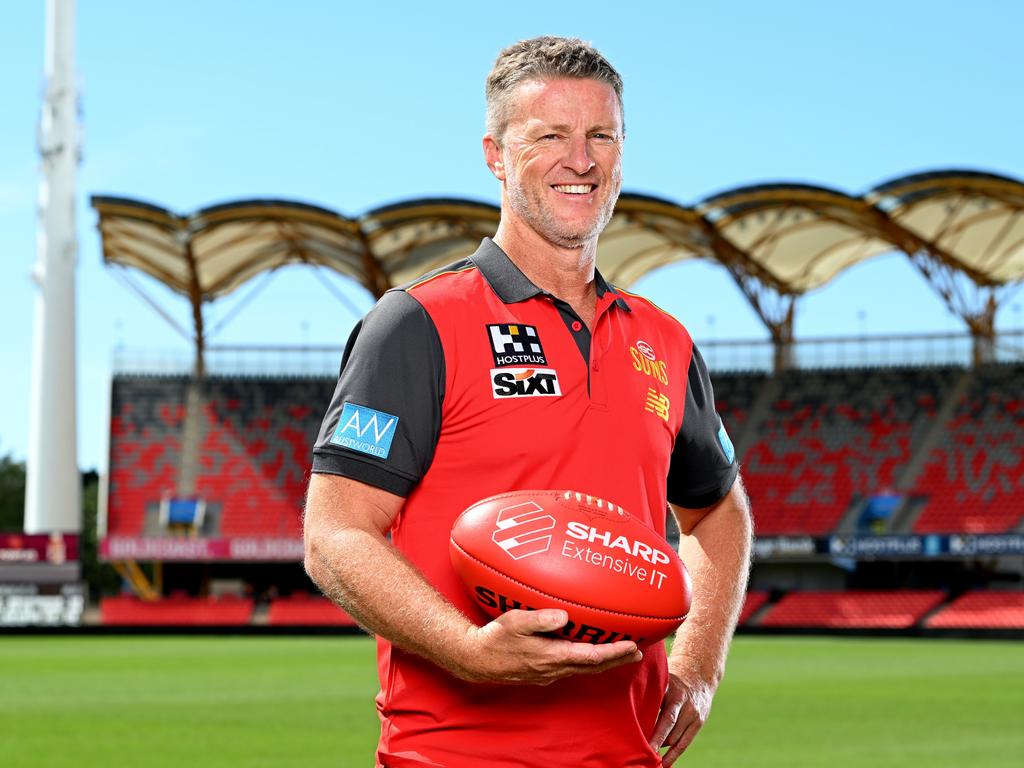
The AFL’s two most recent start-ups adopted two very different strategies.
Gold Coast signed the best player in the league and tried to build a team around him. Greater Western Sydney, meanwhile, assembled a crack team of kids and placed them under a veteran coach.
The $200 million ploughed into the Suns has yet to produce a single finals appearance after 13 years, whereas the Giants became a finals force in their fifth season, albeit while falling short of attaining the ultimate prize.
The Gold Coast reboot starts now.
And with lessons learned from a difficult start-up journey, there are genuine reasons to believe that Suns 2.0 will be a substantial upgrade on the first iteration.
Damien Hardwick is very optimistic and was even talking premierships in his first public appearance as Suns coach.

There is a reason Suns CEO Mark Evans and chairman Bob East have gone all-in on Hardwick. Winning football is literally the only thing that will turn around Gold Coast’s key commercial numbers, which have been trending down for most of their time in the competition.
The Suns started with a bang in 2011 after signing Gary Ablett Jnr. Home attendances averaged 19,169 but that figure quickly dropped and levelled out at around 12,000 to 13,000 over the past decade.
TV ratings have improved, inching up this year, but the Suns were starting from a low base as the second-lowest rating team in the AFL in 2022, ahead of only GWS.
Memberships have improved from 14,059 in season one to close to 22,000 this year. But those numbers have skyrocketed at most clubs over the same period. Some clubs have doubled their tally, while the Giants have topped 30,000 for five consecutive seasons.
Why and how will things change under Hardwick, the fourth man entrusted to hold the AFL’s baby?

DESTINATION CLUB
The heat will be on Hardwick from the start but his record speaks for itself: three coaching premierships at Richmond, along with his two as a player at Essendon and Port Adelaide, already have him in very exclusive company.
If he added another at a fourth club, a struggling one, he would be in rare air. In modern footy only a handful have coached flags at two different clubs: Ron Barassi, Allan Jeans, David Parkin, Leigh Matthews and Mick Malthouse.
Hardwick has been quick to point out he is not the saviour. But he is a very lucky coach to be picking up a team with a young list profile and enormous talent.

The 51-year-old acknowledged as much when he said 80 per cent of the Suns’ first premiership team were sitting in the room.
It was a bold call but not an outlandish statement, especially when the Suns are about to add another three young stars from their academy in the upcoming draft. Key forward Jed Walter is a stand out, as are ruckman Ethan Read and midfielder Jake Rogers.
And if the playing list at the Suns helped attract Hardwick, it should also attract players hungry for success.
Evans helped assemble a quadruple premiership team when he was head of football at Hawthorn. The Hawks took Jarryd Roughead (pick No.2), Lance Franklin (No.5) and Jordan Lewis (No.7) in the 2004 draft, having recruited Luke Hodge with the first pick in the 2001 draft.
There has been a similar list build at Gold Coast. Jack Lukosius (No.2) and Ben King (No.6) came to the club in the 2018 draft then next year they took Matt Rowell (No.1) and Noah Anderson (No.2).

Another factor in the Suns’ favour is they may be one of few sporting organisations in the world to benefit from the Covid pandemic.
When most of the country was in lockdown and AFL clubs were stationed on the Gold Coast, players and coaches had a taste of the lifestyle which has made southeast Queensland the fastest growing region in the country.
Hardwick is case in point himself, having loved his time in the sunshine away from the Melbourne footy fishbowl.
An enormous part of the AFL community had the same opportunity. With Hardwick at the helm of a club in the premiership window, the tables may finally have turned.
It would be a strange state of affairs for a team which lost a host of premiership talent to Melbourne clubs to become a destination club, but with finals footy on the menu and some Hardwick glitter it is possible.

SUNS 2.0: WHAT WAS LEARNED FROM GARY ABLETT ERA
Getting the best player in the competition seemed like an excellent idea to launch the Suns in 2011. Ablett Jnr won the first three club champion honours and all was going well when Gold Coast won seven of the first nine games in 2014.
But when Gary injured his shoulder the wheels fell off and the club finished 12th as they struggled to stay competitive. Without any finals success, star forward Tom Lynch joined Richmond and won the 2019 premiership in his first season at the Tigers. Fellow co-captain Steven May followed suit, landing at Melbourne and winning a flag in 2021.
The Suns had taken their swing and missed.
Rodney Eade replaced Guy McKenna as coach for season five but the progress was slow as they finished bottom four in each of his three years at the helm.

Stuart Dew steadily improved results but it was slow going over his six years in charge. A 12th-placed finish and 10 wins in 2022 equalled their best result, but finals remained elusive. With Hardwick finishing up at Richmond, it was too good an opportunity for the Suns to miss out on.
Adding salt to their wounds, expansion rivals GWS were off and running with their first finals win and preliminary finals in 2016 and 2017, plus a grand final in 2019.
Success didn’t stop the talent bleeding from the Giants, but it gave them something to be very proud of and something to show for their hard labour.
The Suns desperately need something to hang their hat on too, Ablett’s 2013 Brownlow is about their only blip on the footy radar. The Suns are still yet to play a final. The pass mark for Hardwick in 2024 will be finals footy. A win in September would be nice.

THE BIGGER PICTURE
Participation numbers for Aussie Rules in Queensland are going through the roof with boys and girls.
Last year’s record of 55,500 people playing footy is expected to be broken again. Junior football is seeing the largest growth, with Auskick registering 22,500 participants.
Southeast Queensland makes up the lion’s share of these numbers with a host of elite players coming through, led by Gold Coast talent Walter, Read and Rogers. All three are expected to go in the first round of the national draft, with Walter a possible No.2 pick.
There are another five players from the Gold Coast who were named in the under 16 All Australian team.
With the ‘go home’ factor driving an enormous amount of talent away from the Suns, local players would certainly help stem the tide.

STAY THE COURSE
If Hardwick can find success on the Gold Coast with the Suns he will have cracked one of Australian sport’s greatest conundrums: why teams continually fail on the Sunshine Strip.
False dawns have been a Gold Coast specialty for decades and not just in the AFL.
One of the key reasons sporting franchises fail on the Gold Coast is they can’t sustain continued financial losses.
The NBL and A-League simply didn’t have the pockets to keep their clubs afloat for the time required to succeed. It’s no secret that the AFL and the NRL are the only sporting organisations in the country which can sustain the enormous losses that come in setting up brand new franchises in a new and growing city.
Sporting traditions are built over decades and generations.

This applies on the Gold Coast as it does to Melbourne, Sydney, Brisbane, Adelaide and Perth.
The Titans and Suns are still in their infancy. The Titans have been in the area for 16 years, while it is 13 years for the Suns. The Gold Coast Blaze lasted just five years and Gold Coast United only three.
It’s worth noting that the Swans were in the harbour city for 24 years before they claimed their first premiership in Sydney. The Bears/Lions took 15 years to win their first premiership in Brisbane.
The problem for other codes is the money runs out before generational success can kick in.
Fortunately the AFL has the funds to stay the course. But if a premiership or at least a grand final doesn’t come in Hardwick’s six year term it’s hard to see when it will ever come.

GOLD COAST SPORTS CASUALTY LIST
AUSSIE RULES – 1987 – Bears- Moved to Brisbane in 1992
RUGBY LEAGUE- 1988- Seagulls- Folded in 1995
-1996- Gladiators- Pre-season only- licence revoked 1996
-1996- Chargers- Folded 1998
RUGBY UNION- 2007- East Coast Aces- Competition folded 2007
FOOTBALL – 2009/10- Gold Coast United- 2011/12 Licence revoked.
More Coverage


BASKETBALL – 2007- Gold Coast Blaze- Folded 2012
BASEBALL – 1989/90- Daikyo Dolphins, Gold Coast Clippers – Folded 1993/94
The Goldie has been the place sporting franchises go to die. The A-League’s effort to grow football lasted only three years under the ownership of Clive Palmer. Hardwick just might be the missing part of the jigsaw that changes the course of Australian sporting history.

Collins backs Jamarra’s efforts to ‘earn his stripes’ as a Sun

SSP watch: VFL star, ex-Docker battle for Hawks spot

From ‘disbelief’ to Dimma’s new housemate: New Sun’s first steps

Houdini magic: How Gold Coast escaped bid bind — again

Jamarra’s ‘prove-it’ year: Why it’s not just the Suns risking it all
