
How a ‘wild man’ on the field became one of footy’s best analysts during 30 years in commentating
Dermott Brereton once described himself as a SNAB (Sensitive New Age Bogan) and was known for his aggression in uber-successful Hawthorn teams. But injury unwittingly opened the door for his forever career, writes SHANNON GILL.


“Have you been chatting to Eddie?” Dermott Brereton asks.
We’re talking about how he meshed the back-end of his football career with the start of his media career. I suggested it was a template that has become the norm.
Everyone from his own forward-line partner Jason Dunstall to Richmond spearhead Jack Riewoldt have leveraged their time in the playing spotlight to forge a full-time media career when their bodies gave in.
“It’s funny, Eddie has said this to me recently, he basically said a lot of these blokes today should buy you a bottle of wine every Christmas out of their media salary Derm, because you’re the one who opened up this path for them,” Brereton says.
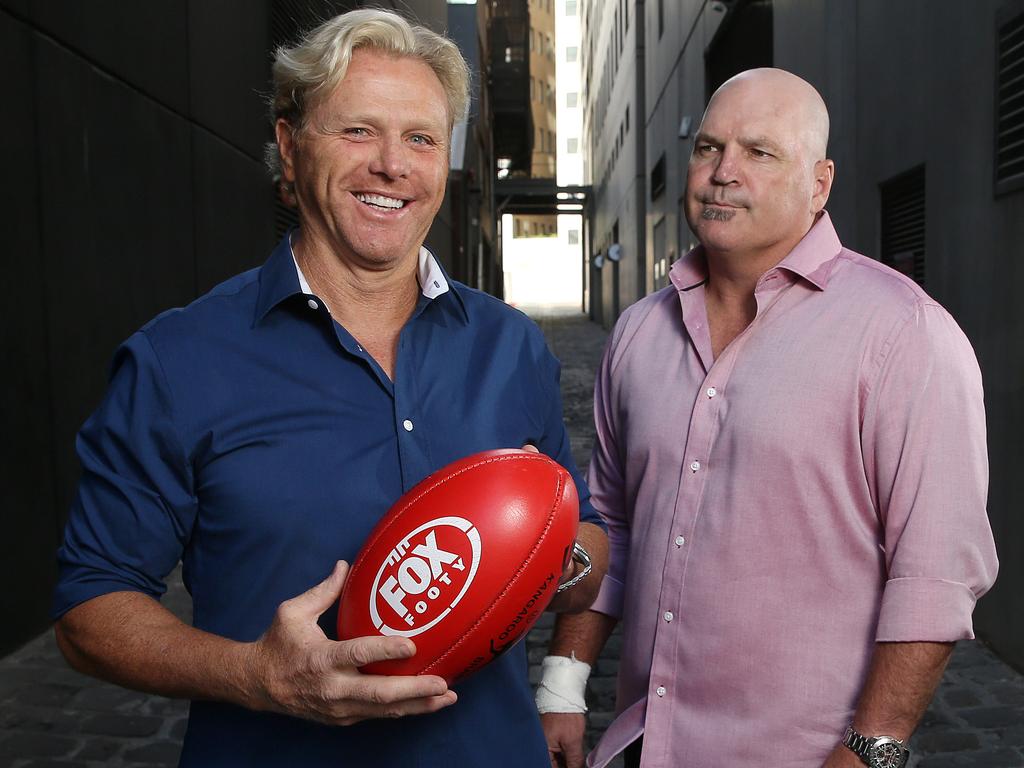
And while McGuire has always been a master of promotion and mythology building, this is not hyperbole and it’s not a Brereton boast. When he sits with his Fox Footy colleagues, they’ve all walked the path first trod by the flamboyant forward from Hawthorn.
“It’s nice of Eddie to say that, but I just happened to be ‘Johnny-on-the-spot’ at the time.”
It’s 30 years since Brereton took a weekly role analysing footy on television, but in 2022 he takes his job as seriously as ever.
*****
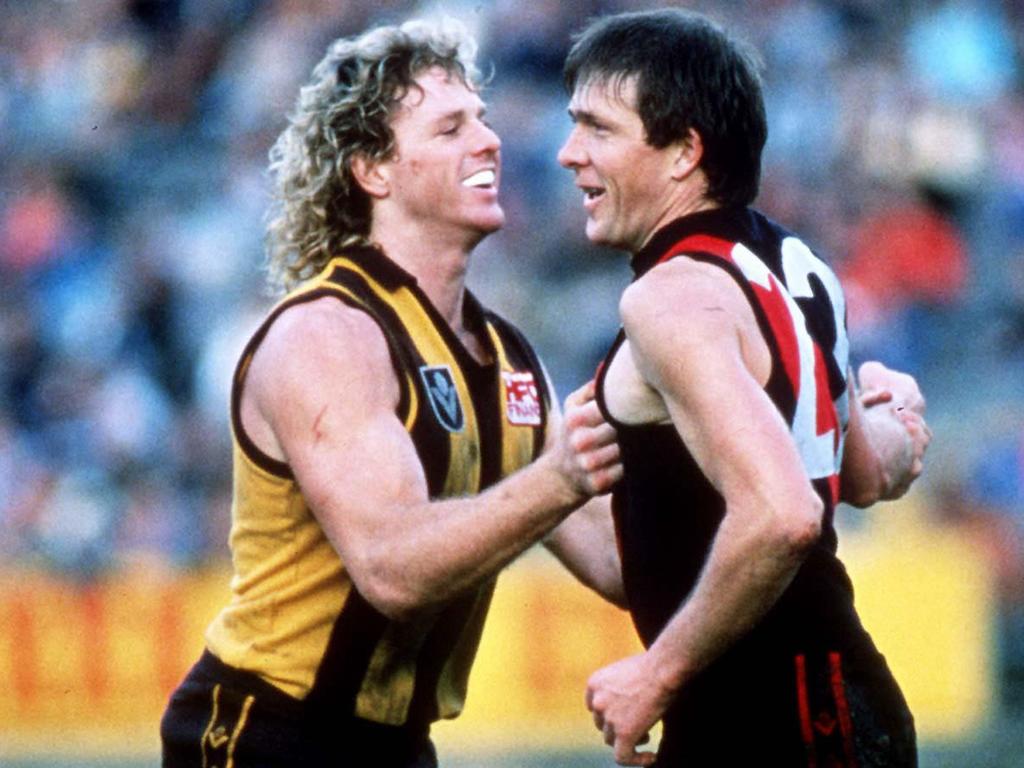
In the 1980s Dermott Brereton was ‘The Kid’. He was brash, outrageous and above all, aggressive. He played for the best team, and for a time he was their best player. He was always their most-feared.
He looked like the lead singer of a hair metal band or a WWF wrestler, and the public assumed he had all the subtlety and nuance of someone in those vocations.
The famous story of him riding his motorbike into Melbourne’s Metro nightclub because he couldn’t find a place to park didn’t change any of those perceptions.
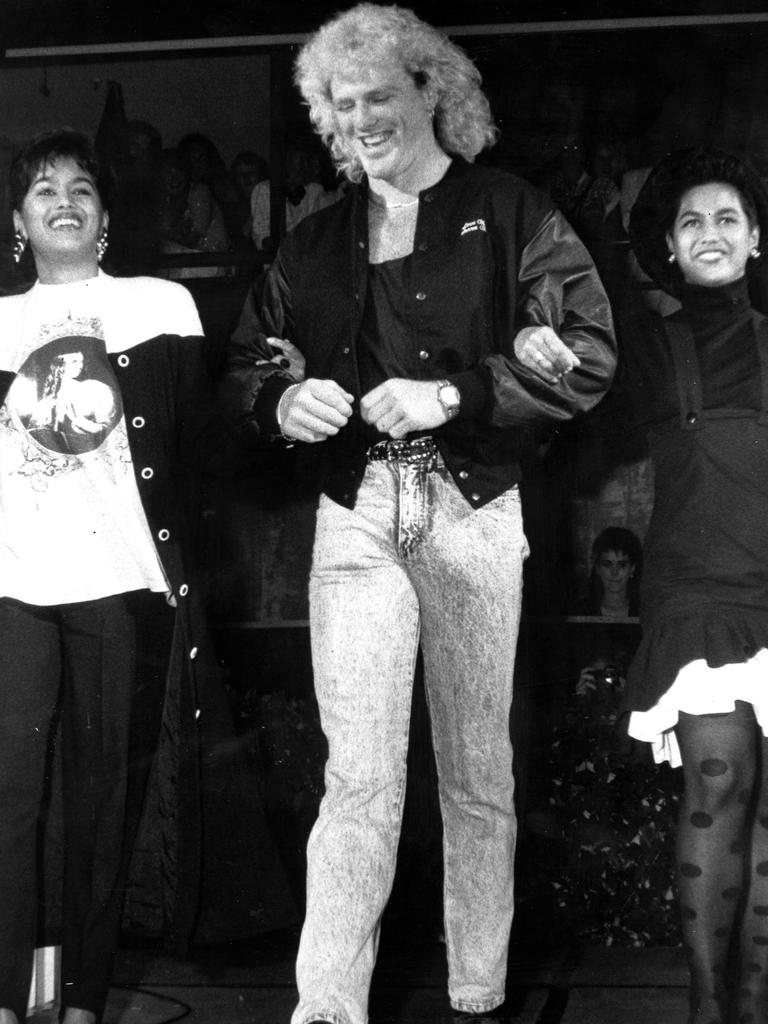
But Brereton, who once referred to himself as a ‘SNAB’ (Sensitive New Age Bogan), says there was more than meets the eye.
“I recognised that I was quite small for a key position forward,” says Brereton.
“So what I did actually took knowledge and technique. I had to have a mind that would adapt to situations, so that helped me become a prominent player. That transferred directly into someone who thinks quite deeply about the game.”
The 80s ended symbolically with him being cannonballed in an epic grand final, body shaken but a premiership won and a legend cemented.
The 90s would be a little different.
“I first started to get really challenged by injuries around 1990,” Brereton says.
“I was quite a deep thinker about the game when tactics weren’t that prominent and I set myself to become a media person in the football world.”
*****

Perhaps the first glimpse of the ‘grown-up’ Kid was the 1991 Grand Final. He listened to Enter Sandman by Metallica on repeat before the game to ensure the aggression was there, but post-game the bombast was gone.
A calm Dermott spent time consoling his opponent Ashley McIntosh and delivered some clear-eyed analysis of the premiership they’d just won.

“(Commentator) Bernie Quinlan came up to me after the game and I felt a bit for the Eagles boys because they’d been the best team of the year. The quote I gave to Bernie was, ‘Unfortunately they weren’t the best team in the finals’. I wasn’t trying to be anything that I wasn’t, but I’d evolved with a bit of maturity.”
“I still thought I had a lot of footy left in me but my body was getting ruined. That was the last game I played with any form of prowess I’d previously had.”
It was in stark contrast to the 1986 model of Brereton who yahooed his way through a post-premiership interview with friend Peter Donegan.
“I look back now at that now (the 1986 interview) and I cringe, that’s a brash 22-year-old. I think ‘what a wanker’.”
But that was then, and by that last dance for the great Hawthorn era in 1991, the hair was less wild and his view was more worldly. He was faced with his football mortality and life beyond it.
“It wasn’t so much, ‘I’m going to be moving into the media, I‘m going to change my attitude’. I just had become more mature.”
*****
Historically, most superstar players were expected to try their hand at coaching once they finished playing. Brereton now had a choice.
North Melbourne sounded him out about coaching in 1993 and it was assumed that one day he’d take the plunge. It remains something he looks back and wonders about.

“I did consult my old coach Allan Jeans as to whether I should do it, and he gave me his imprimatur and said yes, you have what it takes to make it as a coach, but he also had told me it will consume you if you want to do it.”
Despite the public persona of Brereton as the man with it all, it was a warning sign that struck a chord.
“I had my personal reasons. My family had suffered suicide twice, and I couldn’t see my family members becoming emotionally and mentally ill because I was so involved in football.”
It helped him make an initial decision that inadvertently created a path to the media.
“I did toy with the idea of (coaching), but I wanted to see if I could still play. I had an operation, then a second operation, but it didn’t recover properly,” Brereton says.
“My surgeon told me, ‘You might just about be done Derm’. These days it‘s a four week recovery, but in those days it was debilitating. It took 40 per cent of my pace and leap. Not being a tall centre-half-forward hurt me.”


*****
In 1992 Channel 9 needed to fill a spot for Melbourne viewers on its Sunday sporting program while their rugby league segment screened in NSW and Queensland. A 20-minute panel review show was put together with Simon O’Donnell and Sam Newman, and unusually for the time, the still-playing Dermott Brereton.
“In those days we started to look at stats, and today we probably over rely on it, but I was fortunate enough to be on the panels that were analysing the game. You won the ball in the contest, kicked it forward and then you tried to win it in the contest there too, so it wasn’t a terribly difficult game to analyse in those days.”
He’d even branched out into non-football related television in the early 90s – he had a regular guest spot on the Ernie and Denise morning show for many years, and who could forget his cameo on soap E-Street?
While injuries curtailed his ability to play every week, he still fronted up until the 1995 season.
“I still enjoyed playing, but around that early 90s mark, no current day players were entrenched in the analytical side of the media. I was one of, if not the first, to be on those panels in an analysis style.”
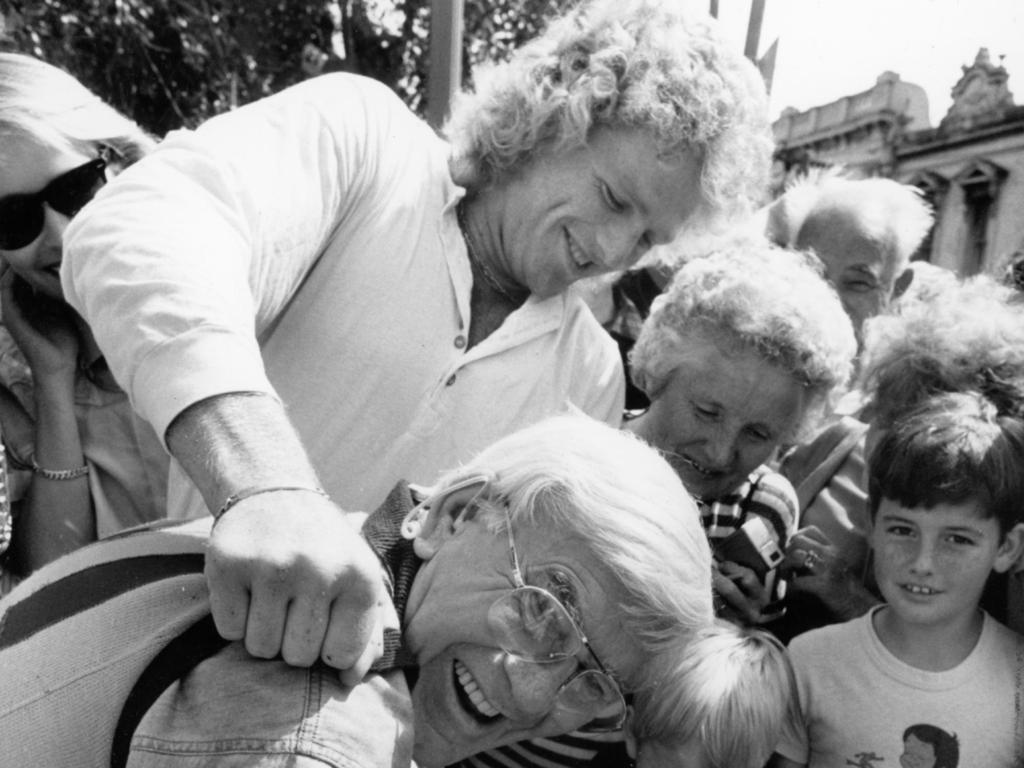
While inspired by the showmanship of footy legends like Lou Richards, Jack Dyer and Ted Whitten, he fashioned himself into something more modern. He wanted to use the thinking he did on the field to bring more sophistication to analysis and explain, rather than just praise or criticise
He looked to America for guidance with a vision to explain why things happened on a footy field, not just tell them what had happened.
“John Madden in NFL Football had an ability to just go ‘bang’ and cut through the bullshit of why something happened. He’d look at it and say, ‘This happened because this bloke missed this tackle’.”
Brereton was ahead of the wave.
During those years football media grew exponentially, that initial Sunday morning slot led to the Sunday Footy Show the next year and then the Thursday Footy Show the year after that – Brereton an integral part of them all.
“The Sunday show became a Friday night pre-grand final show, the ratings went through the roof. Ian Johnson at Channel 9 was worried it may cook the goose that laid the golden egg by going every week with a Thursday night show, but he did. And it became an outstanding success.”

Elsewhere the appetite for the more analytical approach Brereton was pioneering was growing, programs like Talking Footy and increased radio coverage of the game was creating an audience that wanted a deeper-dive on their game.
The end result was that Brereton developed into a seasoned media veteran by the time his body gave up for good. He called time on playing and then seamlessly stepped into radio and television commentary boxes for in-depth analysis that the public wanted.
Just like so many have done since.
*****

Brereton has now been an analyst on Fox Footy since 2012, its as long as his senior career at Hawthorn. His decade at Fox Footy has almost been a reset to focusing on pure football and is what he is happiest doing.
He sees the job of the former-player analyst as one that helps explain and not confuse the viewer.
“I still watch every game,” he says.
“Whatever games I‘m rostered on for the coming weekend, I’ll drill into those clubs and watch the players that I think have had a say in the previous week’s results. You’ve got to work out and decipher the meaning as to why a team has performed a particular way.”

He feels that a footballer’s intuition should guide him and not necessarily the statistics sheet.
“I still like the notion of seeing it with your eyes. Some will flick between the game and the stats, I just like to see what I feel.
“I like to see if a player is just too big for another one to handle at full forward. I like to see if certain players aren’t running through the lines. There’s no stats to say a bloke isn’t chasing hard enough. So you have to see and feel it, believe it and absorb it. And then try to convey it in layman‘s terms.”
Being the bridge between the game and Joe Public is something Brereton is focused on, and he’s conscious that it can be forgotten.
“There‘s been times I feel I’ve lost the direction and I’ve used inner football sanctum speak. But the football-loving public just want to understand what I’m seeing. They’re not at the ground, they want to know what’s happening without show-off talk. Just convey the message.”
Brereton believes chemistry with play-by-play commentators is essential to his role. And while he thinks anyone that rises to play-by-play commentator on TV or radio is very good at what they do, he admits that the partnerships with some of his Fox Footy colleagues have risen to the levels he had on the playing field.

“Anthony Hudson and Dwayne Russell are just fantastic callers,” Brereton says, while a soft spot endures for his old mucker from nightclubs through to television studios, Eddie McGuire.
“He’s just brilliant at everything he does.
“If I got the ball and I lifted my head out of a pack, I knew where (Jason) Dunstall would lead. He sensed me and I sensed him, it was a great understanding. When you work with Huddo, Eddie and Dwayne for so, so long, you can hear the inflection in their voice when they’re leaving you a space to talk.”
Figuratively, Brereton knows where to lead when they have the ball.
*****

Earlier in 2022 he spoke at length about a decision he was involved in as to what footage of an ailing Paddy McCartin to show during a Fox Footy broadcast. Brereton was strong on giving McCartin some dignity while not ignoring the story.
It was a tightrope that he and caller Anthony Hudson helped more inexperienced producers walk in real time.
It belied the idea that the ‘expert comments’ chair is just a sprinkle of star power while others put the show on. Brereton called on 30 years of live TV experience balanced with the players’ perspective.
That incident hit home just how long he’s been in the TV game for and that he knows television (football and otherwise) perhaps better than anything else since his days running around in the number 23.

“I went outside mainstream sport and did Getway and some other shows and loved them thoroughly because the industry is interesting and it‘s always evolving,” Brereton tells CodeSports.
“I now understand all the formulas of TV, because I‘ve been in it so long. I’m now a veteran of television as well,” he says.
*****
Ultimately the key to longevity in sports media is a love of the game. Whether you agree with what he says or not, you can never accuse Brereton of phoning it in.
Whether it’s talking through a piece of play or discussing an issue in the game, Brereton still drills into like it’s the most important thing you’ve heard that day
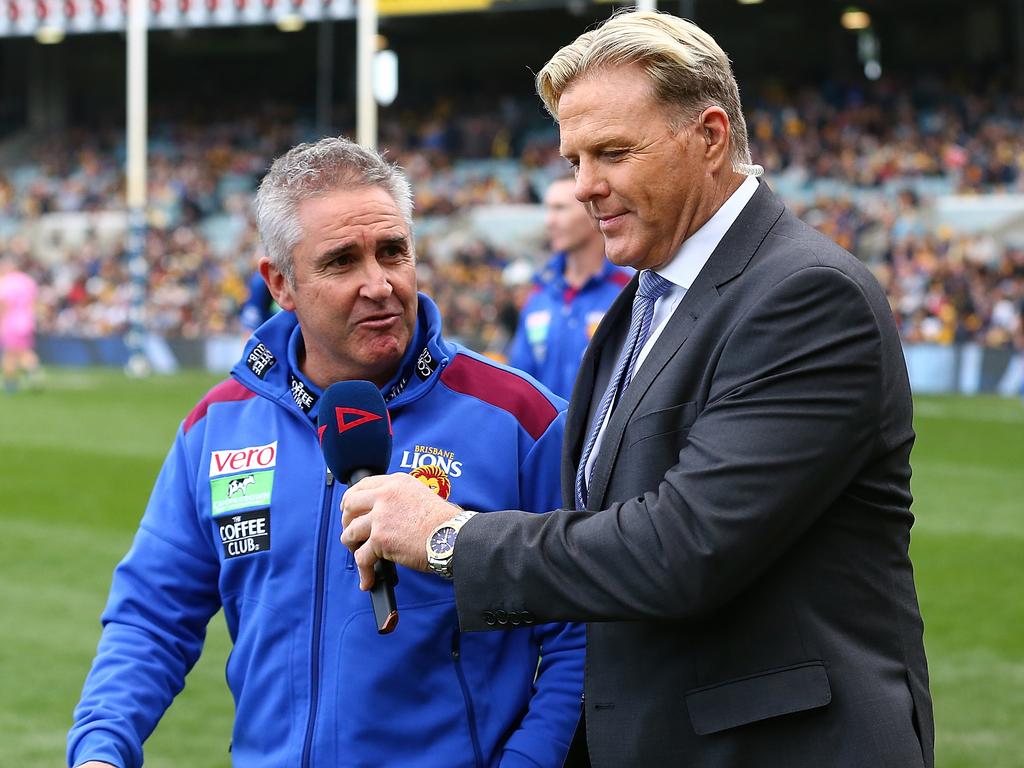
“Football is an entertainment business, for us as players it was hard bloody work. But people are out there earning their wage 9-5 during the week and they want a release by watching their team play. We have to make sure they enjoy it.”
After a lifetime in the sport, it’s still his great passion.
“I often say to people I‘ve got the best job in the world,” Brereton says.
“I get paid to go and watch a game of footy, I just happen to be chatting while I watch it. But I don‘t take it for granted. There’d be 1001 places to turn up to work that would be in the queue behind the footy.”

Brereton has never been glib, so there’s authority when he signs off by summarising that passion.
“If I wasn‘t a caller and I had weekends off, I would still pay to go and watch the footy.”
He’s 30 years down as an analyst, but don’t count on seeing Brereton in the outer just yet.
– Catch Dermott Brereton on game days on Fox Footy channel 504 on Foxtel and Kayo.

Richmond is behind the eight ball — but should hunt Butters anyway

Dogs ‘walk the walk’ as Sellwood wins war over Wizard, abusive fan

Erin Phillips among Crows legends inducted into Hall of Fame

‘They’re nuffies’: Scott slams Crows fans after tense interaction

Tex banned after O’Sullivan shove as Crows sweat on injuries
