
Behind the 12 most extraordinary days in Sydney Swans history
In 1987, the Sydney Swans were all money-splurging glamour. But thirty goals in three consecutive games put them on the map as an attacking behemoth, writes SHANNON GILL.

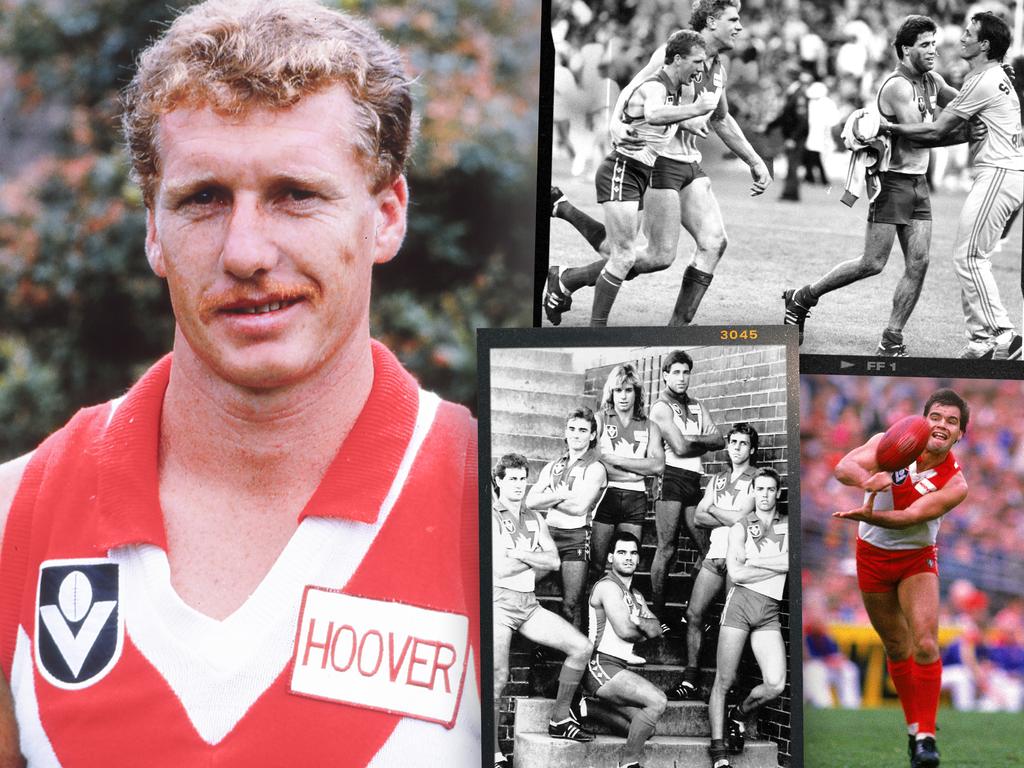
Thirty-five years ago today, Sydney Swans players woke up in the afterglow of a magical 12 days, while the Swanette cheerleaders could have been excused for sleeping in.
They performed a dance routine after every goal, and the Swans players ensured they rarely had time for a breather as a staggering 97 goals were kicked in 12 days.
“The Swanettes’ fitness levels were sky high by Round 18,” laughs Swans backman of the era Neil Cordy.

In more than 15,000 VFL/AFL matches played before and since that date, there have been just 31 occasions where a team has scored 30 goals in a game. From July 19 to 31 in 1987 the Swans did it three consecutive times.
It was the result of the Swans’ money-splurging, pink helicopter flying, tight-short wearing, private owning, glamour era.
Things would slide remarkably from this day onwards but for those that played or watched, it’s a memory that burns bright.
*****

Stephen Wright, was always ‘Stevie’ in deference to the Australian rock legend. Wright started with South Melbourne as an 18-year-old and was one of the true pioneers that flew north to reshape the club as Sydney’s team.
When a private ownership group fronted by Geoffrey Edelsten took over the Swans during 1985 it seemed every decent player in the country had received a big money offer. Wright wisely took stock.
“I was coming off winning the best and fairest in 1985,” Wright tells CODE Sports.
“I went back to Melbourne for Christmas and the advice I got was to stay in Melbourne until they give you a new contract. All these blokes were coming in on big dollars, so just stay there until that happens for you.”
Edelsten went to Melbourne and asked Wright and his wife to lunch at the Rialto.
“He asked me what do you want, I said I thought I was worth this much, and without hesitation he said, ‘Yes and lunch is on me’ and then left.
“As soon as he walked out I said to my wife I don’t think we asked for enough!”
Wright would now play in a midfield that boasted stars from other clubs like Greg Williams, Gerard Healy, Merv Neagle and David Bolton and the Swans swiftly became one of the league’s best teams.

“It was an exciting place to be around,” says Cordy who joined in 1987. “Williams was a legitimate star, as was Gerard Healy, as was Warwick Capper.”
A finals appearance in 1986 was followed by the Swans challenging again in 1987. It was midway through that season when Wright was the unlikely firestarter for the most prolific run of scoring the league has ever seen.
He’d been missing for five weeks with hamstring issues when he resumed against a first season West Coast Eagles, while the Swans strived for premiership credibility behind the top-of-the-ladder Carlton and Hawthorn. It was a red-letter day for the redhead.
“Our coach Tommy Hafey always put pressure on the on-ballers saying, ‘You should be able to kick one goal a quarter’,” Wright says. “I got two a quarter so it made him pretty happy.”
Eight goals doubled his previous career-best, but all the while he was playing predominantly in the middle so also added 30 disposals. Wright looks back at the game as a standout moment in a 14-season career.

“It was the best game I ever played. It was all going our way, but you still have to get in the right spot. That Eagles squad were good players but we got on a roll and they couldn‘t stop us.”
Indeed the Swans trounced the Eagles by 130 points that day. It was the highest score of the club’s shared history in South Melbourne and Sydney.
But they were only warming up.
*****

Many experts tipped against the Swans the next week. Essendon, the 1984 and 1985 premiers, had shown glimpse of their heyday in previous weeks while the Swans were missing a group of players including the previous year’s Brownlow medallist Williams.
A 10-goal second quarter by the Swans put paid to those tipsters, but it would get worse as the Swans topped last week’s show by smashing their club-record of the previous week. The Swans’ total of 36.20.236 would be just two points shy of the then all-time league record, and the 163-point winning margin the biggest loss in Bomber history.
“Terry Daniher, Simon Madden and Roger Merrett were still there and under Sheedy they were very physical,” Cordy says.
“The spread was unbelievable, 11 multiple goal kickers.”
Wright would kick another five goals but nobody would kick more than six goals.
It was an act of selflessness from its glamour full-forward Capper that summed up the team mentality the Swans had developed.
Capper lunged horizontally for a ball long after the game was alive but it bobbled out when he hit the turf. Capper quickly recovered to pick up the ball and break through a bedraggled Essendon tackle before feeding the running Wright to kick the goal from a few metres out.
“Warwick and I had a good relationship,” says Wright.
“We were from the same junior footy club and I used to talk to him during games to keep his mind on the job.”
Wright and Cordy agree that the Capper persona back then and now overshadows the players he was, a century goalkicker in that 1987 season.

*****
A quirk of the draw was that the Swans were scheduled to play their third-straight game at home the following Friday night. By now, the sceptical Melbourne media were acknowledging them as a genuine flag threat and speculating on what score they could rack up against bottom place Richmond.
Since their move five years prior the Swans had become the archetype of everyone’s ‘second team’. In a time when there was very little live football Victorian audiences became as familiar with the Swans as their own team given they were broadcast into their lounge room every second Sunday.
“I was at the Bulldogs for 10 years, but then I went to Sydney and the recognition level among footy fans went through the roof,” says Cordy.
As the team improved and the highwire act of Capper became more outrageous, the Swans became must-see TV, reaching fever pitch during this run.
“People of all clubs in Melbourne planned their Sundays around sitting down and watching the Swans,” says Wright.

*****
At the time the media hype was around whether the Swans could score 200 points for a third week running and there was almost an anti-climatic feel when they could muster ‘only’ 198 against the lowly Tigers.
Nevertheless the Swans rattled home nine last quarter goals to top 30 goals again, this time 31 and with it sail to the top of the VFL ladder.
“We thought we could win a premiership at that point,” Cordy says.
The football world was stunned, but it was a style the Swans had been perfecting for two years.
“It was quick ball movement,” Cordy says.
“You had Williams at the source and then you had Healy, Neagle, Bolton, Barry Mitchell, David Murphy and Paul Hawke streaming through the middle. You then had guys like Mark Browning and Mark Bayes running off half back.”
“If you won the centre clearances at the SCG the midfielders and the wingers could score because of the size of the ground.”

The admiration for the man they called ‘Diesel’ shines through from his old teammates.
“It was all based around Greg Williams,” Wright says.
“The footy world, apart from Geelong, really didn’t know how good he was until he moved to Sydney,” Cordy agrees.
Swans players were shocked in their first practice match with Williams when his old teammates from Geelong hared off in all directions and kept getting the ball.
“We learned very quickly that if he went near the footy you just ran and if you were the bloke in the right spot he’d get it to you,” says Wright.
“He was a dream to play with.”
The running and gunning midfield could live up to Hafey’s demands with the ball being fired out into space and cricket scores were tallied on the SCG scoreboard.

It wasn’t just the TV viewers in Melbourne enjoying the exploits. For the first time Sydney and broader New South Wales locals truly embraced the Swans.
At halftime of the Richmond game David Murphy was interviewed on television and he spoke of how all of Sydney now wanted to know about the Swans.
“The crowds in 1986 and 1987 started to get really big,” says Cordy. “There were some big games where the SCG was filled to the gills and because the stands are so close to the ground it was such a great atmosphere.”
Wright was working as a development officer going out to schools and saw a shift.
“People were starting to take notice more and they actually wanted you to come to their school,” he says. “Winning helped that.”
Those development officer visits by Wright in the era had an effect as Cordy remembers from the day New South Wales beat Victoria a few years later in a State of Origin match.
“A young Wayne Carey asked to wear number 26 for NSW in honour of Stevie Wright,” recalls Cordy.
“He attended a clinic and Stevie took him aside at the end of the clinic and had a kick with him.”
Carey was only a tyro at the time, well before he’d made his North Melbourne 18 famous, so it went unnoticed by many as he lined up alongside Wright and Cordy that night.
“Wayne always remembered the impact it had on him,” Cordy says.

*****
Sadly for the Swans after waking up on top of the ladder on August 1 1987, things never got any better in this era.
As if the extraordinary 12 days of football took it all out of them, the Swans went to Melbourne and were thumped in consecutive second half fade-outs by Carlton and Hawthorn. Then Geelong came back from five goals down in the last quarter to beat them the next week. They fell in against lowly Fitzroy to limp into the finals.
It got worse in the finals, a 99 point humiliation against Hawthorn followed by a 76 point hiding by Melbourne, although it must be said that in today’s football that second final would have been at the SCG and a very different result could have been attained.

“Through 1986 and 1987 the Swans played four finals, and of those they finished above three of the opponents. But all the games were in Melbourne,” says Cordy.
“We had a real home ground advantage in Sydney with the shape of the ground.”
Wright also wonders about the home final issue and injuries that came at the wrong time.
“We lost Warwick and (captain) Dennis Carroll with injury in the first final and the momentum was taken away.”
An era was over just after it reached its peak.
“The year after it fell apart” says Wright.
Behind the scenes the Edelsten-as-owner mirage had long disappeared. By 1987 he was gone, having only played a role as frontman for the ownership group. After the big spending of the previous 18 months the Swans were haemorrhaging money and a knockout blow was to come.
“A month after the 1987 season finished was the stock market crash,” recalls Cordy.
“That fractured the ownership.
“Doug Sutherland was the President and also the Lord Mayor of Sydney in 1987. After the financial crash he was going around with a notebook at training asking each player how much they were owed. Merv Neagle had his car repossessed while we were training.”

Belts were tightened, Capper was lured to Brisbane and Hawke went to Collingwood in the off-season. By the end of 1988 Hafey was gone, and while Healy would win a Brownlow in 1988, injuries forced his retirement two years later. Williams and Mitchell eventually took big money in offers in Melbourne.
“We just missed our timing,” says Wright.
“The dark years started and we financially fell over twice, ” says Cordy.
*****
While the ultimate glory was never reached by that Swans team, they produced some of the most exhilarating football ever seen, reaching its peak in that 12 day stretch.
Thirty goals in three games for a season, let alone consecutively, has never been reached since.
“By the time of the third game there was a lot of hype, but we didn’t speak about any record,” Cordy says. “It’s only on reflection that you look back on it as an achievement.”
Five years later Geelong gave it an almighty crack reeling off 37, 32 and 28 goals in a 13-day period. It equalled the 97 goals across three games achieved by the Swans but never went near the Swans’ achievement in capturing the public’s imagination.
Wright finished his career in 1992, and has coached all around Australia ever since. This year he is an assistant at Dalyston in the West Gippsland League but remains passionate about the Swans.
“They’ve been fantastic in the way they keep chugging along, they haven’t gone backwards for 20 years,” he says.
“Being one of the pioneers, I’m pretty proud of what we did when we first went up there. I say they promised us the world and delivered us an atlas.”

But Wright, Cordy and others kept the Sydney dream alive at various crisis points.
“It‘s a feather in all of our caps.”
And will the record ever be matched?
“Thirty goals in three weeks straight probably won’t ever happen again,” Wright says.
Cordy, the backman who bizarrely received one Brownlow vote in the Richmond goal fest, agrees.
“That’s a lot of goals”

Petracca, Oliver, Goodwin: Drastic overhauls footy’s new normal

Swans’ camp gets awkward — thanks to a kid’s innocent question

Why Bloods recruit rejected Tigers and co for Sydney move

SSP watch: VFL star, ex-Docker battle for Hawks spot

One-on-one with Charlie: Former Hawk desperate to prove himself
