
What really happened when Swans moved from South Melbourne to Sydney 40 years ago
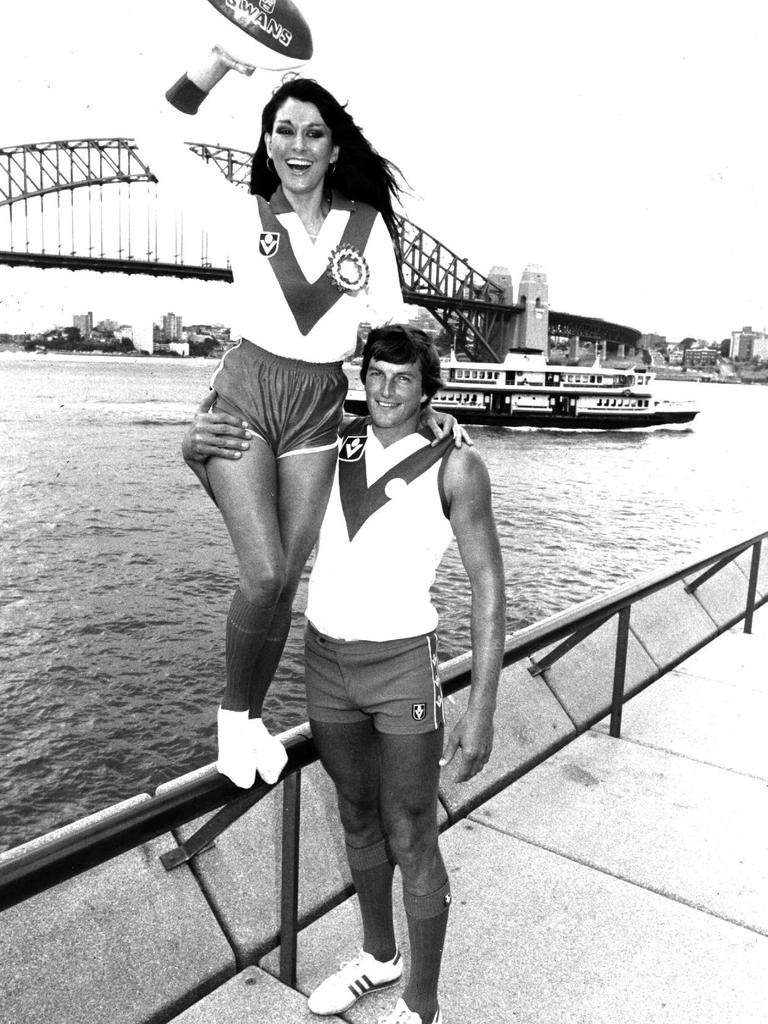
An iconic photo was taken in front of the Opera House when the Swans moved to Sydney, yet behind the glamour lay anger and trauma, writes NEIL CORDY.

In 1982, the Swans heralded their arrival in Sydney with an iconic photo taken on the steps of the Opera House. It gave the impression of a footy team flying high and enjoying everything the Harbour City has to offer.
The real story was quite different.
The pioneering group were under-resourced, underfunded and under-appreciated.
Barry Round was the charismatic skipper of the groundbreaking group. He and his teammates had moved up from South Melbourne to spearhead the VFL’s push for a national competition. But it wasn’t what they were hoping for.
“Sydney hardly rolled out the welcome mat for us,” Round says. “From a sporting point of view we felt like many in Sydney were defending their own turf.
“The press in Sydney were shocking. We had virtually no coverage in the daily papers. The scores were reported about 10 pages from the back and that was it. They called it ‘Aerial Ping Pong’ and an ‘Impostor’s Game’.”

Round and his teammates couldn’t win.
They were looked upon with suspicion from large parts of the Sydney sporting community and were despised by South Melbourne fans for leaving.
“The move itself shifting the Swans from South Melbourne to Sydney was very traumatic,” Round recalled. “It tore the club apart.
“We had meetings at the end of the 1981 season to discuss our future. The options were to wind us up, to amalgamate with St Kilda, or go to Sydney.
“The last game in 1981 was at the Lake Oval against North Melbourne and the cheer squad were dressed in black and the banner was black. The fans were crying, it was a terrible day. Some players said they weren’t going to Sydney and you couldn’t blame them.”
To help smooth the transition, players continued to live and train in Melbourne in their first season and flew to Sydney for the 11 home games at the SCG. The following year, players were told they had to move to Sydney to live or find another club.
For the Morwood family, it was a tough pill to swallow.

The three brothers were close in more ways than one: Paul, Tony and Shane were born in 1959, 1960 and 1961 respectively and by 1982 were all regulars in the Swans line-up.
But only Tony made the move to Sydney in 1983.
Shane and Paul stayed in Melbourne. Shane went to Collingwood, ultimately playing in the 1990 premiership, and Paul moved to St Kilda.
“The worst thing about the move was the break-up of our family,” Tony Morwood said. “It was hard for our parents [Des and Anne]. We started our careers together and then they had to watch us play against each other for different clubs.”
For Tony, the move seemed relatively seamless at first. He transferred his job with Just Jeans from Melbourne to Sydney and his wife Karen did likewise at the ANZ Bank.
Then came the cost of living shock.
“We had rented our house out in Chelsea for $75 per week and moved into a terrace in Paddington which cost us $180 per week,” Morwood said.
Round found the move even more challenging.
“I was a carpenter and I had no contacts in the industry, no source of supplies, and didn’t know the layout of Sydney,” Round said. “I started a handyman business with John Reid [uncle of Swans Sam Reid and former Magpie Ben Reid]. We’d mow someone’s lawn for $10 and it would take us an hour and a half to get there and back. I ended up working as a promotions officer going to schools and that was depressing there as well because of the lack of interest in our sport.”
The small fan base for footy in Sydney at the time impacted employment opportunities at all levels. For instance, teaching jobs at top schools were for rugby union players and cricketers, not Aussie Rules players.
Teachers, like champion full back Rod ‘Tilt’ Carter, had to fend for themselves in some of Sydney’s more notorious schools.
“They had all these PE teachers who came in and couldn’t get out quick enough, it finished them,” said Carter, who once described his job to a teammate as more parole officer than teacher. “You could imagine their surprise when I said I wanted to work there.
“I told the lady at reception I wanted to work at the school. She stared at me like I was on drugs. She asked me what I taught and when I said Phys Ed she said, ‘Don’t move!’”
When his stressful working day was done, there wasn’t much for Carter and the Swans to look forward to on the training front. The low profile and influence of Aussie Rules in Sydney also extended to practice facilities, which were well below the VFL standard.
“We weren’t allowed to train on the SCG,” Round remembered. “We had to train on Oval No. 2, which was used as a car park when the rugby league games were on at the SCG.
“The ground was full of potholes from the cars that parked there. You’d be running along at training and you’d see a bloke fall arse over after falling in a hole. It was a nightmare. The gym was virtually non-existent with just a few weights on the floor in a space about 10 metres square. It was archaic.”

As challenging as the experience was for pioneers like Round, Morwood, and Carter, there was one factor that came close to trumping the negativity surrounding their move north: they were a decent football team.
The Swans won their first game at the SCG against Melbourne and, later in the year, won the night premiership. Dashing defender and future captain Mark Browning was one of their best.
“The photo is Roundy holding the trophy with one hand and his jumper with the other,” Browning said. “I think that is a significant photo.
“Out of that team there were 15 players who played 150 senior games. We had a pretty good team. We had a lot of young blokes. We played in Sydney on the Sunday, won the night premiership in Melbourne on Tuesday and then were back in Sydney on Sunday.
“It showed we were a good team and we could compete.”
Morwood was another star that night and would go on to play 229 games and earn selection in the Swans Team of the Century. “Winning the night competition was a big confidence booster for us,” Morwood said. “We beat North Melbourne who still had Malcolm Blight, Wayne Schimmelbusch, Keith Greig and Arnold Briedis.”
There were plenty of bumps and bruises along the way, particularly in the early years, but the players who skipped down the Opera House steps 40 years ago take great pride in the club’s evolution.

From a team unwanted in Melbourne and unloved in Sydney, the Swans have developed into one of the league’s most consistent clubs with a loyal and growing fanbase.
“I’m immensely proud of how the club has evolved,” Round said. “They have a culture other clubs want to imitate. It makes me think back at those tough times when we first started.”
Browning added: “We were left to our own devices but I never doubted it would work. We had 12,000 to our games but that was twice as many as we were getting at the Lake Oval. We had less than a thousand members. Now we’ve got 60,000.”
Morwood concurred.
“The reason I went to Sydney and stayed there was I wanted our club, the Swans, to be revered and respected,” Morwood said. “Forty years on and we’ve achieved that.”

Petracca, Oliver, Goodwin: Drastic overhauls footy’s new normal

Swans’ camp gets awkward — thanks to a kid’s innocent question

Why Bloods recruit rejected Tigers and co for Sydney move

SSP watch: VFL star, ex-Docker battle for Hawks spot

One-on-one with Charlie: Former Hawk desperate to prove himself
