
The legend of Maurice Goolagong, park-footy Plugger and award-winning Indigenous artist
He learnt how to kick under big skies out west, how to paint while working in maximum security prison. Related to sporting royalty, Maurice Goolagong was himself a footy colossus, writes TIM ELBRA.


Maurice Goolagong sat in a maximum-security prison on Darkinjung land. His past and future met behind the razor wire, invited by an Indigenous boy wearing inmate greens.
‘Why don’t you come over and do some painting with us instead of just sitting there watching?’
Goolagong, a Wiradjuri man serving as a rookie Aboriginal education officer at Frank Baxter Youth Justice Centre, nodded and joined the boy. A hulking full-forward come weekends, Goolagong never fancied himself an artist. Culture found him behind bars. It found the boy, a brushstroke of hope amid ruinous violence, and in turn found the gentle giant who sat beside him.
“I never picked up a brush before then, never knew I had that sort of talent,” Goolagong says, 24 years on.
Back then, Frank Baxter maximum security at Kariong, on the NSW Central Coast, housed the kids deemed too dangerous for general populations in juvenile justice. About half were Indigenous, human statistics of a broken system. Kids all but discarded before they had a driver’s licence.
“As with any population in juvenile centres, there’s a lot of representation of Aboriginal kids, which is a shame. A lot of the kids haven’t got those sorts of role models, so you’ve got to step up and be that role model for them,” Goolagong says.
“They’re good kids, just in the wrong place, wrong time. It frustrates you but you do the best you can do get them out, get them back on track, then it’s up to them once they walk out the doors.”
Goolagong’s gift to those boys was a second chance. Their gift to him was painting.
How he made his name before picking up the brush: footy.
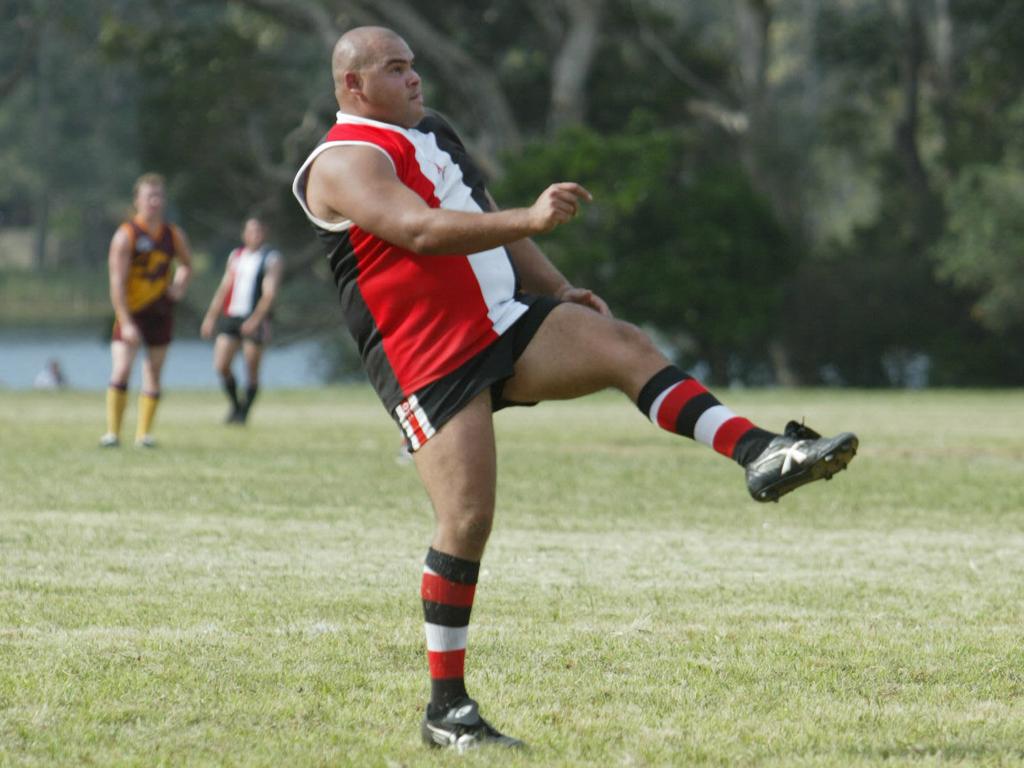
Goolagong, nephew to tennis icon Evonne Goolagong-Cawley and uncle to NRL superstar Latrell Mitchell, was an Aussie rules colossus. A park-footy Plugger from a sprawling field in the NSW Central West, a short walk from the old hospital his family called home.
*****
The year Goolagong met his unlikely painting muse, he kicked ‘only’ 64 goals. The year before, he kicked a ton and the year after, he turned up midway through a grand final and won it for his side after driving 10 hours through the night following a 50th birthday party for his old man in Victoria, hammering a red Ford Fairlane at 120km/h while on his L-plates.
Goolagong was born in Hillston, a rugby league town back then, and moved to Barellan, a footy town, when he was eight. Yarran Street ran adjacent to Barellan Sportsground and Goolagong often made the 200m walk there from the former hospital turned six-bedroom family home, with the scorched timber walls and the fibro interior and the three open fires that poked their chimneys through a tin roof. A dam sat in the backyard alongside old cars that his dad worked on with his grandfather. A clay tennis court was next door, with a rope and streamers in place of a net.
“Dad and all his family lived there and we were all brought up in that house. It was a very old and special house. It was a home,” he says.
So too was the sportsground. It was the vast heart of the community, dirt-ringed yet immaculate.
“The only bad thing about it was the cricket pitch in the middle. When it rained, it was soggy as, and when it wasn’t raining, it was hard as a bloody concrete floor,” Goolagong says.

From age 12, he trained with the men on Tuesday and Thursday nights, and with the adult rugby league players on Wednesdays and Fridays. Whenever he wasn’t in school, he was at the sportsground kicking a footy. The cheeky, ever-smiling kid found purpose there.
“The men were leaving footballs behind the goalposts of a night time – you could pick one up and I’d be at the oval nearly every afternoon, just kicking a football around by myself. What I used to do, instead of trying to kick goals, I used to try to aim for the goalpost, just to get my accuracy up.”
Max Jamieson and Col Male first taught him to kick. Their junior Barellan sides would lose games by 100 points one year, then win premierships the next, thanks to age groups two years apart. The most footy-mad kids would play an under-10s game, back up for under-12s then again for under-14s. That was Goolagong and also the coach’s son, Justin Male, who was awed by how Barellan came alive on game day. Cars, utes and trucks surrounded a field that sat lonesome all week before the boys played footy not only for themselves but a drought-parched community, where a living was hard-earned and respite deserved.
“You’d think, ‘Where the hell do all these people come from?’” Justin Male says. “It’s one of those places you drive through and everyone’s waving at you, whether they know you or not; doing the two-finger wave on the steering wheel. They just love their sport, that’s the main thing.”

Col Male was a wheat, cattle and sheep farmer, like the first men who settled around Barellan more than a century ago. He still is, at nearly 80 years old. Col the old junior footy coach was always running late for away games at neighbouring towns after a week working the land because he’d pick up every kid he could possibly squeeze into his green Ford station wagon with the white roof. It was the team’s official vehicle in the days when seat belts were optional and Justin Male and Maurice Goolagong usually found themselves in the boot, leaving space for the other boys as they filled the car before racing across the Leeton hills. Flat out, clock ticking until first bounce, airborne over the bumps and having the time of their lives before they even got to have a kick that day.
Footy all winter, when the scorching heat gave way to numbing cold. In summer, it was swimming on Saturday mornings – Dawn Fraser used to come out every year to do a clinic at Barellan pool – then junior cricket followed by seniors in the afternoons. Barellan raised its kids to love sport and sport loved them back on those big-sky country fields that lay some 500km from either the MCG or SCG.
*****
The Goolagongs moved around a lot when Maurice was a boy, his father in and out of work, and he was back at Hillston for the start of high school. He was out of home at age 14 and in North Wagga by 16, landing at Wayne Carey’s junior club, the Saints.
He won an under-18s league best and fairest at centre half-back. One game, he did his knee then backed-up for the reserves, coming off the bench to replace an injured forward. Kicked seven goals to win best on ground. He couldn’t walk properly for the next two months but the die was cast.
“When I moved to the Central Coast, they said, ‘What position do you play?’ I said, ‘Full forward’.”
A visit to his sister in Sydney was meant to last a week but lasted two years, after he became a butcher’s apprentice in the big smoke and travelled to Woy Woy for footy every second weekend. An uncle lived there and Maurice kicked his first ton for the Swans, 115 goals in 1997, which made him a prime recruit for a club coming off a 0-18 season, 64 points shy of first place: Terrigal-Avoca.
“No.23 was the number I was wearing when I first kicked over 100 goals at Woy Woy, so I said, ‘I’m not coming over unless I get No.23’,” Goolagong recalls.
“They came back a couple of minutes later and said, ‘Look, mate, can you have No.3, 33, 43 or whatever?’ I said, ‘Nah, it’s either 23 or don’t worry about it’. They came back again five minutes later and said, ‘All right, you’ve got 23’. I found out later that day that the 23 I got was off a life member of the club.”

In Barellan, Justin Male was fed up with farming drought-stricken land, so Max Jamieson put him on to Terrigal-Avoca president Rob Dixon. Pure coincidence.
“I got a phone call a little bit later from the assistant coach. I was saying to him, ‘I’ve got a cousin (Graham Male), he’s a butcher from Barellan, he’s a pretty handy footballer and he’ll come up with me’,” Justin recalls.
“He said, ‘No, we’ve already got a butcher from Barellan, we don’t need two!’ I went, ‘What are you talking about?’ and he said, ‘Maurice Goolagong plays for us’. It blew me away that did. I had no idea he was there, hadn’t heard from him since about 1988, over 10 years. He’s grown a fair bit from the time I left him to the time I caught up with him again. He was a big unit. And dominant.”
A shade under six-foot yet playing anywhere between 118-130kg, Maurice Goolagong was laughed at by opponents … right up until they saw him play and bang goals from 50m out.
“You’d see this big Aboriginal fella run out on the field and go, ‘What’s he doing?’ Next thing, the ball goes down there and he bloody bumps everyone out of the way. He was so large and the ball would just stick in his hands. You’d think, ‘Christ’,” former Killarney Vale Bombers and Black Diamond AFL president Ian Granland says.
Panthers coach and teammate Dean Wall recalls: “Despite his weight, because he’s always heavier than he should be, he was remarkably quick over a few steps. He could turn on a dime and because he was a left-footer, I think blokes used to go the other direction. He’d just turn around on to his left foot and hook goals in. He was a very accurate kick but quite nimble on his feet. He’s not overly tall but he could use his body weight really well, just fend people off so the ball would fall to him. Then if the ball was on the ground, he could pick it up and snap a goal just like any little guy. He was supremely skilled in kicking.”

*****
The Panthers went from dead-last to a grand final appearance in 1998 but got a 52-point thrashing from arch rival Killarney Vale. Maurice Goolagong broke his wrist in the final home-and-away round of the 1999 season, which should have ruled him out of the rematch.
He was 950km away in Swan Hill when he pulled off the cast and called Dean Wall. He was healed and he was in, once his dad Larry’s 50th birthday celebrations were over; 2am on grand final day.
“I didn’t even sleep, I don’t think. I was on my L-plates and I drove most of the way because my sister was too tired,” he says.
“I was sitting on 120km down the Hay straight, the back of Deniliquin and all that, going through there. Once I hit the freeway, my sister (Kim) took over and she drove the rest of the way.”
The red Ford Fairlane slowed to a halt near the Mt White weigh station before he’d even started getting changed into his footy gear. Car accident. They were less than an hour away but it was panic stations.
‘Sis, just go up the emergency lane!’
‘No, I’m not going anywhere near there!’
The chance of being late went from probable to definite. Maurice was filthy.
“We were on the phone to him leading up to it, ‘Where are you?’ … ‘Three hours away’. Then in the next half-hour, ‘Where are you now?’ … ‘Only about an hour away’. He was hurling along pretty quick,” Justin Male says.
“[I said], ‘Why would you leave now? Why wouldn’t you have left last night?’
“[He said], ‘Ah, nah, I left at two o’clock this morning’. I was thinking, ‘You f--king idiot, it’s a grand final!’”

Male was also on the phone to his cousin, who got lost on the wrong side of Wyong River trying to get to the ground. The Panthers ran out feeling like it may not be their day, again, and that’s how the game began.
“We were getting our arses kicked in the first quarter, we kicked one goal bloody 10, some ridiculous score,” Goolagong says.
“I ran out of the bloody car and off I went, I went and got my wrist strapped and I went on in the second quarter.”
Whispers rippled through the crowd that were equal parts wonder and horror. ‘What the f--k is he doing here?!’
“We saw him drive in and we’ve gone, ‘Oh, Christ’,” said Ian Granland, who was Killarney Vale president at the time. “We were quite competitive up to halftime and when he came on, they got beat by 10 goals.”
It was instant folklore that deserved a roaring celebration, yet Goolagong was spent.
“It was a good win but I went back to the club, had one beer and I fell asleep on the table, so I had to go home. I was that knackered.”

*****
The Black Diamond League was born when the Central Coast and Newcastle competitions merged for the 2000 season. The Newcastle City club had the old No.1 Sportsground, a stately regional park with a cream picket fence, grandstand and hill. Terrigal-Avoca’s Hylton Moore Oval, built on an old landfill site, was being upgraded and the Panthers were playing out of beachside Heazlett Park, which sounds far more glamorous than it was.
The field was sandy under thin grass and the astroturf cricket pitch in the centre square was covered with a pile of dirt. The goalposts were there only every other week, swapping places with rugby sticks. The dressing sheds were dingy, the clubhouse a relic.
A giant fig tree climbed by generations of local children filled the space between the sheds and the lagoon, which was far less pristine than the adjoining Pacific Ocean where the Male cousins went surfing when they first rocked up to Avoca, figuring it was the done thing while living on the Coast. It was raining, rough and freezing cold, and the country boys never surfed again.

Retro aquabikes sat by the lagoon edge. The Panthers would take them out and try to grab marks atop the comical vessels as their teammates launched almighty torps and drop punts. The lagoon was a riot for training and a nightmare on game days, when a booming Maurice Goolagong set shot would frequently prove that leather footballs and water don’t mix.
“The amount of footies we lost in the water from Goolagong kicking it too far, into the lagoon … they’d come back waterlogged. It made a hell of a mess of a game,” Justin Male says.
Up the other end was the main road winding through Avoca Beach and no car was safe. Goolagong put one through a bloke’s open window one day as he drove past. “Scared the shit out of him,” he recalls.

The Goolagong bag of tricks was introduced to a whole new set of bemused backmen that season and he led the new league’s goalkicking chart. He couldn’t be held, eyes never leaving the footy as he unloaded banal chat on his opponent to put them off. Even when they worked out he liked to feint right and lead left, they couldn’t stop him.
“A lot of players, because of my size, thought that I was a lot slower. They thought, ‘Oh yeah, I’ll beat this bloke no worries’. They didn’t realise how quick I was over the first 20 metres and how strong I was, my upper body strength. They soon learned after kicking a couple of goals on them,” he says.
The Panthers went from the Avoca Beach sandpit to Newcastle No.1 for the inaugural Black Diamond AFL grand final and the vast space of the city ground was like a fancy Barellan Sportsground to Goolagong. He kicked a bag against Cardiff as Terrigal-Avoca won by seven goals, earning back-to-back premierships in two different leagues and a slice of history.

*****
Maurice Goolagong kicked a ton for the next four consecutive seasons. While comparing park footy to the AFL is strawberries to watermelons, his accuracy was enough to make an elite full forward cry.
His 2001 season reaped 135.12 and ended with 25 goals in the final home-and-away game. “Don’t take me off today,” he told Dean Wall as he strolled onto Heazlett Park to face his old club Woy Woy, well down in the leading goalkicker standings. When he was done, he claimed the trophy by six goals, even though his nearest rival – Killarney Vale’s Simon Cossor – booted 10 that weekend. Peak local footy: Goolagong wasn’t named best on ground. The umpires gave three votes to the opposing full forward, who kicked six in a 24-goal loss.
The endless hours Goolagong spent aiming at the goalposts at Barellan Sportsground paid off well after he left the old field behind, though a trip back west cemented his legend.

The Black Diamond boys were meant to be the easybeats of the 2006 NSW Country Championships in Wagga Wagga. They drove six hours on a coach and stayed at a motel/tavern, the Palm and Pawn, where a handful of players demonstrated the inexact science of preparing for amateur footy by quickly heading to the bar. Goolagong – who stayed separate, with his family – knew what to expect from the other sides.
“Especially playing representative football, they’d just look at me and laugh; but once you kick a couple of goals on them, they go, ‘Oh, hang on, we’ve gotta start playing football here’.”
The organisers put the supposed also-rans in their place from the outset, scheduling all their round-robin games on the dingy Anderson Oval while the big boys took turns on Maher Oval, the far better ground across the road. Goolagong’s family sat behind the posts all day, cheering his goals and swapping ends as he did, while the mighty Riverina, Farrer and Hume football leagues were handed shock defeats. The underdogs, somehow, were into the final.

Riverina was the opponent. Riverina with the paid players. Riverina that had produced Wayne Carey, Paul Kelly, Shane Crawford, Terry and Neale Daniher and Bill Mohr. John Longmire, Billy Brownless, Tom Hawkins, Cam Mooney, Leo Barry and Luke Breust. Riverina led five goals to none at the main break.
Now the Black Diamond AFL president, Ian Granland walked into an officials’ luncheon at halftime with familiar resignation and was greeted by Riverina FL counterpart Graham Buchanan.
“You had us worried, Ian. Your boys have played well,” Buchanan said, per Granland’s recollection. Similar platitudes came from other league presidents who were used to seeing the Coasties get hammered by 100 points at these carnivals. ‘They went well yesterday and it was a great effort, keep trying.’ There was little Granland could say, scoreboard as it was, but he was boiling inside. “You bastards,” he thought.

Goolagong snapped Black Diamond’s first goal late in the third quarter but they trailed by 30 points at the final break. It was game over in everyone’s eyes except the likes of Killarney Vale star Clint Austerberry, who figured a May day in Wagga Wagga was as good a time and place as any for a miracle. “We can beat these bastards! All you’ve gotta do is put your heart in it!”
Goolagong kicked three goals in the final term. Austerberry goaled. Centre half forward Mick Ryan claimed the moment of immortality when he marked on 50 and rifled it through with seconds remaining for a one-point win. Bloody beautiful.
“You think you’re about to lose by 10 goals, so to end up winning by a point – and Maurice was pretty integral in that, kicking goals in the last quarter – it was probably the best win I was involved in,” coach Dean Wall says.

Granland couldn’t help but shoot a triumphant gaze across to the other officials.
“I looked over at the blokes who were like, ‘Yeah, it was nice to have you’, and they were just shaking their heads; ‘How did this happen?!’” he recalls. “Maurie was a really important part of the team that won that game and the championship, the first time we’ve ever done it.
“I went in after the game and I said something like, ‘Congratulations fellas, no one has ever done this before’ … then said something like, ‘F--k the league, you can keep the jumpers!’ The rep jumpers are always handed back and used the next year, the next year, the next year, so everyone’s gone, ‘Yeah!’”

Goolagong went straight out to visit family at Hillston after the game. For his teammates, a 10am departure time the next morning was the only deadline on celebrations, only that wasn’t long enough. “Hectic” is Wall’s recollection of the bus ride home. It smelled of victory but also reeked of sweat, beer and rum.
“We got in the bus and we drove to the local bottlo … oh, Christ, what a trip. I could see these cartons of Bundy and coke coming on board and I’m just going, ‘Oh, Christ’,” says Granland, who sat up front with the old blokes waiting for the players to doze off over the six-hour ride, which they never did.
“They partied on and when we got across the Hawkesbury River, I said, ‘Righto, fellas … It was filthy, the bus, absolutely filthy, so I said, ‘What about we all chuck in because the bus driver’s got to clean up’. We raised about 150 bucks and he was happy with that.”

*****
Maurice Goolagong ostensibly retired from Black Diamond footy after the 2007 season so from 2008 onwards, they named the league’s goalkicking award after him. Mick Ryan was the inaugural winner, booting a ton for Cardiff.
Though Goolagong was engraved into history, he got talked into playing a season for St George in Sydney then came back in 2009 to have a crack at winning his own trophy, only to be pipped by Panthers teammate Peter Van Dam (76-74). He trailed Ryan in 2010, booting just 56 goals.
The 2011 season found Goolagong back at Hylton Moore Oval, the ex-rubbish tip turned fine local footy ground with the funky waft of mangroves drifting from Erina Creek at the southern end. The north end held a baseball diamond and the ground was flanked by a skatepark and a dog-off-leash area. History beckoned that June when the Panthers hosted Warners Bay: Maurice was going to kick his 1000th Black Diamond goal. Justin Male was one of 300 people who showed up to watch. More than 100 people flooded on to the ground after he drilled a 30m set shot in the second quarter.


“We were a few beers deep so by the time he got it, everyone was pretty excited. It was like Plugger had just kicked his 100th at Moorabbin or something, that’s what it felt like,” Male says.
He’d topped 1000 for his Black Diamond AFL career and booted 82 goals that season … which meant he won the Maurice Goolagong Trophy.
“Maurie had retired and he’d present the trophy every year at the Black Diamond Football League presentation night … then he decides to come back and wins the competition, so he’s virtually got to present the trophy to himself. It was quite funny,” Ian Granland says.


In 2012, Goolagong ventured to the Northern Riverina, playing for Tullibigeal as Terrigal-Avoca won a premiership in his absence. In 2013, he returned for a Panthers grand final loss to Newcastle City, in which he kicked the final two goals of his career.
More than 1500 goals across 300 matches was his Plugger-sized local footy legacy in a changing game. The year that Goolagong retired, a Cardiff kid called Isaac Heeney came second in the league best and fairest despite playing only six games. Gradually, midfielders were taking over. The 2019 Maurice Goolagong Trophy, in the last season not hit by Covid-19, was won with only 58 goals.
Goolagong’s records – most goals in a game, season and career – will likely never be touched.
“Not the way the game’s going now. It’s changed dramatically; I think it’s for the better,” he says.
After two decades of destroying opposition backmen, perhaps the most telling part of Goolagong’s career was what went unsaid.
“He was pretty quiet when it came to footy, didn’t talk a hell of a lot of footy,” Male recalls. “We’d all get back to the pub, tell everyone how good you are … but he wouldn’t have to say anything.”

*****
Goolagong taught kids in juvenile detention for 17 years, until the Kariong maximum security facility was changed to house adult inmates. He taught them and he learned from them. Great Indigenous artists would visit to impart knowledge. It mattered. To kids facing the most brutal form of justice allowable by law, it mattered enormously.
“It was a place where you felt you made a difference. When you see them come in, off drugs and all that sort of stuff, no idea about their culture, identity or family history, then you gradually get that out of them … they never picked up a paintbrush or did any artwork before,” he said.
“By the time they’re leaving there, some kids are winning art competitions. It was very rewarding, seeing them from the time they come in to the time they leave. Very rewarding.”


Goolagong himself won art prizes and to this day designs footy guernseys for the local Indigenous round. He can barely keep up with requests for paintings, clearing his backlog during holidays from his work as an Aboriginal education officer at Brisbane Water Secondary College, a public high school of Year 7-9 kids.
More kids these days are identifying with their Indigenous heritage. More non-Indigenous kids are realising the immeasurable value of learning about the culture that has existed in this land for 60,000 years.
“It puts a big smile on your face when they come up to you and talk about it. Especially asking questions about culture. It feels good,” he says.

He goes home for peace of mind and for culture, back to Hillston and Barellan on Wiradjuri land. In 2009, Barellan marked its centenary by erecting The Big Tennis Racquet; a giant replica of Evonne Goolagong-Cawley’s iconic Dunlop racquet, complete with her name and face. When they first saw it, Maurice’s kids – Jye and Shae – couldn’t believe their eyes.
“They go, ‘There’s our last name!’ I said, ‘Yeah, that’s Aunty Evonne!’ Had to tell them the story behind it. They’re all getting to know it,” he said.
There is more knowledge back home, Wiradjuri knowledge that passed with his grandparents and dad but lives on in his aunties and uncles. And on the Coast, there are footy stories of the butcher from Barellan. He was cutting meat on a casual shift the other day when the poor old fullback from that legendary grand final walked in and copped flashbacks of Goolagong and his red Ford Fairlane.
‘That day you bloody turned up at that ’99 grand final … friggin’ hell!’

AFLW Phantom Draft: How the top 20 picks could fall, when bids land

Statistics over passion: Derm reveals truth behind Fox Footy exit

Late mail: The go-home concerns set to shape AFLW Draft

‘I don’t know what happened’: How Clarry found purpose again

Failed trade, TDK, hair cuts down the highway — Marshall opens up
