
VFA reunion: Fast play and fisticuffs were commonplace before the league fell victim to the AFL
The VFA was created before the V/AFL and is still remembered fondly for its wild and weird stories, writes PAUL AMY.

Phil Gibbs is in full cry in the commentary box.
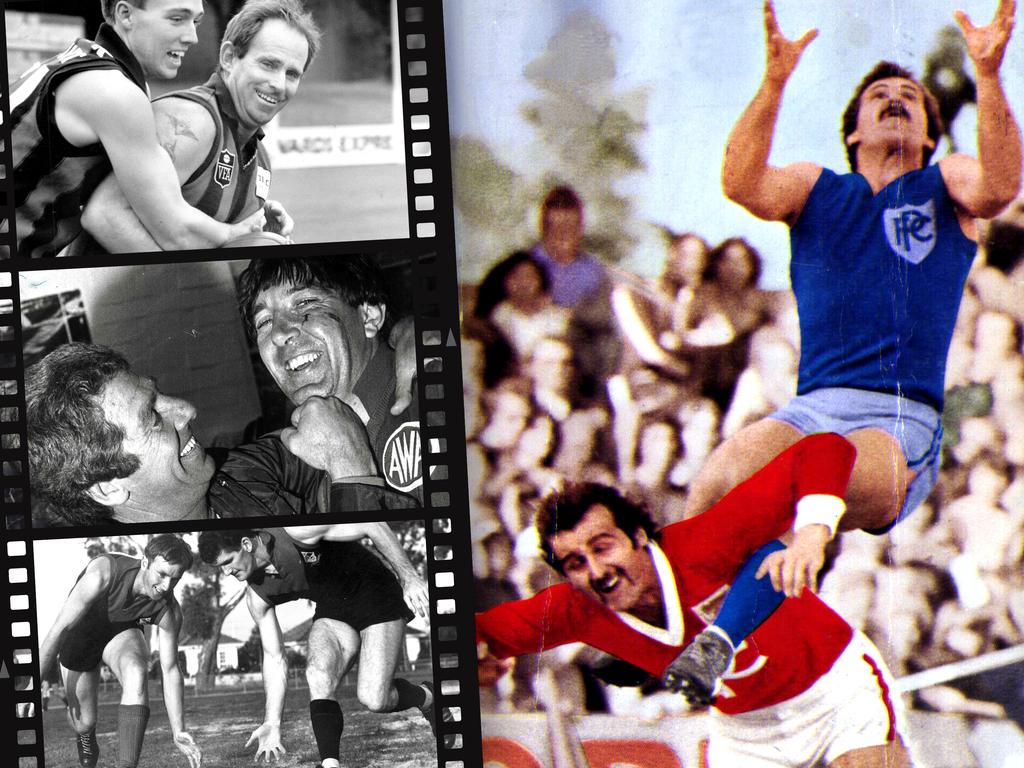
Preston’s Bruce Gonsalves has copped one from Prahran’s Rob Anderson in the 1978 VFA grand final at the Junction Oval.
“Gonsalves and Anderson!’’ Gibbs shouts. “It’s on again. Look at them into it now! Ooooh, that’s Harold Martin facing us and really shaping up … there’s another slap and they’re into it again … well, there’s been sensations galore here in this final …’’
Close to 30,000 spectators are watching at the ground and many more are tuned in to the coverage on Channel O. Unsurprisingly, there’s a scrap. And veteran Gibbs is all over it. He knows a bit of unruly behaviour helps his ratings.
“By gee it’s been a desperate final … well, Fred Cook would be pleased he’s not out there today. He’s just said to me very pleased!’’ he chuckles.
It was quite a spectacle. A lot of VFA games were.
The grand final clip is on YouTube, one of many of the old Victorian Football Association.
Type in VFA and up pops footage that for many fans evokes warm memories of clubs and players from a competition that had a following bordering on fanatical.
A few minutes of viewing can turn into an hour, then another.
The VFA, now known as the VFL, was renowned for fierce suburban rivalries and a fast-flowing brand of 16-a-side football, as well as more than a few fisticuffs.
There were big scores, big personalities and big hits.
Port Melbourne’s Greg Dermott was known as “Biff’’. Teammate Graham Harland’s head spun to “Buster’’.

Preston big man Martin had no such nickname that suggested a willingness to mix it up, but it didn’t pay to mess with “H’’. Same with Coburg’s Trevor Price.
As one YouTuber said: “You would go to the fights and then a game of footy would break out.’’
It was a bit like that when Port Melbourne champion Cook was decked by Dandenong’s Allan Harper in the first quarter of the 1976 grand final. Mayhem followed.
Ahhhh, Freddie Cook, Fabulous Fred, perhaps the greatest of all VFA players, kicker of more than 1,000 goals for Port and pin-up boy to an ocean of small fry.
Ten years after the VFA was rebranded the VFL and Cook had spent time in prison over a drug habit, he phoned the league and said with a laugh to general manager Martin Stillman, “Mate, what have you done to my competition, I left it in good hands, we had crowds of 20,000 and you’ve f — ed it up around me.’’
Cook was doing special comments with Phil Gibbs for the VFA finals in 1978. Gibbs had been calling the action in 1976 when Harper clocked the great forward.

“Cook’s been flattened and it’s right on!’’ Gibbs roared. “Harper is in trouble. Let’s watch this. And another player has been flattened at the other end of the ground. Flaherty’s been flattened at the other end. And there’s another one down! A trainer’s gone down!’’
Cook suffered a bad gash to the mouth and was stitched up at half time.
Thinking he would have to sit out the second half of the grand final, he asked the legendary Port Melbourne administrator Norm Goss who would fill in at full-forward.
And his reply is part of association football folklore. “What’s wrong with you?’’ Goss shot back. “You don’t run on your f — ing chin!’’
There’s a fair chance the line will be mentioned this Sunday, when the “halcyon days’’ of the VFA will be celebrated with a function at Sandown Greyhound Racing Club.
Former Coburg player and coach Phil Cleary, who with his luxurious beard and burst of speed was one of the more well-known players of his time, and who after football became a significant public figure, will be guest speaker.

*****
Established in 1877, the VFA was Victoria’s first major football competition. From it sprang the clubs that formed the Victorian Football League – now the AFL – in 1896.
Behind the league in popularity and the standard of play, the VFA took in highs and lows as well as a few innovations as it tried to keep pace.
There was divisional football, the throw-pass, night games, the adoption of 16 players per side and Sunday matches.
The “halcyon days’’ are commonly regarded as extending from the late 1960s to the early 1980s. The association formed a great hold on the football public, boosted by television coverage that made household names of players such as Cook, Geelong West’s Joe Radojevic and Dandenong goalkicker Jim “Frosty’’ Miller.

With the ball coming in quickly, full-forwards could have a feast in front of goal.
Every team seemed to have a crack spearhead. There was Cook, Radojevic, Miller, Kim Smith, Red Hunt, Ian Cooper, Mark Fotheringham, Rino Pretto, Gary “Happy’’ Hammond, Peter “Fats’’ Neville and Jamie “Spider’’ Shaw.
In a football-mad town, they all assumed large profiles.
The same could be said for a few of the umpires. Frank Virgona, his little legs glistening with oil and his white shorts hitched alarmingly high, didn’t need to produce a pass when he turned up to a ground.
It was common for football supporters to watch their league teams on Saturdays and attend an association match on Sundays.

Names became familiar to the average follower.
Austen, Towan, Marcon and Bux from Preston.
Burt, Beattie, Dohnt and Nimmo from Coburg.
Beus, Wilkins, Hunt and Mackenzie from Sandringham.
Watt, Harris, Murphy and Scarlett from Geelong West.
Miller, Flaherty, Evans and Hibbert from Dandenong.
Cook, Aanensen, the Gosses and Christous from Port Melbourne.
Smith, Foley, Kekovich and McGuinness from Prahran.
But the glory days didn’t last.

When Channel 7 began beaming Sydney Swans matches into Melbourne homes in 1982, the VFA’s grip on Sunday football was weakened.
Crowds gradually fell away.
Clubs battled to pay the bills and some dropped out, including Radojevic’s Geelong West. By the early 1990s the once-robust association was down to one division and struggling.
In 1994 the VFA came under the control of the Victorian State Football League.
That year Dandenong, so strong in the late 1960s and the 1970s, was given the boot under a restructuring.
Oakleigh, admitted to the VFA in 1929 and successful and well followed at its peak, suffered the same fate.
And Prahran, which 16 years earlier had helped pack out the Junction, went too, resurfacing later in the amateurs.
By 1995 the competition was down to nine clubs and playing finals before thin crowds at Collingwood’s Victoria Park.
It was the last year of the VFA.
The name change to the VFL came for the 1996 season. Four years later the league absorbed AFL reserves teams, some aligning with traditional clubs and the others entering their own sides.
Cook’s Port Melbourne hooked up with the Sydney Swans, then North Melbourne, before going it alone again in 2006 and building to stirring deeds under the coaching of Gary Ayres.

Ayres is like many people: he watched the VFA on the terraces and on TV, and recalls it with affection: the crowds, the rivalries, the gallery of champions of villains, and, yes, the biffo.
Graeme Nicol, who has organised Sunday’s reunion at Sandown, remembers all this too.
He’s a lifelong Collingwood supporter and when a couple of his boyhood heroes, Kevin Rose and Errol Hutchesson, crossed to Prahran, he began to follow the Two Blues.
He watched Prahran win the 1973 grand final over Oakleigh.
Nicol went to all the grand finals, first and second division, and he formed an attachment to Oakleigh when his brother-in-law, Garry Gates, joined the Oaks.
Peter McKenna was Nichol’s favourite player. The great goalkicker played at three VFA clubs in three years – Geelong West, Port Melbourne and Northcote – and so Nicol had a bond with those teams too. And a friend, Wayne Muschialli, played at Williamstown.
“My allegiance often changed, depending on which players were where,’’ Nichol, 65, says.

“I grew up in a house full of Collingwood supporters and six or seven people were living there. But everyone had a different VFA team. Yeah, sure, on the Saturday we would cheer for Collingwood but on the Sunday my mum loved Preston and my dad loved Coburg and my sister was Dandenong, and on it went.’’
He particularly liked the tribalism’ of the VFA, when suburb went up against suburb.
“It was really us against them,’’ he says.
Nicol says it’s time to celebrate the VFA while memories are still vivid. Cook died this year at age 73. The Brunswick champion Barry Nolan died last year.
“Everyone is getting older,’’ Nicol says. “Let’s tell the stories about a competition that some people loved.’’
– Tickets for the reunion are available online here

AFLW Phantom Draft: How the top 20 picks could fall, when bids land

Statistics over passion: Derm reveals truth behind Fox Footy exit

Late mail: The go-home concerns set to shape AFLW Draft

‘I don’t know what happened’: How Clarry found purpose again

Failed trade, TDK, hair cuts down the highway — Marshall opens up
