
West Coast Eagles‘ problems were evident in attitude towards Covid-19 hub – and have lingered since
Off-field brand damage forced Eagles into action during drugs era. On-field brand damage might force their hand now, writes MARK DUFFIELD.

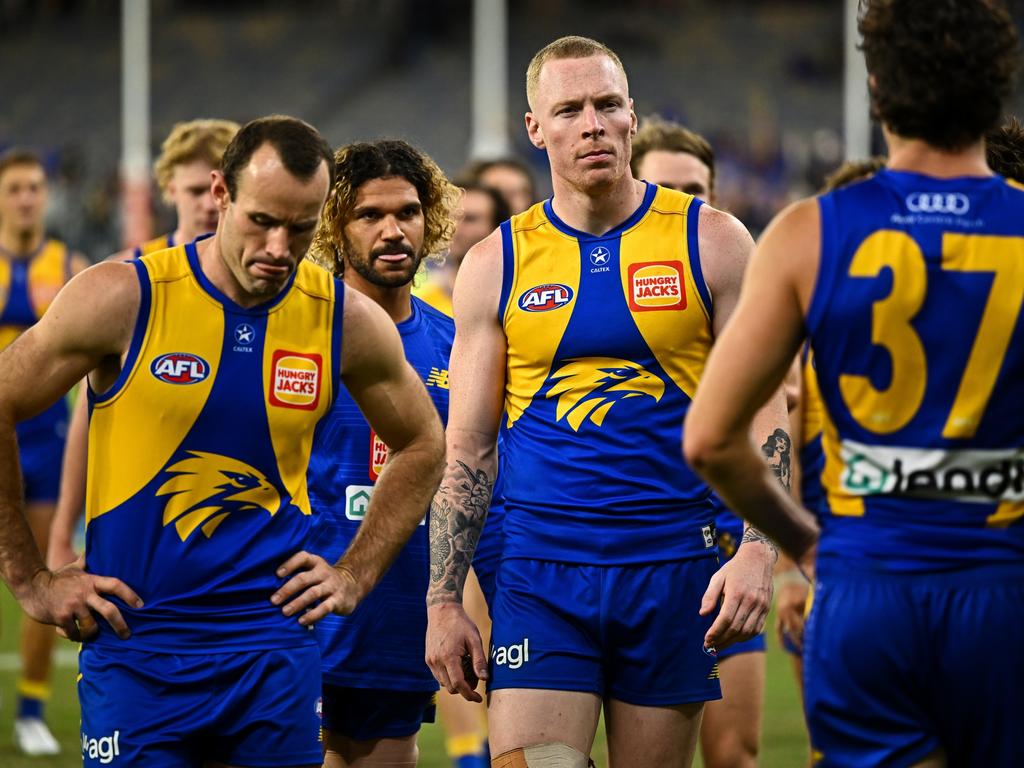
Three urgent questions now confront West Coast after yet another brutal defeat.
The first: Just how bad must things get before the Eagles view radical change as necessary?
The second: Who should make way if that change is ushered in – the embattled coach Adam Simpson, the chief executive of 25 years Trevor Nisbett, or both?
And the third: Will performance or brand damage be the catalyst for the board to act?
It was concern over brand damage that ultimately motivated the club to finally act on player behaviour after the successful – but scandal-ridden – period of 2004-2007 when the Eagles won their third flag but lost control over a section of their player group.
West Coast, who came into the expanded VFL competition in 1987 and quickly established a reputation as a club that expected success and did not tolerate failure, have suddenly become the most failure-tolerant club in football.

The fledgling Eagles of the 1980s sacked two coaches, one chairman and two CEOs in the club’s first three seasons.
Ron Alexander, the club’s inaugural coach in 1987, had won 11 of 22 games, more than any other coach of a first year team in the history of the expanded VFL/AFL. But he was sacked.
Their second coach, John Todd, made finals in his first season but was also sacked after missing them in his second.
Even sustained success didn’t guarantee tenure at West Coast.
Nisbett came to power at the club in 1998 in a brutal Eagles board room manoeuvre which saw the incumbent Brian Cook pushed out. Cook had fallen out with club powerbrokers and lost boardroom support after questioning the omission of captain John Worsfold in the 1998 elimination final loss to the Western Bulldogs. Cook and the board also disagreed on the relationship the club had with the WA Football Commission.
Nisbett had the support of those powerbrokers and had been as successful a football manager as Cook had been a CEO. The pair, and coach Mick Malthouse, had overseen two premierships in 1992 and 1994 as the Eagles quickly became a powerhouse of the AFL competition.
After Malthouse was poached by Collingwood, the ruthless assessment of club personnel continued. The late Ken Judge succeeded Malthouse but was sacked two years into a four-year contract after winning 12 and drawing one of 44 games over two seasons with a 5-17 season in 2001.
This was the West Coast way.
Win or be shown the way out.
Worsfold returned as coach in 2002, made finals in 2003 and 2004, a grand final in 2005 and won a premiership in 2006.
That premiership got Worsfold and Nisbett through three seasons of cultural rebuild when the Eagles brand was damaged by the off-field behaviour of a group of players, including former captain Ben Cousins, who had become addicted to methamphetamine and ended up being arrested, sacked by the club and deregistered by the AFL after the 2007 season.

Chairman Mark Barnaba charged Nisbett with the responsibility of overseeing a cultural overhaul. The Eagles won just 16 of 66 games and endured two 4-18 seasons – in 2008, when the club finished second last, and in 2010, when the Eagles claimed the only wooden spoon in club history.
But Worsfold did not survive 2013 when, after bringing the team back to finals in 2011 and 2012, the Eagles again slipped – this time to 13th.
In came current coach Simpson who, like Worsfold, has taken the team to one grand final loss and one premiership win over nine completed seasons. Worsfold’s team played finals eight times in 12 seasons. Simpson’s teams have played finals six times in nine seasons – although that is almost certain to become six in 10 in 2023.
But it won’t be the six out of 10 record that threatens Simpson’s tenure.
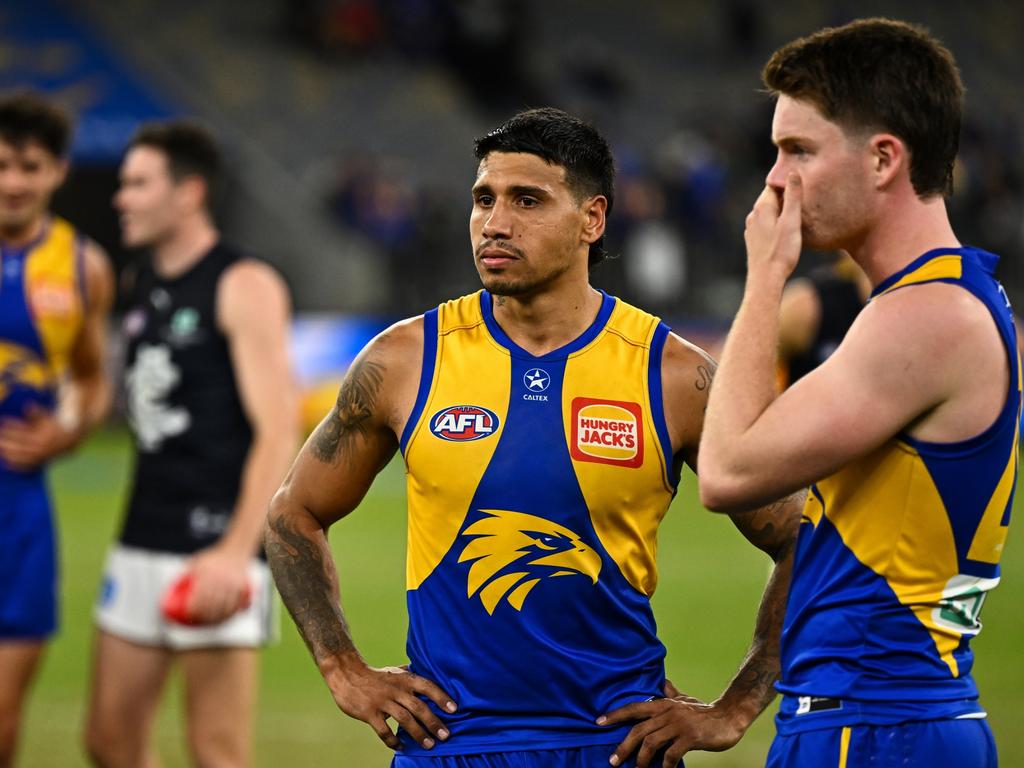
It will be the depths to which West Coast have plummeted to – and stayed at – over the best part of two seasons, culminating in the 108 point loss to Carlton at the weekend.
One former powerful figure at the club, a great believer in the Eagles’ stability over recent years, told CODE Sports on Monday that while Simpson might survive because he has a contract that runs until the end of 2024, it was time to at least indicate a willingness for change. He said he would put an end date on Nisbett’s 25-year tenure as CEO.
Put simply, he said, it was time.
It is hard to point the finger at the CEO for on field performance but the timing of Nisbett’s exit has become a maze for the Eagles board with no exit.
If they are going well, they say ‘why change now’?
If they are going badly, they say ‘we need Trevor’s experience to get us through this’.
Nisbett might be more realistic, telling this reporter over summer that if the club had another year like 2022 I would be having conversations with someone else. Namely, his successor.
Since turning for home at 8-5 and in contention in 2021, the Eagles have won just five of 37 games.
Over a similar period of time in 2009-2010, when the Eagles claimed that wooden spoon, Worsfold’s team won nine of 37 games. Judge’s team, at the back end of 2000 heading into 2001, won seven of 37.
Fitzroy, stripped back to the bare bones by the recruiting raids of wealthier rivals and in the club’s death throes at the end of 1995 and into 1996, won two of their last 37.
In that period of time, the Lions lost 25 games by more than 50 points, six by more than 100.
West Coast’s last 37 games have seen 15 losses by more than 50 points and three by more than 100.
Despite promising signs at times this season, including a round two win against GWS, the Eagles have not been closer than 40 points to a rival since the ball was bounced for the round three derby against Fremantle five games ago.
They were Covid and injury-riddled in a 2-20 2022 season.
They are 1-6 and injury-riddled now with 17 on the club’s official injured list for the Carlton match, Shannon Hurn (whiplash) and Rhett Bazzo (concussion) in doubt for this weekend’s clash with Richmond and Sam Petrevski Seton suspended.
So a lot of this is about misfortune. A lot of the injuries are contact or collision injuries beyond the club’s control.
But some of it is about misjudging the club’s premiership window after 2018, a big ticket trade for Tim Kelly in 2019 and backing in older players with great records but increasingly dodgy injury profiles.
And some of it is about trying to make up for a wasted year in 2020 when the Eagles took a poor attitude into the Covid-19 pandemic hub in Queensland after winning in 2018 and contending again in 2019.
We know now that, by the 2021 turning point, too many of the Eagles were pretty much done. But they were keen to wind up for one last shot in 2022 and were even talking a return to finals in 2023.
From a human nature perspective, it’s understandable. But in the dog-eat-dog environment of the AFL, it’s the sort of miscalculation that costs jobs.

Nic Naitanui signed a two-year contract extension last year which, in theory, would take him into 2024 even though he has not yet played in 2023.
Jeremy McGovern was deep in contract talks earlier this year. There is speculation the club has already committed to him for a further two years even though he has missed six, seven and 12 games in the past three completed seasons and will probably miss at least 12 this year with a hamstring tendon injury.
Luke Shuey, retained as captain, has missed 28 matches since the start of 2020 and will spend at least another month sidelined now with ankle/hamstring concerns.
Meanwhile, the Eagles, who have never missed finals for more than three years in a row, will almost certainly miss their third straight finals series in 2023 with little to indicate they will be back in the mix in 2024.
At West Coast’s plush Mineral Resources Park headquarters, there are five trophy pedestals.
Four have premiership cups on them and the fifth is empty.
It is a statement of the club’s expectation of itself: we will be putting something here soon.
People who are not Eagles fans will consider that arrogant but at least it is a statement about the future. In the past two years or so, the Eagles have looked like a club clinging to the past.

AFLW Phantom Draft: How the top 20 picks could fall

‘I don’t know what happened’: How Clarry found purpose again

Failed trade, TDK, hair cuts down the highway — Marshall opens up

Ken’s call: Butters’ future, Marshall move and straight-sets Crows

‘Absolutely obsessed’: Baby joy for Collingwood star Jordan De Goey
