
West Coast Eagles v Fremantle: Why the Western Derby is the most passionate rivalry in the AFL – from those who have played it
Biffs, bumps and brawls. WILL SCHOFIELD speaks to old rivals and teammates about the greatest Western Derby moments.

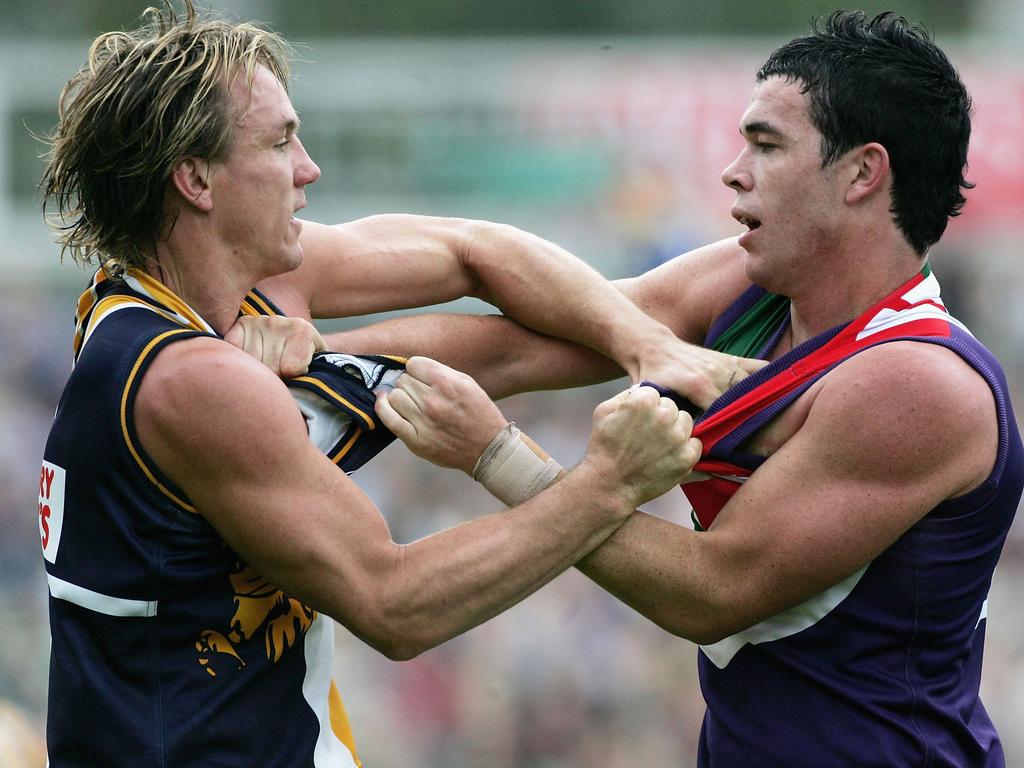
Fremantle’s chief antagonist Hayden Ballantyne describes the significance of the Western Derby succinctly: “Anyone who’s says it doesn’t mean something is full of shit.”
Fremantle’s famous maiden victory in 1999. The Demolition Derby of 2000. Ballantyne’s miss after the siren. There have been close games and blowouts, biffs, bumps and brawls. All memorable in their own unique way.
Derby 54 will look different again this weekend, with health and safety protocols decimating both sides before the first bounce. Will there be an unlikely hero? Who will step up when their team needs them most? What will be the next derby memory?
My favourite derby memory may seem strange to some.
It was Round 3, 2015. The Eagles lost.
The quarter time score read: Fremantle 9.2 (56) to West Coast 0.4 (4).
Embarrassing to say the least.
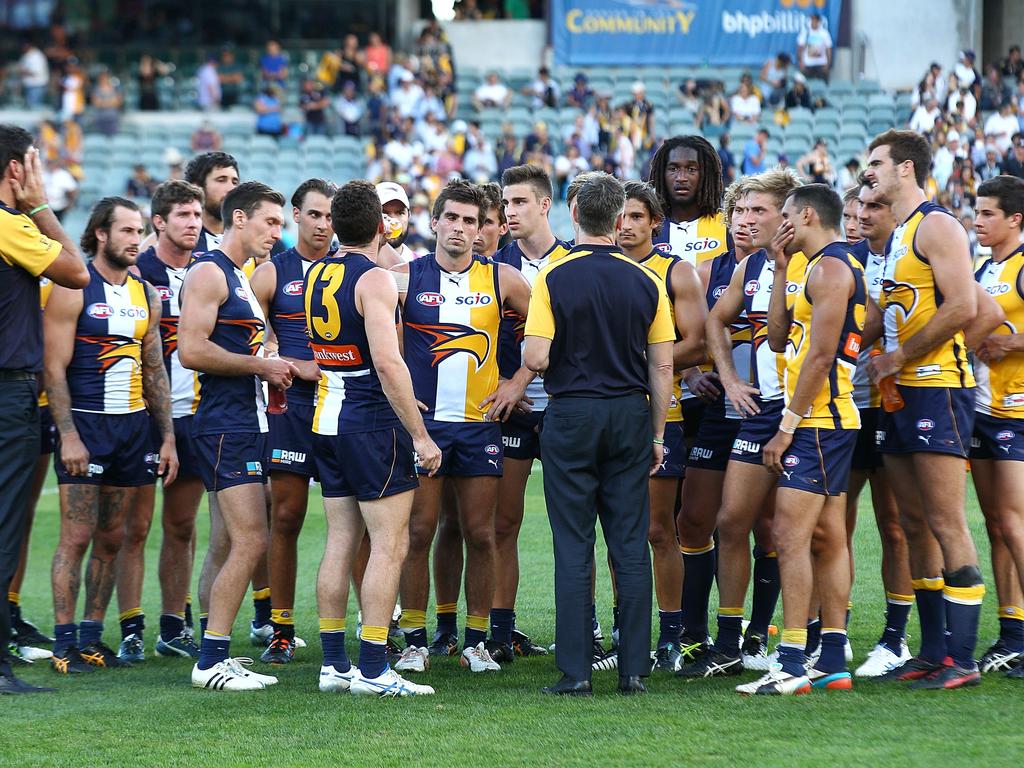
We eventually lost by six goals and were outplayed by the Dockers – not on account of their game plan or personnel, but by their aggression.
Losing the game the way we did is my favourite derby memory because it was a moment that really lit something in me; in all of us. I remember speaking to the backline group on the Monday after that game and I was fired up. Not angry, just passionate.
To that point, we had been training a certain system from the pre-season but our backline was flipped on its head when our two key defenders, Eric Mackenzie and Mitch Brown, both did ACLs in the space of three weeks.
We had to change the way we played. We wanted to be more aggressive, help and support each other in aerial contests. We wanted to play like there were more than six defenders on the field. It was the ‘Weagles Web.’
That Freo match crystallised for me what we needed to do.
Because I was the one doing the speaking, it’s tough to relay exactly what was said the Monday after the match, so I asked 2006 West Coast premiership player Sam Butler, who was in the room and he remembers the message well, to tell the story.
“Schoey said, ‘F--- this, we’re not putting all this time and effort into being more aggressive just to concede at the first hurdle [losing to Fremantle in the fashion we did.] I say we go even harder. Maybe we aren’t doing it enough, maybe we be even more aggressive. See if it works for a month?’”
It was a line in the sand moment for the team.

“So, we did,” Butler continues. “We played right off our men, didn’t even go near them – we wanted to be so aggressive that we dictated their position and where they stood.
“It just started clicking. We were really luck we had a couple of guys that could take intercept marks like they were going out of fashion [Jeremy McGovern, Shannon Hurn.] That helped us a lot. But one thing you really need when you have success is an identity. In 2015, we just thought we could be smarter and more aggressive than the other team.”
West Coast played in a grand final in 2015 off the back of the ‘Weagles Web’ and the Monday meeting after that derby loss is when it was developed.
So, thanks for smashing us, Freo!
There have been so many incredible Western Derby moments.
West Coast premiership player and life member Beau Waters never backed away from a contest in his life – and certainly not the day Fremantle targeted his teammate Ben Cousins.
“I remember the Round 18, 2007 Derby, when the Carr brothers [Josh and Matt] decided go after Cuz,” Waters recalls. “There was a massive and very expensive melee at three-quarter time – all the big names involved. It was a spiteful match but typified what a Derby was all about; win at all costs.”
He continued: “Players that tell themselves it’s only another game are delusional. It’s the closest thing to a Grand Final and, to be honest, great preparation for a final series. WA footy is built around our parochial supporters and this game is the opportunity for almost everyone to have skin in the game. Houses divided, workplaces alight, and the players itching for bragging rights.”

Before Shaun McManus was a superstar breakfast radio presenter, he could play footy, and play it well. Selected in Fremantle’s inaugural squad, McManus was co-captain of the club and the second player in the club’s history to reach 200 games.
“One of my favourite memories was the first ever derby played in Round 7, 1995,” he says. “A massive crowd at Subiaco Oval – standing there, across from the Eagles players many of whom I’d grown up watching on TV, singing the national anthem. The atmosphere was like nothing I’d been a part of before.
“I also remember so vividly the Demolition Derby – the physicality in that game was next level. We won by one point after being behind by five goals at halftime. There were plenty of reports and melees throughout the game. Despite all of that, it was actually enjoyable to play in.”
But it wasn’t all black eyes and bust-ups.
McManus’s last game was in a derby and he recalls the moment fondly.
“The fans from both West Coast and of course Freo treated me with great respect,” he said. “And I’ll never forget that.”

For Norm Smith medallist Andrew Embley, the derby is where it all began. And, in a roundabout way, it played an unlikely role in ensuring his availability for the Eagles’ end-of-season trip to Bali the following season.
“I made my debut in a derby,” Embley says. “They were great games to be a part of – as close to a final as you could get during the season, especially when both clubs were up and about. We tried to play down the fact it was a derby but, on reflection, it was a game that you wanted to win more than others and losing seemed to hurt more than any other loss.
“My fondest memory was the Demolition Derby. I think I was 18 years old. From memory, there were 18 players either fined or suspended and I was one of those. I got fined $2,000 for engaging in a melee. However, I was the only player to go to the tribunal and plead not guilty.
“I wasn’t technically innocent. Selfishly, the only reason I did it was because I needed that money to go to Bali on the end-of-season footy trip and I had no money.
“I pleaded self-defence, got off and got to go to Bali.”

Before Aaron Sandilands revolutionised the role of a big at Fremantle, there was Matthew “Spider” Burton. At 210cm, Burton had a bird’s eye view of the first Derby in Round 7, 1995 – before being literally grounded in the return clash.
“There was so much excitement around the first ever game between the two sides,” Burton remembers. “It was the first game at Subiaco for the year, with the redevelopment of the southern stand and a new playing surface, all games before that in 1995 were at the WACA. Brett Heady really turned it on and West Coast won easily.
“Derby No. 2, in the final round of 1995, was a closer affair … apparently. All I remember was going for a one-on-one against Ryan Turnbull and waking up on the interchange. Woosha [John Worsfold] strikes again! He came out of my peripheral vision and collected me with one of his trademark bumps.
“The all-in brawls and wrestling matches made headlines but the games have always been tough and hard at it.”

Paul Hasleby, a four-time best-on-ground winner in the derby, recalls the significance of the Western Derby for the Dockers.
“In a time when Fremantle didn’t play in many finals, they were the biggest games of our season,” he recalls. “My first year was the 2000 Demolition Derby, whereby Fremantle finally made a statement and stood up to the might of West Coast. To this day it is my fondest memory in football.
“Some of the midfield battles with Cox, Cousins, Kerr, Judd, Fletcher and Embley were the ultimate challenge.”
For Matt Rosa, winner of the Glendinning-Allan medal in 2012, Ballantyne’s shot after the siren remains a favourite derby memory.
“I got pinged for deliberate out of bounds – a questionable decision – on the 50 metre arc as the siren sounded,” he said. “I’d played with Ballas at Peel Thunder and had seen him kick some big goals from outside 50, so I knew he could go the journey. Thankfully it was just off target, and we got the win!”
According to a few Dockers, derby week was coined “Schammer time” during Byron Schammer’s playing career. He still feels the emotion in derbies today.

“I remember how fiery they were,” he said. “Both teams at the top of the ladder, with the best footballers in the country – huge personalities and lots of emotion.
“There was a genuine hatred for the Eagles by us and it came straight back at us by them.”
Fremantle defender Lee Spur lived with Michael Barlow, winner of three Glendinning-Allan Medals.
“One year he [Barlow] won the medal, we had a big night of celebrations and the next morning I came downstairs to find him just sitting in his jocks, having a bowl of cereal, staring at his medal, which was hung up on a nail we put in the wall for all of his medals,” he remembers.
“He turned to me and said with a smile, ‘Every Sunday morning you come down and you pray … you pray, ‘Just give us one more derby win.’
“That’s what the derby was to you as a player. You always wanted one more win and to chase that glory. The biggest day in Perth outside of the grand final.”
May the best team win today.

AFLW Phantom Draft: How the top 20 picks could fall, when bids land

Statistics over passion: Derm reveals truth behind Fox Footy exit

Late mail: The go-home concerns set to shape AFLW Draft

‘I don’t know what happened’: How Clarry found purpose again

Failed trade, TDK, hair cuts down the highway — Marshall opens up
