
Succession drama grips one of baseball’s most storied teams, the Baltimore Orioles
Baltimore Orioles owner Peter Angelos wants the team to be sold when he dies but his oldest son isn’t planning to give up control, write LINDSEY ADLER and JARED DIAMOND.

Peter Angelos, the 94-year-old owner of the Baltimore Orioles, has made it clear what he wants to happen with his team upon his death: His family should sell.
John Angelos, Peter’s oldest son and the Orioles’ chief executive, appears to have other plans.
With his father incapacitated by illness, and with a motivated suitor lurking in the background, John Angelos has indicated privately that he intends to keep the club moving forward, potentially throwing the future of the franchise into turmoil.
This wrangling over the direction of the Orioles is the latest chapter in a bitter and complicated drama that has gripped one of Baltimore’s most prominent families.
The acrimony features an ailing patriarch suffering from dementia whose wishes may or may not be heeded, an explosive lawsuit that pitted John Angelos and his mother against the family’s younger son and a controversial real-estate project that now hangs in the balance. All the while, there is another local billionaire who has had his eyes on the Orioles for many years, waiting to pounce if the opportunity arises.
At stake is the fate of a proud franchise that has called Baltimore home for the past seven decades but hasn’t reached the World Series since a 23-year-old Cal Ripken Jr. led them there in 1983.

John Angelos’s desire to hold on to the family team might have something to do with ambitions that go beyond bringing a championship to Baltimore. He envisions the Orioles’ downtown ballpark as the centre of a large, mixed-use development complex, joining the growing list of sports owners who see value in using their franchises to anchor some even loftier real estate aspirations.
Angelos says his project will focus on serving Baltimore with community facilities. In addition, there would be the usual mix of hotels, bars, restaurants, offices and apartments familiar to anyone who has visited places like the Battery, an entertainment district surrounding Truist Park in suburban Atlanta that has resulted in enormous financial success for the Braves’ owners.
Angelos and representatives from Maryland Gov. Wes Moore’s office even travelled to the Battery in March to take a look at the possibilities for a similar project around the ballpark in Baltimore.
“What I’m trying to do is create a road map — a living, breathing document for the next quarter-century,” John Angelos told The Wall Street Journal in August. “To not do that, to me, is like malpractice.”
Last week, the team took a step toward clarity — but not necessarily the one they wanted. After long, contentious negotiations, the Orioles signed a lease that could keep them in Baltimore for the next three decades.
Though announced as a 30-year commitment, the actual agreement has a giant string attached. It gives the Orioles four years to negotiate a separate deal with the state for the right to use private funding to develop the state-owned land around Camden Yards, the site of their stadium since 1992. If they fail to obtain those rights, they can opt out of the lease after 15 years.
The Orioles had initially said they wouldn’t sign any lease that didn’t give them the right to develop the land but relented following objections from lawmakers.
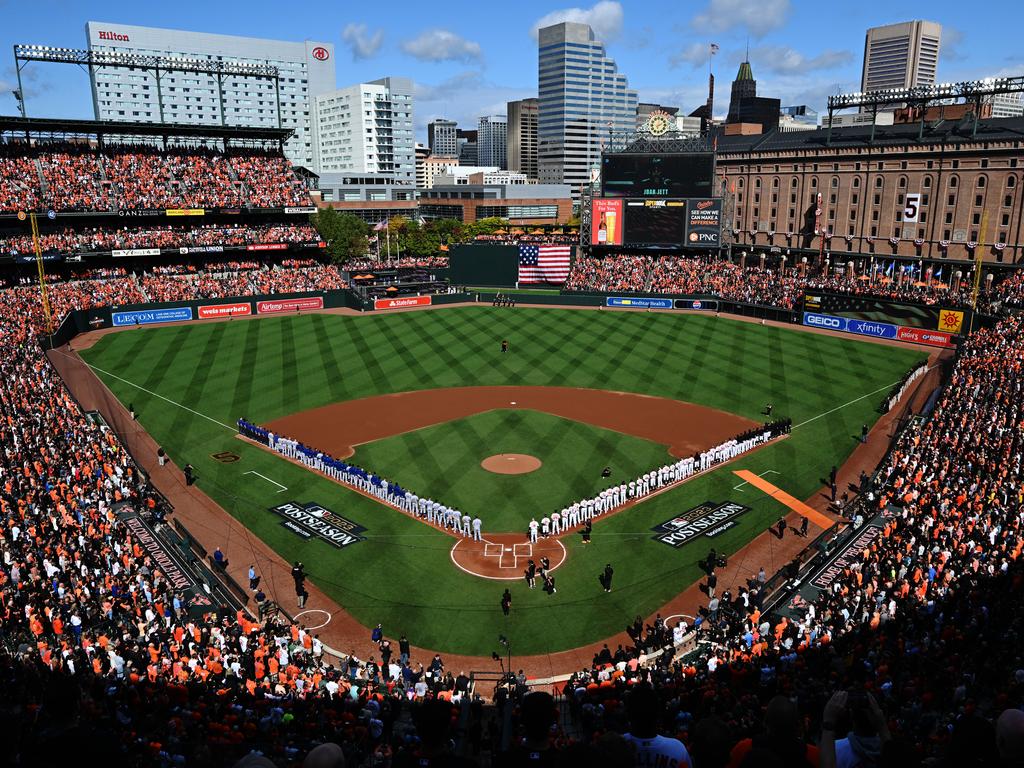
All of this means that John Angelos is positioning himself as a vital figure in shaping the future of baseball in Baltimore for a generation to come. His father, an attorney who earned his fortune representing thousands of workers in asbestos-related compensation claims, led a group of investors who bought the Orioles in 1993 for $173 million. The team John Angelos now runs is likely worth upward of $1.5 billion.
“The wealth is obviously an accident, or an opportunity of birth,” John Angelos said in August. “It’s a problematic thing, obviously, because it’s where everyone wants to be, and you are lucky to be. But then, OK, you’re gonna die like everyone else. And at the end of it, you’re gonna ask yourself, ‘What did I do with it?’”
Court filings from last year revealed that before his health problems, Peter Angelos believed his surviving heirs should sell the Orioles so that his wife, Georgia, “could enjoy the great wealth they had amassed together.”
But in an emergency phone call with Moore earlier this month, John Angelos said that the team isn’t for sale, people familiar with the matter said.
This fraught period off the field comes at a time when the Orioles appear to be entering a golden era on it. They stunned the baseball world last season by toppling the juggernauts of the sport to finish with the best record in the American League, winning more than 100 games for the first time since 1979. With a roster filled with burgeoning young stars and a farm system loaded with heralded prospects, the Orioles seem poised to compete for championships for the foreseeable future.
The lease agreement was of great relief to Orioles fans, who have long feared that John Angelos could look to relocate the team to Nashville, Tenn., where he owns a home. Earlier this year, John Angelos said, “as long as Fort McHenry is standing watch over the Inner Harbor, the Orioles will remain in Baltimore.”

John Angelos officially took over as Major League Baseball’s “control person” of the Orioles from his father in 2020, giving him full rein of the team.
As Peter’s health deteriorated, the friction within the family ramped up, resulting in a public and ugly struggle for power among the heirs. In June 2022, Louis Angelos filed a lawsuit alleging that his brother and mother conspired to push him out of the family’s fortune, including a stake in the Orioles. Georgia Angelos later filed a suit of her own, accusing Louis of wrongfully taking control of Peter’s law firm.
It was those court filings that said Peter believed the Orioles should be sold, though the decision “was ultimately Georgia’s to make.”
The parties dropped their lawsuits in February, but the revelations contained in them show that the family isn’t entirely in agreement about how to proceed with the team they own.
At least one person is ready to talk if the Angelos family is interested in selling. Investor David Rubenstein, a Baltimore native and co-founder of the Carlyle Group, has long expressed interest in purchasing the Orioles, a person familiar with the matter said. His interest burst into public view this month, when Bloomberg reported that Rubenstein was “in talks” to acquire the club.
Though nothing is imminent, the person familiar with the matter said, Rubenstein’s lingering presence caused a snag in the Orioles’ lease negotiations, with lawmakers bristling at proceeding with the team’s ownership potentially in flux. That prompted John Angelos to call Moore to affirm that the Orioles weren’t for sale.
People familiar with the matter said it is extremely unlikely that the Orioles are sold while Peter Angelos is still alive, because it would leave the family subject to hundreds of millions of dollars in capital-gains taxes. The tax burden would be significantly lessened upon his death.

Revealed: SA baseball’s top 25 young guns of 2025-2026

Cricket to implement baseball’s iconic fan catch rule this summer

Dodgers break Blue Jays hearts with World Series fight back thriller

Dodgers fans react to Harry and Meghan’s premium view

Dodgers claim victory in longest World Series game in history
