
Boom or Bust, Part II: Australia’s gold-class elite development pipeline has a shooting weakness
Australian basketball’s junior elite development is envied worldwide, yet one ‘major problem’ is obvious. In Part II of a special report, MICHAEL RANDALL delves into trends that have icons like Andrew Gaze and Brian Goorjian worried.

Australia has never had a deeper pool of basketball talent, in large part thanks to its excellent elite development pathways.
Yet the system isn’t perfect, producing one weakness that runs counter to prevailing global trends in the game.
“Shooting needs to be a focus point at state level and beyond,” history-making former Boomers coach Brian Goorjian says.
“This is a major problem and part of all the camps, part of all the development, should have that aspect to it.”
In Part II of CODE Sports’ special series, Boom or Bust, we explore how Australia’s talent pathways operate and what must be done to keep up with international rivals.
PART I: 150,000 TURNED AWAY: AUSTRALIAN BASKETBALL’S $5 BILLION PROBLEM
‘MY KID IS GOING TO THE NBA’
Dreams of making the NBA have become more tangible – with some less than desirable consequences. More parents are either trying to live vicariously through their kids, or simply seeing dollar signs, given that the NBA has a new $US76 billion media rights deal that could have top players earning $US100 million per season by mid-next decade.
“That’s a huge amount of money and so here in Australia, you’re going to have that effect where mums and dads with a five-year-old are going to go, ‘Well, my kid only needs to get a minimum contract and they could set themselves up twice’, and that’s going to put even more pressure on your club coaches, your club administrators and the officials,” Basketball South Australia CEO Tim Brenton says.
“Whether they are real or perceived, they’re still expectations. The popularity of the sport is creating those challenges for us.”
Some parents with kids playing in their club’s bottom side are complaining when said offspring isn’t selected in state teams. Basketball Queensland CEO Josh Pascoe says unrealistic parental expectations have become more prevalent.
“The kid just wants to turn up to play and have fun, and then they might develop a real ability and a potential to go to the NBA or WNBA,” Pascoe says.
“But, and I hear this from my counterparts too, the parental expectation from the start is that, ‘My kid is going to the NBA’.
“It’s become more and more like that in the sense of, ‘I pay X and we should have all of this’. Managing expectations has become a whole different situation than it was five years ago.”

PIPELINE TOWARDS PRIME TIME
Heightened parental delusion notwithstanding, the NBA, WNBA, powerhouse European leagues and rich Asian competitions are flooded with Australian talent, increasingly coveted thanks to a celebrated development system.
From the introductory Aussie Hoops for 5-10 year-olds to the preparatory Basketball Centre of Excellence at the Australian Institute of Sport in Canberra, Australia’s talent framework is envied worldwide. The pathways create smart and adaptable players, ready to transition into college or professional ball.
High-level club programs are the first step for potential prodigies, with representative basketball feeding into state teams that compete at the Basketball Australia National Championships, from U14-U20 levels.

Retaining talented female players as they reach their mid-teens remains a challenge. Several state and territory governing bodies have reported an exodus of girls around 15-16, with social factors and changing interests among the key factors.
Former Opals co-captain Jenna O’Hea, now the high performance boss at Basketball Victoria, said more work had to be done to keep girls in sport.
“We have tryouts (for state teams) and at the younger age groups, we have an excess of girls who are trying out and then, with each age group, there is less and less,” said O’Hea, speaking at last week’s Hoops Her Way’s women’s luncheon.
“Last year in U20s, we had about 70 girls come out and try for the state teams — the boys had over 200, they were sending boys away.
“It’s definitely something we need to be looking into and continuing to encourage our girls while they’re going through some changes that sport is a good and safe place for them. Sports are slowly bringing in things to help with that — we’re trying to get away from white shorts, for example, because when they get their periods it can be a thing for females.”

Cost to families is an issue at the early stage of elite development. In some cases, so is the rigidity of the system.
Basketball Australia is one of the few governing bodies that fully funds the development athletes in its system, even covering junior national team travel and accommodation to FIBA events. But Boomers icon Andrew Gaze has warned that basketball at a state and territory level must ensure costs don’t leave talented kids from lower income families lost to the elite pathways.
Junior high performance programs can cost thousands of dollars.
“We’ve just got to be cautious and understanding what the consequences could be if we price people out of it, both from an economic standpoint but also from the talent we might be missing out on because it’s cost prohibitive,” Gaze tells CODE Sports.
Meanwhile, CODE can reveal that the son of one prominent Australian basketball figure was told he would not be eligible for selection in any state team if he did not join his state’s high performance program. The teen is a high-potential talent who has a bright future, should he continue his development.
Gaze says states need to have a wide net for talent, rather than restricting selection to their own development programs.
“I do hear the rumblings that there are some who feel perhaps there is a system which, if people want to choose a different pathway to the state high performance programs, then you’re going to be blackballed from state teams and the pathway will become more difficult,” Gaze says.

There are state and national club and schools championships within the framework, and basketball schools where hoops is a subject have continued to emerge all over the country. Rowville in Victoria has produced the Foxwell boys, with Owen a member of the South East Melbourne Phoenix, while Perth Wildcats’ future Boomer Ben Henshall is out of Willeton in Western Australia. There are hundreds of similar stories.
And there has never been more access to private court hire and coaching. Retired 350-game NBL legend Adam Gibson has set up a court in a factory, while franchised locations like Hoops City have increased.
Towards the pointy end of the pipeline is the exclusive NBA Global Academy, currently home to Dash Daniels, Nash Walker, Sa Pilimai, Mading Kuany and Jongkuch Mach. Following that, there’s the Centre of Excellence.
The CoE will get the opportunity to go to another level with the Federal Government’s commitment to a $250 million facilities upgrade at the AIS, which will benefit all sports located at the venue ahead of the 2032 Brisbane Olympics. Among the plans are a new high-performance training and testing centre, a multi-sport indoor dome and new accommodation.

NBA champion Jack White, back at Melbourne United for NBL25, hails the AIS as a “professional headstart” for young basketballers.
“To have that opportunity come my way and try to maximise it every day as a 16-year-old kid, starting at the bottom of the food chain, per se, it’s an experience you need to embrace as you climb the ranks,” White says.
“You always need to find ways on how you can be effective and that’s one thing I tried to do early at the AIS, work as hard as I could, be a sponge to everyone above me, coaches, players, medical and strength and conditioning, and that’s something I’ve been able to take with me up until this point.
“Living away from home, being more independent, taking control of your day-to-day and not relying on everyone else and of course, there’s a schedule there but it’s really on you to how much you want to maximise what’s around you.
“The AIS is a big part of why I was able to take the steps I could take and feel comfortable to live overseas, go to the US for college and be prepared for that.”
There are only 13 CoE spots each for girls and boys, so what are the other options for those who fall through the cracks?
There’s the NBL Next Stars and development player route, the emergence of the second-tier NBL1 national competition, while the US college pathway features hundreds of Australians – including many in elite programs – whether they’ve been through the CoE or not.
And before the Boomers and Opals, top young Aussies compete in junior national teams. The Gems last year recorded their worst-ever finish (ninth) at the U19 women’s FIBA World Cup, while the Emus didn’t compete at the U19 men’s tournament after refusing to play qualifiers in Iran. The Sapphires lost to Spain in the quarter-finals at the recent U17 women’s FIBA World Cup, while the Crocs lost to Italy in the men’s Round of 16 despite topping their group.
Australia has thrice won these tournaments: women’s U19 in 1993 (Michelle Brogan MVP), men’s U19 in 2003 (Andrew Bogut MVP) and women’s U17 in 2016 (Ezi Magbegor MVP).

BUT WHERE ARE ALL THE SHOOTERS?
CODE Sports spoke with dozens of people in Australian basketball and nearly all held a common concern: a deficiency in elite shooting.
Veterans Chris Goulding and Dejan Vasiljevic are seen as the best pure shooters in Australia. Boomers legends Patty Mills and Joe Ingles are not the powers they once were, while Jack McVeigh filled the assassin role wonderfully for the Boomers in Paris, hitting 10-19 from deep through four appearances.
But the reigning NBL grand final MVP is 28, emerging recently through pure hard work and determination, and there’s no obvious next man up. Something needs to change in the development pathways to encourage kids to put more emphasis on the deadly art.
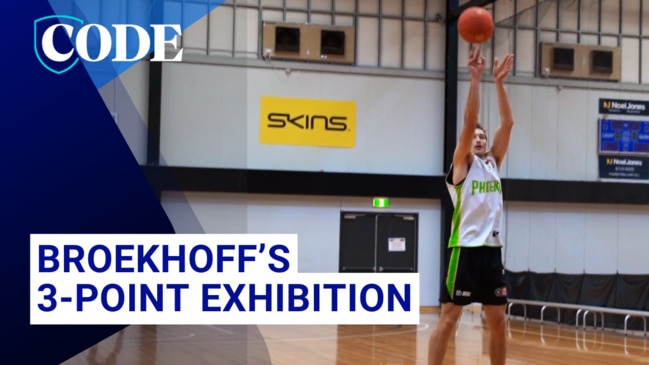
Former Boomer and Dallas NBA man Ryan Broekhoff is one of the finest shooters Australia has produced. In eight of his 10 pro seasons, he shot better than 39 per cent from the three-point line, including two for the Mavericks.
Broekhoff says incessant highlight reels of one-on-one isolation plays and high-degree-of-difficulty shots have lured the new generation to flash rather than fundamentals.
“I guess how the pros play now, kids feel like they’ve got to have the ball in their hands to be effective and to be seen, and everyone just wants to be able to create and make shots off the dribble,” Broekhoff says.
“That role play – run the corners, come off screens – it’s not as flashy, it’s not as high profile, and it’s a different training that I don’t think a lot of kids focus on anymore.
“When I was coming up in juniors, we spent so much time practising our form shooting, practising moving off the ball, and shooting off movement and catching and shooting.
“I feel a lot of kids in a lot of training today, you’ve got a ball in your hand the whole time, can you play pick and roll, can you create your own shots, you know, get in your bag, that garbage term I don’t like.”
Broekhoff says he made peace with his specialised game as a youngster. He believes others could reap the benefits of such pragmatism, not to mention the Boomers.
“A lot of kids have dreams and aspirations of being that No.1 guy and being someone like Josh Giddey,” Broekhoff says.
“I ran into guys a lot more talented, a lot more skilled than I was and I knew if I didn’t have that (specialist) elite skill, I wouldn’t have been able to have a career like I had.
“You can create a long career for yourself having a specialty skill that you can rely upon that’s at a different level than everyone else around you, and it will create opportunities and keep you in a basketball job.
“Finding a young kid who embraces that role and becomes the next great shooter will really help our national program. There’s some incredible talent coming through and guys who can do so much, but it might take someone recognising that and really leaning into that role.”
Goorjian acknowledges that the lack of deadeye shooters was a problem for Australia at the 2023 World Cup and to a lesser extent this year’s Olympics. When Slovenia surrounded NBA star Luka Doncic with a group of knockdown three-point shooters in Japan last year, the Aussies were made to pay every time they tried to double-team him.
“If you asked me where was our biggest deficiency? It was shooting,” Goorjian tells CODE Sports.
“Coming out of the worlds and out of the Olympics, and where the game’s going – the three-point line, small ball and the spacing – shooting becomes a really important skill and we’re behind there.”
Goorjian says it’s an issue rooted in players’ formative years.
“It’s interesting, since I’ve gotten home from Paris I’ve been doing clinics and it (shooting) is a major discussion point,” Goorjian says.
“I did a clinic at Manly, I had 100 kids and some were really good, talented kids. But a lot of them shot the ball funny. (Long-time assistant) Billy Tomlinson and I were talking about it on our way home.”
Goorjian says Australia needs some surgery from a Shot Doctor — the nickname made famous in the US by Fred Vinson, who is credited with improving young Boomer Dyson Daniels’ range and stroke.

However, Gaze says he is concerned that BA may have taken a one-size-fits-all approach to game style, in a bid to emulate NBA play. A key criticism of the Boomers’ Olympic campaign, including from Goorjian himself as his team exited in the quarter-finals, was an excess of isolation ‘hero ball’.
“I am a little fearful from the message that I hear from the direction of Basketball Australia coming from their coaching authorities,” Gaze says.
“I hope we don’t get stuck into one design or a way in which we want to play and teach the game and say, ‘Well, we’re just all about developing players to play in the NBA. This is the way they play in the NBA, so this is the way you have to coach and this is the way you have to teach, and these are the hard and fast rules about what you’ve got to do’.
“We are limited in our progress if we’re going to have a blanket or national policy on how the game should be taught.
“Of course, there are some fundamentals that are non-negotiables, but I have been a bit alarmed at some of the information that I’ve heard — from people who I trust — that we are directing coaches to coach and play and use language in one way only and, if you don’t do that, then you’re looked at in a way that you’re not supporting what they (BA) want to do.
“Five-out, lots of iso, read and react, don’t run a cut, don’t run any structure or have limited structure, you got to let them make their own way … I’m not opposed to that, that’s OK, that’s great, but if someone else is demonstrating another way to do it, don’t ignore it.
“The beauty of the game is the way in which it can be played in so many different ways. Don’t think that one is better than the other, keep an open mind.
“Let’s not legislate style of play. Let’s encourage and accept and, you know what, coaches and players, they figure it out.
“Trying to imitate world’s best practice is a good goal to have, but trying to become world’s best practice is a more inspiring goal.”

Airtime Scouting’s Michael Houben believes the negativity toward Australians’ shooting ability might be skewed by the fact that our best-known players aren’t known for their prowess from deep.
“Perhaps the premise is distorted by the fact that some of our best current talent at the NBA level (Ben Simmons, Giddey and Daniels) are considered suboptimal shooters,” Houben says.
“By all means, we have some great ones — McVeigh, Vasiljevic, Goulding, and at the college level Reyne Smith — but it certainly does feel like, on examination of the wider breadth of our talent, we do fall below average in this area.
“Big or athletic youth players still often get pigeonholed or fall into the trap of leaning into their overwhelming athletic gifts, instead of focusing on becoming an all-round talent that can scale up to higher levels.
“If you look at the Boomers right now, our best shooters were generally those who were more physically limited, and our more physically gifted ones were more limited as shooters.
“Perhaps we have shooters, but not shooters that possess the physical qualities to play at the game’s highest levels.”
New Indiana Pacer Johnny Furphy may prove Australia’s next great marksman. Tall, rangy and with all the hallmarks of an elite shooter, the Melbourne-born 19-year-old is the poster child for Aussie development.
Something of a late-bloomer, Furphy first made Victoria’s Navy second squad in 2022, then the top team the year after. He’s been through the NBA Global Academy, CoE, and took the US college route with a season at Kansas.
The Pacers pounced with pick No.35 and he now gets a chance to develop his shooting in an NBA system while still a teenager. If he continues to make strides, he’ll be a lock for the 2027 FIBA World Cup and 2028 LA Olympics.

US COLLEGE HOOPS BOOM
In a bygone era, Basketball Australia would discourage young female talent from heading to the US to play college ball, with the intent to keep them in the country playing in the WNBL.
That all changed when Opal Alanna Smith was deciding her next step in 2014-15. There was very little information available for those wanting to make the leap to the NCAA, which set former NBL man Darren Smith — Alanna’s dad — on a personal mission.
His research landed a young Alanna — a key figure in the Opals’ Paris bronze medal run — at Stanford; founding what is now BA Pathways, a program that helps young Australian girls and boys navigate the recruiting process and find opportunities at US colleges.
“The college pathway is becoming more of a realistic opportunity for more Aussie juniors because they’re seeing kids going there and having success and through the media it’s becoming more aspirational than it was 10-15 years ago,” says Darren Smith, now a Tasmania JackJumpers executive.
“There’s probably about 100 new Australians each year and we estimate there’s just over 400 total Aussies in the collegiate landscape. We have Aussies in all different levels in the US, scattered across the entire country.”

For so long, a “free ride” was a scholarship that allowed players to attain a college degree while playing ball. But the dawn of name, image and likeness (NIL) payments in the NCAA has opened the door for college players to also be well compensated.
One source estimates that Alex Condon — who has a standing commitment to Collingwood, should he go down the AFL path — could earn as much as $US350,000 at Florida this season.
“We go to all the BA National Championships, U16-18-20, and we provide education sessions for all the athletes and parents on the eligibility requirements and the process,” Smith says.
“What we can do is really help the athletes understand what level their talent might (translate) to in the US, in the entire collegiate landscape, and then we try to connect those athletes to those programs and coaches, make an introduction and kind of advocate on those athletes behalf.
“It comes down to an individual choice. Some athletes are a lot better staying home being with their family, and still do unbelievably well and make it to the highest level. Ezi Magbegor and Izzy Borlase, as an example, never went to college but made it to the Olympics and the WNBA.”

WHO GOT NEXT?
With just 10 Next Star spots up for grabs in the NBL each season, they’re hot property for the best Aussie and international talent. The program allows each team to contract one young player identified as possessing NBA potential.
It has been a roaring success, producing 12 draft picks since 2020, including No.2 pick Alex Sarr out of the Perth Wildcats this year. At least two Australians — 222cm Rocco Zikarsky in Brisbane and elite Sydney everyman Alex Toohey — will suit up as Next Stars in NBL25. Boomers star Josh Giddey opted to be a Next Star in Adelaide rather than attend US college and went at pick No.6.
But for every LaMelo Ball, Giddey or Sarr, there’s a Terry Armstrong, Nikita Mikhailovskii or Tom Digbeu, dumped before the end of their contract or simply unable to meet pro standards. In that respect, it’s a ruthless risk/reward pathway for both the player and club.
NBL champion Tasmania just axed remarkable teenage talent Roman Siulepa before he’d even appeared in a JackJumpers’ jersey, given the 18-year-old wanted to continue playing GPS rugby in Brisbane. He’ll likely join another team but got an early taste of merciless professionalism.
Below Next Star calibre talent, NBL clubs can sign up to four development players aged under 25; WNBL teams, two. These players may be deemed ready to learn but not contribute as pros; or too young for college but in need of a home before heading to the US; they might be returning from the NCAA, or they may already have been on a pro roster previously.

Take young Brisbane guard Kye Savage. A star for Tasmania, Savage spent a short period in the US with CBU Lancers, returned home, joined the CoE and is now a development player with the Bullets. It can take time for a young player to find their feet – Savage is still just 19.
Olympian-in-waiting Nyadiew Puoch spent a season as a development player, helped Southside Flyers to this year’s WNBL title and was snapped up by Atlanta Dream in the WNBA draft.
Current Illawarra Hawks big man Mason Peatling joined Melbourne United as a DP in 2021, after four years at Eastern Washington, and was elevated to starting power forward when star Jack White ruptured his Achilles. He went on to man the frontcourt alongside Jock Landale in United’s last NBL title run.
“As a development player, it’s more about being involved in a high-level environment and seeing other people go about their business,” Peatling says.
“So when you become a professional … you see what someone like Jock Landale does on a daily basis, what Chris Goulding does, or Scotty Hopson and these guys, they all operate extremely differently.
“The development player program has that edge in terms of, you are around elite talent, but there are only 40 spots and teams don’t throw them away to just anyone.”

SECOND-TIER TO STARDOM
The second-tier NBL1 competitions — North, South, East, West and Central — are for both men and women who don’t immediately make the college or NBL/WNBL cut. They are run by state and territory basketball bodies, though the NBL has played a key role in their marketing over the past few seasons, with noticeable results.
Of the 100 players in the NBL last season, 67 had played in NBL1, while dozens of WNBL stars – including the great Lauren Jackson and Waverley national champion Rebecca Cole – have torn up the second tier this year.
“You see some incredible players in the Boomers and Opals squads who have played in the NBL1. Will Magnay for the Boomers, Amy Atwell got a call up to the Opals squad and I remember seeing her play so well in the NBL1 Finals last year in Perth,” NBL chief executive Dave Stevenson says.
“It allows those players to play all year round, it gives them a financial return and also, what we love, it really connects the elite to the community.
“Jack (McVeigh) has progressed through college, NBL1, NBL and gone onto the national team and now into the NBA.
“I think it shows there are incredible pathways that, say a kid who plays for Knox Raiders starting out in juniors, they can actually see how that pathway can move all the way to the NBA.”
Yet it’s a pathway only for the self-disciplined.
“If they were to go through the NBL1 route, the only thing that’s lacking in that environment is that it’s not a daily elite training environment,” Darren Smith says.
“They only train a couple of times a week, most programs don’t have strength and conditioning programs and they don’t have dietary support in place. So it’s up to the athletes to navigate that themselves, whereas college has all that stuff and they train everyday.”

Sobey unstoppable as Phoenix topple the Breakers

Bitter NBL break-up: Trez says Sixers deserted him

Titans battle rivals for back-to-back Darwin Basketball titles

Came to play, want to stay: NBL imports set to join Aussie Bryce

New era for NT Basketball after dramatic vote
