
Analysis: How simple play struck gold for Denver Nuggets stars Nikola Jokic and Jamal Murray
Nikola Jokic and Jamal Murray broke all sorts of records to help Denver win game three of the NBA finals. ROBERT O’CONNELL unpacks why the duo is such a formidable force.

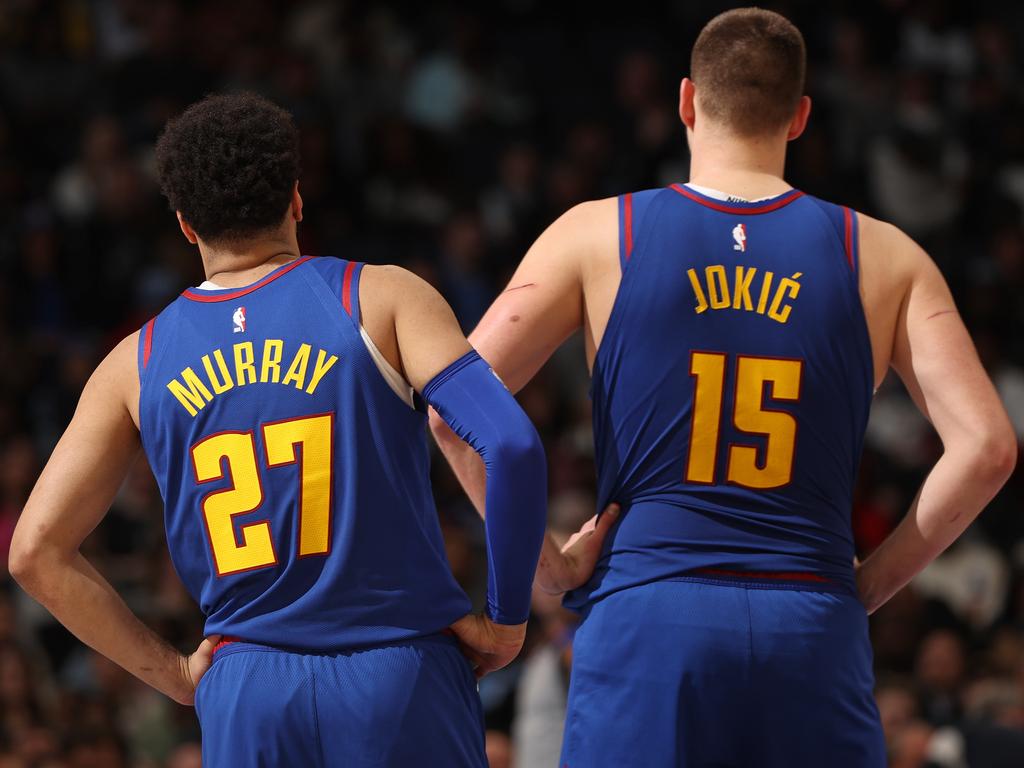
Describing the interplay between Nikola Jokic and Jamal Murray presents the same challenge as stopping it: it’s built on a language all its own. “They know how to communicate with each other without even speaking, just reading and playing off of each other,” Denver Nuggets coach Michael Malone said recently. “No matter how you guard that, there’s a counter to it.”
In Wednesday night’s Game 3 of the NBA Finals against the Miami Heat, Denver’s two-time-MVP centre and its combustible point guard had a historic conversation. Jokic put up 32 points, 21 rebounds and 10 assists, the first such line in the more than 70-year history of the Finals; Murray tallied 34, 10 and 10. They became the only teammates ever to register matching 30-point triple-doubles in any NBA game as the Nuggets won 109-94 to take a two games to one lead.
“I don’t care,” Jokic said postgame. “It’s just a stat.”
Nikola Jokic in the NBA Finals
— Kevin O'Connor (@KevinOConnorNBA) June 8, 2023
33.3 points
14 rebounds
9.3 assists
61.5 2PT%
44.4 3PT%
85.7 FT%
First player in Finals history with a 30/20/10 game tonight.
Jokic: “I don’t care. It’s just a stat.â€
pic.twitter.com/VRzFL4jLnU
More impressive than the numbers was how they were compiled, via the most common play in basketball. Over and over, Denver ran a pick-and-roll: Jokic hauling his broad shoulders into the path of Murray’s defender, Murray dribbling quickly around.
That simple action led to limitless offshoots. Jokic stepped into the lane or backtracked beyond the 3-point arc; Murray shuttled him passes for push shots or jumpers. A Miami player snared himself on Jokic’s elbow; Murray leapt and fired. The panicked Heat defence swarmed Jokic as the ball arrived, and he tapped it along to where a third teammate had snuck, wide open, to the rim.
“It’s not really X’s and O’s,” Murray said. “It’s just reading the game and trusting that the other is going to make the right play. If he throws it to me, he knows and expects what to see from me, and he knows the mood I’m in.”
The pinnacle, on a night with many qualifying moments to choose from, may have come early in the third quarter, in which Denver pushed a five-point halftime lead as high as 19. Murray manoeuvred around a screen, and both of Miami’s best defenders, Jimmy Butler and Bam Adebayo, rushed to double-team him. Sensing that his teammate was unmarked, Murray whirled a pass to Jokic, who faked a shot, strolled past an out-of-position Adebayo and tossed in a layup. In the space of three seconds, what looked like a trap had transformed into a bucket.
“It’s not an easy task to do,” Butler said of stopping the pair. “If we want to win, we are going to have to figure it out.”
In the context of the series, Wednesday’s game was a bounce-back for Murray, who matched his second-lowest scoring output of the playoffs in a Game 2 loss in Denver and left what would have been a tying 3-pointer inches short. Malone said that Murray had blamed himself disproportionately for the Nuggets’ first home defeat this postseason.
Considered on a longer scale, Wednesday represented a delayed pinnacle. The most recent postseason Jokic and Murray appeared together, in the 2020 post-Covid bubble in Florida, they put the rest of the NBA on notice, losing to the eventual champion Los Angeles Lakers in the Western Conference Finals. Then Murray tore his ACL the following April, and without him the Nuggets lost in the second round of the playoffs.
Last spring, there was hope that Murray might return for the postseason, but Denver erred on the side of protecting the then-25-year-old, understanding that his reactive game wasn’t something to fast-track in a few practices before the most important juncture of the season. His absence led to a first-round departure.

“It wasn’t there. He wasn’t ready,” Malone said last week. “We weren’t going to push him.”
Murray, who meditates between games, has said that his mindfulness practice helped him stay patient during a drawn-out rehabilitation process and a slow start to his return season. “Life is going to happen. Stuff is going to happen,” Murray said. “Just got to keep the mental fortitude to bounce back in whatever it is, and stay strong. This too shall pass — it goes for everything, negative and positive.”
As much as his spring-loaded ankles or the any-angle accuracy of his jump shot, that mindset explains Murray’s rapport with Jokic. The centre seems to see and weigh every possibility on a basketball court; the guard reacts to whichever option his teammate picks out. Together, the two turn a rote formula into an impossible riddle. Choose what to stop, we’ll take what’s left.
“A lot of guys play with each other,” Malone said Wednesday. “I think those two guys play for each other.”
"We're running out of things to say."
— Joel Rush (@JoelRushNBA) June 8, 2023
-Jamal Murray on Nikola Jokic:
"He grabs 21 boards and everyone's talking about he can't jump... 30 points, and people say he don't wanna score...
How many times does he have to do that for you guys to believe in his game?" pic.twitter.com/aezRoXPsvV
The statistics, try as Jokic might to disregard them, become more historic by the day. Jokic and Murray combined for 11 assists to one another on Wednesday — 4 from Jokic to Murray, 7 vice versa — bringing their tandem total for the postseason to 111, according to Stats Perform. No other duo in NBA history has managed more than 96 over a playoff single run.
Maybe the only point of disagreement comes when the two players evaluate one another. “He’s our best player,” said Jokic last month, after Murray made six 3-pointers to lead the Nuggets to a win in the conference semi-finals against the Phoenix Suns.

Days later, Murray called Jokic’s case for MVP — he finished second to Philadelphia’s Joel Embiid this season — “self-explanatory.” Murray expanded on his thoughts Wednesday night. “His touch, his creativity, his no-look passes, his IQ — I could go down the line,” he said. “He’s a special, special player.”
Whether or not Jokic and Murray can get their internal rankings straight doesn’t much matter. Every time one of them has the ball, the other knows where it’s going before anyone else in the arena can guess. It doesn’t take a word.

Aussie NBA stud brutally axed amid injury hell

LeBron’s crazy 18-year record snapped

‘It ain’t about the $’: Simmons on his NBA return

‘Run, run, run’: NBL’s ‘entertaining’ pace of play a big coup

Stacked 36ers land former NBA wingman in major signing coup
