
Sacramento Kings v Golden State Warriors playoff series sums up modern NBA
In the opener of their first-round playoff series, the Sacramento Kings and Golden State Warriors put together a 15-second sequence that summed up an entire NBA season.
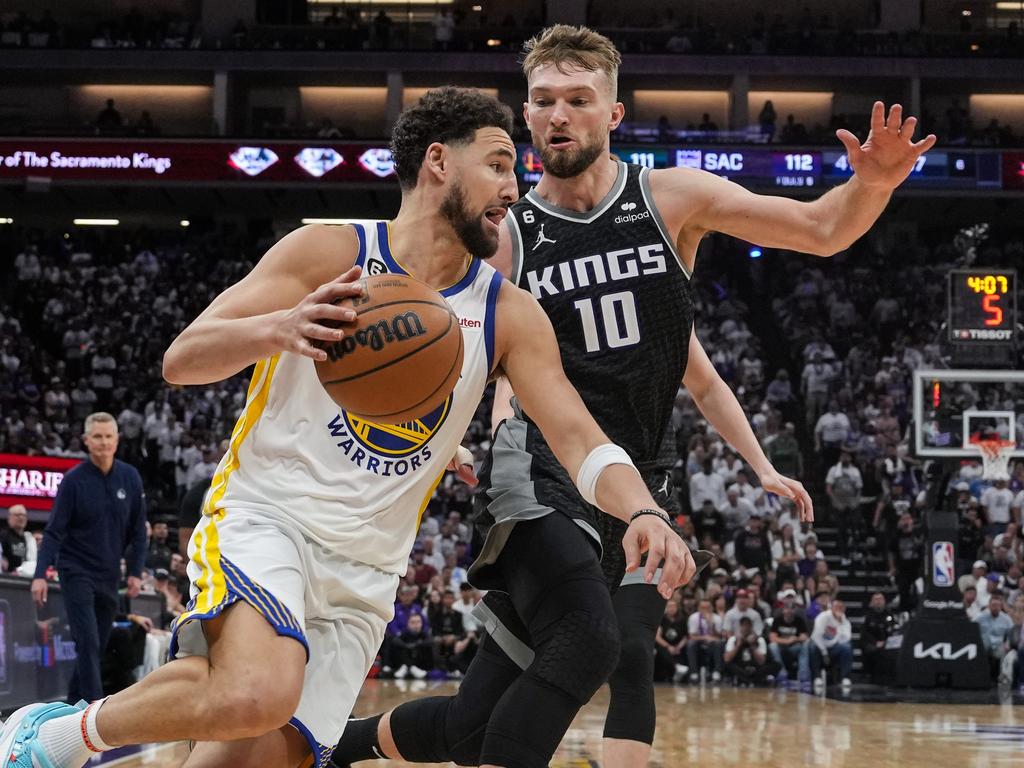
In the opener of their first-round playoff series Saturday night, the Sacramento Kings and Golden State Warriors put together a sequence that summed up the NBA of 2023 — a season in 15 seconds.
With just over four minutes remaining in a one-point game, Golden State’s Stephen Curry caught a pass at the deepest corner of the court and dropped a 3-pointer over the corner of the backboard, flipping the lead. Kings guard De’Aaron Fox immediately sped down the floor, caught a pass on the wing and tossed in a triple of his own to get it back.
Sacramento held on to win Game 1, 126-123, behind 38 points from Fox. It was a fitting, thrilling start to a series that likely will say as much about the state of the sport as the two teams playing in it.
By nearly every meaningful measure, the just-completed regular season featured the finest-tuned offences in NBA history. According to effective field-goal percentage — which weighs the relative value of 3-pointers and twos — players shot at the best rate, 54.5%, since the NBA’s introduction of the 3-point arc in 1979, according to Stats Perform. The average team scored 112.1 points per 100 possessions, also the highest mark ever recorded.
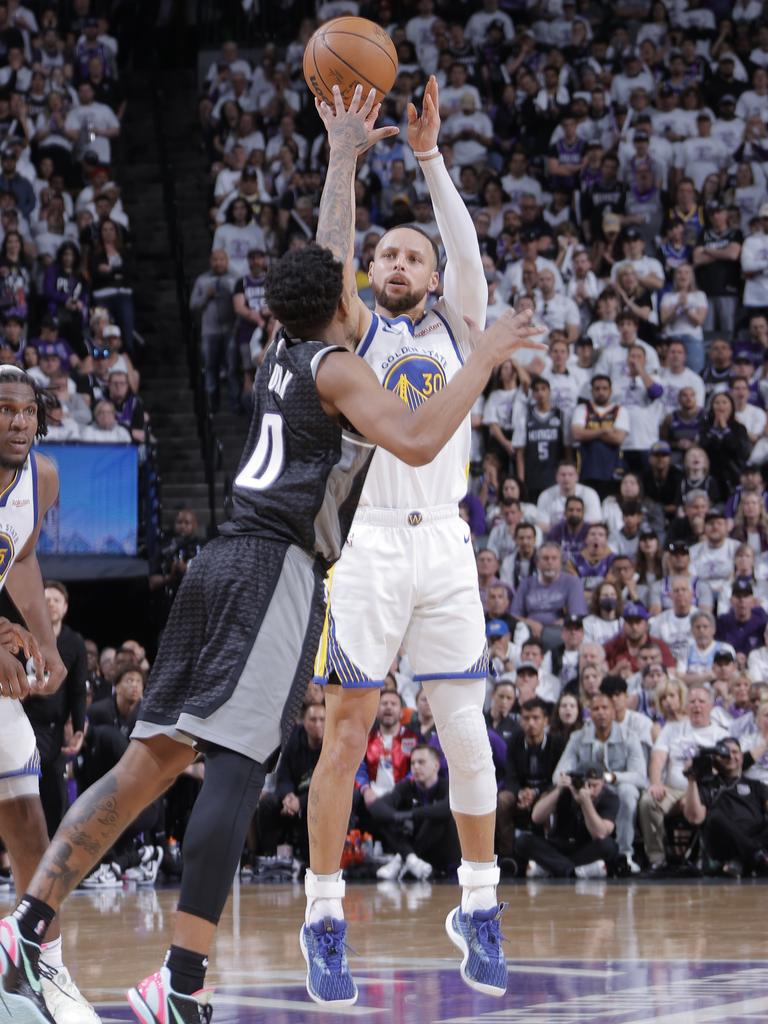
Where did all of these points come from? One way to answer the question is in terms of the aggregation of well-established trends: teams learned the value of the 3-pointer, players trained to access that value and a sport that was once built on driving toward the rim reoriented itself toward hunting pockets of space along the perimeter.
Another way is to look at the factors at work in what figures to be the playoffs’ point-richest first-round matchup. The Warriors reimagined basketball over the last decade. This year’s Kings, who built the NBA’s most efficient attack ever this season, clearly took notes — and added some explosive flourishes of their own.
The far-reaching influence of Golden State is embodied in Mike Brown, the Kings’ first-year coach. Brown began his head coaching career with the Cleveland Cavaliers, during LeBron James’s first stretch with the franchise, and then moved on to Kobe Bryant’s Los Angeles Lakers. Brown’s teams tended to be rugged, defence-first outfits that relied on James’s and Bryant’s playmaking to keep them afloat on the other end.
In 2016, he took an assistant role with Golden State, where he stayed for six seasons, filling in for Kerr when Kerr missed time with back ailments and Covid-19. “I learned a lot from Steve, I really did,” Brown said in October, before a game against his former club. “Obviously, everybody can say when they’re younger and they get older they’re are better. But I feel like I’m 100% a better coach, mainly because of that man.”
Brown emphasised that many of the lessons he drew from Kerr had to do with building and sustaining a collaborative culture, the work that you can’t put on a whiteboard. But in a Sacramento offence that scored 120.7 points per 100 possessions this season — the most in NBA history — the passed-along X’s-and-O’s are visible.

Across four championship runs, the Warriors’ bedrock has always been the interplay between Curry and Draymond Green. Curry is, by reputation and record book, the best long-range shooter in NBA history, but he’s no less a maestro at finding ways to unleash that talent, sprinting sideline-to-sideline and swerving around screens. Green, part-power forward and part-point guard, is his ideal collaborator, knocking defenders out of Curry’s path one play and finding him with a cross court pass the next.
In 2014, when the Warriors hired Kerr, playing this way meant turning basketball norms on their head. A team couldn’t win a title relying that heavily on jump shots and getting that little from traditional interior play, the thinking went — until, at the end of Kerr’s first season, they did.
Try to trace every bit of Golden State’s influence and you’ll never stop scribbling; it’s in the increasingly deep 3-pointers Damian Lillard launches in Portland and the point-centre methods Nikola Jokic is free to use in Denver. Few teams apply the core principles as directly as this year’s Sacramento club, though.
“Mike B. knows us well,” Curry said in the lead-up to Saturday’s game. “We know him well.”
Brown’s favoured offensive tactic inverts the court in Warriors-like fashion. The core strategy brings Domantas Sabonis, a 7-foot-1 centre who otherwise dislodges defenders near the rim, to the crest of the 3-point arc to orchestrate the offence. This allows Fox space to speed into the lane while Sacramento’s shooters dance a Curry-esque ballet, curling and cutting around Sabonis, who picks them out with passes thrown by either hand.

According to the player-tracking database Second Spectrum, Sabonis has executed the most “handoffs” — close-range flips that let him pass the ball and screen simultaneously — over a single season since tracking began. Kevin Huerter made 99 shots taking handoffs this year, and rookie swingman Keegan Murray made 52. (Curry, by comparison, made 55 such shots.) Like Green, Sabonis is a rare frontcourt player who leads his team in assists per game.
Speaking to reporters on Thursday, Kerr sounded as if he suddenly empathised with the teams that have scrambled to defend against his offence for the last decade. “The way they put the puzzle together with Sabonis at the top of the key with all the shooting … is really, really tough to handle,” Kerr said.
If the Kings pull more directly from the Warriors than other teams do, they nevertheless demonstrate how a once-disruptive basketball ideology has become the game’s dogma. Skeptics of the Warriors’ strategies once wondered how they’d work without two of the best marksmen in league history — Curry and Klay Thompson — making them look smart.
The tactics have held up. For all of their talent, the Kings have no certain future Hall-of-Famers on their roster — at least, none that can be identified yet. The new basketball has proven it doesn’t just optimise all-time players. It also maximises the output of merely good ones.
On the floor Saturday night, the game gave off the heat of a simmering rivalry between one team that cracked basketball’s codes and another that picked up its signals.
“Keep shooting the ball,” Brown exhorted his team during a time-out. “Keep shooting it, and let it fly.”

Aussie NBA stud brutally axed amid injury hell

LeBron’s crazy 18-year record snapped

‘It ain’t about the $’: Simmons on his NBA return

‘Run, run, run’: NBL’s ‘entertaining’ pace of play a big coup

Stacked 36ers land former NBA wingman in major signing coup
