
Self-oop: The unstoppable slam dunk move that’s taking the NBA by storm
This NBA season, some of basketball’s biggest stars are finding new players to pass to: themselves. The results have been spectacular, writes ROBERT O’CONNELL.
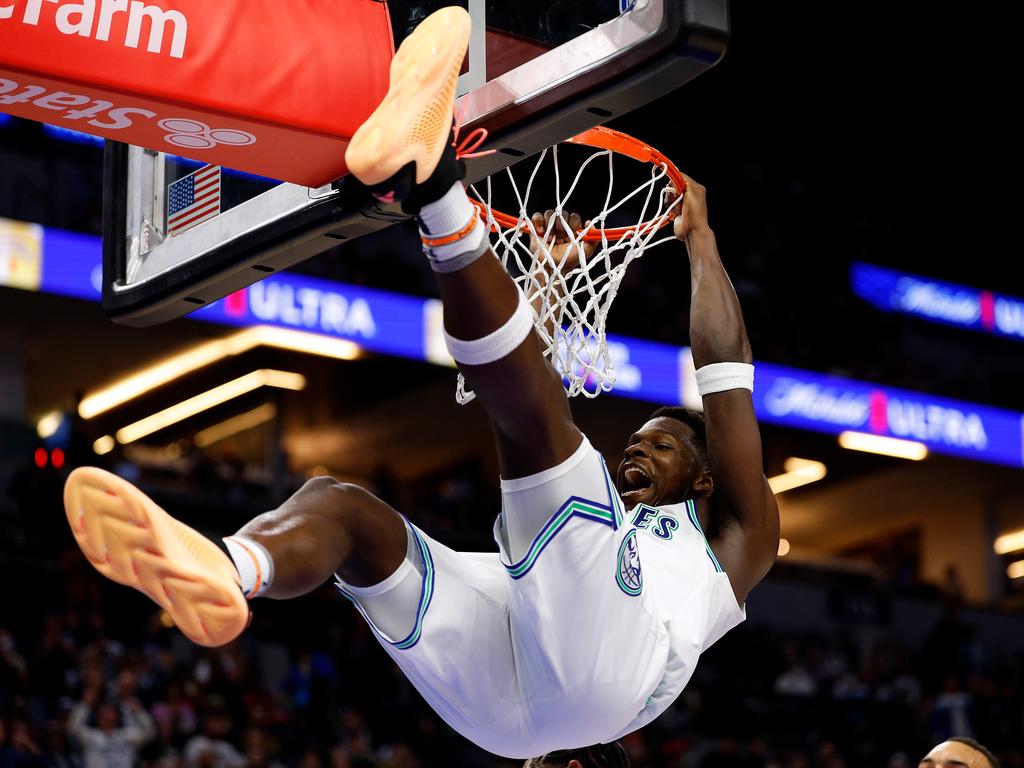
Anthony Edwards was stuck. The Minnesota Timberwolves’ star guard had a defender draped all over him, with four other sets of eyes tracking his every move. His teammates were covered, the clock was running down.
So Edwards passed the ball to the one player on the court he knew he could trust.
Himself.
In a January game against the Memphis Grizzlies, Edwards lobbed the ball up and off the backboard, raced after it, and slammed it through the rim with a two-handed dunk. It was a thrilling sight, an audacious display of athleticism and ingenuity.
But the most remarkable thing about Edwards’ maneuver was that it wasn’t unique. Across the league, this technique—let’s call it a self-oop—is becoming a go-to move for the NBA’s top players.
In past generations, the self-oop was reserved for pregame warm-up lines or no-defense All-Star games. Now it’s evolved into a legitimate strategy, for those bouncy and clever enough to pull it off. Edwards said that necessity—and a deep memory bank of hoops highlights—inspired his attempt.
“I was looking for somebody, and nobody was open,” Edwards said. “But I’d seen somebody do it in an All-Star game, so I was like, ‘I’m gonna try it.’”
ANTHONY EDWARDS ARE YOU KIDDING 😳
— Minnesota Timberwolves (@Timberwolves) January 19, 2024
âï¸ Â» https://t.co/adpbBYDQ4Tpic.twitter.com/Slhm57U20Y
The very next evening, Philadelphia 76ers star Joel Embiid paid homage, tossing the ball up from the free-throw line and chasing it down for a dunk. “I saw it last night,” Embiid said of Edwards’ jam. “I said, ‘If he can do it, why can’t I do it too?’”
Turning to the self-oop in a meaningful game is not unprecedented. Kobe Bryant made use of the maneuver. LeBron James did it when the stakes were highest, in back-to-back NBA Finals in 2017 and 2018.
But this season represents a high-water mark. Two prominent rookies, the 7-foot-4 Victor Wembanyama and 7-foot-1 Chet Holmgren, have pulled off the move, reaching their improbably long arms over stunned defenses.
One player has even used the self-oop to create three points instead of two. Last week, Indiana Pacers guard Tyrese Haliburton put his own twist on the concept, pinging the ball back to himself to attract the attention of the defense before tossing it out to a teammate for a wide-open 3-pointer.
ARE YOU KIDDING?!
— Indiana Pacers (@Pacers) February 11, 2024
Tyrese Haliburton goes off the backboard to himself and hits Pascal Siakam for three 🤯 pic.twitter.com/NSEp48PVFX
What has brought the self-oop to the forefront isn’t style but strategy. For all its razzle dazzle, the maneuver is tactically sound and, in the right situation, nearly impossible to guard against. It uses a crowding defender’s momentum against him, and flips a disadvantageous position into a head start. Couple the on-the-fly geometry with a top-flight vertical leap, and what looks unlikely to succeed, at first glance, becomes unstoppable.
That doesn’t mean it’s easy. A few days after Edwards’ January slam, the Boston Celtics’ Jaylen Brown tried to mimic it. But he flubbed the pass, and the ball rolled out of his left hand.
In more disciplinary eras of basketball decades past, the self-oop might have presented a risk to players like Brown: If it didn’t pay off, he’d find himself glued to the bench.
“Unequivocally, the old school would have thought, ‘Oh, this isn’t a serious basketball play,’” said Doris Burke, an NBA commentator for ESPN.

Tom Crean, who coached Edwards during his one season at Georgia, couldn’t recall his former player ever having used the move in college. Whether Crean would have scolded Edwards for trying it would have depended on one thing: “Did it work or not?”
“But the way he did that, it made all the sense in the world, if you look at it,” Crean said of Edwards’ dunk. “It was not a flippant move. It was a creative, quick move…You’d rather great players have errors of commission, where they’re trying to make plays, than omission.”
The move also arrives at a time when mutual influence seeps through the sport at a faster rate than ever. It is no surprise, said Burke, that the self-oop has proliferated quickly among stars in the Instagram era.
“In this day and age, when highlights become the vehicle for this generation to see and understand the game, it’s all at your fingertips,” Burke said. “So you watch it one night on your phone, and then you try it on the court the next day.”

The self-oop has helped restore the dunk’s status as one of the most exciting plays in the game. In the heyday of soaring superstars—from the 70s and 80s of Julius Erving to the 90s of Michael Jordan and the 2000s of Bryant and Vince Carter—the slam was the sport’s exclamation point, a cue for an arena to start roaring. The arrival of Stephen Curry and the onset of an analytical age, though, changed things: the 3-pointer became the sport’s most valuable, and most celebrated, shot.
You can trace the slam’s dwindling stature through the NBA’s annual dunk contest, held during All-Star weekend. In decades past it attracted A-listers: Dr. J, Dominique Wilkins, Jordan, Bryant. Now it is mostly the terrain of little-known players looking to make a name. Last year, Mac McClung—who had spent most of the season with the Delaware Blue Coats of the developmental G League—took home the crown.

If the self-oop has brought dunking back, it has also introduced a challenge to the NBA’s stat-keepers. Does the scorer deserve an assist? Should he be dinged for a missed shot preceding the made one?
More Coverage


For now, official box scores acknowledge no assists on the plays; they get marked down on the stat sheet as buckets like any other. But they’re more than that: plenty fun, and maybe the future.
“That was an at-the-park move,” Holmgren said after his version. “It just happened, it’s not like I was like, ‘I’m gonna do this.’ But I saw it, the play was there, and I made it happen.”

Aussie NBA stud brutally axed amid injury hell

LeBron’s crazy 18-year record snapped

‘It ain’t about the $’: Simmons on his NBA return

‘Run, run, run’: NBL’s ‘entertaining’ pace of play a big coup

Stacked 36ers land former NBA wingman in major signing coup
