
Shifting furniture to setting culture: Why Boomers stars consider kit man Junior Viranatuleo as family
Two Olympics, two World Cups, Comm Games, shifting furniture and car washing. Meet the humble Queenslander Patty Mills dubs the “backbone” of the Boomers, who Joe Ingles had to have alongside him in the NBA.
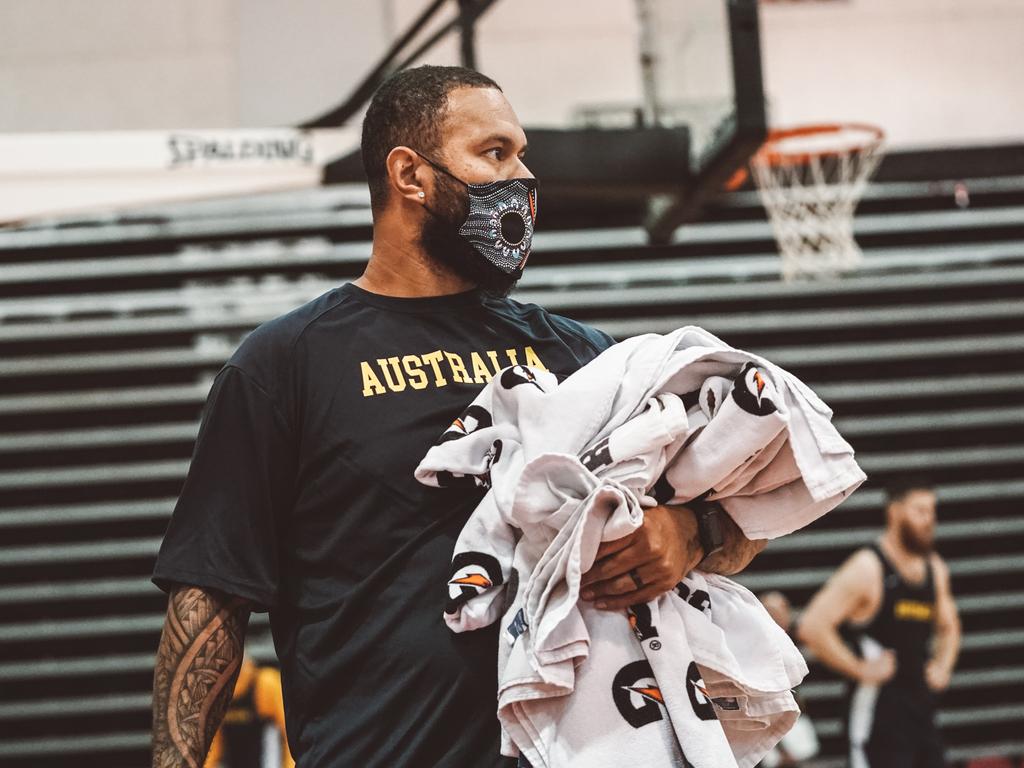
Patty Mills describes him as the “backbone” of the Boomers.
Joe Ingles says he has been “lucky to have him by my side”.
And yet chances are you’ve never heard of him.
Like Mills, he has been a significant figure in establishing the Boomers’ culture before and during the Tokyo Olympics, but his name is seldom found in Australian media reports. Like Ingles, he is a beloved member of the Utah Jazz, but he is unlikely to be stopped for autographs on the streets of Salt Lake City.
What’s more, his story could be straight out of a Hollywood movie.
The one-time furniture removalist who made it to the Olympics and the NBA. The ex-rugby league player who became a beloved member of the Australian and US basketball communities. The kid from Mareeba, a small town of 11,000 in Far North Queensland, who has found a home amid the bright lights and big egos of the world’s best basketball competition.
This is Albert “Junior” Viranatuleo’s story.
And it’s a beauty.

‘Take the call’
It’s 2am in Tokyo. The Boomers have just arrived at the athletes’ village ahead of an Olympics campaign in which they hope to make history. The players, weary after a long flight, head for bed.
Junior gets to work.
After moving 80 pieces of luggage to their respective rooms, Junior pushes through the jet lag and works into the early hours of the morning, executing the plan agreed to with Mills at the start of the Olympic campaign.
“I plastered that whole corridor of our section of the hotel with the Australian and Indigenous flags, quotes [from] influential Australians and our own team,” he says. “That made a difference in the village. The water polo team, who were staying at the other end of the corridor, woke up and were blown away. They knew the Boomers had arrived.”

He continues: “I spoke to Pat and he said, ‘Junior, you’re going to set the culture: I want flags, quotes, signage reminding us who we are as Australians.’ We did it in Vegas, we did it in LA – every place we went to.
“The only time the [Australian] music stopped was when Coach was speaking. Pat wanted everything to be about Australian culture so people knew we meant business.”
Many athletes with the global stature and eye-watering bank balance of Mills don’t pay much attention to the equipment manager. But Mills, in yet another of his cultural masterstrokes, made Junior the centrepiece of the Boomers’ entire Olympic campaign.
Everything was thought through, no detail or expense spared: from the music, to the messaging, to the décor that adorned their practice facilities and hotels. And at the centre of it, the man pulling it all together, was Junior, the Boomers’ ‘glue guy’ and spiritual sixth man.
“Junior has been the backbone of the Australian Men’s Basketball Team for a number of years, providing essential support for the staff, team, players and families,” Mills says. “Junior’s work behind the scenes is what holds our team together and has had an enormous effect on our team culture as well as our ability to win a bronze medal at the 2020 Tokyo Olympics”.

The feeling is mutual. Tears stream down Junior’s face when asked about Mills, his impact on his life and his role in bringing home ‘rose gold’ in Tokyo.
“I’m lost for words to talk about Patty Mills,” he says. “[He] carries all three flags with a purpose to represent everybody. Despite what we have going on at home, it was always more than basketball. His presence allows you to be the best at what you do.”
The long-awaited Olympic medal was an emotional occasion for Junior, but more was to follow. On the third day of quarantine upon returning to Australia, he received a 7am phone call from Ingles. Half asleep, he considered screening the call, but picked up at the last.
“Mate, your phone is going to ring in 10 minutes,” Ingles said. “Utah are calling. Take the call.”
It was a life-changing call. Utah offered Junior the role of Jazz equipment manager.
“Because I worked with their head trainer at the last World Cup and he loved the way I worked and took care of things, they asked for my CV,” he recalls. “And [they] indicated that because I work around high calibre Australians and know how to cater for their needs – the job was mine if I wanted it.”
He accepted.
“I’m so excited that Junz got the opportunity to be with the Utah Jazz, he has earned this chance to work at the highest level,” Ingles says. “I’ve been lucky to have him by my side for massive wins and losses over the last few years and I’m pumped I get to now work with him every day as well as with the Boomers.”
And Mills?
“He and his wife dropped the phone screaming with excitement,” Junior says. “They were in Hawaii and their joy brought a tear to my eye. They just wanted me to be blessed.”

Three jobs, one dream
It might’ve all worked out quite differently had it not been for a footy injury.
Junior grew up around Australian basketball royalty in Mareeba, but hoops wasn’t his initial calling. “Nate Jawai and Aron Baynes, we all went to the same school and played rugby league,” he says. “The only thing that took me to basketball was to get out of the heat and play inside in the cool.”
League brought him to Sydney, where he played with Newtown and Souths and earned a call-up to the Fiji national team. But injury struck. Two dislocated shoulders ended hopes and dreams of a footy career. He decided to head back north.
On the way, he stopped by Brisbane and met a representative of the Southern Districts Spartans basketball side, ‘Big Joe’ Tertzakian. “My fitness was alright due to rugby [league], and because they knew of me [from] being in Nate’s crew, he offered me a spot in the team,” Junior remembers.

And what a team it was. His teammates included Chris Goulding and Adam Gibson. Game time was limited but the bonds forged were permanent. So when Junior’s shoulder dislocated again, Tertzakian’s thoughts immediately turned to how to keep him around the team.
“Big Joe said, ‘Would you be interested in helping me with game night?’ So I laid out the towels, filled up water bottles and that was my new role,” he continues.
Tertzakian couldn’t have known it at the time, but his decision set in train a chain of events that would ultimately take Junior to the Olympics and the NBA, with a few stops in between.
“He embodies the values of trust, respect, humility and loyalty from the day I met him,” Tertzakian says. “Junior is the most selfless person I have ever met. He always puts others first, he loves serving people and making people smile.”
After the Spartans, Junior landed a role alongside Joey Wright at the Gold Coast Blaze in the NBL. “Junior has a way of bringing a team closer,” Wright says. “More like a family and not just a team. Once you witness his countless acts of kindness, you can’t help but do the same. I have witnessed this at every team I’ve worked with him at.”
As much as he enjoyed the role, it alone wasn’t enough to pay the bills. Junior worked three other jobs concurrently in addition to his role at the Blaze, keeping the lights on as a furniture removalist while also maintaining an events gig and a car wash business as well. “Three jobs and working in basketball was so tough to make work,” he says.
But work it did, and it would prove serendipitous. Around this time, the Boomers organised a training camp in Southport ahead of the 2012 Olympics. Junior was invited to help out, his first touching point with the national team.
“The ops manager said, ‘Junior, I’m going to take you to the 2012 Olympics’,” he continues. “He said I was ‘unofficially officially’ on the squad. Which meant I didn’t have accreditation to get in the venue, but I could get in and out to set up and pack up.”

And that’s how it all started. Since then, Junior has worked with the Boomers at two Olympics, two World Cups, a Commonwealth Games, Asia Cups and numerous other games. But nothing has topped the experience of Tokyo.
“As soon as [Brian Goorjian] hit the floor, it was like we had this puzzle that has been spread out for years, and as soon as he opened his mouth it connected and created this beautiful picture,” he says. “When he spoke, we listened and you could hear a pin drop.
“The big part of this tour was culture. It was about being an Australian, about being a mate, about enjoying your basketball but it was more than basketball.”

Life with Donovan, Rudy and co
So, what’s life like with the Jazz?
A lot of washing, organising, making sure everyone from Donovan Mitchell to the assistant coaches have what they need, when they need it, to give the team the best chance of success.
And there’s plenty of counting, too. For example, when players sign jerseys for fans at the end of a game, Junior is taking stock and monitoring who returns to the locker room without a top on. A replacement is promptly arranged.
The player who gives his gear away most is Mitchell, the holder of a whopping $US163 million contract and a superstar of the game. Money hasn’t swayed his perspective or appreciation, though.
“He has this thing where he comes out, super humble and just wants to show gratitude,” Junior says. “He understands his position in the game and how to bless people. There’s a presence about him that’s so relaxed.
“He’s about the fans. He will grab a basketball off the rack, sign it and give it to a fan. We keep an eye on him and we see him sign a jersey and then we tick off on the list and know how many he’s got left. Not everyone gives them away – but he likes to bless people.”
Life in the same orbit as Mitchell and Rudy Gobert can seem surreal at times – “You see Rolls Royces, Ferraris and Lamborghinis parked and you’re like, ‘Damn!’” – and his mates back home are desperate for details.

“Friends and family say, ‘Oh you’re working with Donovan and Rudy and Jordan [Clarkson]’ but … we respect their platform and admire it,” he says. “Being able to separate that from work is important.”
The perks of the job aren’t half bad.
There’s a dedicated Jazz chef.
And there are clothes. Lots and lots of clothes.
“I took two bags of my own clothes which I thought would be plenty,” Junior says. “I had to bring them back. Utah have ‘Jazz Casual’, ‘Jazz Travel’, ‘Jazz Work’, ‘Jazz Game Day’ – four suitcases of clothing for me to wear. I thought, ‘What the hell am I going to do with all of this!?’”
Utah also surprised him by sending him home for Christmas to be reunited with his wife and daughter. “I didn’t plan to come home over Christmas – they told me to head home and have time with my family who I haven’t seen in months,” he continues. “This speaks volumes of the coaches and staff and [how they are] focused on the wellbeing of their team.”

The Ingles family have brought Junior into their home in Utah, which helps deal with the time away from his own loved ones in Australia. “Whenever I talk to people, they hear the accent and ask if I am related to Joe Ingles and I just say yes because he will always be family,” he says.
Joe and Renae feel the same.
“Junz is part of the family and we are stoked to have him here in Salt Lake City as part of the Utah Jazz,” Joe says. “He is an asset to the organisation, and our family unit.”
All in all, it’s a long way from the days of working three jobs to keep a basketball dream alive.
And for that, Junior is grateful.
“My mates say to me now, ‘Hey remember when you would call me from Melbourne saying you’re driving to Sydney and asking if they wanted cash work to move furniture?’” he says.
“It’s a blessing to be a part of it. At the end of the day, it’s about taking care of everybody – coaches, players, staff and fans – everyone has to get a taste of this experience. It’s about giving someone else an opportunity to experience what I’m lucky enough to do.”

‘Rugby’ fears loom over marquee clashes after 36ers-United foul-fest

Overtime heartbreak extends United’s losing run

Bitter NBL break-up: Trez says Sixers deserted him

Came to play, want to stay: NBL imports set to join Aussie Bryce

Beat The Coach: Who replaces Bryce Cotton in NBL fantasy?
