
Martin Samuel: Cult of Bazball lets England hide all their sins and pass blame for Ashes failure
Bazball is the ‘unscrewable pooch’ shielding England’s beaten cricket team and its part-time morality from accountability in this Ashes series, writes MARTIN SAMUEL.
When Tom Wolfe wrote his 1979 book The Right Stuff, about the first Mercury space programme, his research took him to Edwards Air Force Base in Kern County, California. There, he found the men who would comprise many of the United States’ first astronauts: military test pilots.
It was their job to take the nation’s fighter jets to the limits of endurance. Faster, higher. This was developing technology and incredibly dangerous. At the time, a pilot in the US Air Force, perhaps engaged in battle, had a 23 per cent chance of dying in 20 years’ service. This rose to 53 per cent for test pilots. Every family around Edwards lived in fear of the sound of a distant explosion, and the solemn appearance on the doorstep of a grave commanding officer accompanied by the base chaplain.
Faced with such frequent reminders of mortality, and the sheer randomness of tragic events, Wolfe discovered the test pilots steadfastly refused to blame the role played by flawed machinery. Each death, they ascribed to pilot error, banishing thoughts of a Mach 1 lottery. They called those fatal mistakes “screwing the pooch”.
Yet when the space programme began, such was the public desire for heroes that nobody would countenance human error. The second mission – Mercury-Redstone 4 – ended in partial failure when the landing capsule’s exit hatch unexpectedly blew as it floated in the ocean before pick-up, causing water to flood into the interior, with the pod then lost. There has always been conjecture over whether the astronaut, Gus Grissom, lost his nerve and detonated the hatch early, fearing the craft would sink with him in it, or whether, as he claimed, the mechanism simply failed.
Anyway, it didn’t matter. No one wanted to embrace the narrative of a panicking hero. Grissom returned to wide acclaim and received a medal for bravery. Those left behind at Edwards declared that the space mission was the unscrewable pooch. Whatever went wrong, it could never be your fault.

We’ve got an unscrewable pooch this summer too. It’s called Bazball. If you lose, you act and talk as if you’ve won. If you lose again, you act and talk as if you would have won, were it not for some despicable act of cheating that, inexplicably, seems to have found its way into the Laws of the game. You know, like the time Diane Abbott wrote a note that was meant to sit there being harmlessly antisemitic in draft form on her computer, yet somehow made its way on to the letters pages of The Observer and ended her career. Don’t you just hate it when that happens?
“Funny thing, the other day,” the psychiatrist Niles Crane tells his brother in Frasier. “One of my patients had a rather amusing Freudian slip. He was having dinner with his wife and he meant to say, ‘Pass the salt’ but instead he said, ‘You’ve ruined my life, you blood-sucking shrew.’” Cricket’s lawmakers might feel similarly embarrassed. They meant to write: “Once you’ve played your shot, feel free to have a wander, it really is nobody else’s business where you end up. Maybe take in a show.” Instead, they wrote: “The ball shall be considered to be dead when it is clear to the bowler’s end umpire that the fielding side and both batters at the wicket have ceased to regard it as in play.” And as the word batter is used, not batsman, it means that Law was amended by MCC as recently as September 2021.
So if they had wanted to make the dead-ball call a matter for the batting side alone, that was the time to do it. Someone should inform the members of MCC of this oversight, as it appears to have passed them by. And was the ball ever dead? It’s calculated to have been in wicketkeeper Alex Carey’s hands for 0.86 seconds. If Ahsan Raza, the standing umpire, can make a call on what is dead in that time, maybe he should be in a space programme too.

Anyway, back to Bazball, the cult of which is hiding a few sins at the moment. Pat Cummins, Australia’s captain, was pilloried after the second Test for appearing to jest in the face of so much English indignation. Asked a leading question about whether he would tell a player to bowl underarm – as the Australia captain Greg Chappell famously did when New Zealand needed six off the last ball to secure a tie in a one-day match in 1981 – Cummins replied in kind. He made a gentle joke about it depending how flat the pitch was. More fury.
Yet he could have pointed out that Australia sent in Nathan Lyon with all the mobility of the post-duel Black Knight in Monty Python and the Holy Grail and he still scored more, or as many, as three of England’s top five. Lyon lasted 25 minutes, the same as Zak Crawley and Ollie Pope combined. He survived 13 balls – four more than Crawley and Harry Brook put together, or the same as Brook and Pope. Might that not have been a contributing factor to the defeat, as much as a single judgment call, which fell squarely within the rules of engagement?
“An Englishman thinks he is virtuous when he is only uncomfortable,” George Bernard Shaw wrote. And there is plenty to be uncomfortable about if the nation pulls too roughly at that golden thread marked Spirit of Cricket. Ollie Robinson, a player once taken out of England’s squad for historical racist remarks on social media, telling Usman Khawaja – the only person of colour in the Australia team – to “f*** off, you f***ing prick” at Edgbaston. Awkward, at least.

Of course, after Lord’s, Stuart Broad wrote a very fair column about Sunday’s events saying he thought a senior Australia player should have persuaded Cummins to withdraw the appeal as Jonny Bairstow was plainly not trying to gain an advantage. It’s a valid point. Maybe one day Cummins will concede with time and distance he might have acted differently. That is what England’s head coach, Brendon McCullum, did when, playing for New Zealand in 2006, he ran out Sri Lanka’s Muttiah Muralitharan, after he left his crease prematurely to congratulate teammate Kumar Sangakkara on making a century. Later, McCullum expressed remorse. Quite a bit later, actually; it was at a Spirit of Cricket lecture in 2016, so we’re talking ten years. Maybe come 2033 and aged 40, Cummins will have more perspective too.
Missing from Broad’s article, however, was any reappraisal of his decision not to walk when very obviously caught at slip during an Ashes Test in 2013. Inexplicably the standing umpire, Aleem Dar, missed it, and Australia had used up all their reviews. That’s the best that can be said: Australia blew it, through overappealing, and paid the price. It was not Broad’s job to cover for their mistakes, or that of Umpire Dar. Yet where’s the Spirit of Cricket there?
Broad being out was far more cut and dried than the Bairstow call across 0.86 seconds. Isn’t it, really, that what goes around, comes around? As scientists probe and prod David Bowie’s alien in The Man Who Fell to Earth, he holds no grudges. “We’d have probably done the same to you, if you’d come round our place,” he tells them as they doom his planet to drought and desolation. Yet we can’t see the equivalency.

Now, any shift from the avowed nobility of Bazball will be excusable as tit-for-tat against the unsporting Australians. That unscrewable pooch again. We’re even making excuses in advance for all manner of hostility from the Western Terrace at Headingley on the grounds the visitors have brought it on themselves.
And, look, the Australians are often no better. After the 2013 incident, Broad ran in at Brisbane with the Gabba, in its entirety, calling him a wanker. It made the Long Room look like a tea party, which, let’s be honest, most weeks it is. Yet the point remains that England have got very lucky so far. They played the last day at Edgbaston like a frog being boiled, seemingly unaware of the change in temperature until it was too late; and at Lord’s the narrative around Bairstow’s dismissal has been allowed to obscure another one that got away.
As someone who is also trying to reinvent significant defeats as victories in the eyes of the public, one can see why Rishi Sunak is so desperate for association with sexy cricket. He, too, needs an unscrewable pooch, or to be judged on more than results. “The prime minister wouldn’t want to win a game the way Australia did,” a spokesman sniffed on Monday. This from a man who didn’t even have a view on one of his predecessors being banned from parliament for 90 days, just in case it upset a dwindling idiot cabal of loyalist headbangers. Very ethical.

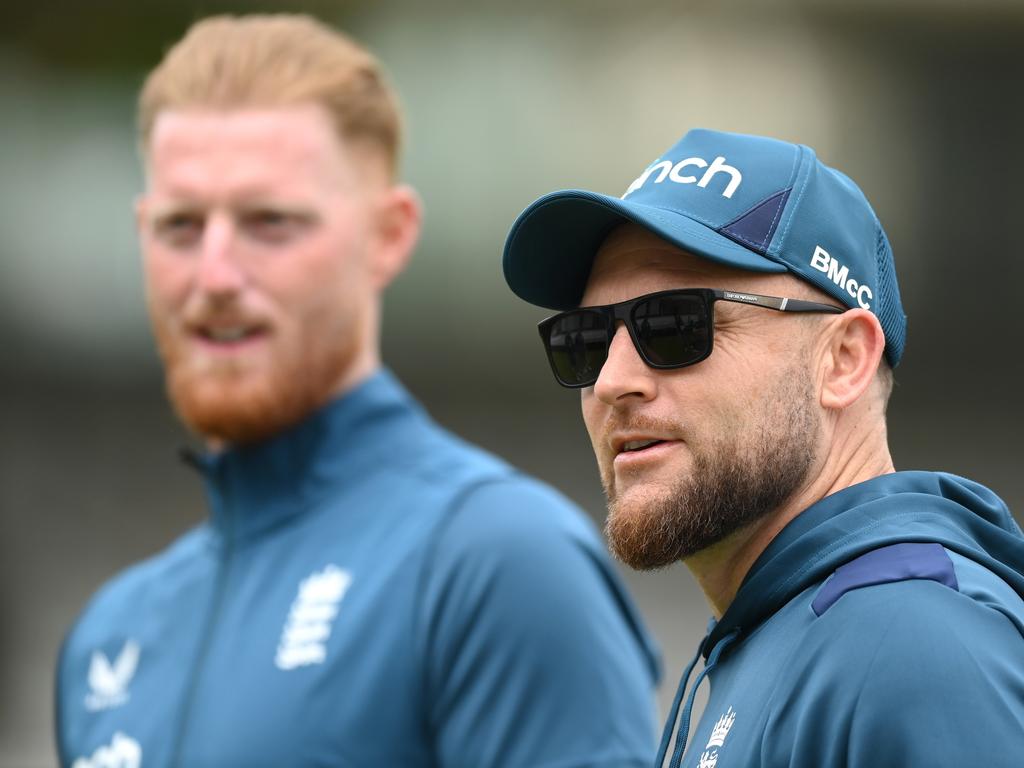
Meanwhile, McCullum and his team’s brilliant, hugely admirable captain, Ben Stokes, have both spoken since Sunday of the need to make noble, moral, decisions, safe in the knowledge the dilemma was not theirs. Yet when Stokes’s bat, diving for home, inadvertently diverted Martin Guptill’s throw for four overthrows in the 2019 World Cup final, could he have asked for those runs to be struck from the score, purely in the interest of fairness?
True, it would probably have gifted the trophy to New Zealand but it would have been a decent act, acknowledging that the consequences of a fortuitous, unintended deflection were wholly disproportionate. Yet Stokes has never expressed a moment’s remorse, nor have those now fiercely invoking the ephemeral Spirit of Cricket. And nobody cheated, nobody broke any rules. England got lucky and New Zealand didn’t complain. But it does illustrate how easy it is in part-time moral England to talk scruples, when those scruples aren’t going to be tested.
Two friends are walking down the street. “If I had two houses,” the first muses, “I’d give one to you. And if I had two cars, I’d give one to you.” “What if you had two bikes?” his mate says. “You bastard,” the first friend says, “you know I’ve got two bikes.”
Originally published as Martin Samuel: Cult of Bazball lets England hide all their sins and pass blame for Ashes failure

Contract calls: Who’s in, out in Cricket Australia shake up

How Australia will avoid repeat of England’s embarrassing Ashes failure

The truth about Stokes v McCullum and why Bazball survived brutal review

CA ignores English cries, doubles down on pink-ball Ashes Test

‘Get us home’: Ashes hero’s plea as Iran crisis traps cricket stars
