
Brendon McCullum and Ben Stokes proving two of cricket’s greatest troubleshooters
Increasing squad form and a lessening reliance on Root reflect the fruitful problem-solving skills of England’s coach and captain.
When the Australia batsman Steve Smith was in his pomp a few years ago, Justin Langer, his head coach at the time, described him as “the best problem-solver in the game”. Whatever was thrown at him, whether different conditions or different strategies, Smith always seemed to come up with a plan and then a successful solution.
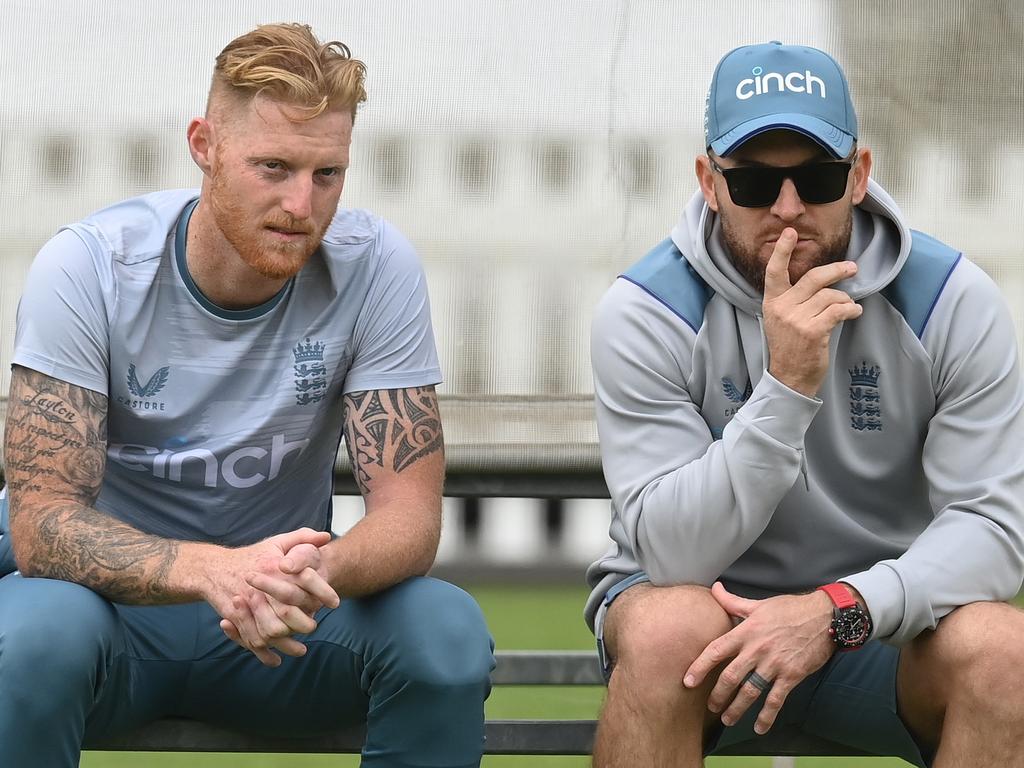
In a wider context, Brendon McCullum and Ben Stokes are fashioning a similar reputation as a management pairing, with the latest Test victory, at Emirates Old Trafford, a glistening testament to the ability of the red-ball head coach and captain to fix problems and difficulties.
With five wins from the past six Tests, it is sometimes easy to forget what a mess England were in before this summer. Only one victory in 17 Tests was a valid indicator of the myriad questions about various individuals and their positions.
But the approach of McCullum and Stokes was remarkably clear and straightforward. Yes, there was the overarching philosophy of a more aggressive and positive way of playing, but more important was the decisiveness of their answers to most of those questions about certain players.

No one to bat at No 3? Ollie Pope was deemed the most talented young batsman in the country and therefore backed to make a success of that spot. He has done very decently.
How best to find Jonny Bairstow’s most devastating form? Make him feel wanted and comfortable in both his role and his place in the side. Most of all, keep things simple. As McCullum said to the Yorkshireman before his 162 against New Zealand at Leeds, when he was fretting about how to play: “Go and get your sudoku book, come and sit next to me and shut up. Whatever you did last week worked [when making a match-winning 136 off 92 balls at Trent Bridge] – go and do it again.”
Bairstow may have been a little quiet in this South Africa series so far, but his 49 in Manchester was vital and he remains the leading runscorer in Tests this calendar year, with 1,061 at an average of 66.31 (Joe Root is second, with 950 at 52.77).

Who should be the spinner? Jack Leach will never be Tony Lock, and he has taken only three wickets in three Tests since capturing ten in the match against New Zealand at Headingley, but the belief shown in him by McCullum and Stokes has been evident in his demeanour and bowling.
How much longer could James Anderson, 40, and Stuart Broad, 36, go on? It seems outrageously silly now that they were omitted from the tour to the West Indies in the winter, but the message has been crystal clear to both: forget about rest and rotation, you are both playing and you are both going to go hunting for wickets at every opportunity.
Sometimes you can be far too clever and look too far ahead – as South Africa discovered with their ludicrous dropping of Marco Jansen for the spinner Simon Harmer, and therefore their decision to bat first in Manchester.
As it was, England were looking for fast-bowling depth in the Caribbean and they found that anyway at home this summer with the inclusion of the in-form Matthew Potts. Which brings us to the return of Ollie Robinson at Potts’s expense at Old Trafford.

The old joke about a bowler paying the price for the failures of the batsmen (bowled out for only 165 and 149 at Lord’s) was rolled out but it was a wise decision and Robinson proved that, with increased fitness, he can be an even better bowler than the impressive figure we saw last summer.
It was also a bold call to give Robinson the new ball ahead of Broad, but it was the correct one and it clearly gave Robinson confidence. He is a fine bowler, the sort who, without being that quick through the air, always bowls an awkward length with sufficient movement to punish any mistake by the batsman.
If eyes were on Robinson at Old Trafford, then they were also on the opener Zak Crawley and the wicketkeeper Ben Foakes. Again, this regime came up trumps. An over-reliance upon Root was rightly highlighted before the match, and when he made his third successive single-figure score (only the second time he has done that, with the other occasion being at the end of the West Indies series), the responsibility fell to others – and Crawley, Bairstow, Stokes and Foakes rose magnificently to the summons.
Foakes’s second Test century was a wonderful riposte to twin failures at Lord’s, overcoming the mental and physical challenge against pace and demonstrating again his nimble footwork against spin (although Dean Elgar’s decision to use both spinners after lunch on the second day defied belief). It has also not gone unnoticed that Foakes has as many Test hundreds in 30 innings as Jos Buttler has in 100.

Crawley’s case is fascinating.
Thirty-eight runs have probably never been so highly acclaimed, but it was the circumstances at Old Trafford – both personal and collective – that made them so valuable and, to some extent given the abstemiousness involved, surprising.
He still has much to do to convince but Crawley is a strong character and for the management to put him in the appropriate frame of mind, amid all the noise around his constant failures, to be able to play like that was a triumph in itself.
There are still concerns, of course, such as the form of the other opener, Alex Lees; the dependence upon Stokes, whose knee problem will surely require further surgical intervention at some stage; and how England fare when the ball is reverse swinging, which should be a factor come the three Tests in Pakistan in December.
But for now McCullum and Stokes are proving to be two of cricket’s greatest troubleshooters.
– The Times
Originally published as Brendon McCullum and Ben Stokes proving two of cricket’s greatest troubleshooters

‘Get out of my face’: England’s shambolic tour hits new low with airport clash

The Test cricket meal an Aussie captain fought to save

‘Heart of Lillee’: The mantra that put Cummins on path to greatness

Lee smashes fifty as Hurricanes claim maiden WBBL crown

Why CTPL clubs want special round to take Pride of place
