
How second XI comp shapes future stars as a key part of Australian cricket pathway
Second XI games are a vital bridge between club and Sheffield Shield cricket. PAUL AMY chats to Clint McKay and Mark Cosgrove about the competition as he goes behind the scenes at a match in Essendon.


He is Cricket Victoria’s head of talent development.
But at a state second XI match, Dean Russ performs tasks you won’t find in his job description.
Like the coffee run.
The start of day three of the game between Victoria and South Australia at Essendon’s Windy Hill is approaching and the Victorian coaching staff and other officials involved need a caffeine fix.
Russ nips down to a café on Napier Street and returns with a tray of six coffees, a skinny cap for him, lattes for Victoria coach Clint McKay and emerging player performance manager Tom Evans, match manager Kristian Piovesan, referee Bob Parry and umpires’ coach Richard Patterson.
A bit earlier, Russ was involved in the warm-up for the Vics, refereeing a ’soccer-volleyball’ game and putting on a mitt to take catches.
“Jack of all trades, master of none,” he says with a laugh.
“You just do what’s needed to support the team.”

It is a talented Victorian team, as you would expect for a level of cricket preparing players for first-class ranks.
Of the 12, four have state contracts – Mitch Perry, Jake Fraser-McGurk, Mackenzie Harvey and rookie Brody Couch – and the others are striving to achieve the same through their performances in Premier ranks and in the state second XI games.
Victoria will play six of them this season.
Hardly anyone turns up to watch, but McKay and Russ say the second XI competition is a vital part of the Cricket Australia (CA) pathway, a sturdy bridge between club and Sheffield Shield cricket.
McKay’s first memory of playing for Victoria goes back to February, 2004.
It was in a second XI game against NSW at a time when the competition was called the CA Cup.
The NSW team included Glenn McGrath, who was coming back from injury and took six wickets in a match his team won by nine wickets.
McKay had figures of 3-66 and 0-27.
“That was a great experience for me back in the day,” McKay, 39, recalls.
“They (NSW) had a pretty star-studded line-up. You had Glenn McGrath. Doug Bollinger. For a young player like myself, that was pretty good to play against guys like that and sort of press your claims and understand the level.
“It’s the same this week with these boys. It’s pivotal in the development of the younger guys coming through, tests them out against a better standard than they’ll see on a Saturday. It’s also important for the mature-age guys who have been around a bit longer. It’s an opportunity for them to compete against the best and showcase their skills and hopefully continue on to represent Victoria.”
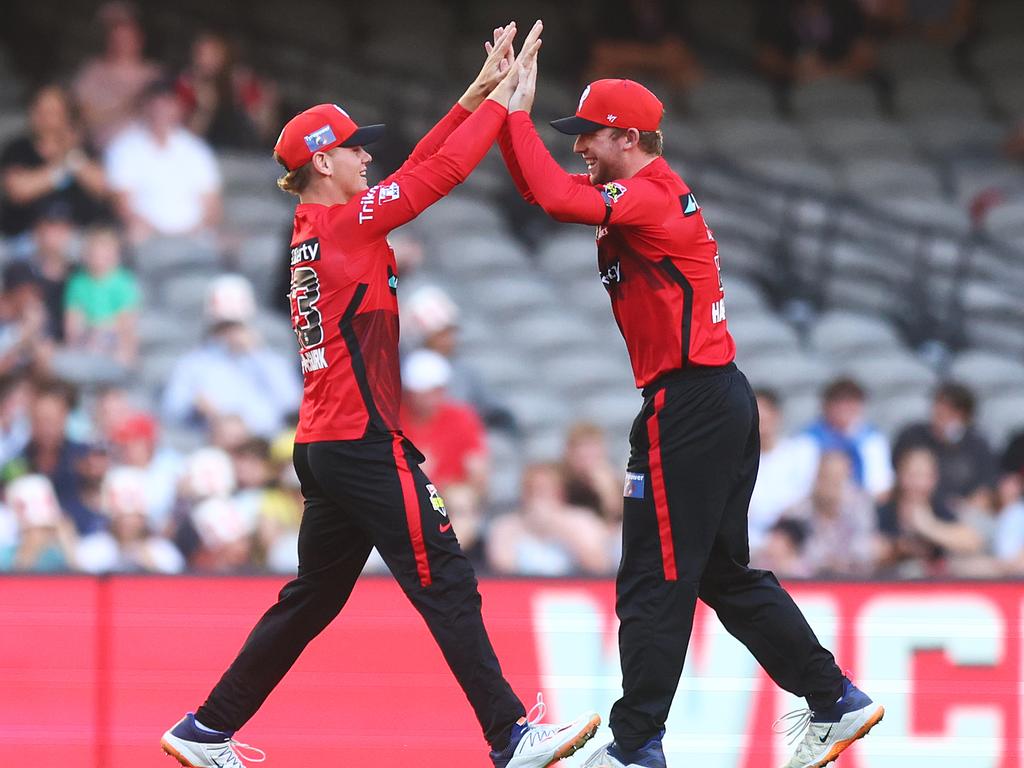
McKay says the gap between Premier and second XI cricket is substantial, sustained pressure setting them apart.
“You see here, South Australia have got three genuine fast bowlers who are all very capable of playing first-class cricket. They don’t let up,” McKay says.
“So the batters have to work really hard and concentrate for long periods of time to make runs and be successful. It’s dealing with that relentless pressure.”
Russ points out it’s a new experience for some of the players to be involved in four-day games, especially after Covid and the glut of white-ball cricket in the past two seasons.
He notes they could be in the field for most of the day, then have to go out and bat late in the last session, perhaps on a wicket starting to take spin or produce variable bounce, presenting challenges as much physical and mental as technical.
It’s a test of “time on feet”, Russ says.
“With these second XI games, we want to make it a clear stepping stone from performances in Premier Cricket to an opportunity to play over four days, understanding what it’s like to go through the different gears of a game of cricket and a real sighter as to what it’s like at first-class level,” he says.

*****
The Victorian team has three players over the age of 30: James Seymour, who made his Shield debut for Victoria in April, 2021 after a run of big scores for Essendon, and leg-spinners Ruwantha Kellapotha and Kyle Williamson, both relative newcomers to Victorian cricket.
Kellapotha played first-class cricket in Sri Lanka. He was called into the Shield team, as an uncontracted player, in October, after a dazzling first season for Casey South Melbourne in 2021-22.
It is South African-born Williamson’s first second XI appearance. He joined Melbourne in 2019-20, almost instantly getting noticed for his accuracy and big-turning wrong ‘un.
At the other end of the age scale, Geelong’s Liam Blackford, given the keeping gloves, is 18.
More than a decade ago, CA brought in a rule that state second XI teams could not select more than three players over the age of 23.
One Victorian official of the day said it made for a “kiddies’ comp”, cheapening runs and wickets while not preparing players for the step up to Shield ranks.
There was a common view that players were being picked more on what they might do rather than what they had already done.
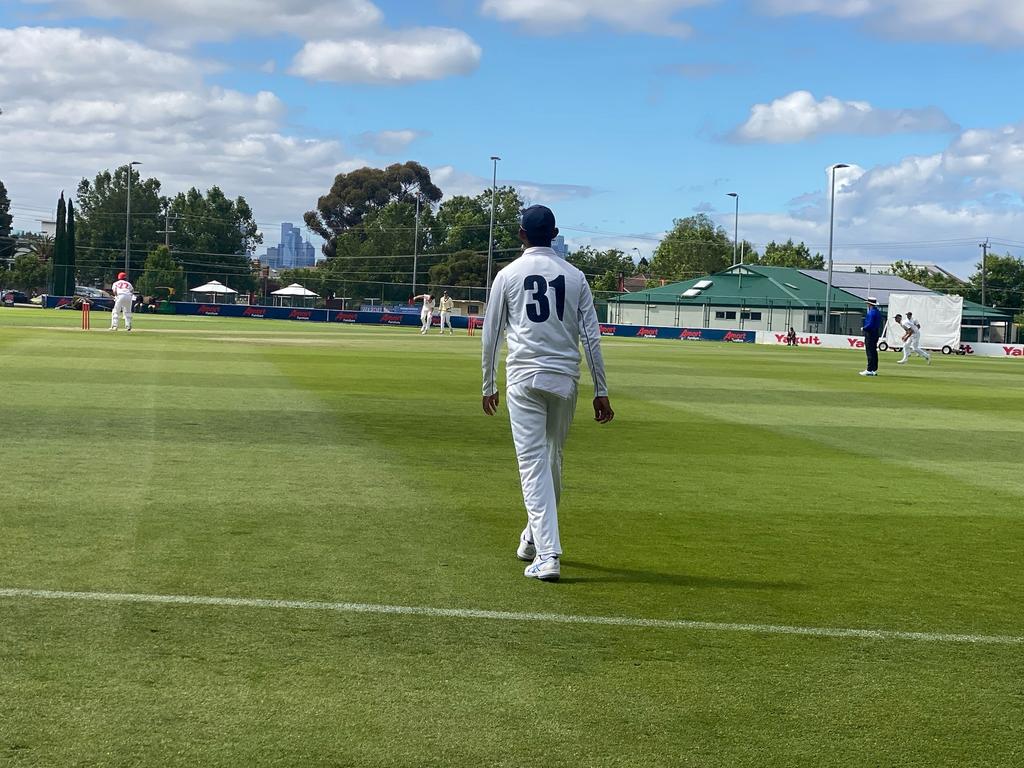
Some senior players left grade cricket disillusioned, believing they would be ignored for selection regardless of how they performed.
The rule was scrapped a few years ago.
“I suppose you could see why they (CA) were trying to develop the young guys but I think the beauty of second XI cricket was having the best cricketers playing, regardless of age,” McKay says.
“It’s great to get back to that. The best players are involved because there are no age restrictions.”
Russ says the ‘Futures League’ badging of the competition was dropped some time ago, but is still in currency in some cricket quarters.
Russ also played for the Victorian seconds, going on to two Shield matches in 2013-14.
The talent manager is in a good position to identify skill in Premier Cricket: at age 36 he’s still playing for Footscray (last season he won the coveted Jack Ryder medal as best player in the competition).
He sees the potential of players just as he sees their performances. From a selection point of view, “it’s a combination of the two”.
“It’s potential with performance,” Russ says.
“I think Campbell Kellaway is the clear example of that, someone who has gone out and made big hundreds in grade cricket, then come into second XI and made hundreds. Ash Chandrasinghe is the same. We feel they’ve got the attributes to play higher but they’re actually performing now.
“We want to really change that narrative, to reward that. There’s always been that push to reward Premier Cricket performances but there might have been a little bit of a misconception out there about it.
“We want our state-contracted players dominating Premier Cricket and then coming into this level and dominating, and hopefully that translates into good, consistent performances in the Shield and the Marsh Cup.”
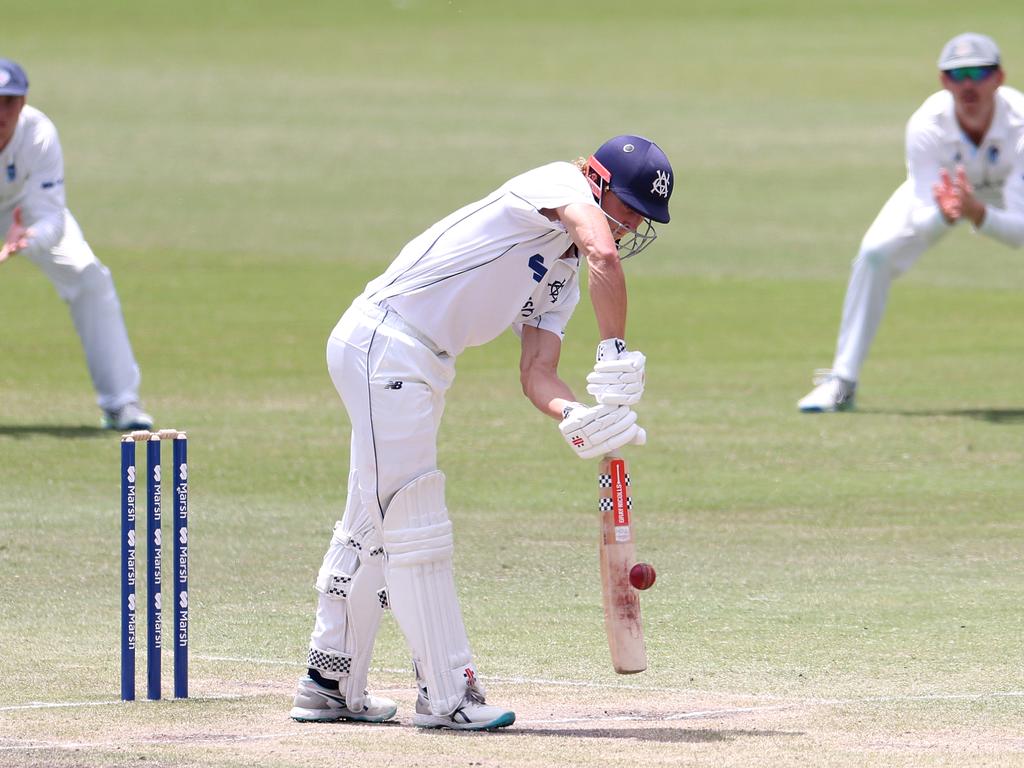
Former Shield batter Mark Cosgrove is coaching the South Australian second XI, supported by another ex-first class player, Shannon Tubb.
Cosgrove makes the same points about the second XI as his former Shield opponent McKay. He says it is a “step above grade cricket and just below Shield cricket” and an essential element of the Australian cricket structure.
“Any chance we get to play a four-day game against quality opposition is great. It teaches our kids to play better cricket and play under a different kind of pressure,” Cosgrove says.
“We had a kid, Harry Matthias, go in yesterday after we lost 2-0. He batted really well in a 100-run partnership with Liam Scott. I see that as a massive win for us.”
Is winning important?
“Yeah, definitely, you want to win, 100 per cent,” Cosgrove says. “You want to educate your players to play good, winning cricket. It filters through to your state team.”
CA high performance managers discussed the idea of awarding Shield points for each state’s second XI results, but there were questions about the concept affecting the integrity of the time-honoured competition.

*****
As he sips on his skinny cap, Russ watches the first hour of play in the WH Cookson Stand at Windy Hill, in front of boxes occupied by Parr, Patterson and scorers Mike Walsh and Chris Doyle.
McKay and Evans are in the same stand, which affords an elevated view from behind the bowler.
There are more team officials than spectators at the game.
Three fans sit on bench seats around the ground. The others perch themselves near McKay and Evans.
One is Ron Davis, 72, of Lower Templestowe.
The game had originally been scheduled at Greenvale but couldn’t go ahead there because of a drainage issue.
Davis was unaware of the switch and went to Greenvale on the first day. He laughs at the suggestion he had to hurry across to Essendon to beat the crowd.
“It’s a shame not many people come to watch it (state seconds) because it’s high-level cricket and there are a lot of good players playing in it … you’d think some of them will eventually move up into the big time,” Davis says.
“You get to see them early, I suppose.”

Russ believes there is far more interest in second XI matches than indicated by a headcount at the ground, with many people tuning in to the livestreams, following social media updates and logging onto MyCricket (where games are listed as the Toyota Second XI in the CA state competitions).
In that respect it’s much like the competition that second XI players are aspiring to reach. Shield cricket is closely followed but rarely attended.
It’s the first time state second XI cricket has been staged at Windy Hill, a suburban oval that for many years hosted league football.
Essendon Football Club last played there in 1991.
Essendon Cricket Club remains – indeed, it has been at Windy Hill for 150 years – and has assembled a group of helpers to support Cricket Victoria and make sure the match proceeds smoothly.
Club stalwart Charlie Buhagiar is propped up in the canteen in the social rooms, and other Bombers work the scoreboard and move the sightscreens.
Essendon also has a presence in the South Australian camp – young first XI player Farzan Chowna is called in as a substitute fielder.
President Simon Tobin says his club is chuffed to be hosting such a high level of cricket.
Cricket Victoria performance general manager Graham Manou was at the ground on the first day and assessed the playing surface as the equal of any first-class venue in the country.

Tobin is hoping for runs from Seymour, playing on his home deck and carrying the confidence of two centuries for the Bombers this season.
The left-hander hit a Shield ton in 2021-22, only to lose the state contract he had held for 12 months.
Seymour missed out in the first innings against South Australia, but he had some company: the Vics were castled for 108 in reply to 206.
The visitors start day three at 7-203 in their second dig. The Victorian coaches are hoping the bowlers can quickly dock the tail and restrict the lead to about 330, making for a good run chase.
“That would be a good challenge for our batters. The wicket’s flattened out quite nicely and hopefully our guys can right some wrongs from the first innings,” McKay says.
But it’s a tough day for the Vics. They can’t take the game into a fourth day.
South Australia bats on for two hours, eventually being bowled out 276 and setting Victoria 375 to win.
Seymour opens with Fraser-McGurk, a player who is invariably mentioned whenever the potential/performance discussion surfaces in Victoria.
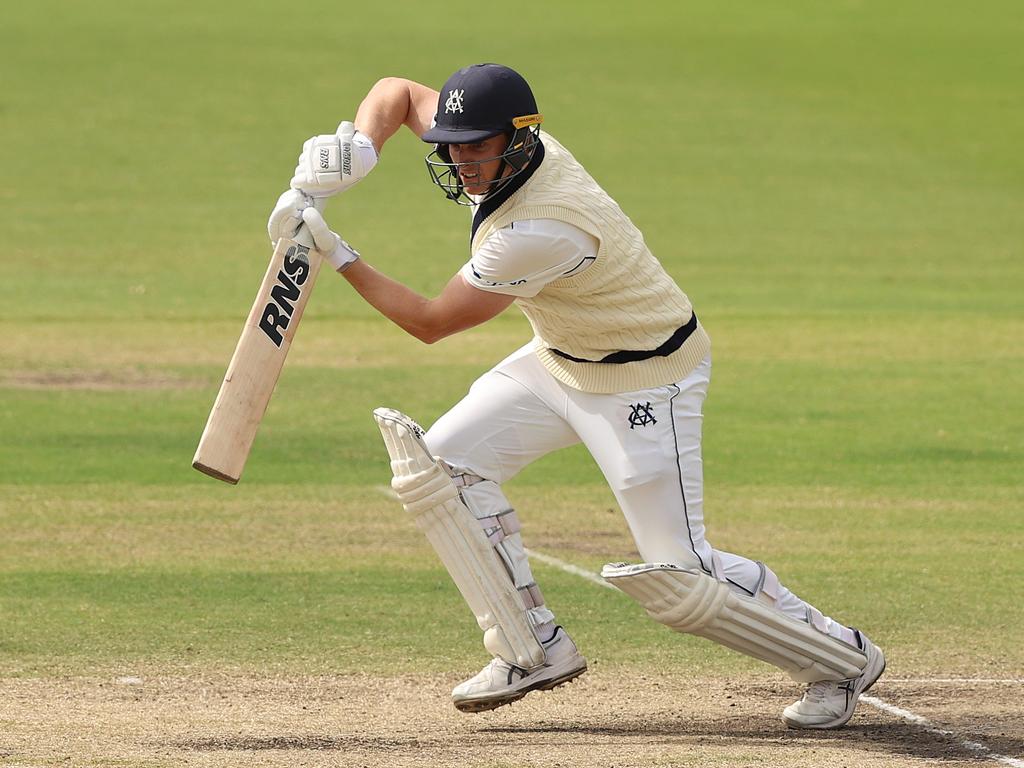
Everyone agrees the 20-year-old, whose head spins to “Rooster”, is an immense talent; as he showed on Shield debut against Queensland at the MCG in November, 2019.
But senior hands in club cricket note he has yet to make a century for his club, Richmond.
The idea of him opening is to assign more responsibility in a competition in which last season he hit 146 against NSW Metro then thrashed twin tons against ACT/NSW, 100 off 107 balls and 100 off 73.
Fraser-McGurk starts well against the South Australian new-ball pairing of Nick Winter and Henry Thornton, the ball pinging off his bat.
Then it rattles his stumps, his booming drive bringing an inside edge off the bowling of Spencer Johnson.
He’s out for 24 and Victoria is 1-38, which becomes 2-41 when Seymour (12) is snaffled in the slips, though he waits for the umpires to come together to confirm the low catch.
Mackenzie Harvey and Tom Rogers both go cheaply too, giving Johnson the first four wickets.
Victorian head of male cricket David Hussey has dropped in and sits with Russ as Harvey (9) is given out caught behind, a decision that prompts the left-hander to toss his head back in frustration.

The dismissal of Rogers is more clear-cut. He aims a pull, skies a catch and is out for 12, disappointing for a player who has scored nine centuries in the past two seasons for Ringwood but has found runs elusive for the Victorian second XI.
The Vics are ultimately dismissed for 223, a long way short of their target.
Jack Lalor is run out for 25 and young Blackford hits 41, but it’s Perry, captaining the Victorians, who most pleases the state coaches.
He’s unbeaten on 63, a red-inked half-century to go with figures of 4-26 and 3-18.
“We try to look at the all-round cricketer and how we can develop them holistically,” Russ says. “Mitch is a very popular member of the squad, and giving him the captaincy in this game adds another string to his bow, promotes his leadership. He’s been exceptional. That’s the sort of performance you’re looking for at this level of cricket.”
Second XI match at Windy Hill, Essendon November 28-30
South Australia 206 (Liam Scott 67, Jake Carder 50; Mitch Perry 4-26, Matt Fotia 2-10, Ruwantha Kellapotha 2-40, Kyle Williamson 2-54) and 276 (Liam Scott 67, Harry Matthias 43; Mitch Perry 3-28, Matt Fotia 2-50, Ruwantha Kellapotha 2-54) d Victoria 108 (Henry Thornton 3-19, Liam Scott 3-11) and 223 (Mitch Perry 63no, Liam Blackford 41; Spencer Johnson 4-44, Lloyd Pope 3-67).

‘Get out of my face’: England’s shambolic tour hits new low with airport clash

‘Heart of Lillee’: The mantra that put Cummins on path to greatness

The Test cricket meal an Aussie captain fought to save

Lee smashes fifty as Hurricanes claim maiden WBBL crown

Why CTPL clubs want special round to take Pride of place
