
T20 World Cup final 2022: England win the trophy, but the tournament‘s most enduring legacy could be the role of emerging nations
England made history but nations like Ireland, Netherlands and Zimbabwe set this World Cup apart with USA on the horizon, writes DANIEL CHERNY.

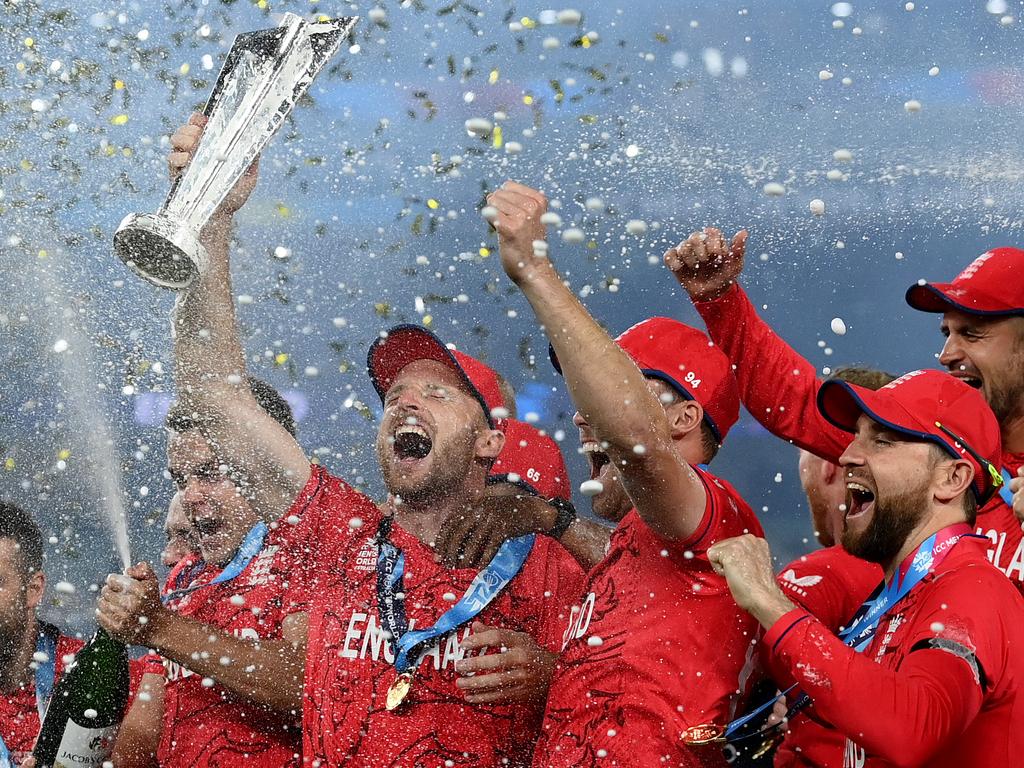
An otherwise forgettable tournament can be salvaged by an epic finale.
This was, to the contrary, an intriguing and seismically competitive tournament ending with a solid, but not jaw-dropping, series of knockout matches.
With the utmost respect to England, who deserved a second world T20 title, perhaps the best thing about this final is that it happened at all.

There was an overwhelming sense of resignation around this game given the heavy rainfall forecast for the night of the match, and again on the reserve day. A few specks of rain appeared early in the run chase, enough to have tournament organisers peering nervously out the MCG windows towards the skies.
But despite a tournament in which La Nina has played a disproportionate role, the final was spared, just as the match for which this event may ultimately be best remembered: India’s escape against Pakistan in front of more than 90,000.
The semis had both been decided by powerful opening partnerships.
The final itself was a bowler-dominated affair, with player of the match and tournament Sam Curran’s variations and Adil Rashid’s leg-breaks ultimately wearing Pakistan down on a sluggish pitch. It was not as though this was a flawless showing with the ball from England either, with Ben Stokes and Chris Woakes both sloppy.
However Curran and Chris Jordan’s outstanding contributions at the death kept England’s asking rate to below seven runs per over. Overall, England bowled sensibly and defensively. It wasn’t pulsating but it was effective in the conditions.
That is not to say the decider didn’t have its moments of drama. Pakistan, arguably against reputation, played gritty and attritional cricket, taking England deeper than India had done defending a much bigger score three nights earlier in Adelaide.

Naseem Shah, Haris Rauf and Shaheen Shah Afridi – at least before he was injured completing a catch in the deep – repeatedly beat the English bat with their exhilarating pace.
Had one or two shies at the stumps hit the target, this could have easily turned. As it was, though, Pakistan were probably 20 runs short.
Even as Stokes fell 10 runs below a 100 strike rate, the equation had not become dire. A few get-out boundaries in quick succession and the World Cup was as good as England’s.
So, ironically for a country that has in one respect moved past this format of the game by introducing an even more abridged type of cricket, Twenty20 is coming home.
The concept devised by former ECB marketing chief Stuart Roberston will be two-decades old next year, and the trophy will be in England’s possession, capping more than half a decade of limited-overs excellence and innovation. England has become the first men’s team to hold both white-ball world titles simultaneously.
And for all the Covid water under the bridge since that fateful day at Lord’s, Stokes again played a crucial part in a World Cup final, and England again prevailed. Plus ça change, plus c‘est la même chose.
Yet paradoxically for a tournament won by the country in which both the sport and the format originated, in a final played at the ground which hosted the first Test match, this event should linger for the manner in which the world order was tested like never before.
Lost in the worry about the weather and Matthew Hayden sound bites, it is arguable that not enough had been made in the lead-up to this match of the fact that the final was played between sides that had respectively lost to Zimbabwe and Ireland during the group stages.

The tone was set on the opening day of the tournament when 2014 champion Sri Lanka was beaten by Namibia. Two-time winners the West Indies didn’t even make it to the main body of the event having been upstaged early by Scotland. And the Netherlands played a critical hand, adding to the rich lore of South African World Cup ignominy by eliminating the Proteas on the final day of the Super 12.
None of the 16 sides went through undefeated, and only one was winless: Afghanistan. And the Afghans had an asterisk in any case, with two of their matches washed out. Hell, they almost beat Australia in Australia.
So while the semi-finals were not all-timers, and the final didn’t quite reach a magnificent crescendo, this was a great tournament, one for which it was worth waiting an extra two years.
If in 20 or 30 years’ time someone like Ireland or Namibia or the Netherlands or the UAE, or dare we even float the idea the US are playing in a final of a tournament like this, we should look back on the 2022 T20 World Cup as the event that paved the way.
The hosting duties for the next instalment of this event are being shared by the Windies and the US, with 20 teams up from 16, and no in-tournament qualification for the group stage.
For a sport that so chronically self-sabotages, that is a healthy environment.

Waugh out; Waugh in: The Ashes selection which captivated a nation

Michael Neser destroyed England — but he might also save them

Up to the stumps, up the order: Carey’s challenge to selectors

Connolly overshadows Babar to lead Perth to BBL win

Aussies’ biggest selection hints yet as Adelaide line-up intrigue swirls
