
Former fish factory worker Jonas Vingegaard wins a Tour de France that will be spoken about for decades
When other Tours have receded to dim corners, the 2022 race will be often spoken about. One scene will transcend the others – a moment that encapsulates everything that is beautiful and brutal about that sport, writes DAVID WALSH.


When other Tours have receded to dim corners, the 2022 race will be often spoken about. One scene will transcend the others. The moment, halfway through the race, that teammates Jonas Vingegaard and Primoz Roglic got Tadej Pogacar to themselves on the early slopes of the Col du Galibier. What they then did to the man in the Yellow Jersey was as close as cycling could ever get to a blood sport.
They didn’t so much attack him as bait him. First one went, then the other. Pogacar closed one gap, then another. Intent on breaking him, they repeated the torture. Entranced, we watched a battle that was at once physically punishing and psychologically brutal. How could Pogacar not get drawn into it? He hit back, accelerating away, forcing them to chase him.
They were at the foot of the Galibier, 60km from the end of the day’s stage. After the Galibier, there was the Col du Granon, which was the toughest climb in the Tour. The only other time the race had been to the Granon was 1986. Then the great Bernard Hinault lost the Yellow Jersey for the last time. And on the Col du Granon, Pogacar too would have the Maillot Jaune taken away.

Vingegaard and Roglic softened him on the Galibier and Vingegaard finished him on the Granon. Cruel but effective. Two minutes and 22 seconds behind the Dane, we sensed the game was up for Pogacar, the winner of the Tour in 2020 and 2021. He had come to the race buoyed by that sense of invincibility that sometimes belongs to the young. Until that day on the Granon, the 23-year-old Slovenian had never known what it was to suffer or, at least to truly suffer, in the Tour.
In defeat the boy racer became a man. Now he knows the terrible place this race can take you. Time will tell whether he can go back and do better.
On Saturday evening Pogacar came to the press centre in Gramat after his time-trial. He smiled a lot and spoke enthusiastically about the race and how second place and three stage victories wasn’t the worst result in the world. He admitted, though, that there had been mistakes, both from him and from the team, UAE Team Emirates. A few questions later, someone asked him to give an example of one such mistake.
He instinctively spoke of what he had got wrong. “The mistake I have made was the stage to the Col du Granon. I was too motivated to follow everyone, and I think in the end I paid really hard. I like challenges in life, and I had a big challenge this year in Jonas which I couldn’t beat. I’m really motivated for the next races and the next Tour to beat this challenge.”

It will be interesting too to see how Ineos Grenadiers cope with the challenge that the 25-year-old Vingegaard, who completed his maiden Tour victory yesterday (Sunday), now presents. They were saved in this race by Geraint Thomas’s excellence throughout and Tom Pidcock’s brilliance on the stage to Alpe d’Huez. They also won the Tour’s team classification, but this is more embarrassment than achievement.
Ineos won with one stage victory whereas Jumbo-Visma, Vingegaard’s team, won the Yellow, Green and Polka Dot Jerseys and the combativity award, as well as six stages. There was one dominant team in this Tour and it was not Ineos. They need a new general classification rider. To borrow a line from the songwriter Paul Simon, “Tom Pidcock, our nation turns its lonely eyes to you.”
There was the hope that maybe Pidcock might get involved in the Champs-Elysees bunch sprint yesterday (Sunday), which was won impressively by Jasper Philipsen, the Belgian, but the young Ineos rider was on his last legs through the final days of the race.
Close to 11pm on Saturday night, we pulled into our hotel, the Ibis Nord at Limoges. There were support staff from the Jumbo-Visma team having a nightcap to celebrate Vingegaard’s win and the team’s dominating performance.
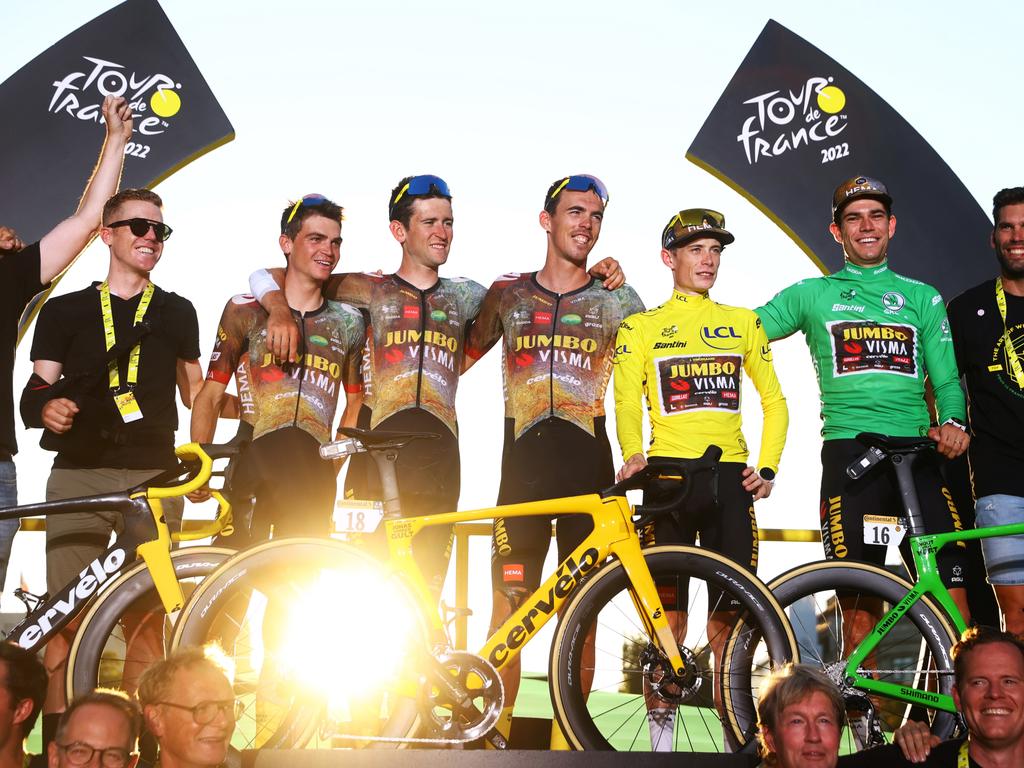
Already gone to their rooms were the Jumbo riders, including the champion. It didn’t seem inappropriate that on the first night he knew he was going to win the Tour de France, Vingegaard slept in a room at an Ibis that can be reserved for euros 55 (about pounds 46) per night. He wouldn’t have found fault with the accommodation, remembering that just four years ago he was working in a fish factory for euros 19 an hour.
It was the Tour with the fastest average speed and it wasn’t a surprise that the doping question was asked. Vingegaard handled it with what seemed sincerity. “We are totally clean, every one of us, and I can say that to every one of you,” he said. “Not one of us is taking anything illegal. I think why we are so good is because of the preparation we do. We take altitude camps to the next level, and everything: materials, food and training.”
Outside the Ibis in Limoges late on Saturday night Frans Massenn, a Jumbo-Visma directeur sportif, told a journalist colleague that he was a little disappointed about the doping question at the champion’s press conference. It is the price the sport pays for the culture that existed in Massenn’s day and during the decade after he retired.
He said he believed Vingegaard was the cleanest rider in the peloton. There is no evidence to suggest otherwise.
Wout van Aert, the Jumbo-Visma rider who won the points classification, was less patient with the doping question. “I don’t want to answer this question,” he said. “It’s such a s--t question. It comes back every time someone wins the Tour. So now because we’re performing at this level, we have to defend ourselves? We worked super hard for this, and cycling has changed.
“We have to pass controls every moment of the year. It’s not that we’ve come out of nowhere.”

All this is true. So, too, is that two of Van Aert’s teammates, Roglic and Tom Dumoulin, cast doubt on the legitimacy of Pogacar’s brilliant time-trial performance at La Planche des Belles Filles two years ago.
They did so without a shred of evidence but suspicion goes with the territory. It was shameful that Roglic and Dumoulin never apologised for those heat-of-the-moment comments. The younger generation inspire far more confidence than previous generations; Vingegaard, Pogacar and Pidcock have all arrived and immediately performed outstandingly.
Could they have done this if those they were competing against had been doping for five or six years? Elite riders are now drawn from a much bigger pool and the standard of rank-and-file rider is far higher than it was in the past. It used to be that France, Spain and Italy were big players at the Tour. Between them, they got one stage win this time.
To better understand what has changed, compare the scene at the finish line of a mountain stage now with what it was during the era of EPO and blood transfusions. What we see now is more human and more credible.
Originally published as Former fish factory worker Jonas Vingegaard wins a Tour de France that will be spoken about for decades

Formula One star unveils latest SA venture

How cycling’s biggest name could race at Tour Down Under

Cycling’s biggest fears exposed by protest chaos, embarrassing finish

‘I’m not going to live’: Olympian’s miracle escape from truck crash

Olympic defector makes mockery of record
