
Grand final fan rage is shades of A-League’s worst revolt, as club bosses face another seminal moment
Seven years ago, furious A-League fans took on football bosses and won. The APL’s grand final sell-off threatens to shatter an uneasy truce, writes ADAM PEACOCK.

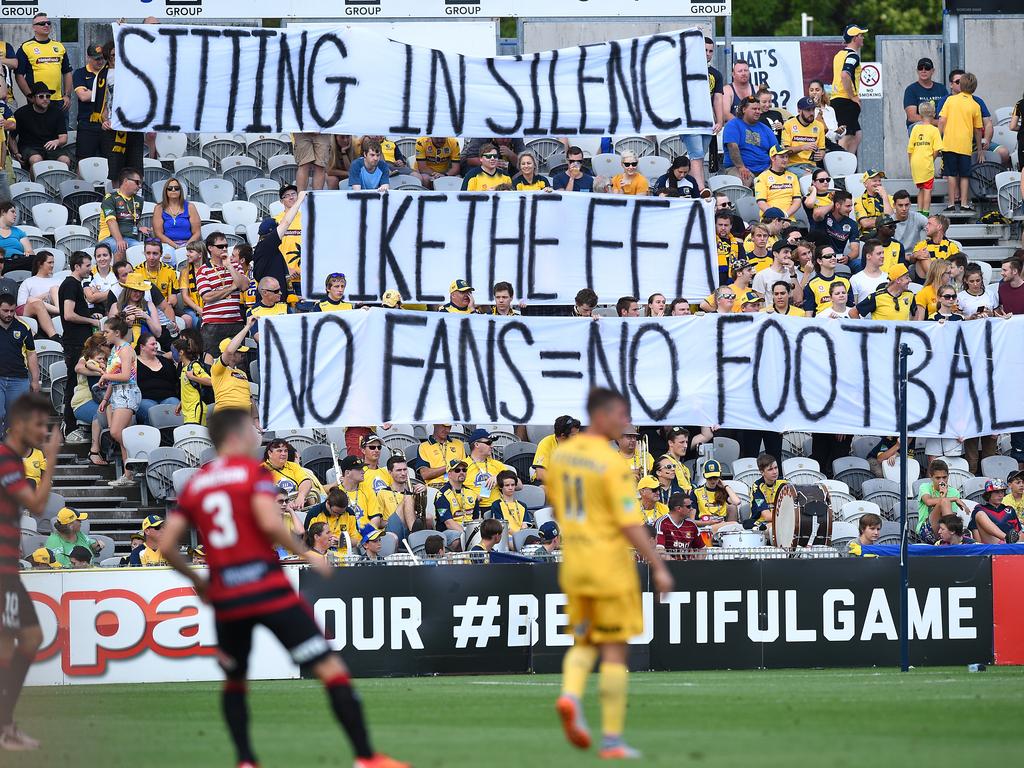
It was a warm December night in 2015, and Sydney was about to be hit by a biblical storm.
As rolling thunder got louder, the air was still and tense.
Nothing, though, compared to the atmosphere inside the meeting room of a five-star hotel at the bottom of George St, in sight of the Opera House.
A-League fans were face-to-face with the FFA, which was then running the domestic football competition.
Lightning flashed through the windows as the two parties stared daggers at each other.
The fans were in revolt, sick of perceived mistreatment from administrators. Sick of going to games and feeling like criminals from security and police. Sick of not being able to appeal banning orders.
So they started boycotting games. The FFA had lost control.
To broker peace, the FFA and the fans in revolt agreed to meet on that warm Monday night.
Seven years later, despite the blue skies of the last magical month of Australian football, on the horizon, from nowhere, another almighty storm is brewing.

*****
In deciding to sell the grand final rights to the NSW government for three years, the current day administration of the A-Leagues, the Australian Professional Leagues (APL), expected some heat.
They didn’t expect to be dancing on the sun.
It took less than 12 hours for every fan group, including those in Sydney, to rip into the decision, with all releasing statements condemning the move.
These fan groups are well organised and social media savvy. They release a statement online, and it bounces around quickly. In a ground together, the opposing fan groups spew hate toward each other.
But if overlords overreach, they form an alliance.
The FFA didn’t expect it in 2015. The APL didn’t either in 2022.

The APL argues the grand final decision is about forming a new tradition. The highest-placed team earning the right to host the grand final is only 18 years old. Why do it? Other codes in Australia don’t. England’s FA Cup final is always at Wembley. The Champions League final bounces around Europe to the highest bidder.
Those were the comparisons, but A-League fans don’t really care much for comparisons.
A-League fans loved the notion of their team being good enough during the season to win the right to host a grand final. And for the away team, a case of quickly cobbling together some coins and travelling by any means necessary to see if they can do the unthinkable and knock off the home side on their patch, in front of their home fans. It produced golden days and nights in Brisbane, Perth, Adelaide, Melbourne, Newcastle, and yes, Sydney.
Even though the world has moved on from industrial revolution times, when football clubs started popping up, those values remain with the masses.
Football, at its heart, is a working class sport. Hard work, with a bit of luck, will get you places in life. This is why fans are riled. Hard work, and a bit of luck, will send you to Sydney, no matter where you are from.
— The Cove (@TheCove23) December 12, 2022
Because of the timing of this announcement, another ‘young’ tradition looks set to suffer.
The pre-Christmas Melbourne Derby is one of the best fixtures of any season. It’s fewer than 10 years old, but it will forever be a lock on the calendar.
There is a festive spirit, laced with real angst between Melbourne’s two biggest clubs, the traditional powerhouse Victory and the decade-old City, who are now the benchmark thanks to heavy investment from the Abu Dhabi owned City Football Group.
The football will be fantastic. The atmosphere should be white hot.
It won’t be after 20 minutes when the main fan groups at either end stage a walkout.
It’s not a threat, it’s a promise.
The promises will go on, until fans feel they’ve been heard.

*****
This story carries more than a whiff of the European Super League bombshell that was dropped by superpower clubs in April, 2021.
The biggest clubs in football’s biggest continent wanted to form a breakaway competition, quarantined from the notion of merit, in order to maximise their own revenues.
Didn’t matter if a team finished seventh in their domestic league. If they were a superpower, they’d still have a spot in the Euro Super League, backed by a mammoth TV deal and sponsorship.
It all looked great on a powerpoint presentation, and a balance sheet. Then the fans got wind.
Football has a complex relationship with its past and present when it comes to who truly owns the game. The masses are besotted, in every corner of the globe, ripe for rampant capitalism at its charging best.
The English Premier League breakaway in the early 90s, Euro Super League, a 48-team World Cup are all classic examples of evolution based on making more money.

Mega wealthy owners are facilitators. The bad ones walk around with earmuffs on. The best ones never forget to understand what a club means to the poorest person in the stadium, who will do anything to watch their team, waiting for that moment that makes them feel exactly the same as the richest person in the stadium.
It could be Messi. Could be Mitch Duke. Or a Grey Wiggle.
An action that takes less than a second, mutates into a reaction that lasts for a lifetime.
An action based on hard work, maybe, with a little luck thrown in.
*****
In 2015, the fans did come back, but only after a robust evening of talks that lasted six hours.
The FFA had to do most of the listening on the night, as fans, in great detail, explained what was wrong, and what they wanted fixed. Ease up on the bans. Give us an appeals process. Tell police and security to back off on game day. Yes, we are loud, and different to the ‘footy code’ crowds, argued the fans, but loud and different doesn’t mean dangerous.
At one point, in a break when the two parties were in separate rooms, a senior FFA executive exclaimed the fans had no idea what they were on about. The game was hard to govern, so leave it to the governors.
And therein lay the whole problem for the FFA.
The fans always knew they were right, even when they were wrong, because it was coming out of their pocket.

Eventually, an uneasy truce was brokered. The FFA administration of the time, led by David Gallop, did well to even get to the table. Not many administrators would have the courage to sit face-to-face like they did. The FFA introduced an appeals process for banned fans, and promised to work harder for fans. Still, total trust in the eyes of those in the outer never quite returned.
Now the APL owners have control, after a messy divorce with the FFA.
The owners wanted to run their own race, arguing they were the ones putting in the money so they deserved to control their own destiny.
Move the game forward, unlock the potential of the domestic game.

Seven years later from that night in 2015, here we are.
A similar moment. A seminal moment.
The eight-figure sum for the clubs from this deal was impossible to ignore. So too, all of a sudden, is the thunder rolling in.

The Tackle: Mata has last laugh over ‘embarrassing’ Wanderers

Vergos ends drought with brace in original derby win

Victory ‘bleeds success’: This star knows that better than most

From Italy to Sydney: Logarzo makes last-ditch Matildas bid

‘Last chance’: Western United’s lifeline amid Pendlebury court battle
