
Barcelona finally has a winner again. This time, it’s the women’s team
The club that set a women’s soccer attendance record is undefeated this season and helping Barça supporters get their trophy fix
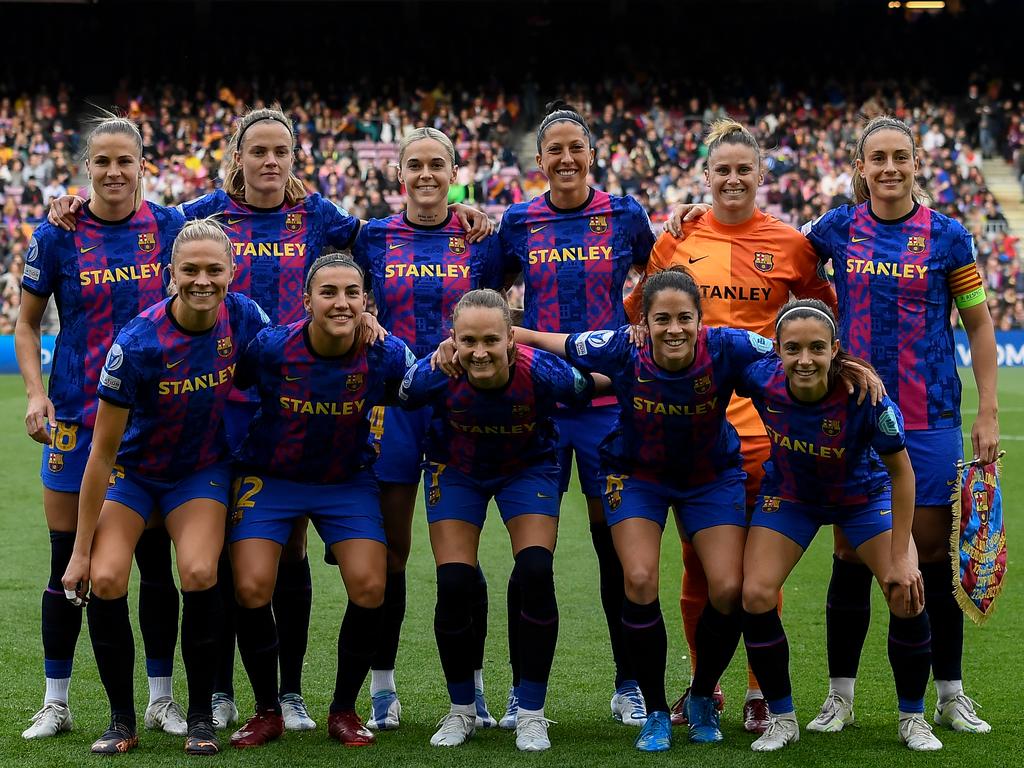
FC Barcelona has spent most of the past year coming to grips with life after Lionel Messi. The club searched for ways to replace him in the line-up, make up for the goals he wasn’t scoring, and most of all, fill the Messi-shaped gaps in the Barça trophy cabinet.
As it turned out, Barça didn’t have to look far for a winner. It just happened to be the women’s team.
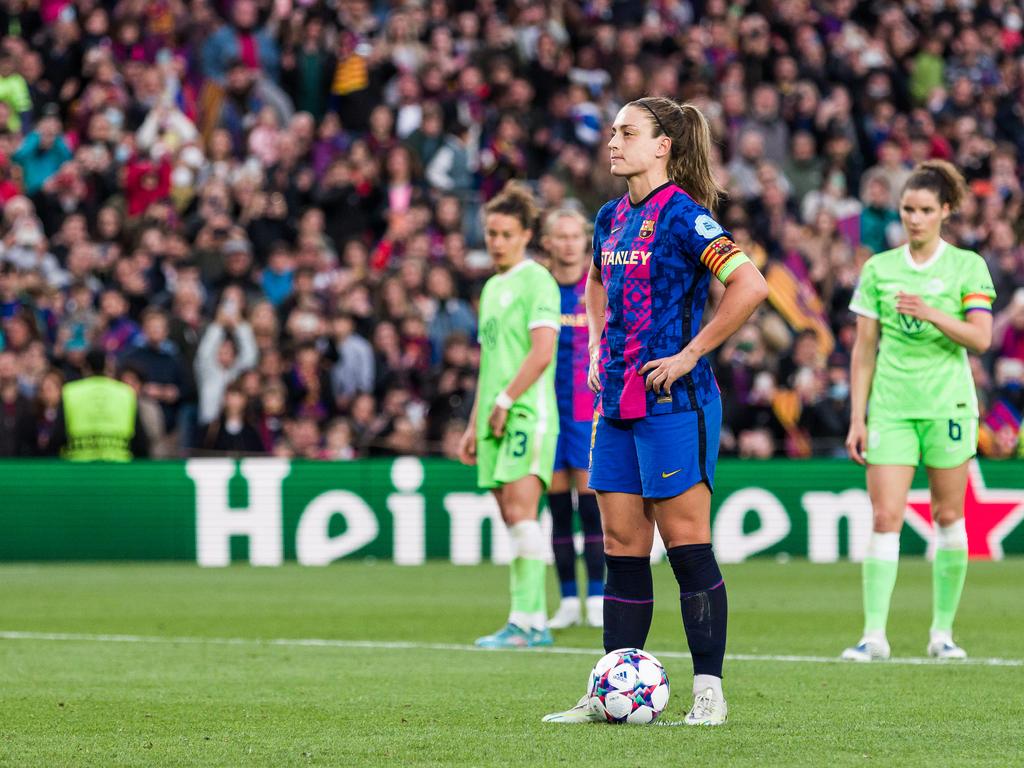
While the men have floundered this year, sliding from contention in La Liga and crashing out of European competition, the women’s side has grown into a juggernaut. Not only is Barça Femeni on track to win all three major trophies available to it, the team has simply forgotten how to lose. Through 27 league matches, Barcelona has 27 victories. It has scored 146 goals at an average of 5.4 per game while conceding just 8. And on Friday, it put one foot in the Champions League final with a 5-1 first-leg victory over Wolfsburg.
“We are trying to help the balance of the club,” said Markel Zubizarreta, Barça Femeni’s sporting director.
The team has only been professional since 2015. But in that short time Barcelona has become a study in how quickly a superclub can build a world-beating women’s side simply by deciding to care. With a budget of 5 million to 7 million euros (US$5.5 million to $7.6 million) a year less than what Barcelona used to pay Messi in a month — the club has been able to combine homegrown talent with a handful of international stars to build what is right now an untouchable squad. And yet, what Barcelona spends is still less than the likes of Paris Saint-Germain, Chelsea, and the original women’s powerhouse, Olympique Lyonnais.
“We are not in a normal situation,” Zubizarreta said. “What is normal is that we lose more, even if we win trophies. So we need to keep this level as much as we can, knowing that someday it’s going to end. Because this is not normal — professional sport is not this.”
The team is well aware of this, because before Barça Femeni could win everything, first it had to lose. It had to lose a lot.
Unlike some of the other women’s programs started around the same time by European heavyweights, this wasn’t a case of sudden investment warping the playing field overnight. Juventus, for instance, won the Italian league in each of its first four years of professional existence. London club Chelsea turned pro in 2014 and then proceeded to win five English championships in eight seasons. Barcelona, meanwhile, went four years without a sniff of a Liga title.
The first objective was to reach a Champions League final within four or five years, “but, of course, with our way of thinking about football.”
That way of thinking about the game is the blessing and the curse of being Barcelona. The club insists that there is only one acceptable way of winning soccer games. The style must be death-by-a-thousand-passes. The core of the team must be homegrown. And the games must be entertaining. Ever since Dutch master Johan Cruyff brought that philosophy to Catalonia in the 1970s, winning with stodgy play has been considered to be a betrayal.
When it works, it can be breathtaking. But building it can take what feels like forever. So what the women’s team has built in less than a decade rests in part on 100 years of Barcelona know-how — and not just in soccer. The club’s directors took lessons from Barça’s handball, basketball, and futsal teams about contract offers and roster construction, because the pay scale in those sports was closer to women’s soccer than the astronomical sums on the men’s side.
“We were in the best university to do this kind of project,” Zubizarreta says.
The club doubled its number of women’s youth teams from three to six and realised quickly that its homegrown hero had been right under its nose for years. In Alexia Putellas it had a local kid who had been with Barcelona since the club’s amateur days. Today, she is the team’s captain and holder of the women’s Ballon d’Or, awarded to the best player in the world.

But throughout its crucial, formative era, Barça Femeni enjoyed one luxury that the men haven’t known in decades: a little bit of breathing room.
“On the men’s side, the moment that you don’t win, everything is wrong and you have to change everything,” Zubizarreta said. “For me, one of the main things about this project is that this project has grown [while] losing.”
Nothing, he adds, did more to shape the current team’s perspective than being stomped on by Olympique Lyonnais in the 2019 Champions League final. After 15 minutes, Barça was down 2-0. After 30, the score was 4-0. The gap couldn’t have been any clearer. Sitting around the hotel later that night in Budapest, the team had two realisations.
“We need to train more,” the players told each other, according to those who were there. “We need to train better.”
Over the next three seasons, the club’s full-time support staff grew to nearly 20. The roster barely changed. Fourteen members of the squad that lost to Lyon were still around two years later in Gothenburg, Sweden to hammer Chelsea in the Champions League final. While the men racked up humiliations in Europe, Barça Femeni had arrived to help fans with their trophy fix.
And this year, the fans have begun to show their appreciation. Nothing made it clearer than the Champions League quarterfinal match against Real Madrid in March. The team that used to play its matches on practice fields in front of maybe 200 friends and family destroyed its old rival at Camp Nou in front of 91,553 supporters, a world record for an official women’s match. (It broke that record again on Friday with 91,648 against Wolfsburg, Barcelona said.)

The club could hardly believe it. Officials thought that selling a respectable number of tickets would require a huge marketing campaign across the region, going into schools and local clubs to root out every potential attendee. The overall plan was for a two-month push.
“But we didn’t do anything,” says Zubizarreta, pointing out that club members were allowed to buy four cheaper tickets at a time instead of the usual one. “The game against Madrid was sold out in four days.”
On the day of the Real Madrid match, though, the club wasn’t sure that everyone who had bought a ticket planned to actually use it. Traffic tied up the streets from central Barcelona to Camp Nou. Rain clouds rolled in over Catalonia. And it was a random Wednesday afternoon. But the supporters came anyway. More surprising still, the fans who usually ducked out in the 85th minute to beat the traffic stayed long after the 5-2 victory was over. Barcelona was celebrating a winner again.
“This has been utterly magical,” Putellas said afterwards. “When the match finished, the fans simply didn’t want to go home.”
– Wall Street Journal

SuperCoach EPL: How to replace missing AFCON stars

Sydney football club mourns player killed in Bondi terror attack

The Tackle: Mata has last laugh over ‘embarrassing’ Wanderers

The Melbourne-born teen who has world football giants circling

Vergos ends drought with brace in original derby win
