
Carlo Ancelotti: The Champions League winning coach whose plan is to have no plan
Carlo Ancelotti is the only manager in history to lift Europe’s foremost club trophy five times. He achieved those triumphs without any discernible football philosophy or signature playing style.
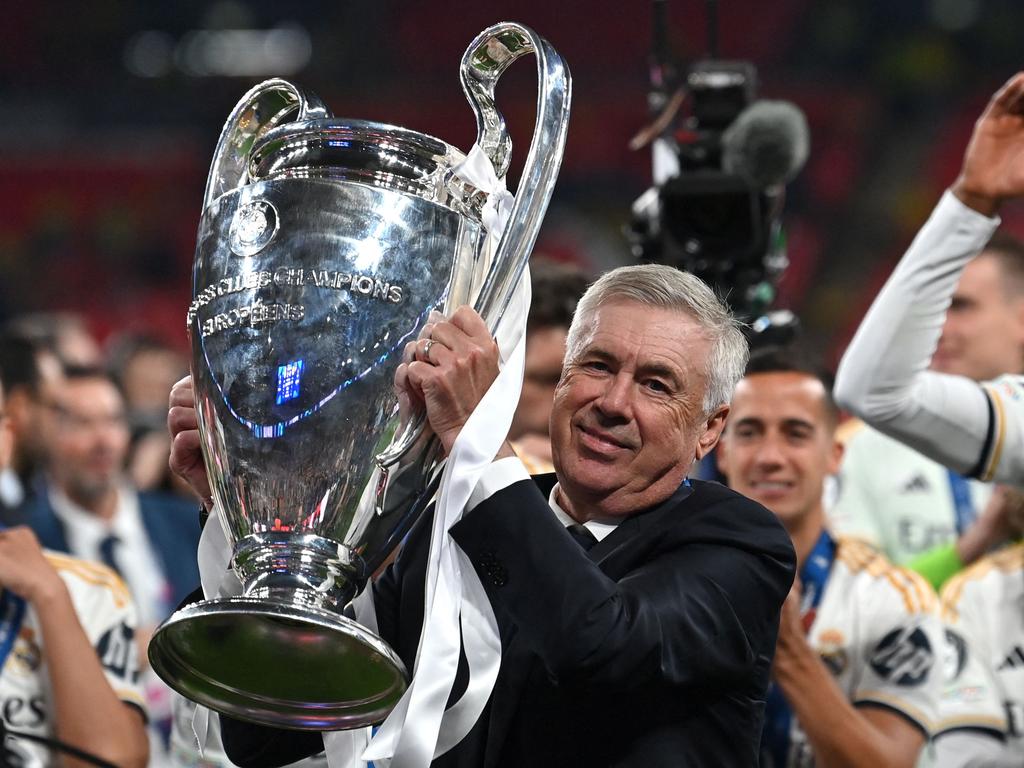
This time three years ago, Carlo Ancelotti was going through a strange interlude in his glittering coaching career. The serial winner who had won enormous football prizes with AC Milan, Chelsea, Bayern Munich and Real Madrid had landed at sad-sack Everton.
Ancelotti, now in his 60s, had been sold on trying something different. Instead of chasing more Champions League titles, he was there to slow down and build a project for the long term.
He spent his time plotting to turn Everton around. He went for walks on the beach with his wife. And pretty soon, Ancelotti got bored. It turned out that reclamation projects weren’t what he was about. Ancelotti is a trophy hunter.
In 2021, the silver-haired Italian returned to Real Madrid for a second stint as manager. And now, three years later, there is no doubt it was the right move. On Saturday night, the perfect marriage of club and coach delivered Real Madrid’s second Champions League title in three years and its 15th overall.
“At this club, there is a continuous hunger,” Ancelotti said. “We’re never satisfied.”
The same goes for Ancelotti. The 2-0 victory over Borussia Dortmund at London’s Wembley Stadium also left him in a rarefied football atmosphere, all by himself. He is the only manager in the seven-decade history of the competition to lift the trophy five times, which comes on top of his two triumphs as a player with AC Milan.

But what makes his success all the more mind-boggling is that Ancelotti has pulled it off without any discernible football philosophy. There is no through line from season to season in how an Ancelotti team plays. Instead, he has racked up unimaginable success by adapting, reinventing, and trusting that the collection of exquisite talent in Real Madrid jerseys will figure out how to win.
“You have to win this Champions League with sacrifice and with quality,” said Ancelotti, 64. “You need both—only having one of the two is not enough.”
Much of football’s modern obsession with signature playing styles stems from Pep Guardiola’s Barcelona sides of the late 2000s. His team of diminutive geniuses, inspired by Dutch football and honed in Catalonia, elevated a free-flowing offensive approach to high art. And as the world admired Barça’s beautiful passing schemes, many clubs decided that it was no longer enough for their coaches simply to deliver results. They also needed an ethos.

But while an entire generation of coaches went one way, Ancelotti moved in the opposite direction. Once upon a time, he’d been a tactical purist—schooled since his playing days in the philosophy of Arrigo Sacchi’s all-conquering AC Milan teams of the 1980s. Ancelotti was so disinclined to stray from it that during his time coaching Parma in the mid-1990s, he refused to sign a ponytailed Italian forward because he didn’t fit his 4-4-2 system. That forward turned out to be Italy legend Roberto Baggio.
Years later, Ancelotti would admit that whiffing on Baggio had been one of the great mistakes of his career. Still, the lesson stuck. In the years that followed, Ancelotti would divorce himself from any kind of set approach, developing a reputation as a specialist in man-management rather than as a master tactician. And nothing has made that clearer than his latest run to a trophy.

In the quarterfinal second leg against Manchester City, for instance, Real was content barely to hold the ball at all. Madrid had just 36% possession, bending without breaking before finally toppling the defending European champion in a penalty shootout. There was no talk of attacking flair or commitment to soccer ideals from Madrid that night.
“They don’t sell philosophy,” former Real manager José Mourinho said on British television. “They put cups in the office.”
In 13 Champions League matches this season, Ancelotti deployed at least five different formations. His last, and perhaps most important tweak of the season came at halftime inside the Wembley locker room, when he shifted Real into a 4-3-3 set up for the second half. Even that, Ancelotti says, “wasn’t my decision alone.”
He ultimately left the call to his senior players, the guys who had five Champions League winners’ medals at home—and were about to add a sixth.
“I didn’t need to get angry,” Ancelotti said. “I needed to clarify a few things, because it was pretty clear how Dortmund wanted to play.”
That approach doesn’t work with just any team. Ancelotti can afford to count on his core players’ accountability because of who his core players happen to be. The old, reliable heads in his locker room, such as Toni Kroos, Luka Modric, and Dani Carvajal, are all deeply invested in the Real Madrid mythmaking. Each of them already had five Champions League titles with the club before Saturday night. They had experienced enough epic comebacks to become convinced that there would always be more. They lived and breathed the soul of a club that cared only about winning with little regard for how it got there.
Take Carvajal, a workmanlike fullback who has been with Madrid since the youth teams. He is so steeped in Real’s culture that when he was 12 years old, he’d been selected to lay the first brick of Madrid’s new training ground at Valdebebas. Twenty years later, he scored the opening goal against Dortmund—only the second Champions League goal of his career.
Ancelotti could never claim to have drawn it up that way. But as any Madridista will tell you, that’s the whole point.
“We know how difficult it is to win the European Cup,” Carvajal said. “And I’m so happy, because I have done this six times, always as a starter, with the club of my life.”

SuperCoach EPL: How to replace missing AFCON stars

Sydney football club mourns player killed in Bondi terror attack

The Tackle: Mata has last laugh over ‘embarrassing’ Wanderers

The Melbourne-born teen who has world football giants circling

Vergos ends drought with brace in original derby win
