
Chasing Messi, and close friend Beckham for a boss: Phil Neville’s life less ordinary with Inter Miami
Phil Neville is enjoying a life less ordinary at Inter Miami. He has close friend David Beckham for a boss, a transfer target list that features Lionel Messi, and the balancing act of managing his son as well as Beckham’s.
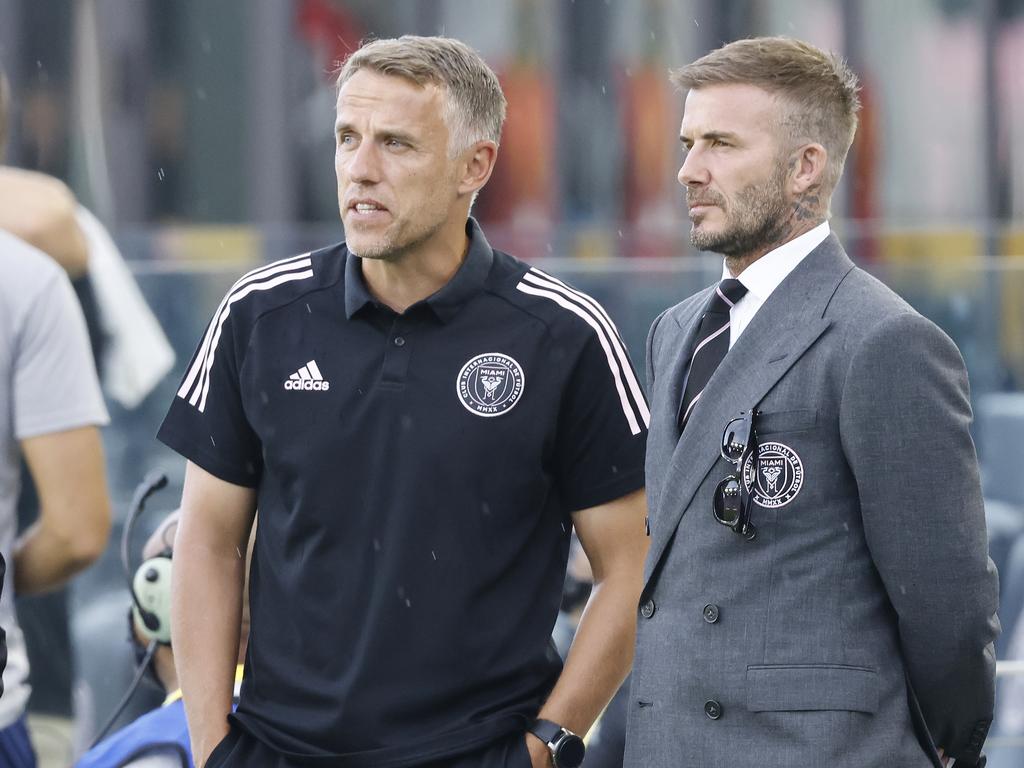
A life less ordinary was Phil Neville’s objective when he made the transition from professional player to coach, and here at Inter Miami he has certainly found that.
As he conducts a tour of the MLS club’s super-smart complex in Fort Lauderdale, Neville explains how training can be halted by a siren that signals the threat of an electric storm. “If that goes off we have to come in,” he says. “The climate is fantastic but, honestly, you’ve never seen rain like it.”
Some of the local residents can also cause a bit of disruption. Neville points to a harmless lizard but says that a rather gruesome-looking snake sparked a degree of disquiet the other day.
However, it is when Inter Miami’s head coach eventually sits down in his office and talks about the ambition of the franchise that things get really interesting. Lionel Messi? Yes, there does appear to be a genuine desire to sign him at the end of this season.
There is also the unique challenge for Neville of having David Beckham as his boss when, for most of their lives, they have been close friends, teammates and, more recently, business partners as the Class of ‘92 co-owners of Salford City. Does it mean Beckham would struggle to fire him? “No,” Neville says with a smile. “I think he would do that fairly easily.”

He reveals there is also a slightly tense situation developing under the roof of what is the new Neville family home, having sold up in Manchester and bought a house in Florida.
Harvey, Neville’s 19-year-old son and a right back who may be on the bench for Miami’s opening MLS game of the season against Chicago this weekend, wants to move out.
“Julie has said she’ll divorce me if he goes,” Neville says. “But the lad wants to fly and I do think it will be for the best.
“He’s my best friend, I love him so much. But I also have to be hard on him. It’s more difficult for him to get in the team than anyone else, and he has to live with that stigma of being my son.
“That, however, can make it tough when we both get home from work. I might be on the phone talking about training, or a performance, or another player, and that creates a conflict. I’ve spoken to people who have been in the same situation and they all say it can become tricky.
“Harvey has some good friends in the squad and all the players live in the Las Olas area [towards the beach] and he wants an apartment down there. He’s looking forward to it. Of course, when it comes to it, I’ll probably be the one who’s told to go and live there.”
Romeo Beckham is also at the club, and Neville obviously takes a special interest in a young right winger he has known since he was a baby. “He’s a delightful kid,” Neville says. Do the two boys have what it takes? Instinctively protective, Neville will concede only that they have a chance.

Right now his main focus is on the job, the team, the project. Neville is entering the second season of a two-year contract, with no guarantees of a third, but the intriguing prospect of potentially working with one of the two best players in the world.
Jorge Mas, a co-owner of the franchise alongside Beckham, told the Miami Herald last June that they wanted Messi. Beckham echoed the sentiment, speaking of “huge ambitions” for a club he is hugely passionate about. Messi, himself, has made no secret of a desire to one day live and play in the United States. He already has a home in Miami and there is a sense here that he really could move to the club from PSG.
“This club will always want to bring a superstar to Miami, and a lot of top players want to come here because of where we are,” Neville says.
“If Messi comes we will have to see what happens. The fact is you have to be successful on the field in any job, and I am no different to any other manager. I want longevity here, of course. But the club needed a reset. That’s why I was brought in, to lay those foundations.”
His first season was difficult, not least because of a situation he inherited. Sanctions for breaches of salary cap and roster regulations left Neville hamstrung when it came to recruitment. “We had to get 19 players and could only bring 12 in,” he says.
“We suffered because of the sanctions. That said, it also enabled us to get rid of some players who were only here for the money; selfish players in some cases. We’ve got young hungry players now, and we’re more of a team.”
There were, by his own admission, “some difficult moments”. “We lost 5-0 at home to New England,” he says. “We lost six games on the bounce. I was thinking I could be in a bit of trouble here. In the Premier League I’d have gone. But the owners were strong. They knew what was going on.
“People ask about the relationship with David. There are pluses and minuses, but one of the biggest pluses is that he trusts everything I’m doing. He knows what I’m doing. We speak regularly about it and he understands what is needed. David is big on culture, the environment, hard work, the young players. He was hugely involved in the kit design, the detail [the pink and black is deliberately art deco Miami].
“When he comes in here he doesn’t ask me about tactics or the team. He asks me about the culture. He wants The Cliff [Manchester United’s old training ground] here. That’s his vision for this place.”

Yet exactly how do mates, great mates, do the whole employer-employee thing? Beckham, like the other owners, is said to have ploughed a fair bit of money into this club, after all. The training ground and the adjacent DRV PNK Stadium, complete with its 18,000 seats, cost in the region of $60 million.
“Since I’ve come here we’ve probably been more disciplined in our friendship,” he says. “He’s my boss, and there is a clear distinction between how we speak to each other, the way we behave. We probably haven’t been for a meal as friends in the nine months I’ve been here. But that’s the way it has to be.”
So he could sack him? “Of course, just like Gary [Neville’s brother] at Valencia,” he says. “Peter Lim [the Valencia owner] is one of Gary’s closest friends, but it still happened. Right from the start, David and I said to each other that, whatever happens, this will not impact our friendship.
“To be honest, I think we’d both know if it’s time for me to move on. But until that day comes, he’ll back me.
“There were times last season when I knew he wasn’t happy, but it’s actually an easy conversation. We had those conversations at Manchester United, when someone would say, ‘That’s not good enough.’ He wants to win, regardless of whether I’m the head coach. Every defeat hurts him.”
For 45-year-old Neville, this is what he craved; what he envisaged for himself and his family when he finally called time on a fine career as a player for Manchester United, Everton and England.
“I wanted a coaching career that would be a bit different; offer me different experiences,” he says. “It’s why I’ve gone from Manchester United to Valencia, to England Women and now here.
“When I finished my playing career, I wanted to move away from home and learn a language. I wanted to experience the things I couldn’t when I was playing. As a player you’re cocooned, doing the same stuff every day. I took a military-style approach to that. I was so regimented in everything I did. I had the same schedule for 20 years; you speak to my wife.”
He has always been an early riser. “As a player it was 6am,” he says. “Here it’s 4am, because four to six is the only time I have to phone my mum, speak to family, catch up with things.
“I wanted these experiences for my family too. Valencia was a great experience. We all learnt the language. It’s why we stayed for another two years. The whole family speaks Spanish. And we love this part of the world. We used to come on holiday to Miami every year. We had our honeymoon here.”
It was one reason why he had to take this job, although he admits it did mean “breaking a promise” he had made to Baroness Sue Campbell, the director of women’s football at the FA. “I made a commitment to Sue to stay on for the Olympics in Tokyo,” he says. “So I did feel as if I’d let Sue down, because I love that woman and I’d broken a promise. I didn’t like that.
“This job came up in the December and at the time it was 50-50 as to whether the Olympics would even go ahead, and I was concerned this opportunity might not come up again. Even so, it was one reason why the ending wasn’t great for me; there was some sadness after what had been a special period in my life.”

He was not entirely happy that the FA announced he would not be staying beyond the end of his three-year contract. “England was an incredible education but I hated the way it ended,” he says. “The World Cup [in 2019, when England finished fourth] had been great but, with Covid, things had lost momentum. Tournaments were pushed back, the Olympics were postponed. Sue and I had a chat and I just felt it was the right time to move on.
“Sue has a way of doing things and she wanted it out there that they were looking for a new coach. That’s fine, but for me it meant the players switched off. I suppose that’s international football, where you don’t get to say goodbye. I’d have rather gone out at the end of a tournament.
“Sue was great though; a massive influence. She had the courage to fight the establishment. Sometimes it was exhausting. They’d give you something, and then take it away again. For example, they [the FA] said you can go business class to the SheBelieves Cup. The players were so chuffed because that’s what the men get. It was like giving them a million pounds. And Sue and I would be thinking, ‘We’ve won.’ And then maybe a month later, we’d be flying EasyJet to a game when the men’s under-21 team would be flying on a private charter. Every day, Sue would be battling away. We didn’t always agree on stuff but I found her inspiring.”
He felt the same about the players. “It was an incredible education,” he says. “I’ve worked with some of the very best male players as a coach, but that group of England players were so inspirational. Just the best experience, working with them. I don’t think there’s a day that goes by where I don’t speak to someone from the team or from the women’s game.
“I would reflect on my own experiences as a player, the pampering, and it was quite humbling. The sacrifices many of them had to make. The prejudice some had to deal with. The main thing I wanted to change; I wanted them to experience what I had experienced. It wasn’t just, ‘How do we win?’ It was, ‘How do we give them greater visibility?’ I felt quite emotional when we had nearly 80,000 at Wembley for the Germany game. Everyone said no to the BBC fly-on-the-wall documentary before the World Cup. I said, ‘We’re doing it,’ because I wanted people to see what I’m seeing.
“I’d do games for TV and guys I was working with would be saying, ‘What’s it like working in the women’s game?’ I’d say they’re unbelievable — [Lucy] Bronze, [Steph] Houghton, [Jill] Scott, [Karen] Carney. They reminded me of players I’d played with. Jamie Carragher, John Terry, Steven Gerrard. They had the same mentality. I used to look at Lucy Bronze and think of my brother. So similar. Blinkers on. Knew where they were going. People say don’t compare. But all I could see were similar attitudes, the same mentality, great athletes. But they’d had it so much tougher.”

He is disappointed that his successor was not English. “We’ve got that centre for English coaching at St George’s Park and yet we’ve gone Dutch [Sarina Wiegman],” he says. “I wish her all the best but I really wanted an English coach to succeed me. I thought Casey Stoney should take over. Rehanne Skinner is now third in the league at Tottenham. Emma Hayes is probably the best in the world. Bev Priestman guided Canada to the Olympic title. There were definitely English options.”
His passion for the women’s game clearly remains strong. “I’m not finished in women’s football,” he says. “At some point in the future I’m sure I’ll return to it. I still feel there is so much growth.”
Now, though, it is only about Saturday. We head for lunch to a delightful spot on one of Fort Lauderdale’s inland waterways, watching speed boats and some fairly spectacular yachts float past. “This is my last break before the weekend,” he says. “It’s back to PCR tests tomorrow and then the game.”
The alarm is already set.
– The Times

Sydney football club mourns player killed in Bondi terror attack

The Tackle: Mata has last laugh over ‘embarrassing’ Wanderers

The Melbourne-born teen who has world football giants circling

Vergos ends drought with brace in original derby win

Victory ‘bleeds success’: This star knows that better than most
