
Cristiano Ronaldo’s poor free-kick returns are a mark of his waning powers
Cristiano Ronaldo’s ineffectiveness with the knuckle-ball free kick is an example of the Portuguese forward’s diminishing influence in the game.
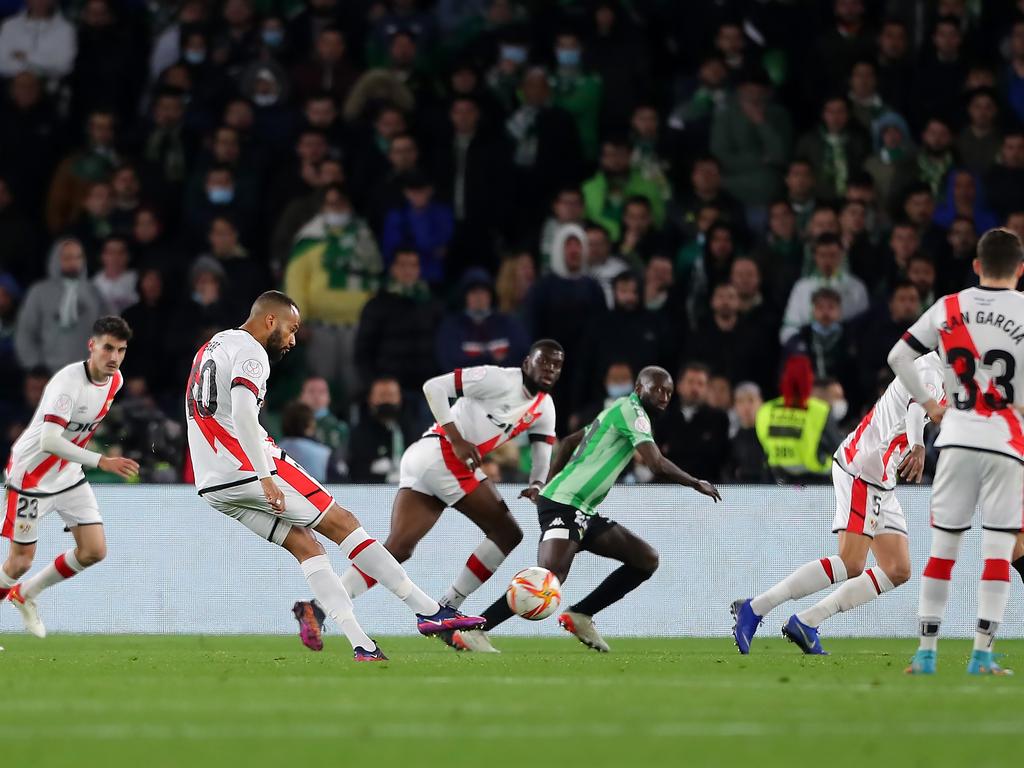
This week a thirty-something Portuguese forward, one of Sir Alex Ferguson’s most famous signings, rolled back the years and screamed home a free kick. It was an astonishing strike, hit from 30 yards with that strange, wobbling, trajectory known as a “knuckle ball” and it seared past a leading goalkeeper into the top corner.
But the taker was not Cristiano Ronaldo — come on, this isn’t 2009. Rather it was Bebé, scoring for Rayo Vallecano against Real Betis’s Claudio Bravo in Spain’s Copa Del Rey. It seems that even a player once dubbed “Manchester United’s weirdest transfer” is trolling Ronaldo over what was once a trademark but is now his agony: set-piece goals.
Before last round’s Manchester derby, Pep Guardiola spoke with diplomatic respect about “one of the greatest” players, suggesting Ronaldo remains a “goalscoring machine” but even if Ronaldo can emerge from his worst trough since his teenage years (for that’s what his 2022 form represents), it is hard to imagine one particular part of the contraption getting fixed.
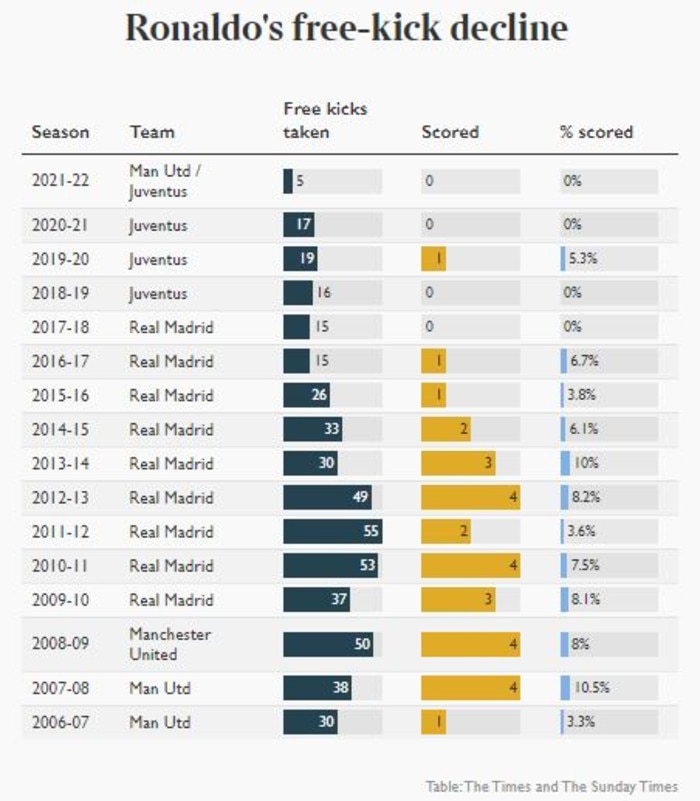
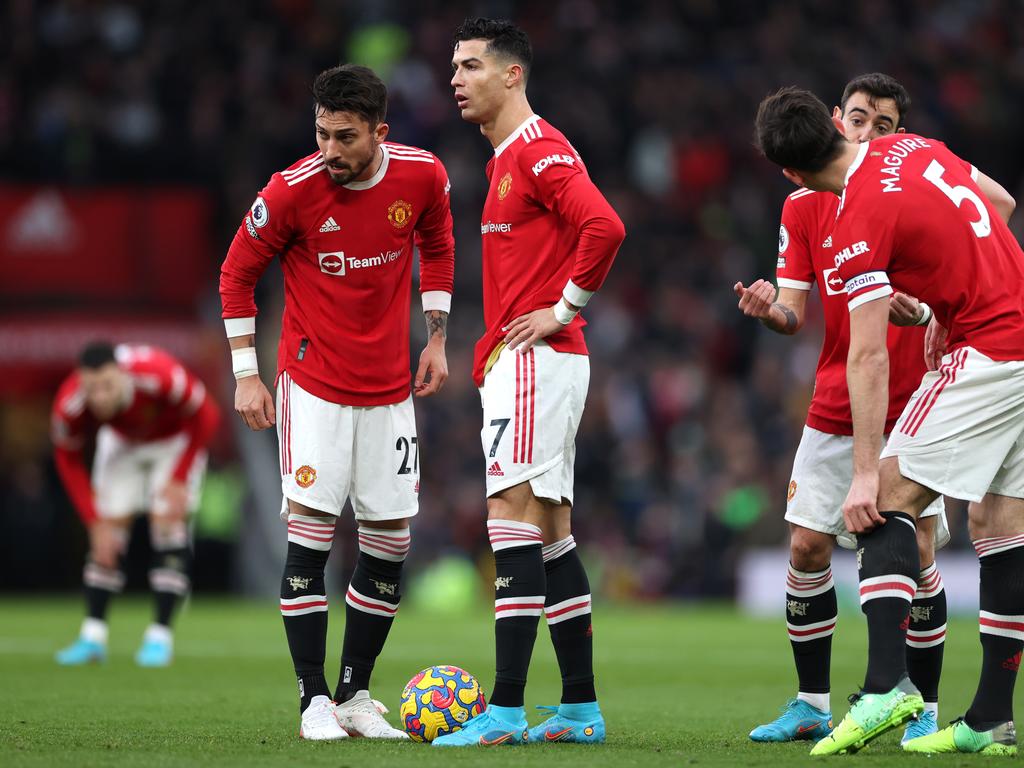
The free-kick radar: Ronaldo has scored only one of his past 79 free kicks in league football and none in the Champions League since September 2016. For United in 2021-22 he has had nine fruitless attempts, the most recent a rather anguished effort against Atletico Madrid that was still rising as it flew five feet over the bar, while Bruno Fernandes lowered his gaze and Alex Telles stood, hands on hips.
Ronaldo let Telles take United’s most recent free kick (versus Watford) so perhaps he is finally willing to give up duties, and one of football’s most stubborn sights will be no more: that of Ronaldo, grabbing the ball, placing it meticulously, adopting his studied stance and routine … then smashing it high or into the wall.
Four of Ronaldo’s five Premier League attempts in 2021-22 were blocked and the other missed the target. No goalkeeper has been tested and there has been a paradigm shift inside Old Trafford. There, once upon a time, when Ronaldo lined up a free kick opposition fans could barely look. Now it is home ones.
What happened to the marksman who has still scored more free kicks than any player in Champions League history, who in his first spell at United became synonymous with dead-ball prowess, the “Rocket Ronaldo!!!” of Sky Sports commentary when he struck against Portsmouth in 2008, acclaimed by Ferguson as the Premier League’s best free kick ever?
There are theories. One is that a chronic injury that flared up in 2014 — tendinosis, affecting the region around his left kneecap — has compromised his kicking. Another blames a tweak of technique that occurred around 2011, when Ronaldo switched from a distinctive way of hitting free kicks with the top of his foot to a more sidefooted style, seemingly in search of greater accuracy.
But what if the whole idea of Ronaldo as the fallen free-kick master is based on a false premise? He has certainly scored big and spectacular goals from set pieces (his first strike for United was a free kick, as was his 100th for Portugal) but has the frequency ever been that impressive?
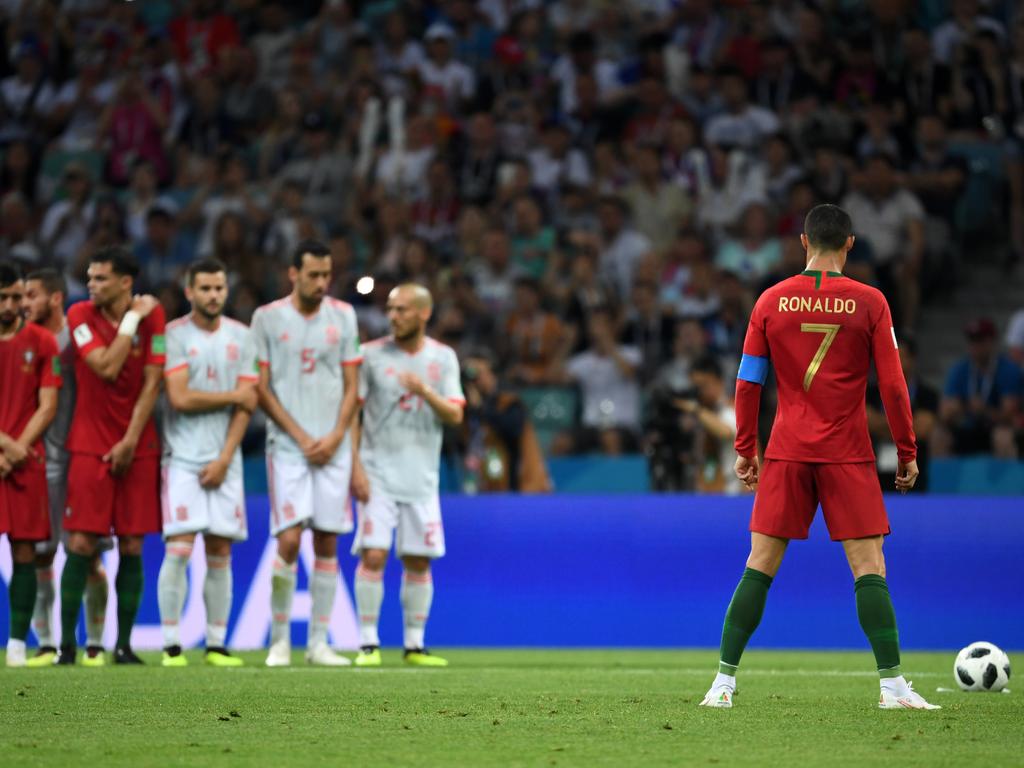
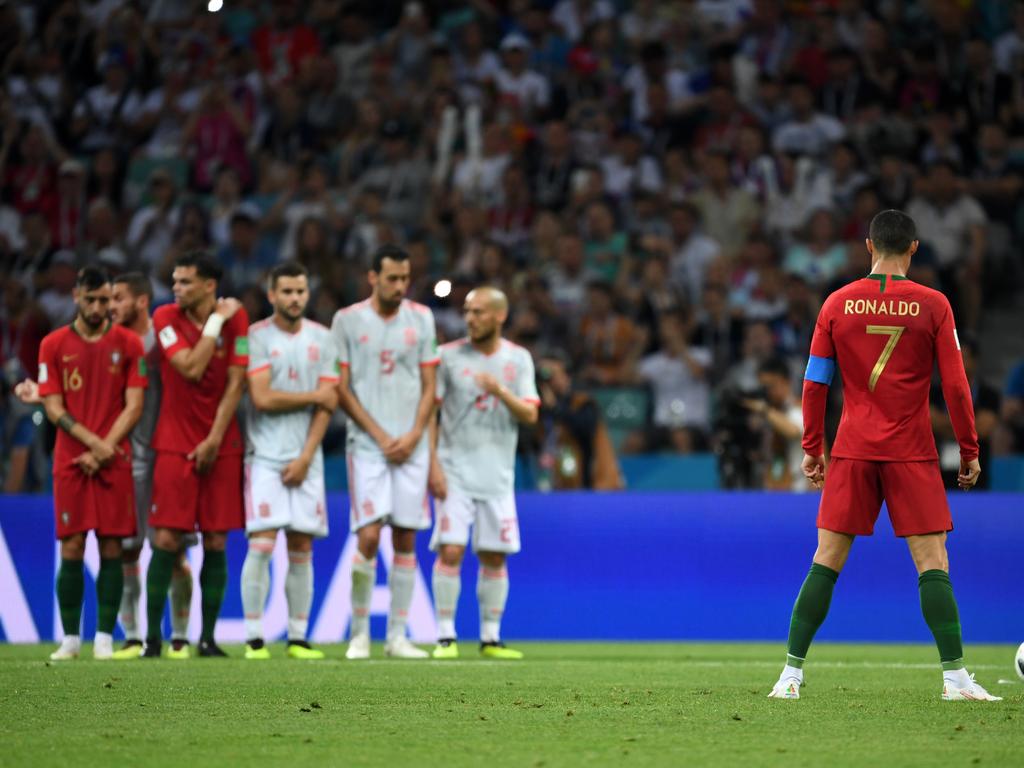
For example, his last-minute equaliser in a 3-3 draw with Spain at the 2018 World Cup is part of his legend, but it stands as his only converted free kick in 51 attempts at leading tournaments since 2004. He has 55 career goals (including internationals) from free kicks — but has played 1,111 games.
Bartek Sylwestrzak is perhaps football’s leading ball-striking specialist coach. The first point the Pole makes is that the lack of understanding and coaching of ball-striking is “the greatest paradox in the game” — it’s one of its most important, yet also most understudied and undercoached elements, and one that defeats even great players. “With Ronaldo, we’re talking about a top player suffering from the same technical problems for about 15 years now. He’s not been able to solve them himself and he’s not had anyone to help him,” Sylwestrzak says.
Ronaldo should be the best ever. “His type of co-ordination and movement characteristics are perfectly suited for shooting and he’s got great explosiveness in the swing,” Sylwestrzak says. The fact he’s not had the instruction means his potential has not been realised. With the number of opportunities he’s had he could have beaten all records.”
Even in his peak period, when scoring 24 league free kicks for United and Real Madrid from 2008 to 2014, Ronaldo’s conversion rate was 7.7 per cent. This compares with 11 per cent for Lionel Messi during his zenith and the 13 per cent, achieved since the start of 2013-14 by James Ward-Prowse, rated by Guardiola as “the best taker right now in the world”.
But, for Sylwestrzak, the common perception of free-kick excellence is flawed. If you want to see what it truly looks like, he says, study a legendary trinity of Brazilians: Juninho Pernambucano, the former Lyons midfielder who scored a record 78 free kicks, Marcelinho Carioca, whose sublime ball-striking earned him the nickname “Angel Foot”, and who scored 77 free kicks plus three goals direct from corners, and Marcos Assunção, who in two years at Palmeiras scored 25 free kicks. Compare that with David Beckham, who took nine seasons to reach his Premier League record total of 18.
The analysis doesn’t exist, but given their exceptional technical abilities, the probability of scoring for each of the Brazilian legends was far higher than what we see with even the most highly rated specialists today and what is definitely true is all three were masters of topspin — the most lethal skill a free-kick taker can acquire. Topspin is what gets a ball over a wall and back down again so it drops under the crossbar. Its opposite is the “knuckle ball”, whose strange trajectory is a result of a slow spin.

Juninho was an anomaly — a maestro of both. Ronaldo, Sylwestrzak says, has never mastered the lifted topspin shot that was used by the Brazilians, which is technically a different type of strike. He “relentlessly” hits knuckle ball kicks. They brought success early in his career (13 of his first 25 free-kick goals were knuckle balls) but often when striking from distance (like his 40-yarder against Arsenal in the 2009 Champions League semi- final). Now he blasts them from close range. Which is why he is far more a hazard to the wall than the scoreboard. “With Ronaldo there is clearly a struggle to lift the ball well. He’s been hitting the wall for about 15 years now.” Sylwestrzak says. “For Juventus, 58.1 per cent of his free kicks went into the wall.
“He tries to apply his knuckle ball technique to go over the wall and even though he can put forward spin on the ball with this swing, he is not getting the height. He occasionally made some small changes to his technique but never implemented the principles needed for him to become an expert in the topspin free kick over the wall which was the main source of goals for Juninho and Assunção. Using the same swing to try to get it up and over the wall — like he’s been doing for years — was doomed to fail.”
Juninho, who arrived at Lyons in 2001, popularised the knuckle ball in Europe, and Ronaldo was an early adopter. But goalkeepers are more used to the technique now and are perhaps more attuned to deal with such strikes. Even when Ronaldo does get one of his strikes past or through the wall, it’s more “savable”.
Cathy Craig, professor in experimental psychology at Ulster University, is a world expert at using virtual reality to study decision-making in sport. Her company, INCISIV, uses VR to train goalkeepers, with free kicks an area of interest. “Wobble is more lethal than spin: harder for the brain to anticipate,” she says. “Goalkeepers start to learn how to deal with it.”
There have been 13 free kicks scored in this season’s Premier League and only one, from Ward-Prowse, was a knuckle ball. Ronaldo? Of his past two free-kick strikes in league football, one was a deflection — but both (for Juventus v Tornino in 2020, and Real Madrid v Atletico Madrid in 2016) were in derbies. And you know what he’s like. Even against the guy who lands one shot in 79, City cannot entirely relax.
-The Times

SuperCoach EPL: How to replace missing AFCON stars

City, Villa keep heat on Arsenal as Spurs fall to Ange’s old side

Slot laughs off farewell game whispers for Salah after tirade

‘No right’: Prickly Slot confirms Reds retaliation after Salah rant

Extraordinary tirade could end Salah’s legendary Liverpool run
