
Marcus Rashford’s chance to reset after year to forget with Manchester United and England
With a new manager in place ahead of a new season, England and Manchester United star Marcus Rashford will be desperate to turn his career around after a dire 12 months, writes JONATHAN NORTHCROFT.
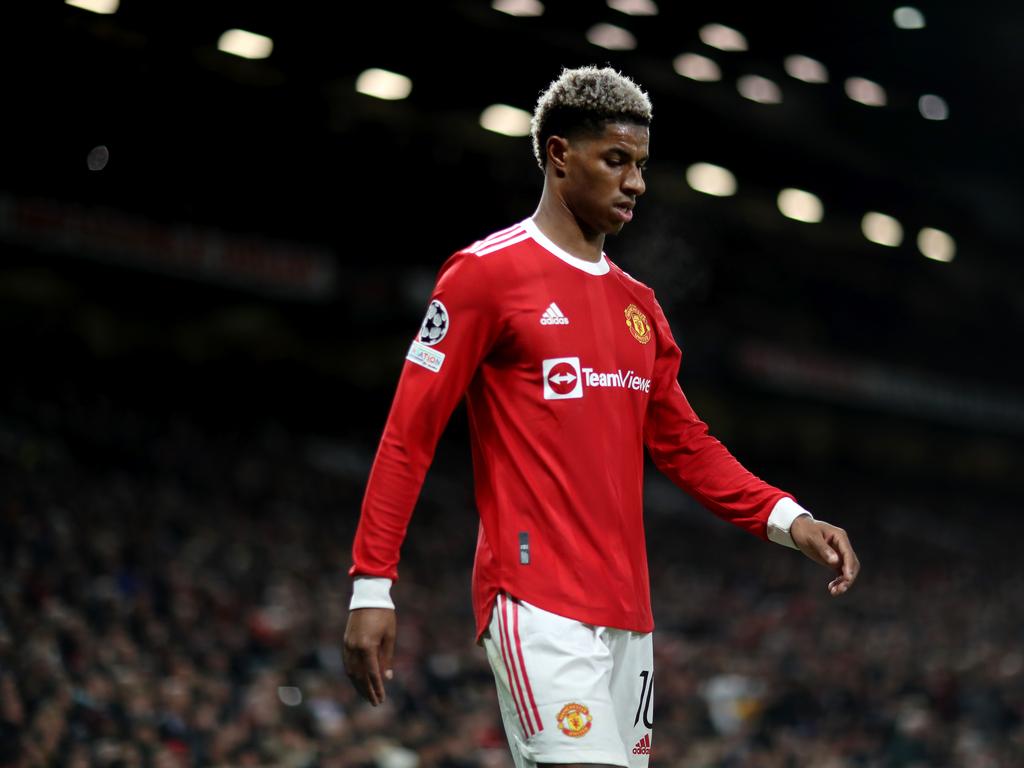
Almost a year ago a young man stood, trying to shut out the noise, facing one of those moments that resonate for a lifetime.
Destiny lay 12 yards away and depended on the white ball, on the white spot, he was about to strike with his green-booted right foot. He stood, telling himself: “I can score penalties in my sleep” and yet – he admitted subsequently – “something didn’t feel quite right”.
He stood, knowing if he beat Gigi Donnarumma, England would have one hand on a first major trophy since 1966 but that if he did not, the personal consequences would not be pleasant.
He stood, perfectly still, body angled, as Wembley held its breath.
He stood.
And stood.
Marcus Rashford broke a world record in the final of Euro 2020, standing over his penalty longer than anyone has ever stood over a kick in a big tournament shootout. Eleven seconds: that’s the remarkable time Rashford waited, from referee’s whistle to making his attempt.

For comparison, the average “wait time” for successful takers in shootouts at the tournament was 2.5 seconds. Why Rashford’s delay? “PRESSURE! A final. 55 years of hurt. Wembley. Substituted on too late. Hardly played in previous games,” wrote Geir Jordet, the football psychology researcher, acknowledged as the world’s foremost authority on penalties.
When Rashford finally did take his kick, it struck a post and stayed out and he bent double burying his face in his palms. The shootout shifted in favour of Italy, who prevailed as Jadon Sancho and Bukayo Saka also missed, and Rashford’s anguish was undiminished when he posted one of his Twitter messages to the world, the next day – an apology for “letting everyone down”.
“A penalty was all I’d been asked to contribute for the team … All I can say is sorry. I wish it had of gone differently [sic],” he wrote.
A young star. Under pressure. Frozen. Desperate to do his best and prone to take things to heart: it’s hard to remember that image of Rashford waiting, and waiting, ball on spot, and not perceive it as a metaphor for the past 12 months of his career. Off the pitch, he received an honorary doctorate, won book awards, got engaged to his school sweetheart and continued to do incredible things to help children and the poor. But on it, he seemed so flat, so stuck.

Rashford’s 2021-22 was by far his worst season since his coruscating breakthrough, aged 18, in 2015-16. His paltry Premier League numbers: four goals, two assists, only nine key passes, a lowest-ever dribble success rate. He hasn’t played for England since the Euro final and CIES Football Observatory, having named him the world’s most valuable player 18 months ago, with an estimated transfer worth of pounds 150 million, has downgraded him to the pounds 35 million-pounds 45 million range.
A coach who knows him well says that you still shouldn’t doubt his gifts and potential, but senses a player struggling to find his way, who has suffered from changes of manager, changes of position, and the endless cycle of hype, failure and criticism that has, throughout his career, beset Manchester United. His mind seems “clouded” – but the one person who can clear it is him.
This tallies with other opinion, from those who have worked with Rashford, and those in football who have observed him closely, as well as this writer’s personal one – a talent in limbo, who has been hard done by, but ultimately holds the key to himself. Perhaps thankfully, Rashford also sees things this way. He accepts responsibility for his dip but is determined to fight back rather than dwell on it and worked concertedly during his summer break so he could return for pre-season training under Erik Ten Hag in the best possible shape.
Before reporting to Carrington on Monday, Rashford spent two weeks abroad, training in a gym by himself, then undertaking a two-week fitness camp at the LeBron James Centre at Nike HQ in Portland.

He has resolved that the past year won’t define him. Ralph Rangnick observed a player who could dazzle in training then be subdued in the game, and did not have the time to get in his mind and understand why. Other managers have liked his humble, attentive nature and appreciated his dynamic skills – especially in the transition – but not defined his jobs on the pitch. Last season alone he played five positions in four systems and across his United career been used 147 times in his favoured left-wing spot, and exactly 147 times in other roles.
It feels a collective, cumulative failure by a club to clear the pathway for its star academy graduate and for England his position has also switched around. His Euros do not represent Gareth Southgate’s finest piece of man-management. Rashford delayed surgery to play at the tournament and was built up by being made captain for England’s final warm-up game, against Romania, but then didn’t start a single game.
His five substitute appearances were in four different positions – including right back, which he was sent on to play with one minute remaining of the final, so he could be a taker in the shootout. Hence, the angst in that line he tweeted: “A penalty was all I’d been asked to contribute … all I can say is sorry”.
The surgery was to correct an issue with his left shoulder that he had lived with since suffering a back muscle tear in November 2020. In January of that year he suffered a double stress fracture in his back having previously played through a packed festive period with a single stress fracture. Before that he had been using an ultrasound machine to ease movement in his back for two or three years.
He also played with a piece of bone floating in his ankle, after fracturing the joint against Liverpool in February 2019 and is nothing if not game and physically brave. At only 24, his next appearance will be his 350th in senior football – and so this summer, his first one off since his teens, brought welcome scope to recharge and reset. It is worth noting that before the double stress fracture he had been flying – scoring 29 goals and providing 12 assists for United in the first year of Ole Gunnar Solskjaer’s management, while enjoying six goal involvements in seven games during that period for England.

After the Euro 2020 final, Rashford was the victim of vile online abuse – a portion of it racist – and a mural of him in Withington was vandalised. A Conservative MP, Natalie Elphicke, apologised after suggesting that “Rashford should have spent more time perfecting his game and less time playing politics,” in apparent reference to the player’s campaigning over the provision of free school meals, through which he forced a u-turn from Boris Johnson’s government.
The snide strain of criticism that links Rashford’s social missions to his drop in playing performance seems uninformed, “footballers should stick to football”, dinosaur stuff. Last season he was involved in very little off-field work and United are across everything he does, in that regard. A Euros hangover and not starting the campaign until mid-October (as a result of the surgery) are more obvious factors sparking his drop.

It will be interesting to see what Ten Hag, the arch coach, does with the details of Rashford’s game. Whether he starts on the left, the right or at centre forward (where he broke through, and where he was being developed at United’s academy), he will have to improve with back to goal and in terms of pass-and-move, given Ten Hag’s emphasis on possession. He could also do with scoring more “easy goals”, on getting into more close-range positions and finishing clinically. This may come down to repetition on the training ground and a coach clarifying to him that these skills should be his focus. Five headed goals, for a forward, across 6 and a half seasons, is not good enough either.
At perhaps Rashford’s zenith, when he scored a 14-minute hat-trick against RB Leipzig in the Champions League in 2020, Paul Scholes compared him to Ruud Van Nistelrooy and it’s worth recalling Van Nistelrooy’s uncluttered genius in how he approached forward play.
“At that moment, in front of goal, there’s no ‘next,’” he once told me. “There’s no future or past. It’s only, purely, the moment. And when you’re at your best, you’re so in the moment that nothing else is there. You don’t see the crowd, you don’t think of anything. In your mind … there’s nothing.”
For Rashford – new season, new manager, new start – there’s an opportunity to clear the mind and make the clouds lift.

City, Villa keep heat on Arsenal as Spurs fall to Ange’s old side

Slot laughs off farewell game whispers for Salah after tirade

‘No right’: Prickly Slot confirms Reds retaliation after Salah rant

Extraordinary tirade could end Salah’s legendary Liverpool run

City closes gap on Arsenal as 18-match unbeaten run comes to end
