
Fixing Australian football’s broken pathways: The critical development calls coming in 2022
In a World Cup year, the system that puts the Socceroos on the global stage is in dire need of an overhaul. But make the wrong move now and it could set Australian football back a decade, writes ADAM PEACOCK.


Before the ins and outs of what utopia looks like, some ready-made examples of where Australian men’s football is really at.
Birkan Kirdar is a talented young player. A quick-thinking midfielder, he made his debut for Melbourne Victory as a 16 year-old and looked to be on the path to a successful career.
In the four years since his debut, Kirdar has played 27 senior games for Victory.
Fair enough, he might not quite be ready. Needs more time.
Where he has spent that time though has not helped one bit.
When not involved with Victory’s first team, Kirdar drops down to the youth side. Due to the upheaval around Covid-19, there hasn’t been a national youth comp involving the A League clubs since 2019. Even then though it was a laughable eight-game competition.
Kirdar’s other game time comes with Victory’s NPL (National Premier Leagues) side in a competition that runs from March to October. The A League runs October to May.
And not only are the seasons misaligned, Victory play in the third division of the NPL – the fourth tier of Australian football.
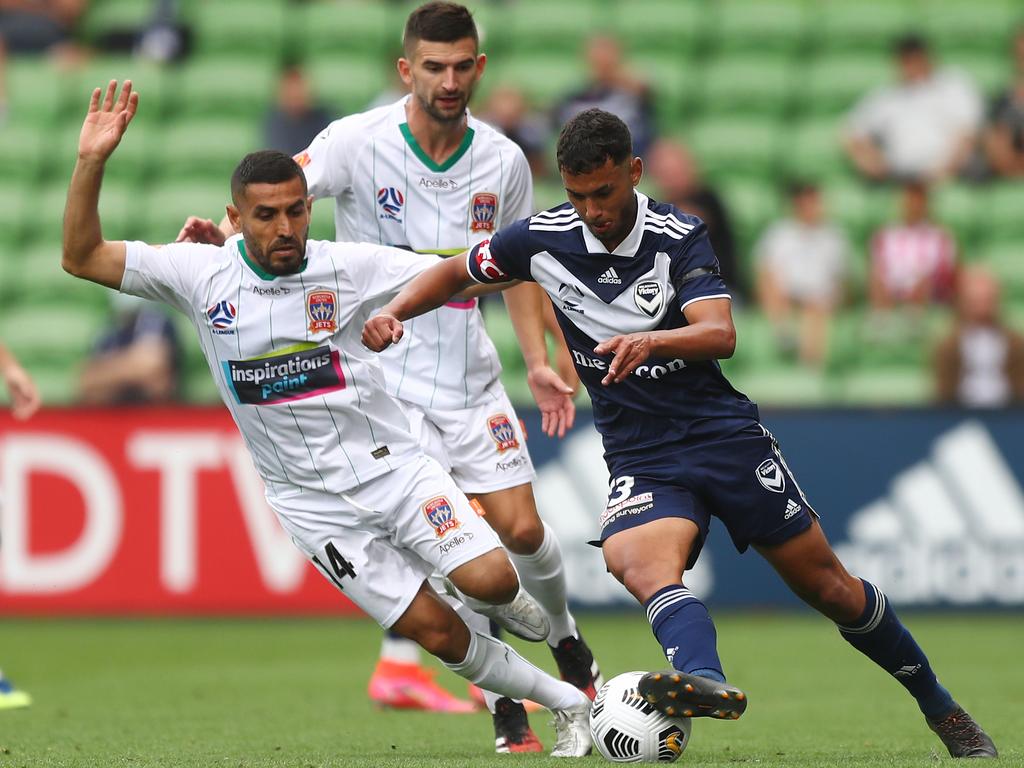
Kirdar can’t go out on loan to a local NPL 1 side, because being on the cusp of first-team selection up until May, he’s one injury crisis from being needed more in the A League.
And when Kirdar is called up, is he as ready as he can be?
Imagine, for a moment, an AFL or NRL player being on the cusp of first grade, but the only time they can keep up their match minutes is out of season, and at the fourth tier of competition. It is as laughable as it is nonsensical.
“We have a system based on compromised decisions, not with the player at the centre,” says John Didulica, Victory’s director of football, who has also worked as head of Professional Footballers Australia (PFA, the players union).
“We shouldn’t be focused on meeting our own standard, we are part of a global sport, so the focus should be meeting world standards.”
By the way, young players in Europe don’t play out of season, nor in eight-game youth leagues.
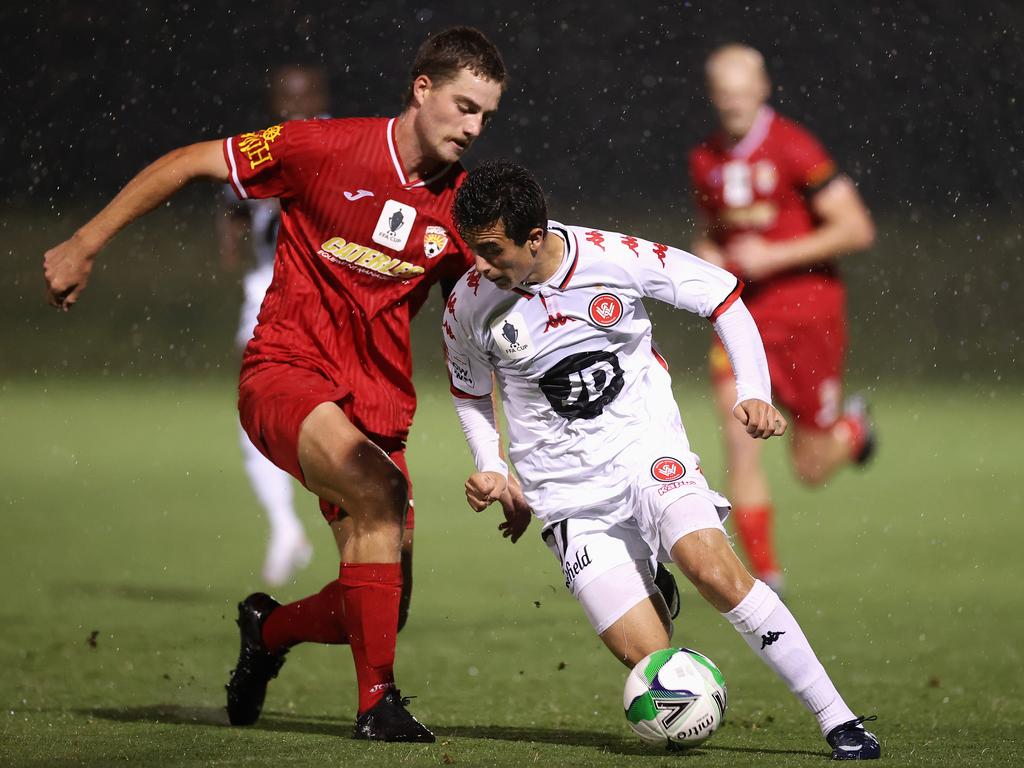
Alex Badolato of Western Sydney Wanderers is where Kirdar was four years ago; a 16-year-old of immense promise.
Badolato has played and scored for Wanderers’ first team after coming through the club’s youth academy from under 13’s. He was part of an age group at Wanderers that was simply outstanding. This writer saw that team play numerous times, and it was as good as any youth football you’d hope to see. Ball movement, positioning, decision-making ahead of their years.
Badolato is the first to transition from that group to men’s football. But now what?
He needs more time to develop from boys to men’s, and at a club like Wanderers, perennially under pressure to perform, his opportunities will be limited behind more seasoned pros.
Minutes for Badolato are crucial in the next three years.
His options are to stay at Wanderers and play out the A League season with the NPL side, as well as hoping a national youth league is re-established. Or he leaves Wanderers to an NPL club waiting for the second-tier competition to start.
Time is ticking.

Don’t get bitter, get better
Big decisions, from which big opportunity can spawn, will be made in Australian football in the next 12 months.
A long-awaited national second division is a go.
Football Australia CEO James Johnson told CODE last week “it’s going to happen in 2023.”
The FA boss also sees the implementation of a domestic transfer system as key. At the moment there are A League clubs at the top and then state-based NPL clubs underneath, where lots of young talent emerge from, who once upon a time played as kids at grassroots level with their mates.

Johnson wants to incentivise clubs to produce players under the A League level, and collect due compensation for it should they be good enough to progress up, and beyond that, hopefully overseas.
The game has been desperately searching for reconnection mechanisms since the great political bonfire of 2004, when the Frank Lowy-led FFA charged into a new era by casting aside the traditional NSL (now NPL) clubs for a closed-franchise model. The A League was born. Bitterness ran rife, and continues to lurk.
“At every level of the game there remains hate,” one source involved in youth development told CODE.
“The associations hate the state federations, the state feds hate the A League clubs, the A League clubs hate the FA.”
Brutal, but hard to argue.
Collective ambition is critical, and at the top, green shoots have emerged.
In days gone by, Football Australia (previously the FFA) had been accused of ignoring everything underneath A League level, and making judgments on best practice youth development based on cost, rather than what was best for the player.
Dollars and cents are still relevant, but developing players can’t afford more neglect.

A first-rate second tier
Every person CODE spoke to for this article agrees on two matters. Young players need more match minutes to develop.
And a second tier of professional football in Australia needs to happen.
Young players find it hard to get regular minutes in the A League. Though the average age in the past two seasons across squads has dropped from 27 to 25, it’s still an old profile compared to similar football leagues around the globe.
The idea of a second tier underneath, opening up plentiful opportunities for the player in his late teenage years to develop at a higher level is universally accepted as a good idea.
The FA, and Johnson, will make the final call on how a second tier is run.
There is a network of clubs from the second tier down who are linked through the Australian Association of Football clubs (AAFC), who for the last five years have been pushing hard for a national second tier. Some call it a second division, but that alludes to football’s traditional promotion-relegation format, which is for further down the line.
“Promotion and relegation to and from the A Leagues is not on the agenda now. The focus is on setting up a competition, and growing from there and we expect it will then follow,” AAFC Chairman Nick Galatas says.
More than 30 clubs have registered an interest, including some famous names like Sydney Olympic, South Melbourne, Wollongong Wolves and Adelaide City.
These clubs are adamant the concept is sustainable, with commercial opportunities allowing increased travel, player and coaching costs to be met.

Galatas is adamant their ambition will lead to more chances for young talented players, as well as give opportunities for coaches, referees and others to test themselves at a higher level.
“What we want to do is build the number of clubs,” he says. “That’s not only because we are a club-based organisation. But more clubs operating at a national level means you can accommodate more players and coaches, unlock investment, bring in more supporters and along with facilities grow the game’s footprint.”
A look north to Japan illustrates how far behind Australia has fallen in giving professional football opportunities. This country has 11 professional clubs. Japan has 58.
The AAFC will aim for a younger profile of player, realising a current player in his late 20s, who holds down a full-time job, won’t be giving up, say, six figures as a tradie, to train more and fly around the country on a lower wage.
Dollars and sense
Cost is critical. The A League clubs will tell you that. They’ve lost tens of millions over their 15-year existence, and the bottom line was a big reason why they wanted to break away from the national federation (FA) and run their own race. Which they now do.
The AAFC sees their proposed product as filling a gap in the market, but not at any cost.
“We need to pitch this where we are at, and let it grow,” Galatas says. “We look around the world and think, ‘Look at these great competitions’. Well I wouldn’t mind it if my first house when I was 23 was right on the beach, but it’s not possible!”
The costs of running a national division the way the AAFC and the FA want it remains the great unknown.
This week the AAFC will present a report to the FA which will work through the finer details of developing the competition, and landing on an exact model.
Given how Johnson runs the FA, emotion and ambition won’t be given free rein, and while the sentiment of how wrongly treated the old NSL clubs were in 2004 lingers, the AAFC reckons that’s all in the past.

Participation in a national second tier is not for everyone. There are many around Australia who don’t see it as sustainable yet, with one general manager of a large club in Queensland telling CODE; “we get the ambition and have nothing against it, but we have a responsibility to run a football club of over 80 teams, from kids playing park football to a first team in the NPL.
“At this time, stretching our resources wouldn’t fit that responsibility.”
Galatas is ok with that sentiment. “You can’t design anything that will accommodate everybody, you just can’t.
“We want to help clubs emerge, instead of being suppressed. We reckon clubs will emerge from the state-based NPL comps into this higher division. And we say, ‘Why isn’t that a good thing?’”
The PFA, the players union that looks after contracts and has protecting players’ livelihoods at the heart of their charter, believes in a professional second-tier competition, but not at any cost.
“We’ve got really finite resources in Australia,” PFA co-CEO Beau Busch says.
“I was a player at North Queensland Fury when they went bust.
“Players came back to Australia, left other jobs to commit to growing the game, and within two years they were out of work, defaulting on their home loans and [it] caused a huge amount of damage to the football community in North Queensland.
“This competition needs to be reverse-engineered. Look at the ideal, cost it out, then plan around that, rather than, ‘This is the best we can do and we’ll work around that’. That is likely to be self-defeating and not allow us to achieve the objectives we are all likely to share for this competition.

Market forces or forcing the market?
James Johnson told CODE last week a domestic transfer system, in which Australian clubs can pay for players within the pyramid – as is the case in just about every other developed football nation – is another way to help mind the disconnection.
“A transfer system is the way to create a relationship between a second tier and the A League, because it regulates the player movement, and shapes the economic flows between those levels,” Johnson says.
So instead of the current payment of $10,000 when a player from an NPL player signs his first official A League contract, market forces will determine the value of a player.
The idea is that money then gets pumped back into the selling club, with more resources in club facilities and coaching to help the development of the next player, and so on.
“It’s part of a holistic approach,” Galatas says on behalf of the clubs, “we’re in favour of it along with Football Australia.”
Regulation will be heavy to avoid the controversies of the NSL-era, when transfers between clubs didn’t always filter to the right places.
While not concerned in that regard, the PFA, for their part, isn’t so sure a transfer system will be the panacea others think it will be.
“If we look at the operation of domestic transfer systems around the world, PFA chief Busch says, “they aren’t the pre-requisite of a thriving youth development ecosystem, and they often act as a hindrance to players moving up levels, something the game can ill afford.
“The redistribution down to the lower levels is rare and is often centred on a select few clubs. Relying exclusively on a domestic transfer system for economic safety is a little like relying on winning lotto to pay bills at home. Hardly a sound strategy in isolation.”

Johnson, who in a previous life worked as FIFA’s head of professional football for 5 years, giving him an innate understanding of transfer systems, is certain a domestic transfer system will be beneficial. But as he told CODE last week, “When you put a transfer system on the table, not all stakeholders buy into it. That’s quite frankly a frustration.”
Johnson wouldn’t name those stakeholders.
Meantime, the A League’s clubs (APL) managing director Danny Townsend won’t be drawn on his organisation’s position on a transfer system, as not enough detail has been provided.
Other sources tell CODE there is angst behind the scenes regarding a transfer system. A prevailing belief being money changing hands between clubs won’t change the standard of player, a point of difference to the FA and AAFC, who believe money trickling down will help improve the environment in which those players develop in the first place.
Maybe it’s all academic?
Whatever the case with any potential transfer system, the A League clubs (APL) run their own race now, which curiously comes at a time when most agree the football pyramid needs mending.
Regarding the second-tier competition, CODE threw an idea at the main stakeholders when it comes to implementing a second tier below the A League Men’s.
The APL clubs all have youth academies, home to most of the best young talent in the country, all the way down to under 13s.
Currently the ‘first team’ of those academies, primarily an under 20s side, play in the state based NPL system.
So what if those youth teams, mixed with some experienced heads who aren’t selected in the A League each weekend, could compete in the new national second-tier competition?
It happens throughout continental Europe, with the big clubs playing their developing talent in lower professional leagues.
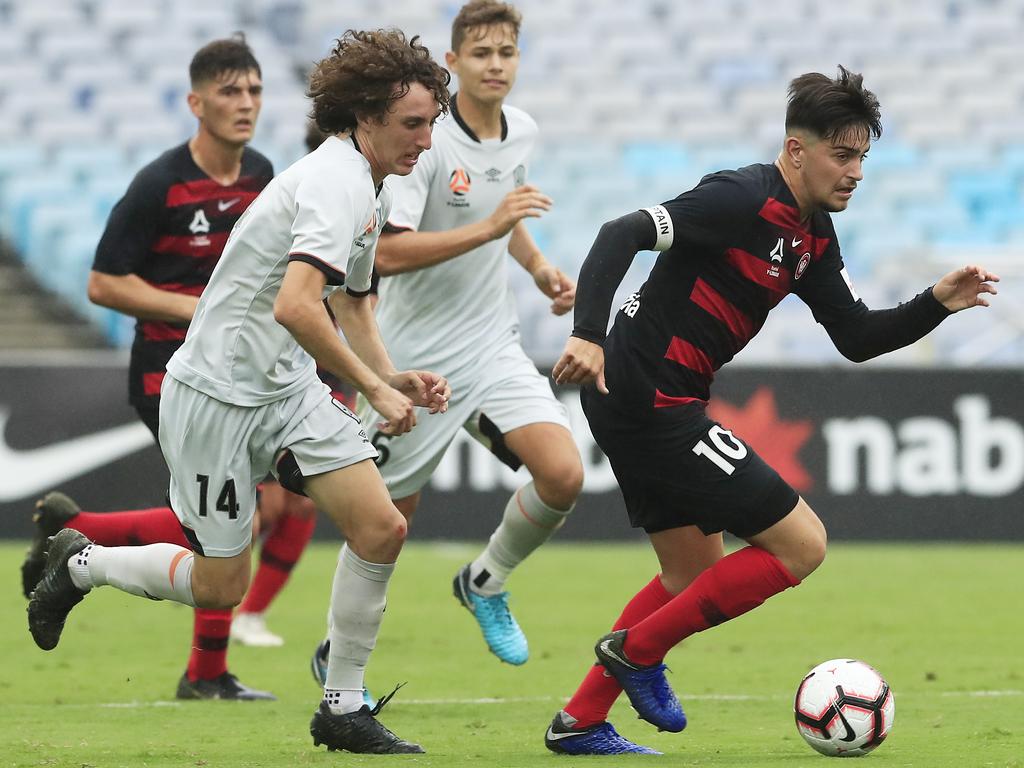
Mustafa Amini, now at Sydney FC, was at Borussia Dortmund as an 18-year-old, playing in the German third division in front of 20,000 away fans wanting the kids to get smashed. It helped him grow up, real quick.
A joint second tier would nearly double the number of clubs involved (from 12-16 to 22-26), allowing a conference system (maybe two rounds v a team’s own conference, one round v the other) that could also cut down travel costs. More money for other resources.
“We’re not against an idea like that,” says Danny Townsend of the APL, “but we haven’t been invited to one discussion about how a second-tier competition looks, and whether we could conceivably be involved in it.”
From the AAFC point of view, Nick Galatas says, “You can’t have A League reserve teams, or youth teams, in a second-tier competition.
“That doesn’t add to the number of clubs, and you’re back to square one.”
Other officials from NPL clubs wanting to be in a national second tier howled down the idea. No chance, no way, was the overwhelming sentiment.
Instead, the APL will look to push on with plans for an extended National Youth League, not of the previous eight-game variety, rather one which will see a full season played concurrently to the A League Men’s.
In a nation of already stretched for footballing resources, the game could soon go from no national competitions under the A League, to two.
No soul in the spreadsheets
Structure, governance and economics are important.
But football is a sport that has deeper emotional meaning. It’s embedded into the DNA of those who love it with generational family connections the starting point for a successful career, or a lifetime spent devoted to the game.
Some believe the game is gradually losing that critical piece.
“It’s become a game with a lack of attachment to what a football culture is,” Socceroos great John Kosmina says.
Kosmina has spent his life immersed in Australian football. In 1977, he was an emerging star when the NSL started, and transitioned to coaching A League and second tier clubs across Australia.
There is little he hasn’t seen or experienced.
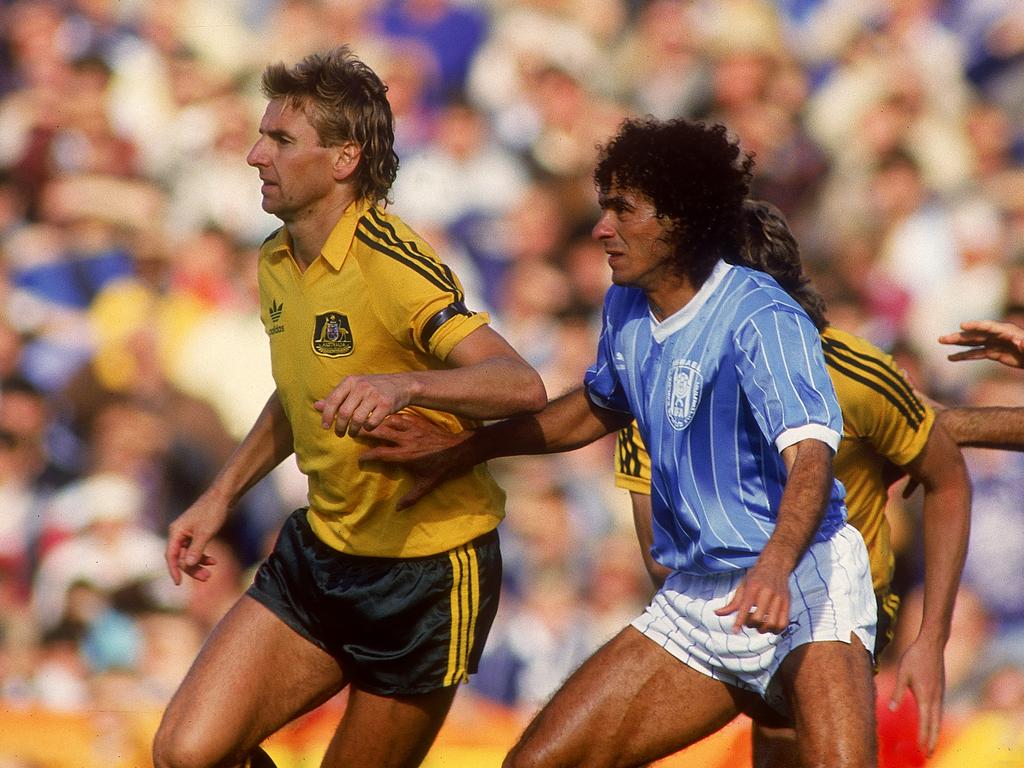
While not hands on now, apart from coaching a school team in Brisbane, Kosmina can see the key factor that made Australian football tick for decades has waned.
“Of course the game has become more corporatised,” he says, “that’s natural, but it feels like it’s lost its soul a bit.”
By soul, he means a devotion you can’t explain on a spreadsheet.
After World War II, Australia rid itself of the White Australia policy and opened its door to immigrants from continental Europe, where football is life.
“It was so strong a few decades ago, “but as we move further away from that mass immigration period of the 50s and 60s, the identity moves away from what it was.”
In 2019 the PFA released a study into what produced the greatest batch of male players the country has seen, like Mark Viduka, Harry Kewell, John Aloisi, Mark Schwarzer et al, who returned the Socceroos to the international game’s grandest stage at the 2006 World Cup.
“We found culture amplifies talent, and that actually became the name of the report,” Busch says of the player union’s report.
“Those players, sons of European immigrants who had an affinity with clubs set up in the 50s and 60s by Europeans.
“Those players’ early football experiences had the club environment at the heart of it. They spent most of their weekend at their clubs, had a real desire to play for them, then move overseas. Unfortunately the report’s findings have never been discussed in detail with the FA… and the game has remained stuck in a cycle of admiring the problem.”

Busch can see an aspirational second-tier competition helping to rediscover a deep-seated football culture. Where the fortunes of the first-team run through the club all the way down to the youngest players, who are immersed in the game and harbour ambitions to one day play first-team football at that club.
Finding the sweet spot between passion, ambition and fiscal reality is the cure to many ills.
A game still divided or conquering new ground?
Divisions will always exist inside football. It’s the nature of it.
Clubs hate each other. Fans make mortal enemies of players just because they play for the opposition.
It runs dangerously deeper in Australian football, because of the mistakes of the past, and a previously misguided present.


The next 12 months will go a long way to seeing if the game has moved beyond internal divisions.
A brighter future awaits, if the game wants it.
If not, just copy and paste the quotes above in a decade’s time. They’ll be as relevant as ever.

The Tackle: Mata has last laugh over ‘embarrassing’ Wanderers

The Melbourne-born teen who has world football giants circling

Vergos ends drought with brace in original derby win

Victory ‘bleeds success’: This star knows that better than most

From Italy to Sydney: Logarzo makes last-ditch Matildas bid
