
Gill Foster recalls playing World Cup with a broken leg, in a very different time for the Matildas
There was a time when playing for the Australian women’s team was far less glamorous than now. ADAM PEACOCK speaks to Gill Foster about her tears, toughness and Matildas dream.

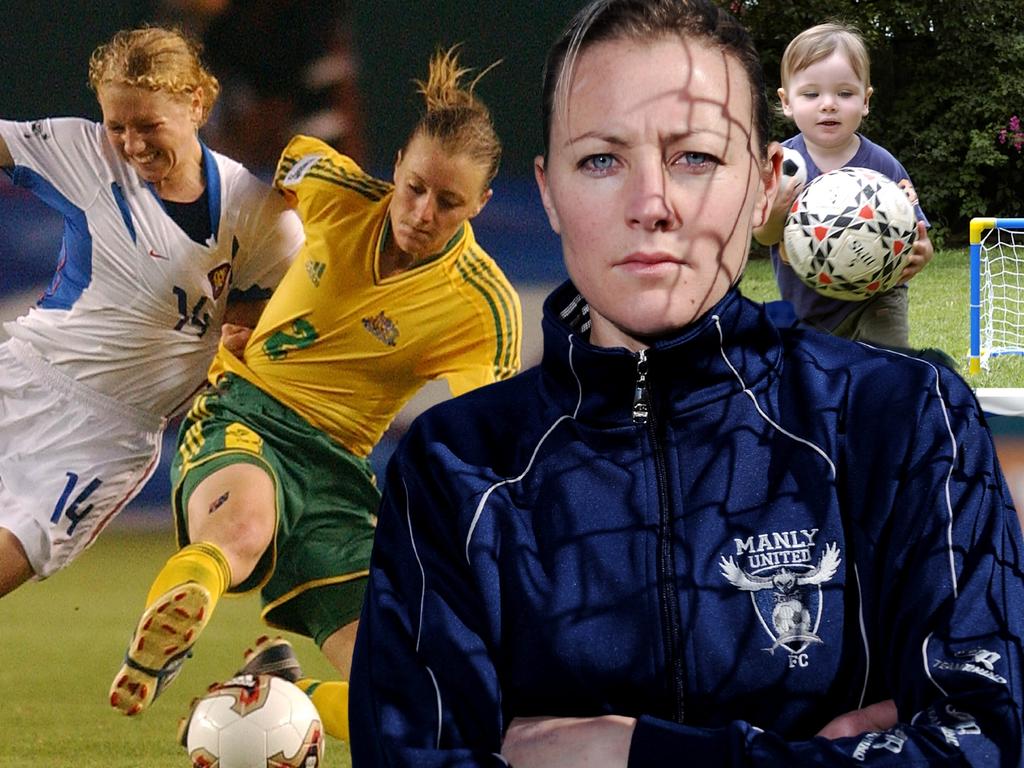
There are 1001 stories of how life has changed for those who represent the Matildas.
Gill Foster has a beauty: the time she played an entire World Cup campaign with a broken leg.
Foster accumulated 32 caps in another time for the Australian national women’s team. The current group are now in Queensland, in five-star luxury, starting a month-long preparation for a home World Cup that millions will expectantly watch.
In 2003, things were different. There were no lucrative European playing contracts. No Matilda was on a billboard, or in a worldwide documentary, or had the issue of juggling sponsor commitments.

They all had jobs, and understanding bosses.
Foster, based in Canberra in 2003, was an electrician.
All she wanted was to go to a World Cup with the Matildas, who had been to two previous Cups without winning a game.
Foster put herself through hell to play her part in attempting to make history.
*****
For some wild reason, Soccer Australia saw fit to send the 2003 World Cup squad the long way to the west coast of the US, where they’d play their three group matches.
China, then the UK, then Canada, then Los Angeles.
The first stop was horrible. The whole team went down with severe gastro. One went to hospital. Only the coach, Adrian Santrac, didn’t get sick, and jokingly bragged about it. ‘Soft, the lot of ya!’ was the tone.

The karma bus, via the virus, steamed through Santrac days later.
Onward to the UK for two more matches, then to Canada for another warm up game.
It was there when Foster realised something was not right at the top of her left leg.
“Doctor and physio had a look, they thought it was hip flexor,” Foster says.
Minor problem. Don’t let on, Foster told herself. It’s a damn World Cup. She was otherwise reaching peak fitness, despite the domestic scene being just a meager ten-game season.
“It was difficult for us, we went from a low level to such an intense training and game situation. Always sore and tired. You brushed a lot aside.”

So the World Cup. 2003, in the USA again, four years after the home side won the lot and pushed women’s football toward the mainstream for the first time.
Foster’s issue was nagging during the first game, a 2-1 loss to Russia, who scored an 89th minute winner.
By game two, a surprise 1-1 draw with powerhouse China, it got worse. Not indescribable pain, but pain she could do without.
Going into the final group game against Ghana, the Matildas still had a chance to make the quarter-finals.
A first ever win at a World Cup could do it, if Russia also smashed China.
Foster’s world, though, was in turmoil. The top of her left leg would sear with pain every time she planted it to kick with her favoured right.
She trained the day before Ghana,
“I was in tears for a whole training session.”

No-one noticed, says Foster, due to the heat. Sweat and tears look similar in 30 degree heat.
“Always walked a fine line between telling them you’re in pain, or keep it to yourself and it will be ok,” Foster says.
“You always played that game, the whole time.”
But by game time against Ghana, the pain was getting ridiculous. After the warm up, Foster could barely move.
“Went back into the change room finally admitting to myself I couldn’t run, I wasn’t going to be good enough,” Foster says.
It was her call.
“They gave me a couple of Panadol, patted me on the back and said you’ll be right.”
“Been given a job, just went out there and tried to do it.”

*****
It was over 30 minutes later.
Foster, playing in a wide midfield role, was like Wile E. Coyote trying to keep up with Roadrunner. Time and time her opponent burned past.
Eventually she relented, and came off. Tears.
The Matildas would go on to lose 2-0 to Ghana. More tears. The wait for a win would go on.
Foster tried to forget about it all with a holiday to London, packing her undiagnosed problem with her.
“Was dragging a suitcase around, limping like a 70-year-old woman!” Foster laughs now.
It wasn’t until she got back to Canberra a fortnight after the Ghana game that an MRI exposed her problem.
Foster had played an entire World Cup with a stress fracture in the neck of her left femur, where it joins the hip.

She had no right to be able to run, but blames no-one for her situation.
“The medical staff can only go by what I’m telling them. I wanted to play. Goal as an athlete was to be on that field.”
It took Foster nearly six months to recover with the sole goal of making the 2004 Athens Olympics.
Lonely days of running rehab, listening to Christina Aguilera’s “Fighter” blaring in her ears “makes me that much stronger, makes me work a little bit harder…”
Foster made the Olympics, despite another setback along the way.
“Snapped some ankle ligaments. Taped it up so that the foot would fit in the boot.”
In 2005, Foster had a child, and priorities changed.
“Went to a World Cup, went to an Olympics. Wasn’t going to be the best player in the world, so what else was there?”
She kept playing football. Against the men in a local Sydney competition for a while, and in the first days of the W-League in 2008.
Foster also became a paramedic. “Had some accelerated learning!”, and now, like every other ex-Matilda, can’t wait to see what this current crop can do.

“The difference now is the self-belief across the team,” Foster says.
The Matildas have made the knockout stages of every World Cup after 2003, built on a need to never give up.
It’s well founded.

The Melbourne-born teen who has world football giants circling

Vergos ends drought with brace in original derby win

Victory ‘bleeds success’: This star knows that better than most

From Italy to Sydney: Logarzo makes last-ditch Matildas bid

Yallop headed for surgery, Asian Cup dream all but over
