
Saving Football, Part V: The only path to a better future is investing in youth, writes Adam Peacock
How can the large, complicated family that is Australian football thrive into the future? After speaking to more than 100 people during a month-long investigation, ADAM PEACOCK found a simple answer.


Australian football is a loving, yet somewhat dysfunctional, family of four children.
Grassroots, youth development, A-Leagues and national teams.
Grassroots is a good kid. Just gets on with it, the odd tantrum, but needs help accessing play areas and equipment.
Youth development is a complex kid. Scatterbrain at times, needs the right role models and mentors to realise that learning is a long process, not just about the present.
A-Leagues is in rehab after a period of self-destructive behaviour. Needs to search deeper for its reason for being but its parents, Football Australia, are back on the scene to offer support.
And national teams is the popular eldest child. But don’t neglect them. They can still go off the rails.
So, to the big question: can this large, complicated family thrive in Australia?
And by thrive, I don’t mean smiting all its rivals to become the biggest sport with the biggest crowds and the biggest TV deal in the land.
Being realistic, that’s not happening in this lifetime.
For football, thriving means treating itself properly – and seeing where that leads. Setting structures and systems are important, but clear ideas related to how football works around the world are needed most.
I’ve sought to answer this question over the past month by speaking to more than 100 people for the Saving Football series.
The answer, as far as I can tell, is quite simple.
Getting there, though, is a complex task.
In some areas, the sport doesn’t need saving.
In others? Pass the oxygen, please.
RESUSCITATING THE A-LEAGUES
We still don’t know the true depths to which the APL bottom line has sunk.
Club distributions, the centrepiece of each club’s operating budget, are still not set for next season despite a board meeting this week. It could be less than $1 million, meaning clubs with A-League Men’s and Women’s teams would need to somehow find $6 million from behind the couch to make ends meet.
No one envies the new APL management. Its leaders, chief executive Nick Garcia and chairman Stephen Conroy, have a herculean task ahead to pick through the financial ruins of the post-Football Australia period and find a model that is initially sustainable and ultimately successful. Both declined interview requests from CODE Sports.
Garcia took over from Danny Townsend who, in December 2021, said this after the announcement of Silver Lake’s $140 million injection into the APL.
“We’ve been really clear with everyone involved in the game, we’re not going to go and blow $140 million,” Townsend told this writer.
He continued: “I don’t think (football) has ever had the money to piss up against a wall. What’s going to be important over the next five years is that we don’t do that.”
Fast forward today and, abracadabra, the money is gone.

So, where to from here?
The next 12 to 18 months will be critical.
TV revenue might have plummeted and commercial cash is hard to find, but there is another source of cash and hope for the league – one not available to other Australian sports.
The global football transfer fee economy is worth $15 billion annually.
Australia taps into about $15 million of that.
That’s 0.001%.
For one of the nine nations that made the knockout stages in the most recent men’s and women’s World Cups, that is grossly under what it could, and should, be. The professional game, and the layer below, youth development, will be powered up if that figure rises to $50 million per annum, or 0.003%.
Fine margins, big difference.
Some A-League Men’s teams, namely Central Coast and Adelaide, operate within their means by developing and selling talent. It’s a model that works for clubs the world over. What a wild concept.

Resources must be put into the development of coaches, not chasing clicks. Yes, the $140 million private equity investment was based in part around a digital strategy, but now KeepUp – and the loot that funded it – is gone and it will affect football. Higher quality imports won’t come to complement the emerging talent who need their guidance.
Football Australia could be the saviour. They don’t want to run the A-Leagues but can still offer help, knowing the domestic competitions need to survive if national teams are to thrive.
A decade ago, the governance wars bored the life out of the average fan as the clubs looked to run their own show away from the close control of the then-FFA.
The atmosphere became venomous; personalities not liking others, and in the middle, the game became collateral damage.
This sin has been committed over and over.
Those placing themselves before the game.
But at least the FA and the APL are getting back on the same page.
Anter Isaac, FA chairman, is a key figure in all of it. He and APL chairman Stephen Conroy are collaborating, but Isaac’s role goes further. As the former head of Football NSW, Isaac knows all layers of the game intimately.
A common view is that the governance model – where the nine state federations hold enormous political sway – needs changing.
It won’t change.
Because those same state federations control the voting system.
What is key is collaboration and leadership from the top down. Isaac, an ex-Football NSW chairman, knows the jungle well. It’s up to him to lead, and lead well.

BUILDING A TALENT FACTORY
For the development of football on the field, evolution is key.
Coaching courses must cultivate a freer style for players.
We need goalscorers and attacking maestros. Badly.
Sam Kerr gets injured and thank goodness Michelle Heyman can still lace them up. Graham Arnold’s two big attacking threats remain Mitch Duke (33) and Craig Goodwin (32).
Good players, fine careers, but where are the young wizards around the 18-yard box?
This comes back to the structure.
Promotion and relegation is accepted for youth football, but not for the A-Leagues?
Australia is at the other end of the football world in more ways than one.
There is hope. Queensland presents an interesting case study. Promotion and relegation in youth competitions based on results does not exist. Clubs are measured on their whole programs.
Playing identity.
Age-appropriate coaching.
Players developed to be as well-rounded as possible by adulthood.
There are murmurings that states like NSW are about to follow Queensland’s lead. There will be complaints. Too bad. Kids must be the priority over the club. The ones who help cultivate special talents will benefit, thanks to FIFA’s solidarity payments for any transfer fee paid for a player.
Again, the transfer market is the pot of gold that no other sport in Australia can compete for.

Former NSL and other state-based club identities may prosper again in a national second tier competition, finally ready to launch in 2025. Like the A-Leagues, sustainability is key. Is that possible when commercial and broadcast revenue is hard to find? Only time will tell.
The FA wants to set up new academies around the country. More elite development opportunities sounds positive, but will it step on established patches? Yes. Is it best for the kids, though? That point must not get lost.
What’s not in question is the need for junior national teams to play as regularly as possible.
Money, of course, determines how often they can. FA has returned to a strong financial position with a clever strategy and some of those funds must be devoted to boosting junior national programs. As a start, the 10% of all transfers from the A-Leagues that goes to FA simply has to go straight to either junior national team funding for high-quality international games or the running of the FA academies.
Develop and nurture.

CONNECTION
The grassroots game is bursting at the seams, with youngsters and adult women in particular inspired by the Matildas and Socceroos.
The squeeze for playing space can be helped by tapping into the special $200 million fund announced during the whirlwind of euphoria that was the Women’s World Cup, but offered to all women’s sport.
The deadline for submissions has just passed.
One official at a member federation reported a healthy take-up, albeit with some clubs and councils not bothering to put in submissions for $1.5 million grants because they felt it was a ruse or not a priority.
Mind-blowing.
Distrust and loathing hurts the game once more.
That said, football is full of good people who devote their time and passion into running canteens, preparing fields, coaching the Under 6s, running the line and organising playing kits.
The challenge is, as it always has been, to connect them to the other levels of the game. And for those people to be the sport’s defining image and lead the narrative, rather than the riot police who decide to rock up to an A-League game, just because.

As Sir Alex Ferguson famously said, “Football, bloody hell.”
It is all so infuriating.
It breaks your heart then sets your soul alight with moments that live forever.
Mat Leckie’s goal against Denmark in 2022 and Sam Kerr’s howitzer against England in 2023, seen by the world, united and delighted the nation like no other sport could. Just writing that sentence spikes the heart rate and makes the spine tingle.
This is the sport’s potential in Australia.
This is the place in our society it can occupy.
Leckie and Kerr are just two examples of those who have made it through the Australian football system and onto the world stage. Who is next? Do they have access to a ground to start playing? Or a change room at that ground? Do they have the right coach as they develop? Are they pushed at the right time?
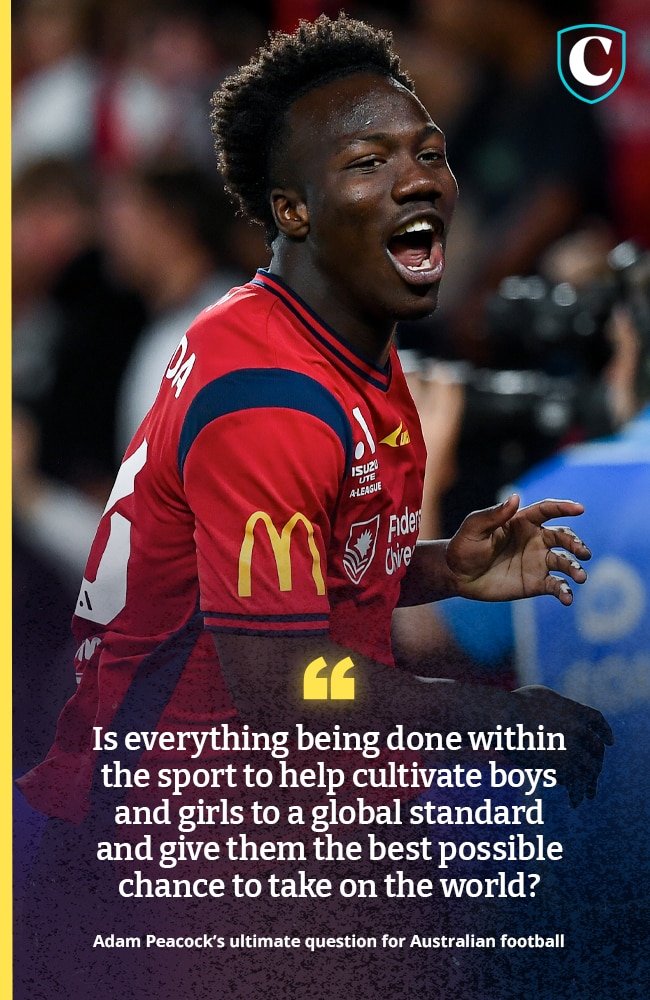
Finally, we must all look past, if possible, the boardroom battles, management malpractice, systems and structures, and ask ourselves this: is everything being done within the sport to help cultivate boys and girls to a global standard and give them the best possible chance to take on the world?
If so, everything in the game starts to fall into place.
If not, Australian football is kidding itself.
And always will be.
‘Saving Football’ is a five-part investigation into the state of Australian football amid a critical period for the game. Authored by respected writer, broadcaster and commentator Adam Peacock, the series delves into the issues and solutions for football at every level.

The Melbourne-born teen who has world football giants circling

Vergos ends drought with brace in original derby win

Victory ‘bleeds success’: This star knows that better than most

From Italy to Sydney: Logarzo makes last-ditch Matildas bid

Yallop headed for surgery, Asian Cup dream all but over
