
Relaxed FIFA rules and modern migration will pave the way for Australia to nab more Alex Robertsons
Thanks to lenient FIFA rules and mass migration, players are now spoiled for choice about which country to play for. ADAM PEACOCK explains how Australia will benefit.

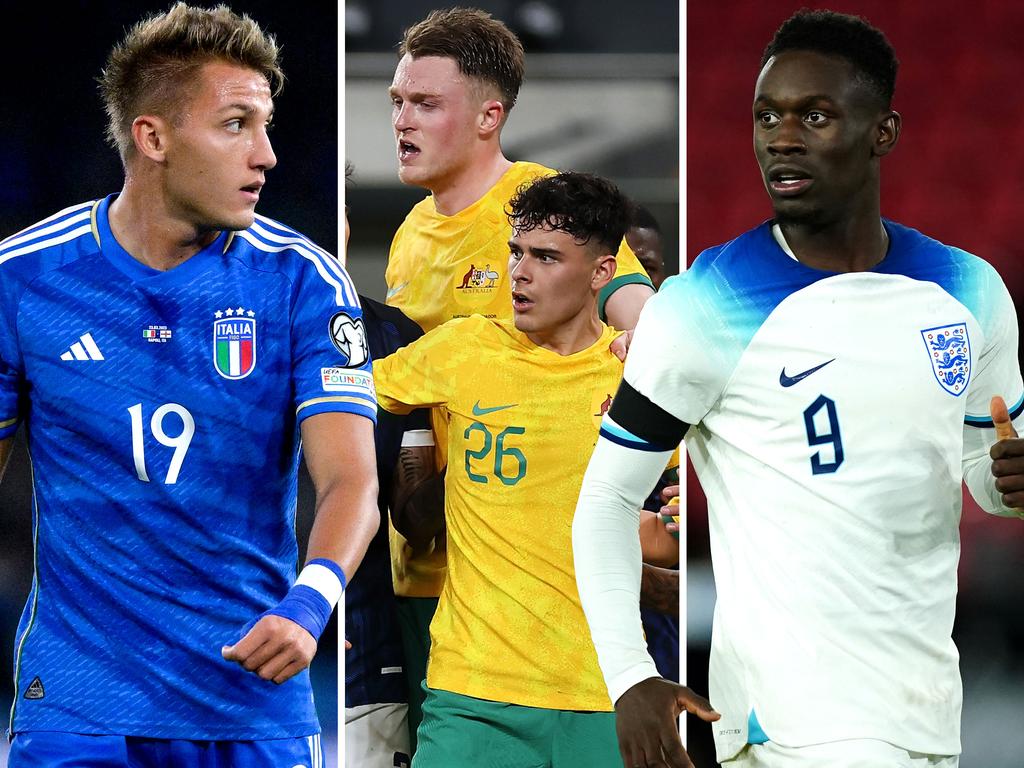
Words from the newest Socceroo, Alex Robertson, last Friday night warmed more than a few hearts in Australian football.
“It’s passion playing for my country and I would do whatever for this shirt,” the 19-year-old said minutes after his debut.
He’s all in.
A Socceroo for life, turning down England, Peru and Scotland.
At last count, there are more than 30 players in the same situation as Robertson scattered around Europe. Young players, eligible for Australia and at least one other nation.
This is not a new phenomenon in football. For decades, players have had choices to make about what country to represent, but the sheer volume of players with that choice has exploded.
Morocco made a World Cup semi-final with 14 of its 26 man squad born outside Morocco. The Socceroos had nine born on different shores.
It’s the big guns, too. Italy, England, Germany, France, all a potpourri of multicultural backgrounds and all in the market.
Migration trends and FIFA rules are the cause.
The effect is national teams, Australia included, are now like clubs when it comes to one key area in football: Recruitment.

*****
Once Tuesday night’s second Ecuador game is done, Socceroos coach Graham Arnold will pack both his bags and his tact, and head to Europe and talk to players with a choice to make.
The most notable name he’ll sit down with is Christian Volpato, who is playing this international break with Italy’s Under 20s team ahead of the Youth World Cup later this year.
Volpato is still wavering. He would have been in the 2022 World Cup squad, but the Sydney-born youngster who has Italian legend Francesco Totti as his agent, couldn't commit.
Volapto is one of a number of young Australians busy this international window with nations other than Australia. German born and based striker Matteo Mazzone, who has an Australian parent, played with Italy’s Under 18s this week. Noa Skoko got more time with Croatia’s Under 17s.
Volpato, Mazzone and Skoko are just the tip of an expanding iceberg.
According to Twitter account @AussieScout, there are 36 young players overseas eligible for Australia and at least one other nation.
These numbers are the minimum. There are others who have headed over to Europe off the back of parent passports, yet to properly announce themselves in youth club systems.
There’s even an option at Alex Robertson’s club Manchester City in defender Marley Leuluai, the son of former NRL prop Kylie. Leuluai is eligible for Australia but last week captained New Zealand’s Under 17s.
Others will emerge from nowhere, with FIFA’s rules as lenient as they’ve ever been in allowing players to swap nations. Ties that bind can go back to grandparents, and players can swap nations after three or less senior internationals before the age of 21, as long as those appearances don’t come at major tournaments.
Arnold has help from his main analyst, Doug Kors, and the junior national team coaches to track prospects. There’s never a bad time to have more depth, especially with a senior Asian Cup and Olympic qualification on the horizon in 2024.

*****
Smaller nations have traditionally gone down the path of attracting diaspora to represent. At the last World Cup, semi-finalists Morocco had 14 players born in six nations other than Morocco in their squad. Senegal and Tunisia had 12.
Arnold makes no apologies in bringing in the Scottish brigade, Harry Souttar, Jason Cummings and Martin Boyle.
Big nations are needing to recruit too.
There was a huge fuss in Italy last week when Azzurri boss Roberto Mancini called up an Argentinian striker, Mateo Retegui, for their European qualifiers.
Retegui, who plays in Argentina, doesn’t speak Italian, but qualified through Italian grandparents, was needed by Mancini thanks to a dearth of depth.
“I don’t know why there are so few strikers, we are very limited in attack,” Mancini complained.
“We have three (Italian) teams in the Champions League quarter-finals, but out of the three teams there are seven, eight Italians at most. This is the reality.”
Mancini’s drastic selection appeared a little hypocritical.
In 2015 Mancini scolded Italy’s then-manager Antonio Conte for picking non-Italian born players.
“The Italian national team should be Italian,” said Mancini.
Eight years later? “But the world has changed,” Mancini pleaded.
The press feasted on this, and made reference to Retegui’s limited Italian lingo.
“It's another reason why you need to have a little patience. He’s been in Italy for three days, how can he speak Italian?”

Deep down, Mancini didn’t care. Managers will take any breeze that pushes them in the right direction. He needed a goalscorer, and Retegui validated his selection with two goals in two games and is now considered more Italian than a week ago.
Mancini continues to hunt depth. Christian Volpato could be on the radar soon.
England is one of the few nations not recruiting. Instead, manager Gareth Southgate is at the mercy of having options poached.
“Eighty per cent of our players can play for more than one country now,” Southgate told media in London.
“We are not arrogant expecting everybody to want to come to play for England.”
Folarin Balogun – American-born, English-raised of Nigerian heritage – is the latest example. Balogun is one of Europe’s most exciting young strikers, having scored 17 goals for Reims in France’s Ligue 1 this season, while on loan from Arsenal.
For this international break, Balogun pulled out of England’s Under 21 squad with injury, and next minute was seen in Florida meeting with USA coach Anthony Hudson.
England manager Southgate didn’t see the move as a trigger to panic.
“We cannot go and give first-team call-ups to someone just because we don’t want them to go somewhere else,” Southgate said.
“Clearly, other nations have been quite aggressive in their recruitment and what they are offering.”
Southgate, though, has a recruit in his midst, in midfielder Declan Rice. It must be said Rice was born in England, but used his grandparents’ nationality to represent Ireland three times in 2018, before switching to England in 2019.
The buzz of watching England at the World Cup in 2018 changed Rice’s mind.

*****
The trend of international teams recruiting will only escalate, caused by two key factors.
FIFA’s very open rules are guaranteed to produce a flood of players representing one nation, then turning to another.
And then there is the bigger factor of exploding migration numbers, which have tripled in number since 1970.
Nearly 300 million people are classified as migrants, born in one nation and living in another. Of course, the world’s biggest sport will be affected in turn.
For the Socceroos, convincing young talent to ignore other overtures will continue to be a part of the process.

Sometimes, luck is involved. Harry Souttar was set to play for Scotland, having represented at Under 19s level. Then Scotland Under 21s manager Scot Gemmill decided Souttar wasn’t good enough, leaving him out of squads.
Australia swooped in for Souttar, and the rest is history. No word yet if Football Australia sends a case or a bottle of champagne each month to Gemmill.
Souttar, though, is an outlier.
Most top young talent hold the power of their own destiny, and it’s up to national federations to make the pitch.
For Graham Arnold, tactical nous won’t just be confined to preparing for Socceroos games in the next four years.

The Melbourne-born teen who has world football giants circling

FIFA slammed as Aussie fan’s bill hits $35k to attend World Cup

Every game: Download your 2026 World Cup draw poster

Revealed: Venues, dates for Socceroos World Cup fixtures

FIFA World Cup: Winners and losers of the draw
