
$300 billion can’t buy dismal Qatar a cure for stage fright in home World Cup opening loss to Ecuador
$300 billion can acquire the World Cup, build a city out of the Arabian desert and grab global attention. It cannot buy you a half-decent international football team, writes MATT DICKINSON.
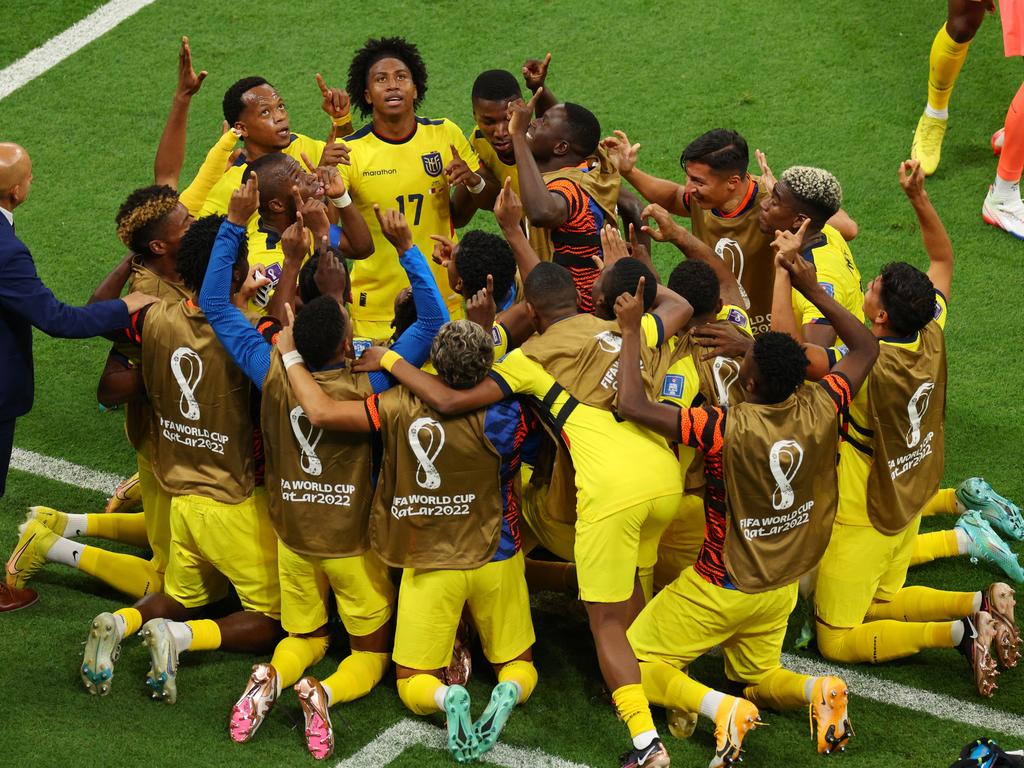
Qatar 0 Ecuador 2 (Valencia 16 pen, 31)
Hundreds of billions of pounds can acquire the World Cup, build a city out of the Arabian desert and grab global attention. It cannot buy you a half-decent international football team.
That part of a gobsmackingly expensive power play appeared to have failed Qatar last night (Sunday) as they became the first World Cup hosts to lose their opening match. It was a defeat so deflating that thousands of fans departed early in the second half, more concerned about beating the traffic.
Qatar’s great coming-out party – 12 years and more than $US200 billion ($AU300m) in the making – was marked by stage fright among the players and bewilderment among many fans who hurtled back down the eight-lane motorway to Doha long before the final whistle. All the years of high emotion around this World Cup and yet, on opening night, a strange indifference.
Unless he is a big fan of Enner Valencia, the former West Ham United forward who scored twice for an Ecuador side tactically and physically superior, this was not the opening night that Sheikh Tamim bin Hamad al-Thani had come for in his gleaming cavalcade that swept into this tent-like stadium 30km north of Doha. The emir was joined by fellow potentates. Gianni Infantino ranks himself among them.
The Fifa president sat between Qatar’s leaders and Mohammed bin Salman, crown prince of Saudi Arabia, the two men Infantino was most obviously courting with his ludicrous eve-of-tournament address in which he lectured on global immigration, LGBTQ+ issues, workers’ rights, European colonialism, female suffrage, racism, disability, orientalism and, of course, a tough upbringing being ginger with freckles.
After his guff, and all that has gone before in the fraught build-up, it was a relief to see a ball being kicked. Qatar 2022 became a football tournament on top of vexatious arguments about human rights and allegations of corruption. There were soon to be further complications for the hosts.
Perhaps regretfully in hindsight, Qatar had demanded that they be given the global profile of the opening match and so, as recently as August, this fixture had been moved forward to a relatively cool evening. It ended up drawing attention to the hosts’ considerable shortcomings on the pitch and a few teething problems off the field.
With no metro coming out to Al Bayt, this was a complicated stadium to reach and there were long tailbacks before the ground filled for the opening ceremony – Morgan Freeman, dancers, messages of peace, you know the drill – in a 68,000-seat venue that will have its top tier exported post-World Cup.
For all the years of talk of Qatar as hosts, much less was known about Qatar as a team. The other 31 sides have had a few days to prepare; the hosts have been together for months of training camps since June, with players taken out of clubs. You would not have known it.
To help them become credible finalists, Qatar had enjoyed guest status at the 2019 Copa America (a South American tournament), the 2021 Gold Cup (for North, Central American and Caribbean nations) and had joined a Uefa qualifying group for 2022 even though their place was guaranteed.

Expectations of being competitive had grown as they had climbed to 50th in the world rankings (above Saudi Arabia and Ghana of the other finalists) from 113th when Qatar was awarded the competition in 2010, and even won the Asian Cup in 2019.
All in the hope of avoiding the indignity experienced by South Africa in 2010 when the hosts failed to make it out of the group stage, the first time that had happened. But with Senegal and Holland to come, Qatar’s fate already seems sealed.
In Saad al-Sheeb, Qatar had a goalkeeper who betrayed terrible nerves even as a player with more than 80 caps, though he will have had some hard questions for his defence.
As if to prove that this tournament will never escape controversy, we had a VAR incident within four minutes. Sheeb came for a punch, watched the ball balloon into the air and flapped horribly at the rebound. Felix Torres’s overhead kick sent the ball flying across goal, where Valencia headed in for what seemed a startling opener.
Then came the VAR intervention with a tight offside for a stray knee by Michael Estrada. In the close margins, and delay to properly explain or show graphics, was a void that quickly, inevitably, filled with conspiracy theories about Qatar’s ability to shape anything and everything.

An outrageous slur on the officials, of course, and Daniele Orsato, the referee, may have appreciated the chance that came after 15 minutes to demonstrate impartiality by awarding a penalty against Qatar.
In truth he could hardly have missed it as the hapless Sheeb sent Valencia tumbling after the forward, now playing for Fenerbahce, had made a simple run straight through the heart of the Qatar defence. Valencia stepped up to place the penalty kick calmly into the net.
Ecuador doubled their lead when Valencia met a deep cross with a superb far-post header and, thereafter, they largely kept secure control. Almoez Ali had a chance to drag Qatar back into the game but he skewed an easy header horribly across the goal just before half-time.
By the time Mohammed Muntari hit a dipping shot on to the roof of the net late on, as much as a third of the stadium (though not the noisy bank of Ecuadorian yellow) was empty. It was a dispiriting sight that was bound to raise fresh questions about the choice of hosts.
Originally published as $300 billion can’t buy dismal Qatar a cure for stage fright in home World Cup opening loss to Ecuador

Slater: How Socceroos can defy history and defeat Turkey

‘More talented’: Turkey captain’s swipe at Socceroos

Socceroos make shock Popovic call on eve of World Cup

Popa ignited Australian football’s golden era — can he do it again?

SuperCoach WC26: Plenty of time to build a killer XI
