
World Cups, Presidents, Popes: How Pele become a global phenomenon
Long before Messi and Ronaldo there was Pele, football’s first global superstar. A World Cup winner at 17, he went on to rewrite the beautiful game and met every US president from Richard Nixon to Barack Obama.
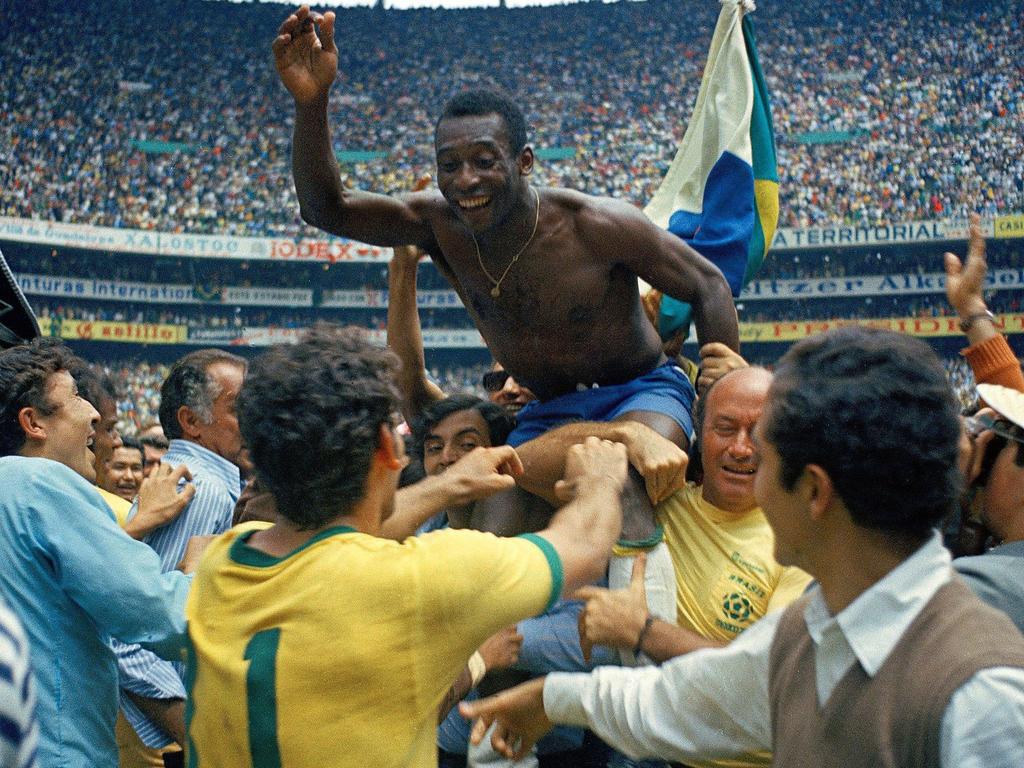
Pelé, arguably the greatest soccer player of all time and a three-time World Cup winner with Brazil, died on Thursday in São Paulo of multiple organ failure due to colon cancer, according to the Albert Einstein Hospital, where he was being treated. He was 82.
During a 22-year professional career that set new standards for goal scoring and individual virtuosity, Pelé came to redefine the meaning of global sports celebrity and established Brazil as the supreme power of the world’s most popular game. He spent most of that time with his boyhood club in Brazil, Santos, before a high-profile move to the New York Cosmos of the North American Soccer League in 1975, a disco-era experiment that created a brief surge of passion for the sport in the U.S.
But the moments he etched in soccer history all came in the yellow-and-green No. 10 jersey of Brazil. Since the World Cup’s inception in 1930, he is the only man to lift the trophy three times. His first triumph came at just 17 years old back when Brazil, strange as it might sound, was just another frustrated soccer nation that had never won the World Cup. But Pelé upended the world order of what he famously called “the beautiful game.”
A inspiração e o amor marcaram a jornada de Rei Pelé, que faleceu no dia de hoje.
— Pelé (@Pele) December 29, 2022
Amor, amor e amor, para sempre.
.
Inspiration and love marked the journey of King Pelé, who peacefully passed away today.
Love, love and love, forever. pic.twitter.com/CP9syIdL3i
“People called me the king in 1958 when we won the World Cup,” he said after being named co-player of the 20th century by soccer’s world governing body alongside Argentina’s Diego Maradona. “That is good enough for me.”
Pelé helped Brazil win the World Cup again in 1962, despite missing much of the tournament because of injury, and in 1970, led one of the most stylish teams in history to victory over Italy in the final.
“I told myself before the game, ‘He’s made of skin and bones just like everyone else,’” said Tarcisio Burgnich, the Italian player charged with defending Pelé in that game. “But I was wrong.”
Pelé was born Edson Arantes do Nascimento to a journeyman soccer player and a teenage mother in Três Corações, Brazil. His childhood of poverty fit all the cliches of a Brazilian soccer upbringing: He learned to play in the street with balls made of rags and socks. Individual skill was prized above all. He and his friends once stole peanuts to sell so they could afford jerseys for their team.
This was long before he was known as Pelé. He hated the nickname so much that he punched a classmate over it, and he later wrote that he didn’t even know what it meant. He much preferred his given name, Edson—a tribute to Thomas Edison since electricity had recently reached his parents’ town, he said. But the moniker, inspired by a teammate of his father’s, stuck.
Popes and presidents all knew it, even in countries where soccer isn’t king. When Pelé visited the White House in 1982, President Reagan introduced him by saying, “You probably are aware of who is with me here today. Oh, by the way, my name is Ronald Reagan.”

Global audiences were truly introduced to Pelé at the 1958 World Cup in Sweden. As a naive, but prodigiously talented 17-year-old, he made his first trip outside South America—his first trip on a plane, too—with a Brazilian team whose “samba soccer” style, defined by free-flowing dribblers and offensive creativity, had yet to conquer the world.
His biggest shock when he arrived in Europe, coming from racially diverse Brazil, was the ethnic homogeneity. “All the other teams had only white people. I thought it was really weird,” he wrote in his 2006 autobiography. “I can remember asking my teammates, ‘Is it only in Brazil that there are blacks?’”
The event started Pelé on his road to becoming one of sports’ truly international Black icons, around the same time of Muhammad Ali’s rise in boxing.
Pelé scored twice in the 5-2 victory over Sweden. The highlight was his brilliant second goal, when he controlled a long pass on his chest, looped the ball over a defender and volleyed it home.
Four years later, Brazil repeated its success, but Pelé played a smaller role, severely hampered by injury. And at the 1966 World Cup, a bitter disappointment for Brazil, his unrivalled dribbling, passing and ambidextrous shooting abilities were at times violently suppressed by European defenders who were bamboozled by his skill.

“Defenders were ordered to man-mark me wherever I was—and this got to absurd levels,” he wrote in his autobiography. “I can remember moments when I had to go off the pitch to tie my laces or something, and there by my side would be the defender, hands on hips, supervising me as I crouched down.”
Still, he excelled. In 1969, Pelé became the first man to crack the 1,000-goal barrier as he played before more than 65,000 fans at Rio de Janeiro’s Maracanã Stadium for Santos in a Brazilian league match. The game took 25 minutes to resume in the midst of wild celebrations.
Because of sketchy record-keeping at the time and loose definitions of what constituted an official game, it is unclear what Pelé’s final goal total was, though it is often placed at 1,283. In any event, he remains the national team’s all-time leading marksman, scoring 77 times in 91 games for Brazil.
“Those of us who were lucky enough to see him play received alms of an extraordinary beauty: moments so worthy of immortality that they make us believe immortality exists,” the Uruguayan novelist Eduardo Galeano wrote of him in his book “Soccer in Sun and Shadow.”
Pelé’s fame echoed around the world, as he became one of the planet’s highest-paid athletes. He met with three different popes and every U.S. president from Richard Nixon to Barack Obama. In 1966, Pelé wrote, John Lennon had even tried to organise a private Beatles show for the Brazilian national team. When Pelé visited Nigeria with Santos in 1967, the sides fighting the country’s civil war called a 48-hour ceasefire for his visit. Andy Warhol said Pelé’s celebrity would last not for 15 minutes but for 15 centuries.

He cemented his status by winning the World Cup for a third time in Mexico in 1970. He started all six of Brazil’s games there at the heart of one of the most electrifying teams ever to kick a ball. The Seleção, as the national team is called, danced its way to the final against the best Italian team in a generation. Brazil brushed it away, 4-1, in front of 107,000 people, turning the last half-hour into a joyous exhibition of attacking flair. Pelé, who had scored the first goal, assisted two more.
“Pelé was the greatest—he was simply flawless,” his teammate Tostão once said. “And off the pitch he is always smiling and upbeat. You never see him bad-tempered. He loves being Pelé.”
Pelé didn’t play in another World Cup. But in the 1970s, seduced by a $1.4 million annual salary and a Manhattan lifestyle, he brought international glitz to the struggling North American Soccer League. He was a New York Cosmos forward by day, playing alongside the Germany great Franz Beckenbauer, and a regular at Studio 54’s bacchanals by night, where he partied with the likes of Mick Jagger and Rod Stewart.
In 1977, the New Jersey sports complex where the Cosmos played, the Meadowlands, drew more than 75,000 fans to Cosmos games on three occasions. Pelé called the last one, his farewell game just before his 37th birthday, the “greatest moment of my life.”

As in all matters of greatness in sports, Pelé’s status is contested. The question of soccer’s record best ignites bar-stool debates all over the world, especially across Brazil’s border with Argentina, which has produced two more recent geniuses of the game: Maradona and Lionel Messi.
In retirement, Pelé served as a global ambassador for soccer and spoke out regularly against racism in the game.
Back home, he continued to be revered, a hero whose image was sometimes used by the government to distract from deeper issues. He was Brazil’s sports minister from 1995 to 1998 and was personally dogged by allegations of corruption, which he denied.
He later became a driving force behind the country’s successful bid to host the 2014 World Cup.
Over the years, he also used his status to become one of the most widely endorsed athletes of his era, which mostly helped him recover from repeated financial missteps. He moved credit cards for American Express, soda for Coca-Cola, luxury watches for Hublot, sandwiches for Subway, cars for Volkswagen, bank accounts for Santander and erectile-dysfunction pills for Pfizer.
Distracting as the years of overexposure could be, they didn’t eclipse the sublime talent that got him there in the first place. His playing career reached its pinnacle at the 1970 World Cup final. In that moment, Pelé wrote, “I had achieved everything I set out to achieve.”

Sydney football club mourns player killed in Bondi terror attack

The Tackle: Mata has last laugh over ‘embarrassing’ Wanderers

The Melbourne-born teen who has world football giants circling

Vergos ends drought with brace in original derby win

Victory ‘bleeds success’: This star knows that better than most
