
Johnny Allen’s rags-to-riches rise to Cox Plate glory made him the best all-rounder in a century
From North Cork to the Cox Plate, Irishman Johnny Allen has become one of Australian racing’s great success stories, writes ANDREW RULE.


If young John Allen had been better at Gaelic football and his little brother not quite so good at the Irish national game, the betting is that John would never have become one of the great success stories of Australian racing.
Step in a time machine, go back 25 years or so to the village of Araglin in North Cork and hit replay. Some grey day in that faraway time and place, young Michael beats brother Johnny to the ball and bolts away with it. After that, the football dreams belong to Michael.
But the young Johnny Allen’s bad luck on the football pitch turns into good fortune for his older self, the 2021 model.
Without it, he would not have won his second Victoria Derby the way he did the Saturday before the Melbourne Cup, beating the royal blue of the global Godolphin racing empire backed by its ocean of middle eastern oil.
Without it, he wouldn’t have snaffled the Cox Plate on State Of Rest for a branch of the O’Brien family, who are about as influential in Irish racing as the Bonanno family is in New York waste disposal.
Once again, jockey Allen outpointed a Godolphin runner, this time the glamorous colt Anamoe, first in a bumping duel then a head bobbing finish inevitably adjudicated in the stewards’ room.
Prosecuting the case against him was Anamoe’s rider, Craig Williams, a formidable talker in any company and desperate to land the Cox Plate for leviathan owners whose splendid colt needs a glittering CV as stud credentials.
For Allen the quiet Irishman it was like Clint Eastwood trying to debate Robin Williams. There’s a temptation to say he needed the luck of the Irish and got plenty of it, which is true as far as it goes.
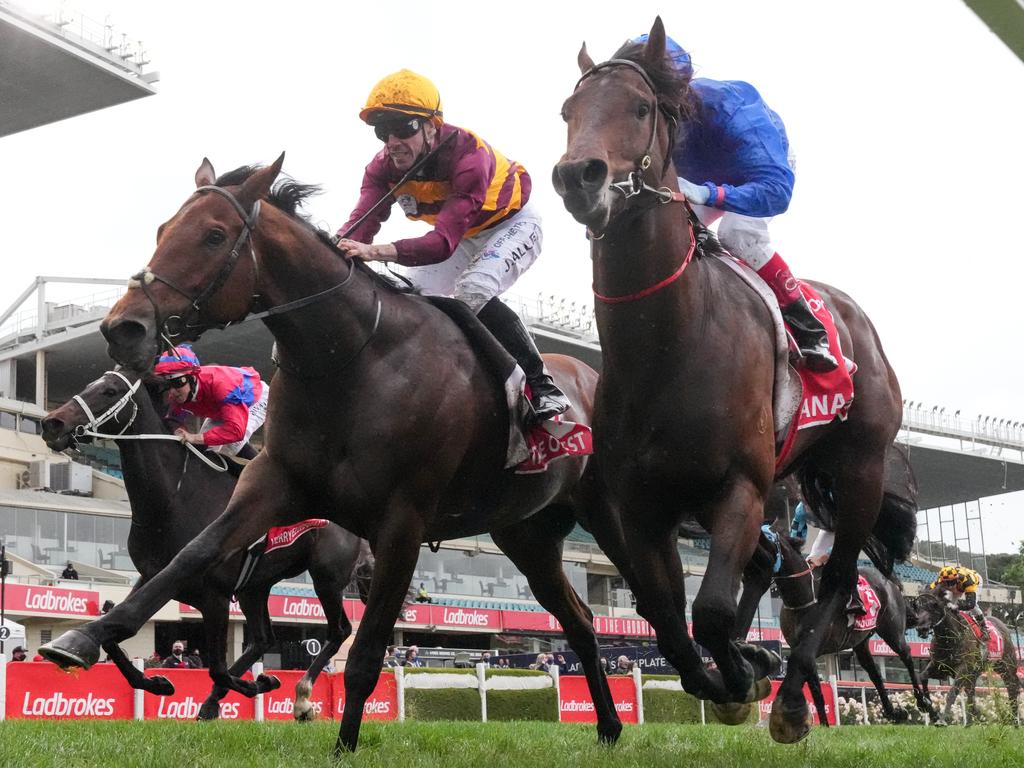
To be fair, Australian stewards have always been shy of reversing the result in a big race short of attempted murder in the straight.
Craig Williams might think he didn’t get his Anamoe protest upheld because neither he nor the horse was actually gushing blood when they came back to scale after what trainer Joseph O’Brien, via telephone from Ireland, kept insisting was “a brush not a bump”. O’Brien could have been a Mafia defence lawyer but given the stewards’ form, he was kicking with the breeze.
Some heads still shake in disbelief at the memory of the aristocratic English trainer Lady Anne Herries taking home the 1998 Caulfield Cup after her jockey Ray Cochrane “knocked down” Champagne and Jezabeel on the English longshot Taufan’s Melody, already a controversial runner because it was gifted a run ahead of a well-credentialed local.
To be fair to Cochrane (who later won a bravery medal after rescuing Frankie Dettori in an air crash), he had copped rough-house Australian tactics in the previous year’s Melbourne Cup when Greg Hall on Doriemus knocked him sideways to pursue (and nearly beat) the frontrunner Might And Power.
Cochrane’s horse Harbour Dues finished the best of the rest but could not claw back the lengths lost when Hall did him over. The point is that John Allen’s luck in retaining the Cox Plate is based squarely on precedent: it might raise eyebrows but at least it’s consistent.
The bigger point is that in a sport so dangerous that an ambulance follows the field, Allen doesn’t shrink from the contest. He might be shy in front of a microphone and as polite as any country cousin from County Cork but in the saddle he is not shy at all. He’s as fearless as he is balanced. And, as his sister Michelle diplomatically puts it, “very competitive”.

Behind the quiet front he turns to the world, the quiet man is as hungry for success as any jockey riding, and more than most. He rides like Mexican fighters fight.
Which brings us back to the Gaelic football. When the Allen kids were growing up in Araglin and it became clear that young Michael had the makings of a better footballer, it meant Johnny concentrated on riding like the devil.
That’s sibling rivalry for you. Mind you, the Allens were bred for the saddle in the county where steeplechasing was born: in 1752 local horsemen had a difference of opinion about who had the best cross country hunter, and settled it by racing between the towns of Buttevant and Doneraile, a distance of just over seven kilometres from steeple to church steeple.
Their father Mick was an agricultural diesel mechanic by trade, a punter by inclination and friendly with local trainers. But racing people know that the dam side is often more important than the sire, and Johnny Allen chose his mother wisely.
Mary Allen is a Houlahan, one of a family brought up in the rural Irish tradition of breeding, buying and educating show jumpers and hunters for the British market.
Mary was a classy show rider turned pony club instructor and infected three of her four children with the bug. The two girls, Ann-Marie and Michelle, took on showjumping. In fact, both Ann-Marie and their mother competed at the legendary Dublin Horse Show. Ann-Marie took an Irish Sport Horse bred by their grandfather Houlahan to Grand Prix level.
But Johnny was always more attracted to the rough and tumble of “drag hunts” and point-to-points — amateur steeplechases over fences, stone walls, hedges and ditches.
It’s not as if the Allen kids had “made” horses handed to them because those ones got sold to people with money. When John was a schoolboy, maybe eight years old, his mother came home from a horse fair with a rough pony they named Cobbler.
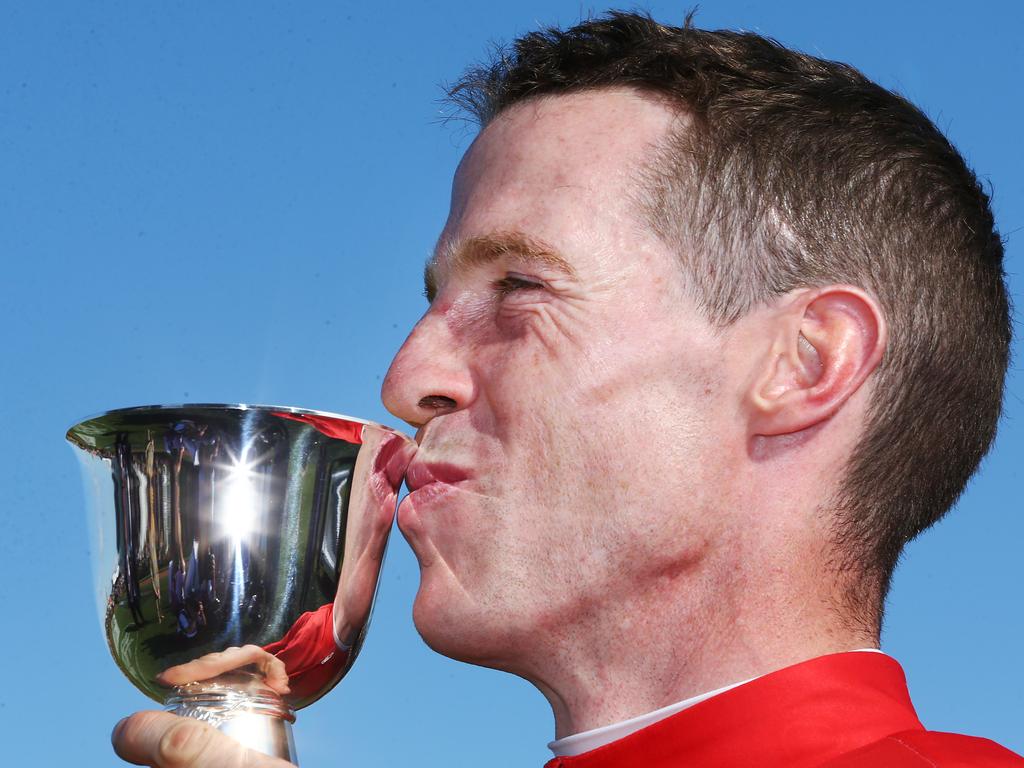
“John was the last out of bed during the week,” recalls his sister Michelle, a finance manager who now lives in Melbourne. “But he was first up on the weekends to go racing.”
Cobbler was black with a white blaze and as rough to ride as he was to look at. But the tough kid saw something in the tough pony.
Sometimes young John would get his mum to stand strategically in a gap or on a sharp turn so Cobbler wouldn’t run off the track. The boy had to extract every advantage by riding tightly and aggressively to compete with better-bred ponies.
It was the ideal apprenticeship for a budding cross country jockey. But that alone doesn’t quite explain why Johnny Allen has blossomed into one of the most successful flat riders in the world in a few years. Proof of that is the world-class Sydney trainers who want him to ride their horses when they come south. So do English and Irish raiders. That sort of endorsement can’t be bought, only earned.
It’s a rare transition for an Australian jumps rider, like graduating from grease monkey to Formula 1 driver. In Australia, where jumps races are marginalised, the best cross country jockeys are good but the rest would be seen as part-timers and journeymen in Britain and Ireland, birthplace of jumps racing.
With notable exceptions (hello to Clayton Douglas, Jamie Mott and Jamie Evans), few riders here have mixed flat and jumps riding at a relatively high level. But in Ireland, where the horse culture is probably unparalleled in the western world, lightweight jumps riders have regularly made the transition to the flat.

One reason for that is the popularity of ‘pony racing’, also known as ‘flapping’ in Ireland and the UK. These are unregistered flat meetings on makeshift courses on farm land or beaches. Some ‘flapping’ races are literally for ponies but others are for full-size gallopers. The result is a little like an Australian picnic meeting — but without officialdom to enforce the rules.
Any regulation is basic and self-administered. ‘Pony races’ might sound like kid stuff but in Ireland it was, and is, a little like Fight Club on horseback.
“It was down in Kerry and West Cork,” recalls Allen in the brogue that a decade in Ballarat hasn’t made much easier for Australian ears to decipher.
“It gave me huge experience. It was pretty rough but it made you harden up — there was no such thing as a stewards’ inquiry.”
This Rafferty’s Rules racing produces young teenage riders who ride in scores of races before they move into professional racing. They have a huge advantage over conventional apprentices in other countries who, if they can ride at all when they start, have little concept of race tactics and pace, or knowledge of how to get “toey” mounts to the start and jump them out smartly. Those skills and instincts are sharpened by the split-second decisions made and chances taken in the heat of fierce competition at the impressionable age when their contemporaries are learning to surf or skateboard.
With conventional racing in Australia, run under strict rules and occupational safety regulations, formal trials and jump outs theoretically educate young race horses — and riders who might have not mounted a horse until they were ready to leave school. Unregistered meetings here are virtually extinct, crushed by racing authorities and punitive insurance, a double whammy that shrinks the field of skilled young riders.
The point is proven by the success of Irish riders wherever they compete, and by the South Americans who dominate race riding in the United States.
Joao Moreira is called ‘The Magic Man’ for a reason: he has succeeded in every jurisdiction from his South American homeland to Hong Kong, Singapore and Japan. He learned to ride as a poor boy in Brazil, racing bareback on half-wild ponies, giving him the acrobatic balance, strength and natural seat he has never lost.

Moreira, Allan and another uncannily balanced jockey, Jamie Kah, are about as different as three people can be — except in the saddle. What links them is a childhood crammed with experience of riding well away from the white fences and manicured turf of elite racing. Each looks more at home on a horse than anywhere else.
A Victorian jockey who befriended Allen when he first turned up at Darren Weir’s sprawling Ballarat stables in 2011 recalls just how casually competent the quiet Irishman was. Being the jumping jockey around the place, he tended to get the rough ones, the rogues and the young, green horses. None of it bothered him. He would have one hand on the reins and the other holding a mobile telephone, calling his parents in Ireland before it got too late in their time zone.
This nonchalance impressed Weir, himself regarded as one of the better all-round horsemen among Australian trainers, in the way that the one-time outback stockman Brian Mayfield-Smith was, and former Olympic horsemen like Greg Eurell and Eric Musgrove.
What Allen’s fellow trackwork riders and stable jockeys couldn’t work out was why he left Ireland to battle for jumps rides around Ballarat, given he could sit on so well.
One of them asked the question while giving the Irishman a lift to the races before he bought his own car.

The answer was that he had started out working for a small trainer, Sean O’Brien, in his home district. Then he moved to the yard of an established trainer, Joe Crowley, up the road at Kilkenny. Here he was a conditional rider, effectively like an apprentice jumps jockey. His first professional winner was a hurdler named Permiyr at Clonmel in early 2003, his only win for the season.
Crowley was a good trainer rather than a big one. By the time Allen started with him, he was old. Then he had a stroke. As Crowley whittled back his stable before retiring, the loyal Allen stayed busy riding work for his boss but got fewer good race rides. He was stranded, like a polar bear on a melting iceberg.
The fact that Joe Crowley was father-in-law to the “wizard of Ballydoyle,” Aidan O’Brien — and grandfather of his namesake Joseph O’Brien — didn’t win Allen many stray rides from the mighty Coolmore racing operation.
Joseph O’Brien, who has since won Melbourne Cups and much else besides in a dazzling international career, now trains at his grandfather’s former yard after a glittering apprenticeship as a jockey. But his rise as a trainer in the footsteps of his famous father came too late to help John Allen, who had to make his own way.
It would take until 2021 for Joseph O’Brien to reach out to his grandfather’s “lad”, when he sent State Of Rest to Melbourne, via Saratoga, to run in the Cox Plate. It wouldn’t be sentiment that prompted the decision to call on Allen but it makes sense that the Irish kings of racing use someone they know and trust. Someone who had not only won a dozen Group 1s on the flat but Australia’s biggest jumps races as well, Grand Annuals and Grand Nationals.

This makes Johnny Allen the most remarkable all-rounder in Australian racing since Malua, the Tasmanian galloper that crossed Bass Strait and in 1884 and not only won premier sprint races like the Newmarket Handicap and the Oakleigh Plate but also the Melbourne Cup — and would later win the Grand National Hurdle while standing at stud.
Malua the horse could do everything but ice skate and was always earmarked for greatness. But Johnny the jockey was a late developer, going virtually unrecognised for a decade before he made his own luck.
Allen had visited Australia way back in 2004 for an international jockey challenge, just two years after leaving school. He earned the trip by running second, just one win behind Robert Power, in the jumping ‘claimers’ premiership. He doesn’t recall much about the trip Down Under except riding in a steeplechase at Moonee Valley “in the pouring rain”, the sort of weather he thought he’d left behind.
Back in Ireland after the Australian tour, Allen “had a couple of good years” but as Crowley’s stable wound down and good rides dried up, he lost his claim, his chances of having a foothold among the top riders slipping away.
As he would tell an Australian friend much later, it wasn’t long before 40 jockeys were ahead of him in the Irish jumping ranks. In 2010 he won just four races. So when he saw an advertisement for track riders in Victoria in the Racing Post in 2011, he and a couple of other Irish riders booked their tickets to avoid the Irish summer, a quiet time for jumps jockeys.
He was supposed to go to Cairon Maher but just before he left Ireland, Maher called the trip’s organiser and said he didn’t need him and suggested trying Weir at Ballarat. Fate turns on phone calls like that.
After his six months was up, Allen returned to Ireland for the jumping season. But without a berth in a gun stable, he was even further down the pecking order. So he returned to Australia in 2012 with nothing to lose, heading back to Weir’s growing empire at Ballarat, which drew heavily on travellers doing working holidays.
It was Maher, himself a reformed steeplechase rider, who mentioned there were not many jumps jockeys based near Ballarat, which might give the visitor an edge instead of competing with established riders at Cranbourne or Pakenham.
At first, Weir was characteristically noncommittal towards the Irishman. But he warmed to Allen’s obvious all-round horsemanship and later made other trainers prick their ears when he described him as “the greatest horseman I’ve ever had anything to do with.”
Not a bad tip, given it came years before Allen broke into the big time with his first Group 1 winner, the 2018 VRC Derby on Extra Brut.

Most days, every week of the year, Weir’s fleet of trucks carried dozens of gallopers to distant meetings all over Victoria. He needed riders who could ride in races as well as in an endless roster of jump outs and trials, and here was an experienced jumps jockey light enough to ride on the flat if he could shed a couple of kilograms.
In a state where there are fewer than 70 jumps races a season — about a week’s worth in Ireland — the question of ‘why not try flat riding?’ answered itself. After a conversation with a fellow Weir rider on the way to the races in 2012, the Irishman did the sums. If he could get down to 56 kilograms, he could catch the Weir wave of winners, cheered on by the punters’ chant, “Back Weir, drink beer!”
The afternoon that Glen Boss won the Cox Plate on Ocean Park, J. M. Allen was three hours drive away at sleepy St Arnaud in the central Victorian wheatbelt. His partner in this obscure piece of sporting history was a bay gelding named Jungle Fighter, trained by Dan O’Sullivan.
Allen slid his toes into the dainty featherweight stirrups of the tiniest saddle made, a wafer weighing no more than the elastic girth holding it on. Five minutes later, the obscure backpacker jumps jockey had ridden his first official flat winner.
If someone had told him then that nine years later he would replace Boss as the hero of Cox Plate day, he would have laughed.
But that’s how it happened. Along the way he has ridden close to 900 winners, 14 of them Group 1. In fact, he has placed in a third of the 100 or so Group 1s in which he has ridden, starting with Howard Be Thy Name in the South Australian Derby in 2016.
Any punter backing him in Group 1s would be up 45 per cent on investment, which is why the international heavyweights Coolmore and Godolphin now compete to get him on the big days.
His countryman Mark Power, travelling foreman with State Of Rest, marvelled after the Cox Plate, “Johnny Allen was super on him, you won’t get stronger than him inside the last 200 metres from Johnny there. He’s as strong as an ox.”

Allen hasn’t found his Winx or his Makybe Diva yet but he is doing nicely, taking care of business. The fact that some influential owners and Ciaron Maher stuck with him after Weir was disqualified for four years in 2019 means Allen survived and thrived when it could all have crumbled.
The day he won the Cox Plate, his fiancee Emma Church was saddling up Southern Native to win at Yarra Glen, beginning a training career that you’d imagine will see the quiet couple as a force in racing for a long time.
But the boy from Araglin isn’t getting ahead of himself. On the Monday after the Cox Plate, he got into the trusty, dusty VW Passat that has taken him to every professional racetrack in the state, and drove to St Arnaud to ride in a dozen jump outs.
When he’s not on a horse, he still keeps his hand in with the Gaelic football. He plays for Ballarat in the local competition alongside other Irish nomads and a few converts. Even in a game not dominated by tall players, the man who rides at 56 kilograms is one of the smaller ones but he’s hard at the ball.
These days, brother Michael is an electrician in Perth, meaning three of the Allen siblings are now in Australia.
No matter how much Michael kicks a ball around the park, the fact is he’s a sparky and can’t hope to stay as fit as his Group 1 brother, who lives on salads, constant exercise, reflexes and risk. Which means that after an Allen family Christmas some day, there might be a return bout with a round ball.
Not Cain and Abel, exactly. More Rafferty’s rules. But appropriately, still pretty willing.
*****
Subscribe now for full access to CODE on website and app - Download on the App Store or Google Play.
And don’t forget to check out CODE’s weekly podcast with Adam Peacock and Georgie Parker: CODE Words

‘He’s just a freak’: J-Mac lost for words after Romantic Warrior win

Ka Ying Rising ‘in a league of his own’ after Hong Kong Sprint romp

Sosie stars in Vase as Al Riffa battles bravely

Kempsey, Orange Monday previews: Colt’s guns in showdown

Kempsey, Orange Monday tips: $8 value bet
