
Legendary race-caller Bill Collins and the day he called the Cox Plate wrong
Forty years ago, legendary race-caller Bill Collins turned a rare mistake into one of the most iconic sound bites in Cox Plate folklore. SHANNON GILL chats to the men moulded in his image.


Deep in Cox Plate folklore lies one Saturday 40 years ago when ‘The Accurate One’ Bill Collins got it wrong.
Collins saw a champion struggling and at the 400-metre mark uttered the immortal line: “Kingston Town can’t win.”
But Bryan Martin, long-time understudy to the legendary Collins, says he in fact had it right.
“Most of us who have been in this profession would defend him there, because if you stop the tape and watch it, he was right,” Martin, a race-calling titan in his own right, explains.
Broadcasting great Peter Donegan, who idolised Collins and later worked with him, once asked him whether he’d call the race in question the same way again.
“I said would you call it the same way again and he said ‘Yep, and I’d be wrong again!’”

The year was 1982 and Kingstown Town was aiming for his third-straight win in Australia’s premier weight-for-age race, the Cox Plate.
Two years earlier, Collins vividly painted a picture of Kingston Town’s first win: “But Kingston Town is cantering, we’re going to see the real one today”, before it romped to victory. Martin says Collins completely summed that race up 600 metres from home.
But this time was different.
“When he said Kingstown Town can’t win, the horse was going backwards,” Martin says.
“If I was calling that race I would have said Kingston Town is gone.”
Within seconds, Collins had to recalibrate as the champion stormed home.
“Kingston Town flashing, he might win yet the champ,” Collins roared.
“Oh Kingston Town’s swamping them, what a run, Kingston Town wins it a neck to Grosvenor.”
Another brilliant Collins call emerged from a ‘mistake’.
*****
It’s been 25 years since Collins passed away and almost 35 since he hung up his binoculars.
He called his last race on Easter Saturday 1988 on radio, and Martin picked up those binoculars as the number one caller in Melbourne on Easter Monday.
“I knew him from about 1972 onwards, but was well aware of what a great caller he was and a great broadcaster he was. He was a special, special race caller, but he could do anything, he was a rare talent.”
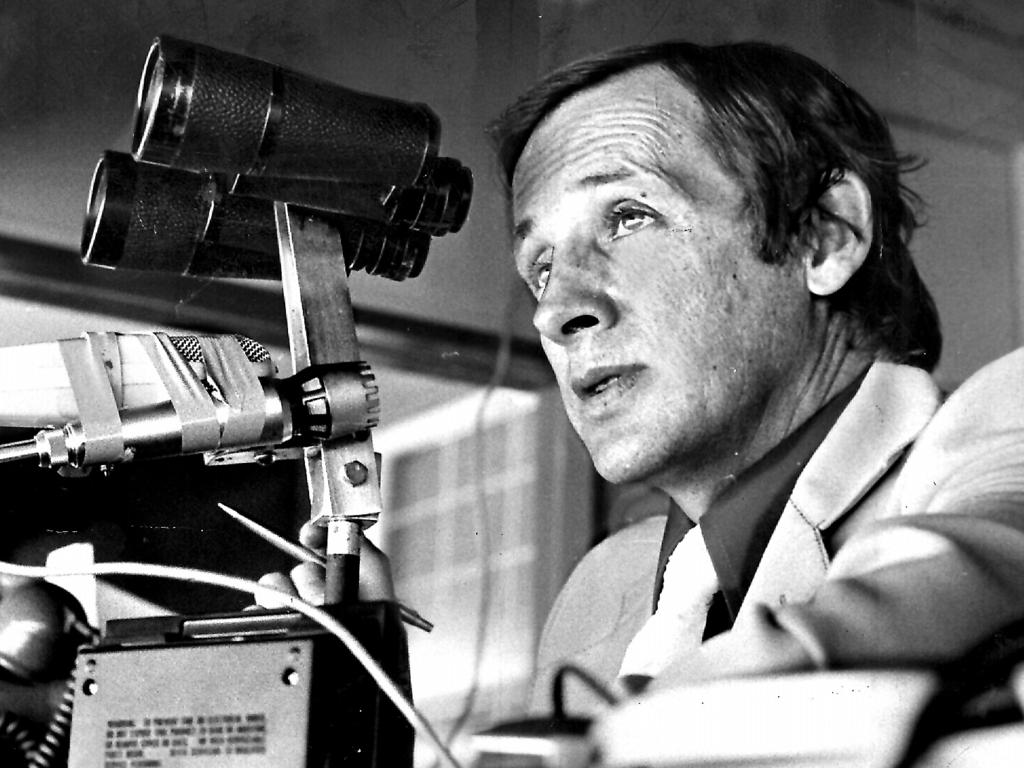
Despite the time that’s passed since Collins was actively calling, Martin says his influence on racing and broadcasting has continued.
“It’s a specialist area and we’re lucky to have lived in Bill’s time, unbeknown to us at the time we were learning so much from him. It was ingrained in us.”
When sports broadcasting doyen Bruce McAvaney was inducted into the Australian television hall of fame this year, he singled out Collins as his greatest inspiration.
“Bruce particularly, as when he started out he was nearly a Bill clone, but in every caller from Bruce to Greg Miles to myself you’ll hear a bit of Bill.”
Donegan remembers holding Collins in awe as a child.
“He had a huge influence on me,” he says.
“Being a Melbourne boy I used to listen to him all the time and his accuracy was something I always aspired to.
“As a kid I used to go to the Moonee Valley races and see the commentators come down from the broadcasting boxes and I remember saying to my dad, ‘Look, there’s Bill Collins’.
“To get to work with him later was amazing.”

Collins started calling races on radio in 1953, and the next year called his first Melbourne Cup, the start of 34 straight years calling all the major races in Melbourne. Thirty-four Caulfield and Melbourne Cups and 34 Cox Plates.
But to say Collins has only influenced racing sells him short. Racing may have been Collins’ bread and butter, but the boy from Trafalgar in regional Victoria was one of the early pioneers of television across the board in Australia.
The owners of his radio station 3DB also purchased the Channel 7 television licence and Collins was there broadcasting the 1956 Olympics when TV came to Australia.
He then went on to host variety shows like Sunnyside Up and the Penthouse Club with Channel 7, as well as being the face and voice of its racing coverage and a key part of the legendary World of Sport program.
“It was a golden era for television and right at the forefront was Bill Collins,” Martin says.
“He was a song and dance man, he could sing and host. If the Queen was arriving the next day he could host a four hour broadcast and keep talking with everything word-perfect.”
There was a footy passion, too. He stepped in to chair South Melbourne at the time of a bitter divide over moving to Sydney, and as well as jostling with the footy greats of World of Sport, Martin believes he also holds a significant place in the history of football broadcasting.
“I think you’ll find that he did the first ever televised VFL Grand Final.
“We’ve never had one that could do so much, whatever he turned his hand to he was at the top of the game.”

*****
What made Collins legendary was his ability to get it right, but also understand the moment.
“He had a brilliant brain and a brilliant eye,” says Martin.
“He was dynamite in a close finish and that’s how he earned the title of ‘The Accurate One’.
“The art of great broadcasting in any field of sport is the words have got to be right, and he had the right words at the right time.”
That was never more evident than perhaps his greatest call, his second-last Cox Plate in 1986.
Martin produced the promotional video for the race, where it was dubbed the race of the century. The two New Zealanders, Our Waverley Star and Bonecrusher, were the best two horses in the field and the build up was a match race between two champions.

“They were coming to face off for the heavyweight title, and it just went to script,” says Martin.
Collins rose to the occasion.
“It was so good, because the call married the moment, and the moment was extraordinary.”
Collins understood the gravity of the race and the level of media hype it had generated, he took the experience of watching a great race to a higher level.
“Here it was the defining moment, and he played his role perfectly, because he said, ‘Here come the New Zealanders, have they gone too early?’”
The riders of Bonecrusher and Our Waverley Star went for broke 800 metres from home to create a thrilling and elongated climax.
“I don’t think I’ve ever heard a bigger roar at a racetrack than that day when Bonecrusher and Our Waverley Star came around the turn,” says Donegan, who by that stage was working with Collins on the Channel 7 broadcast.
“They took off at the 800, and so did Bill!
“He was up there from the 800 and did an amazing job to keep going at that level of excitement for almost a minute.”
On the post Collins exclaimed, “Bonecrusher races into equine immortality!” as it grabbed the lead, a line that Martin still admires today.

“Bill captured it beautifully. It needed the right words at the right time to make it even better and that‘s what we got.”
Donegan and Collins’ colleagues beamed when they checked the video post-race.
“To listen to it back later on, his call was unbelievable.”
It’s a race that stirs the emotions of fans 36 years on, but it wouldn’t be the same without the Collins soundtrack.
“He got it right so many times, but that one was the defining one,” Martin says.
*****
Martin would almost match Collins’ longevity with a 29-year stretch, including calling his horse Fields of Omagh in two Cox Plates wins.
But Collins, Kingston Town and that 1982 win still looms large in his memory of Australian racing.
“To see the emergence of Kingston Town and win three Cox Plates, I never thought I’d see anyone win three Cox Plates again, let alone four. And then Winx comes along to win four, ” he says,
“But he was a special horse, he’s in the top three or four horses I’ve seen in my 50 professional years without a doubt.”

As much as Collins has history with all the major races, it seems that via these magic moments the Cox Plate is inextricably linked to the Collins legacy above any other race.
“He made the call so special, so often. He never wasted a word,” says Martin.
Donegan agrees that The Accurate One was the most fitting moniker.
“One thing that stood out was his calmness under pressure, it didn’t matter what situation he was in.”
Martin says it’s fitting Collins and the Cox Plate go together given what the races mean to fans.
“You can have the pop-up races like The Everest and all that, but the rich history, the roll call of the champion horse that have won it, where its run, the time its run, the amphitheatre it’s staged at … in all the racing I’ve seen around the world, nothing equals it.”
*****
Collins’ calls of Cox Plates appear on YouTube, and a comment on the 1982 version sums up the ‘mistake’ by likening it to Don Bradman making a duck and finishing with a batting average of 99.94. The imperfection makes him human and perhaps more legendary.
Donegan says his influence will live on beyond his own generation.
“It will always filter down, because there will be people who will want to emulate Bruce, and Bruce wanted to emulate Bill, so it’s a generational thing that’s passed on.”
There’s threads of Bill Collins in everyone from Gerard Whateley to today’s pre-eminent Victorian race caller Matt Hill.

But there’s only one ‘Accurate One’.
“There’ll never be anything to equal him as far as overall talent,” says Martin.
“The world doesn’t make them like Bill Collins anymore, he was a one-off.”

Ka Ying Rising ‘in a league of his own’ after Hong Kong Sprint romp

Sosie stars in Vase as Al Riffa battles bravely

Kempsey, Orange Monday previews: Colt’s guns in showdown

Kempsey, Orange Monday tips: $8 value bet

$5 million and counting: No slowing down for Leap To Fame
