
Boston Marathon hills halt Eliud Kipchoge in nightmare run as Evans Chebet defends crown
Eliud Kipchoge’s quest to win all six of the world’s major marathons hit its first major hurdle in Boston as the record-breaking runner’s race went up in smokes on the notorious Newton Hills.
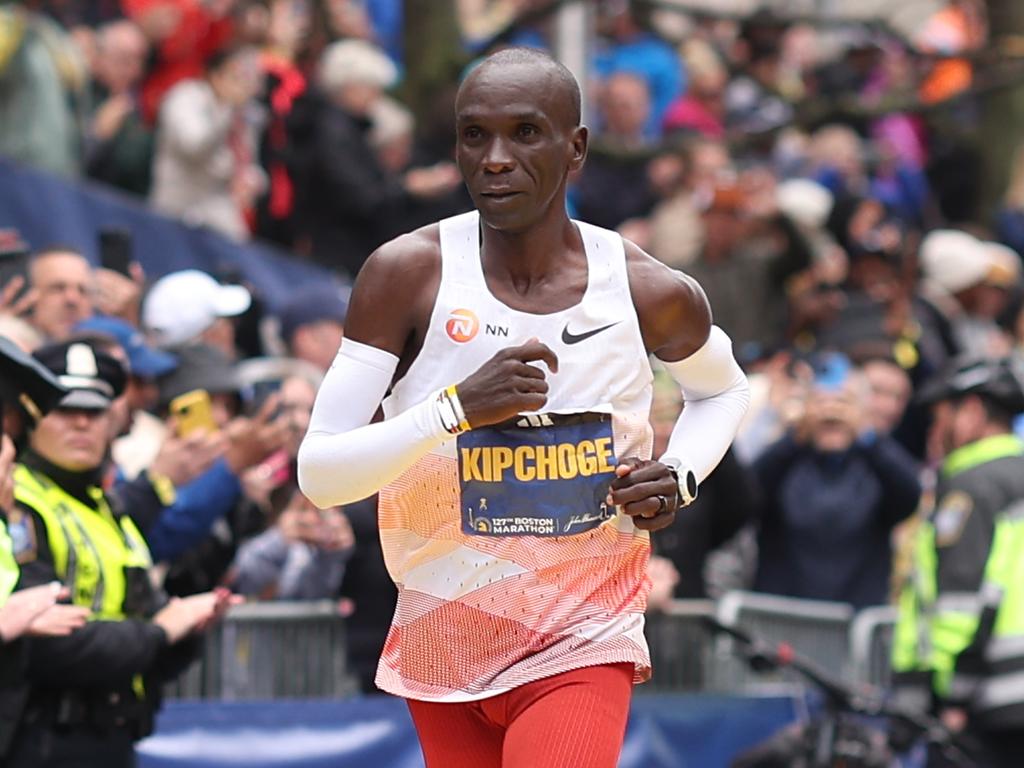
Eliud Kipchoge came into Monday’s Boston Marathon riding a seemingly endless series of astonishing successes that have earned him a label as the greatest marathoner of all time. Then the Kenyan superstar — whose biggest milestones have come on flat courses — got his first nasty taste of Boston’s notorious hills.
Kipchoge was leading the pack and looked to be in control until about the 19-mile mark, when in rapid succession he missed taking a water bottle, fell off the lead and even briefly stopped for a spell as he faltered in the course’s brutal Newton Hills.
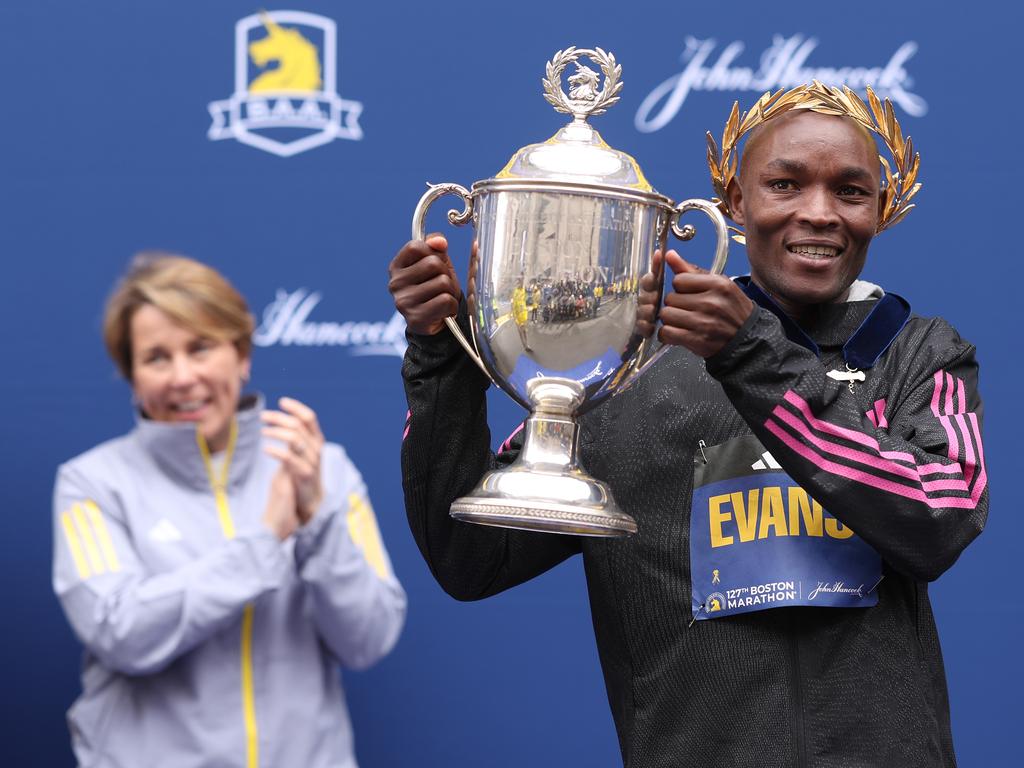
His unexpected missteps opened the door for Evans Chebet, a fellow Kenyan, to pull off a stunning upset, defending his 2022 title to win in 2:05:54. Kipchoge, attempting to win his fifth different major marathon, faded to finish sixth in 2:09:23.
On the women’s side, Hellen Obiri of Kenya pulled away from the pack in the final mile to win in 2:21:38. The victory gives the 33-year-old Obiri, a two-time Olympic medallist and two-time World Champion on the track, the first major marathon win of her career in only her second attempt at a 26.2 mile race.

Up until the final miles, it looked like Emma Bates might have what it takes to become the first American woman to win the Boston Marathon since Des Linden braved a Nor’easter to take the crown in 2018. Bates was unable to respond to a late move from the leaders, but held on to cross the finish line in fifth place in a time of 2:22:10. Scott Fauble was the top American man, taking seventh in 2:09:44.
Kipchoge came into the race as the clear favourite with a clear goal. Nevermind that he had never raced in Boston — or on any other hilly marathon course. Nevermind that he did not practice running on the course: “I want the win,” he said.
Kipchoge’s entry in Boston was part of a long-term ambition to achieve two new feats. He wants to win all six of the world’s major marathons. And in taking on Boston’s hills, he was taking a step toward the 2024 Paris Olympics, where he hopes to win a third gold medal on a steep course.
But his Monday went much differently than planned. Despite leading the pack at what looked like a comfortably easy pace for the first half of the race, as runners got thoroughly soaked from scattered rainstorms, his race fell apart in the marathon’s soul-crushing Newton Hills.
At the 30-kilometer mark, Kipchoge failed to grab his bottle, thus denying him a vital nutrition boost on the most challenging part of the course. About two kilometres later, the world-record holder had fallen to the back of the pack. By the time he reached the race’s infamous Heartbreak Hill, he was solidly out of contention, as the course’s most difficult obstacle lived up to its name. Shortly after, Kipchoge stopped briefly on the course to take a breather — confirmation that he knew victory was out of reach.
Though Kipchoge toured the course by car over the weekend and said that he knew it intimately through visualisation, the runners who finished ahead of him had all tested their mettle on the pavement, either during training runs or previous races. That experience proved to be the differentiating factor on Monday.
“Today was a tough day for me,” Kipchoge said in a statement after the race. “I pushed myself as hard as I could but sometimes, we must accept that today wasn’t the day to push the barrier to a greater height.”
I live for the moments where I get to challenge the limits. It’s never guaranteed, it’s never easy. Today was a tough day for me. I pushed myself as hard as I could but sometimes, we must accept that today wasn’t the day to push the barrier to a greater height. pic.twitter.com/hYadxV5yLE
— Eliud Kipchoge - EGH🇰🇪 (@EliudKipchoge) April 17, 2023
Remarkably, this is only the third time in 20 marathons that Kipchoge has stepped up to the startling line and failed to win. He placed second in his first marathon in Berlin in 2013, then took eighth on a modified London Marathon course in 2020 when driving rains pelted the small elite field.
The rough outing may mean that a return to Boston is in the cards for him if he still hopes to win all six of the major marathons. He’s already won four — Berlin, Chicago, London and Tokyo — and has yet to attempt New York.
Chebet is the first runner to successfully defend his title in Boston since Robert Kipkoech Cheruiyot won three in a row from 2006 to 2008. Chebet shaved nearly a minute off of his finishing time from 2022 to 2023. Sandwiched between his titles in Boston was a victory at the 2022 New York City Marathon.
Women’s champion Obiri has only recently shifted her attention to the marathon. Most of her running success has come on the track, winning silver medals in the 5,000 meters at the 2016 Rio de Janeiro and 2020 Tokyo Olympics. She made her marathon debut at the 2022 New York City Marathon, where she finished sixth on a steamy day.
It was somewhat of a disappointing result for Obiri, but she said it came with important lessons — namely, patience. She put that into practice in March at a chilly New York City Half Marathon, winning in a course record of 1:07:21.
She practised patience again on Monday, waiting until the home stretch to turn on the jets. “I was patient for maybe the first time in my life,” Obiri said after the race.
Despite her success, she very nearly didn’t race in Boston. The Kenyan moved to the U.S., to train in Boulder, Colo., three weeks ago. She didn’t commit to joining the elite field in Boston until a week later.
“I didn’t want to come here because my heart was somewhere else,” Obiri said after the race. “My coach told me you’ve trained well. Something tells me, ‘Go to Boston’.”
Obiri’s coach was right. Her decision to run in Boston paid off fabulously.

WWE fans fume as John Cena’s career ends with ultimate irony

Named: The stars of the Australian Volleyball Schools Cup

Inside the innovative public school that churns out elite athletes

Big futures: Who are the Aussie U18 Rugby Sevens golden studs?

100+ photos: The best local sport action
