
Inside the minds of people running UTMB, the race dubbed the Wimbledon of trail running
It winds through three countries, has 10,000m of elevation gain in 170km of running and takes some two days to finish. Ultra Trail du Mont Blanc is not for the weekend warrior, writes BRENDAN BRADFORD.

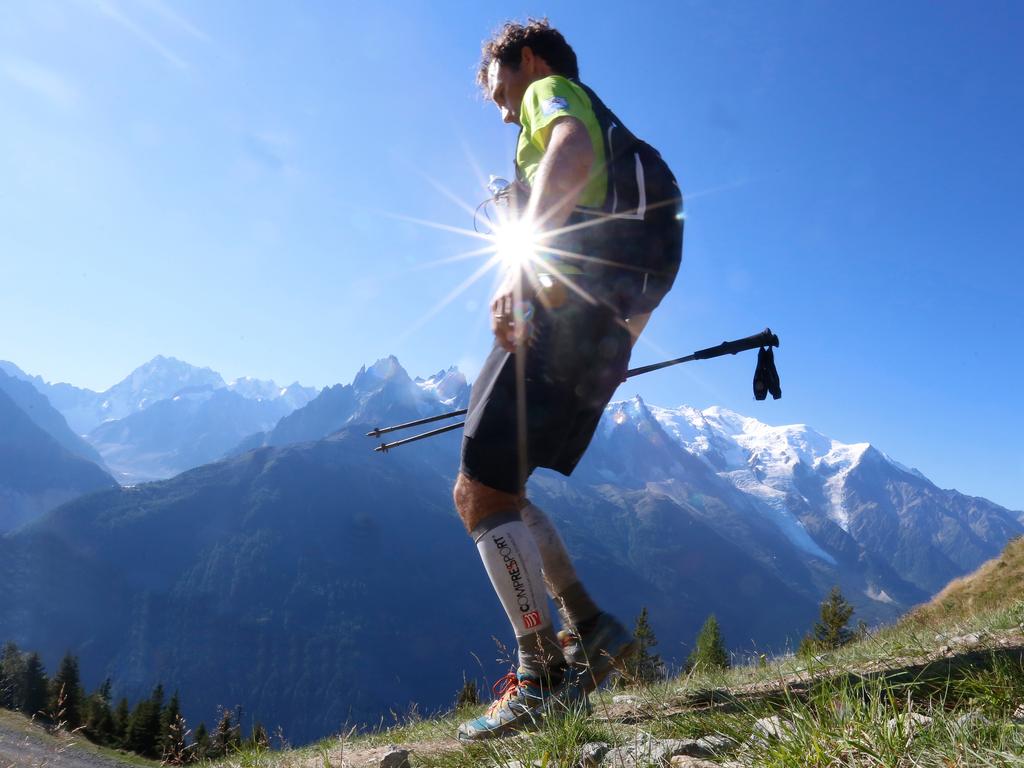
Chamonix is an idyllic Alpine skiing town most weeks of the year.
The host city of the very first Winter Olympics in 1924, it’s a picture postcard type of place, tucked away in the heart of the Alps, near where France’s border meets Italy and Switzerland.
Each year, millions of tourists travel there to test themselves on the many ski runs and backcountry tracks that surround the town. Sitting on the northern slopes of Mont Blanc, it also attracts tens of thousands of mountaineers, with around 200 people reaching its summit every day.
But, for one week every August, Chamonix becomes the global epicentre of the ultra-distance trail-running world.
Skis and snowboards give way to Salomon trail shoes and Camelbak hydration packs as thousands of runners – some of the fittest people on the planet – arrive in town for a weeklong series of races.
The showpiece event is the Ultra Trail du Mont Blanc – or UTMB – which is being run this weekend.

UTMB is a 170km single stage trail race with 10,000m of elevation gain that sees competitors run around the base of Mont Blanc, starting in Chamonix, and spending time in Italy and Switzerland.
In the world of ultra-running, UTMB reigns supreme. It is trail running’s equivalent of Wimbledon, the Masters or the World Cup, with huge crowds flocking to the finish line in scenes more reminiscent of a Tour de France mountain stage.
For the past 10 years, two figures have dominated men’s races in the sport, helping take it it from an underground cult venture to a global multi-million dollar business.
Those two men are Spain’s Kilian Jornet, and American Jim Walmsley.
Jornet, 34, dominated the ultra scene in the early 2010s, and has won UTMB three times. Three years younger, Walmsley is a three-time winner and course record holder of the almost-as-prestigious Western States in California. He was also named ultra-runner of the year four years in a row between 2016 and 2019.
Jornet and Walmsley are the Federer and Nadal, the Messi and Ronaldo of trail running.
This weekend the pair will be two of the biggest drawcards in the most star-studded field ever assembled for UTMB.
“UTMB is like the Tour de France for trail-running. It’s the biggest event in the world,” Kiwi ultra-runner, Scotty Hawker, who finished third at the race in 2019 and will be on the start line this weekend, tells CODE Sports.
“It’s got the most exposure, the most publicity and the most craziness around it.
“If you want to know where you stack up against the best athletes in the world, you turn up at UTMB at the end of August every year, and you’ll find out.
“It’s really cool that Kilian’s running, because when Kilian runs races, people flood in to watch.”

*****
Ultra-running – any race above the marathon distance of 42.2km – has experienced a near-exponential rise in popularity over the past 20 years.
Like any mass participation sport, it has its stars – like Jornet and Walmsley – but is supported by an ever-increasing number of sub-elite runners.
Its growth comes as ‘merely’ running a marathon isn’t considered as epic an achievement as it once was.
People want more. More distance, more wilderness, more vertical gain and more picturesque shots for Instagram.
“That’s a really cool part of it, that there’s more and more people realising that they can be trail runners and run in these beautiful locations,” Hawker says.
“Even in Sydney, people do City2Surf, then realise there’s a trail run up in the Blue Mountains. Maybe they’ve had a friend run it and they decide to do it as well.
“That’s been really cool with the growth of trail running.”
Super accessible for people of all abilities, ultra-running – like running itself – simultaneously accommodates the sport’s elite and the Average Joe in a way that few other sports can. You’ll probably never experience what it’s like trying to tackle Cristiano Ronaldo at Old Trafford, or return a Roger Federer serve on Rod Laver, but you can run on the same Berlin Marathon course on the same morning as Eliud Kipchoge.
“It’s so cool that everyone stands on the same start line, runs the same course, and shares the same moment before the start with the ambience and the atmosphere,” Hawker says.
“It’s really cool, really special.
“I coach a couple of athletes who will also be running UTMB this weekend, so it’s cool that you can enjoy these shared experiences with people.
“Some of my clients will be finishing 15 or 20 hours behind me, but we’re still running on the same trail, we do the same hills and feel the same way about the same climbs that suck and hurt.
“Just getting to share that experience is really cool.”
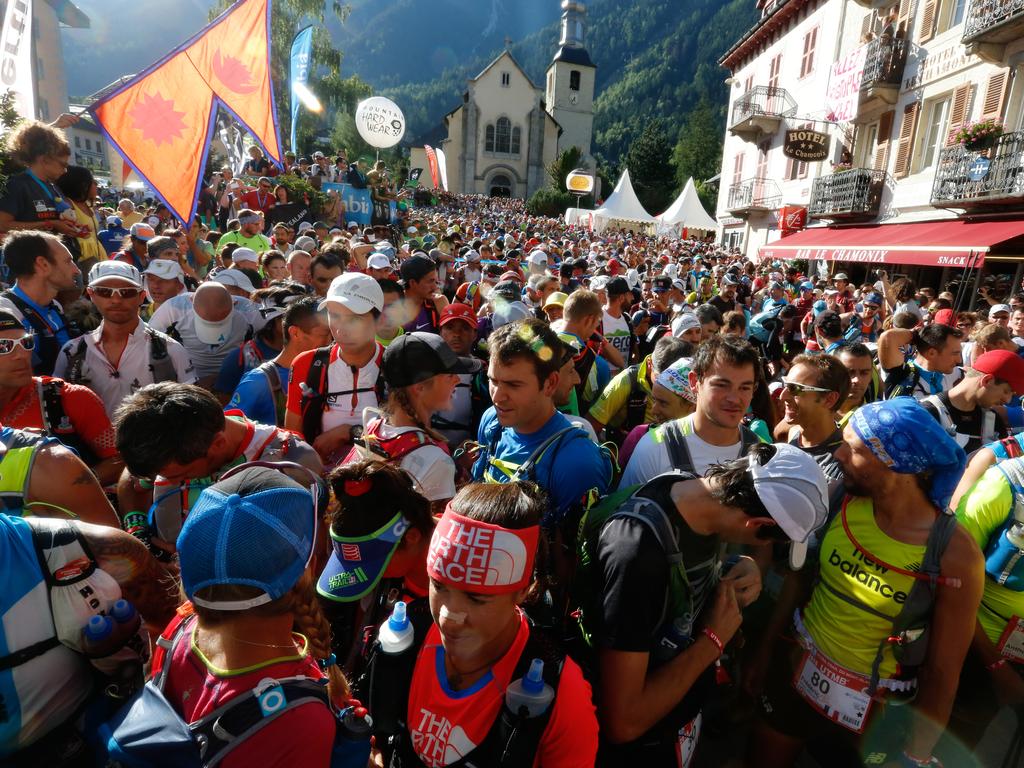
With no barriers to entry, ultra-races often sell out within hours, if not minutes.
UTMB is not one of those races.
It has a strict set of qualifying specifications, meaning only the most dedicated runners can race it.
It isn’t for the weekend warrior.
La Petite Trotte à Léon, or PTL, is one of the other races held earlier in the week leading up to UTMB. It’s a gruelling 300km race for teams of two or three people and involves more than 25,000 metres of elevation gain.
Around 40km into this year’s race, in the early hours of Tuesday morning, a Brazilian runner fell from a trail.
An emergency rescue helicopter transported the runner to hospital, but they tragically died as a result of the fall.
A year earlier, in the TDS – 145km long race held in the same week as UTMB – a Czech runner died in a similar accident.
The dangers associated with running these types of races aren’t lost on the sport’s best athletes.
“I just can’t imagine the family of the runner who passed away, what they’re dealing with and going through,” Hawker says.
“It‘s just devastating. It gives you a sick feeling, because that person was a trail runner, just like me. They were doing what they loved, just like me.
“They were just out there loving the mountains and doing a sport that we love. To lose your life doing it is just so tragic.
“But when you’re incredibly fatigued, running through the night and fueling yourself on gummy lollies and energy gels, you’re not as alert as what you’d normally be. Your decision-making is different.
“The mountains can be a very harsh environment, and going into the outdoors, there’s no guarantees.”

*****
Like many of today’s top ultra-runners, Hawker happened upon the sport by accident. As a kid, he loved the outdoors, had easy access to hilly trails near his home in Christchurch and, most importantly, was a fast runner.
As he grew older, he began competing in multi-sport events, before realising his true passion lay in running around in the mountains.
He moved to Australia more than a decade ago, which gave him access to more races, where he stacked up a few wins and started gaining a profile.
With the sport exploding in popularity in 2014, Hawker maxed out a few credit cards to race overseas. In August that year he secured his first sponsor, who paid for flights and accommodation so he could race UTMB for the first time.
The biggest event on the calendar, Hawker’s UTMB debut came at the end of the busy few months of racing. He was worn out and quickly appreciated why UTMB is regarded as the toughest trail run in the world.
“I had my first sponsor, and I was thinking, ‘Oh, shit this is pretty cool’ but I ended up getting about 30km into UTMB and thinking, ‘Oh, shit, what have I done … I’m absolutely cooked,” he says.
For a race where it’s not unusual for up to half the field to drop out, Hawker did well just to finish, crossing the line in 64th place after spending 27 hours and 53 minutes on the trails.
Eight years on, he’s a fully-fledged professional ultra-runner and has steadily improved his UTMB results, finishing 11th in 2017 and a historic third in 2019, the last time he raced it.
In an ideal season, Hawker will generally compete in a 100km race early in the year, build up to UTMB in August, and finish with another 100km event in November or December.
In and around those tent pole events, he will race between two and four 50km-75km races, mainly for fitness and exposure.
*****
When he first started racing seriously, Hawker was just happy to have his airfares and hotel room paid for by a sponsor. Now he’s one of a growing number of athletes making a fulltime living from the sport, earning the vast majority of his salary from sponsors.
“Don’t get me wrong, we’re definitely not earning Formula One or bloody English Premier League money, but it’s at the point now where you can live a good lifestyle and travel the world,” Hawker says.
Although the sport has taken off in popularity, the prize money at most races, including UTMB, is paltry.
When Hawker finished third in 2019, stopping the clock after 21 hours and 48 minutes, he was paid just €1500 (AU $2160), which was then taxed by the French and New Zealand governments, leaving him with around $1500 NZD.
“I saw something on social media the other day saying that there’s a fantasy league, pick-em, type thing for UTMB this year,” he says.
“The prize purse for winning the fantasy picks was actually more than the prize money for winning UTMB.”
Which is why performing well at the sport’s biggest races is so important. It means earning a higher profile and commanding more, and better paying sponsors.
“It changes your life. You get that big result at UTMB and all of a sudden doors start to open and brands start reaching out to you,” Hawker says of his third-placed finish three years ago.
“It’s the biggest opportunity to have their brands and images out there, so it’s important to race for them as well, because they’re paying the bills at the end of the day.”
*****
The best runners in the race, like Jornet, Walmsley, Hawker and 2019 winner Pau Capell, will spend around 20 to 22 hours on the course. Down the field though, there will be people spending up to 48 hours traversing the 170km of trails.
It requires a phenomenal physical and mental commitment, but also a strategic nutrition plan.
Don’t eat or drink enough early on, and you’ll hit the wall in a big way. Eat too much, or too fast, and you risk vomiting, or worse…
There are 15 aid stations along the route, and runners will often have a support crew on hand to help them eat, drink and replenish the pockets of their running packs with snacks for the route.
Some racers might even grab a few minutes of sleep.
Preparing the right food and drink is as crucial as getting in enough training miles before the race.
Hawker eats a mixture of high carb, high-calorie food, with a selection of gels, bars and sports drinks.
“I have mashed potato and some sushi rice with avocado. I’ll have some plain white bread Marmite sandwiches with avocado as well. Some bananas too. Those are my solid food options,” he says.
“I use these Spring Energy Gels, which are kind of like fancy baby food – just packed full of calories and carbohydrates and really easy on the stomach.
“It’s a mixture of different things, because one of the biggest things when you’re going to be racing for 24 hours is variety. It doesn’t matter how much you might love something, taking it over and over again, you’re going to get sick of it.
“Then it’s making sure that the intensity that you’re racing at isn’t going to cause issues with your stomach processing things.”
*****
Now 35, Hawker has spent nearly a decade in the upper echelons of the sport. Physically and mentally draining, Hawker has seen many athletes arrive on the scene with a bang before burning out.
He’s managed to avoid those pitfalls, and hasn’t dealt with too many serious injuries, but he knows his time in ultra-running will come to an end soon.
This weekend, with one of the most star-studded fields ever assembled, he just wants to see what level he’s still capable of achieving.
“Am I still in good enough shape to compete with the best in the world?” he says.
“The biggest thing is the competition. I want the best athletes in the world on the start line with me at UTMB.
“I’d rather get 15th at UTMB and be beaten by 14 absolute studs and know this is where I stand. Rather than getting a result, and people saying, ‘Yeah, that’s because Kilian wasn’t there’ or something.
“This year, pretty much anyone who could be running UTMB, is running UTMB. The best runners will be on the start line on Friday night, and we’re gonna see what happens.
“It’s exciting.”

WWE fans fume as John Cena’s career ends with ultimate irony

Named: The stars of the Australian Volleyball Schools Cup

Inside the innovative public school that churns out elite athletes

Big futures: Who are the Aussie U18 Rugby Sevens golden studs?

100+ photos: The best local sport action
