
The Super Spikes era is breaking records in long-distance athletics events
The number of runners finishing in elite times has surged in races from the 800 to the 10,000 meters.
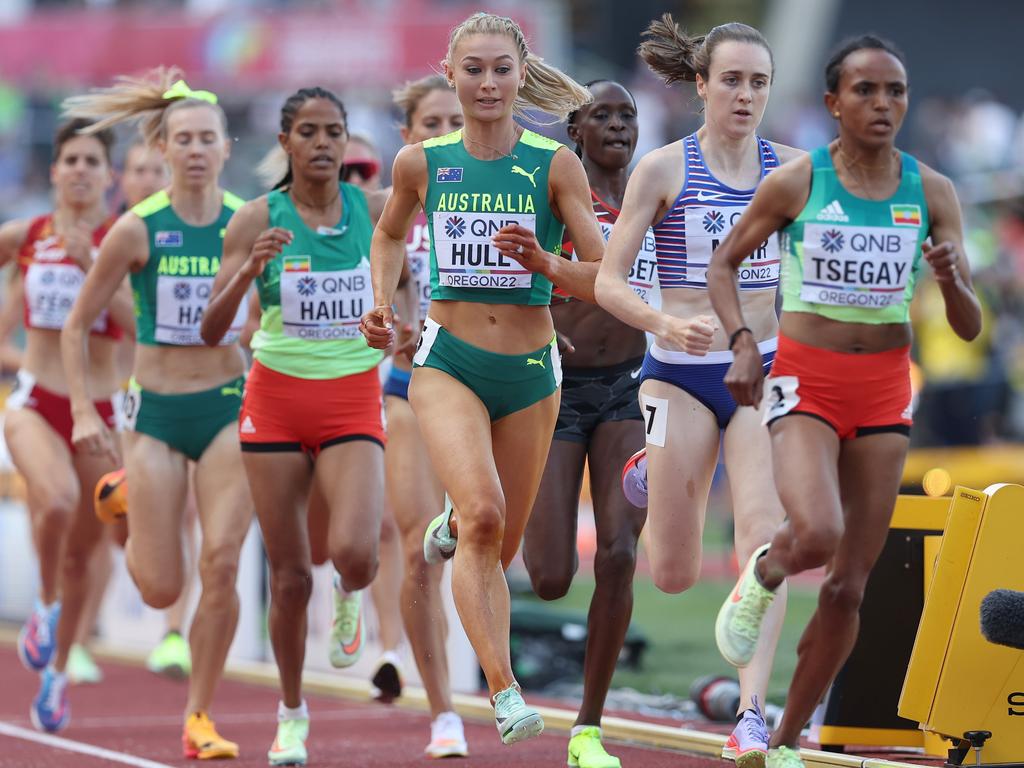
The number of elite finishing times in races from the 800 to the 10,000 meters has surged recently, coinciding with a revolution in the design and materials of racing spikes, according to an analysis of global race results.
One of the most startling findings was a bumper crop of four-minute miles. In 2016, 35 men competing in NCAA indoor meets ran the mile in less than four minutes, a total that changed only slightly for several years. In 2022, when the new spikes became available to all, 90 men ran sub-four-minute miles, a nearly 160% increase.
As the track and field world championships take place this week in Eugene, Ore., many athletes are wearing the new-generation super spikes. The wave of elite times indicates that track and field governing body World Athletics' adoption of the shoes — which feature superlight foams and rigid plates — might also have ushered in a new era of faster races.
The analysis of race times was conducted with publicly available data by Peter Thompson, a Eugene-based coach and former officer for what is now called World Athletics who has also worked at various times for several athletic-shoe companies. Thompson’s analysis is among the most comprehensive look yet at the increase in world-class times in middle- to longer distances on the track during the super-spikes era that began in early 2021.
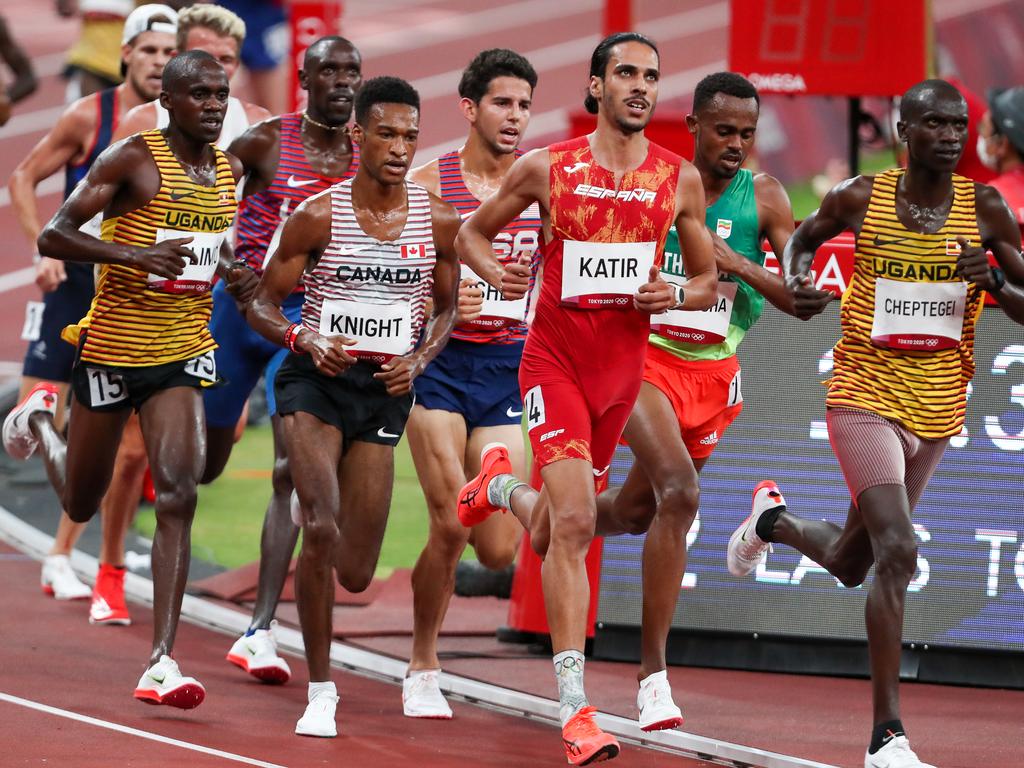
Shoes weren’t the only influence on elite track running in recent years. The Covid-19 pandemic spurred changes in the amount of time athletes spent training and added an extra year of competitive eligibility for American college athletes, which allowed them to become stronger and faster.
Yet those things probably didn’t carry the impact on elite race times that the revolution in shoe design did, said Wouter Hoogkamer, an assistant professor in the department of kinesiology at UMass Amherst who reviewed Thompson’s analysis for The Wall Street Journal.
“I think for these distances, the effects are so large that it’s hard to come up with enough alternative explanations to suggest that it would not be the spikes,” said Hoogkamer, who has published peer-reviewed research on the effects of super shoes. “So I think his analysis is in very strong support of that.”
A description on Nike’s site of its Air Zoom Victory spikes, for instance, says the plate “provides a snappy sensation with each step.”
Globally, the number of men posting times in 800-meter races of less than 1 minute, 46 seconds, for instance, increased 56% between 2016 and 2021. Both were Olympic years, the latter delayed because of the pandemic. In the same span, the number of men who ran 10,000 meters on the track in less than 27 minutes, 50 seconds jumped 59%.

The range of improvement in women’s times was wider, but every standard race distance from the 800 to the 10,000 meters saw increases in the number of elite times. Most pronounced was the change in the 5,000 meters: The number of women finishing in under 15 minutes, 10 seconds more than doubled from 2016 to 2021.
A World Athletics spokeswoman said in a statement that the organisation’s role as the sport’s regulator “includes embracing innovation that helps athletes train and perform to their talented best while balancing that with fair play and reasonable access to new technology.”
She said that in addition to the innovation of shoe companies, other factors that improve performance include training advancements, better racing conditions including pacing, weather and purpose-built tracks.

The number of people notching elite times in an event typically changes gradually from year to year. To figure out the effects of the two radical forces affecting track and field in recent years — shoe design and the pandemic — Thompson charted standout times. He chose the cut-off times that gave him roughly 60 to 90 results in each event for 2021 or 2022, then worked backward.
“I had no axe to grind,” said Thompson, who doesn’t receive funding from any shoe company. “All it is is a collation of data.”
His analysis shows the number of elite times plummeted in 2020, when many meets were cancelled or postponed, then surged in 2021 past previous highs.
The shoe revolution began when mysterious Nike prototypes appeared at the 2016 U.S. Olympic marathon trials. They morphed into the Nike Zoom Vaporfly Elite, which featured a thick, light sole with a rigid plate, and stirred controversy about whether the road shoes gave runners too much assistance.
While swimming’s international governing body banned hi-tech suits after they were shown to provide an advantage, track and field’s governing body took a different approach to the advent of so-called “super shoes.” World Athletics grandfathered in most of Nike’s new design elements and allowed them to be used in competition. Other brands scrambled to create their own versions.

Super shoes improved running economy and contributed to marathon times 1-2% faster than runners wearing older-generation shoes, according to published studies.
In 2019, Brigid Kosgei smashed the women’s world record by more than a minute at the Chicago Marathon, one day after Eliud Kipchoge broke the 2-hour barrier for the men’s marathon on a closed course. Both runners were wearing versions of Nike Vaporflys.
More recently, the design-and-materials metamorphosis spread to racing spikes for the track. With the pandemic causing supply-chain issues for shoe companies, some even took the unusual step of allowing their sponsored runners to wear competing brands in the U.S. Olympic trials so they wouldn’t be at a disadvantage.
Hoogkamer, whose lab at UMass has received research funding from Puma and Saucony, said that he generally likes innovation in shoes and doesn’t want their advances to detract from individual performances.
Thompson’s review didn’t track who was wearing what kinds of shoes, merely what the top performances were before and after the new spikes became available. But the analysis does show, Hoogkamer said, “that something is going on.”

Named: The stars of the Australian Volleyball Schools Cup

Inside the innovative public school that churns out elite athletes

Big futures: Who are the Aussie U18 Rugby Sevens golden studs?

100+ photos: The best local sport action

30+ NAMES: See FNQ’s best student athletes of 2025
