
The sacrifices, strength and spirit of Shamera Sterling – netball’s intercept queen
From McFlurries and sitting down after one training drill to the game’s indisputable intercept queen, Shamera Sterling has risen beyond both her own limitations and racial roadblocks she simply shouldn’t have to.

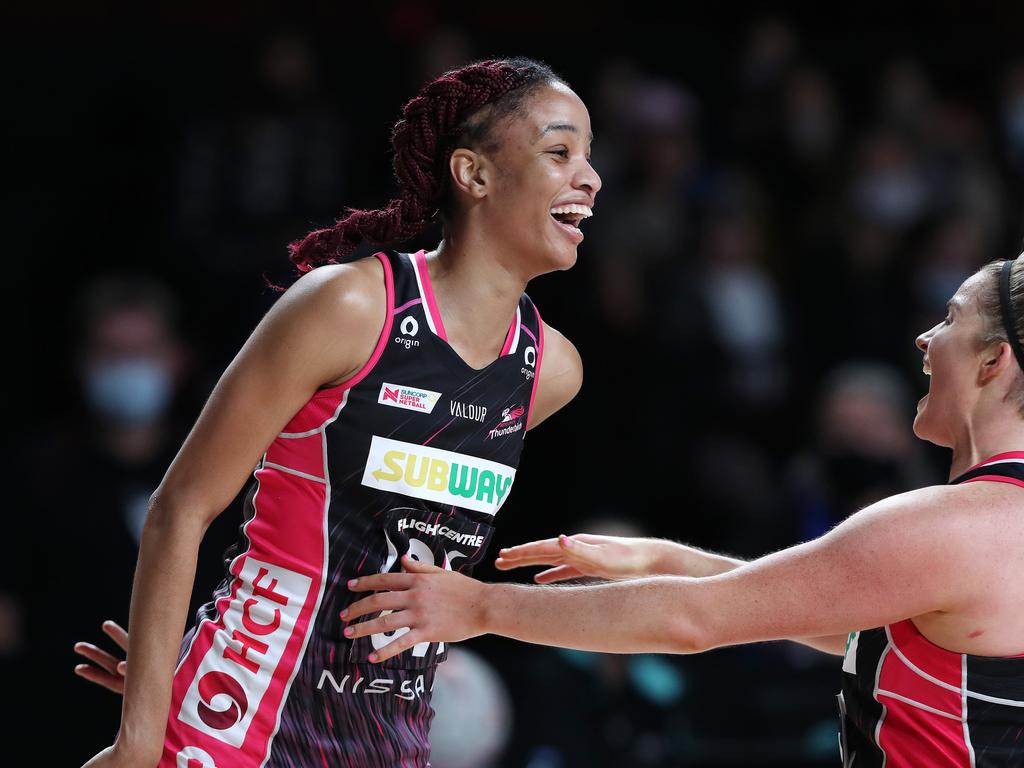
She was the star recruit. The tall but wafer-thin goalkeeper with the freakish ability to snaffle intercepts. The first player signed by the Adelaide Thunderbirds for 2019, thanks to her aerial domination of the UK Superleague and Gold Coast Commonwealth Games.
And then Shamera Sterling started training. Let’s just say first impressions were memorable. If not perhaps in a good way.
That initial session, with assistant Cathy Fellows filling in for new T-birds head coach Tania Obst, started with a high-intensity footwork drill.
Straight afterwards, Sterling walked off the court. Sat down. That was it. Finished for the day.
“She was done after the first drill,’’ Fellows laughs, recalling her first introduction to the spindly Jamaican who had rarely been in a gym before arriving in Adelaide.
“That was my first meeting with her and I was like ‘Oh, my God! What have we [done]?’ I knew of her and everyone had obviously heard how good she is at the international level.
“She trains beautifully now, but it was a shock to her to train at that intensity. One of her big improvements has been that she’s now able to do it and sustain it.’’
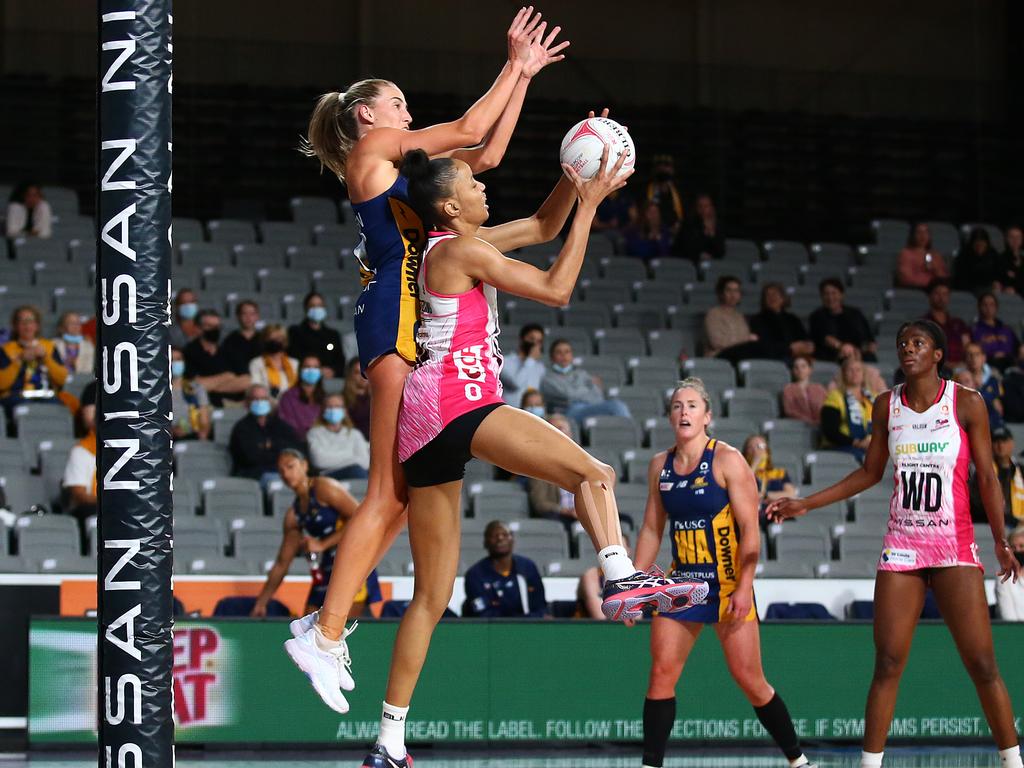
A happy contrast, and constant, has been the 26-year-old’s league-leading tally of interceptions for each of her three Super Netball seasons. In this current campaign, and in the absence of her greatest threat, the pregnant Sunshine Coast Lightning ball thief Karla Pretorius, whose progress Sterling once monitored weekly, Sterling has 23 from six rounds. Or eight more than the West Coast Fever’s Courtney Bruce.
Not that she’s counting, though. Not any more. That was the old Shamera.
The one whose favourite and frequent meal was a McDonald’s BBQ Bacon Lovers Burger and McFlurry washed down with a Caramel Frappe, and who’s only issue with weight is putting it on. But who now enjoys the healthier fare provided by her host family, the Coopers.
The one who has adapted her game to counter the savvy teams no longer feeding high balls into her strength in the air, and now enjoys the challenge of a moving circle so much that she finds defending a tall, holding shooter such as this weekend’s opponent, compatriot Jhaniele Fowler, “a bit boring”.
Meet 2022 Shamera. Or “Shammy” as she is widely known.
“At the moment I do not care about interceptions any more,’’ she says (with the minor caveat that sometimes Super Netball posts the numbers on Instagram, which she might just occasionally stumble across). “I think it’s a bit of maturity for me — you don’t worry about the stats, just do what you have to do.’’
That includes the gym workouts she completes not because she loves them, despite what Fellows might think, but because she knows they’re essential to keep improving her crowd-pleasing game.
Then there’s more of Fellows’ regular footwork exercises, which Sterling and her Jamaican defensive partner Latanya Williams — known as “Lanny” — have christened as “Cathy’s Death Drills’’.
No problem with those. Not any more.

*****
Sterling grew up in Montego Bay. The eldest of five children, her siblings range in age from 22 years to 18 months. Having started her netball life in the primary school quadrangle as a goal attack, she had moved — temporarily, as it turned out — to the midcourt by the time she made the national under 16 squad.
“I realised that I wouldn’t have made it there as a centre,’’ Sterling admits, with typical candour. “The work that centres put in I wasn’t prepared to be that fit, whereas as a goalkeeper, I’m not saying I don’t push much, but I put in the effort that is needed to play a goalkeeper position.’’
The switch to defence came at the behest of former Jamaican captain and coach Oberon Pitterson, Sterling’s mentor-turned-manager. Her vertical leap was showcased in intercollegiate high jump at the University of the West Indies, where the primary teaching student filled in for one competition to help out. And finished fourth with a best of 1.69 metres. “I didn’t do any trainings or anything — I just rocked up and jumped my way through.’’
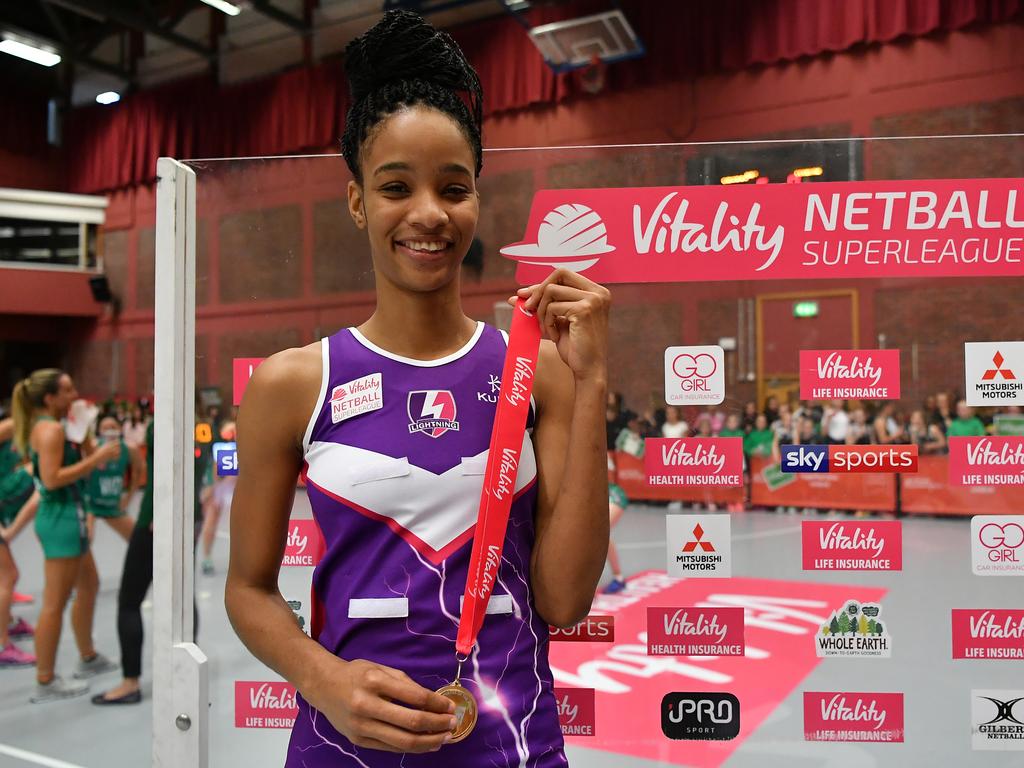
The prodigiously-talented athlete did not so much choose netball, she says, as the other way around. Her first international season was in 2018 with the Loughborough Lightning in England, where she racked up 108 intercepts in just 18 games and was crowned league MVP.
Next was the Commonwealth Games, where she led the intercept tally. Of course she did. When the wooden spoon Thunderbirds came calling, choosing a team that needed her help rather than one that was already successful appealed to Sterling’s sense of competitive equalisation.
Which did not mean that she was fully prepared for what she would find, and the culture shock extended from compulsory seatbelts, to an absence of Jamaican foods and spices and the dearth of “people of my kind” in Adelaide.
“I’ve never seen a Jamaican here, other than the girls that play in the league,’’ she says, pleased to share a culture and language (in private) with Wilson since 2021. “And being in a first-world country and I’m coming from a third world country; everything is just so different. Everything here is strict … but I’ve adapted to it.’’

*****
In few places is netball more popular than a) New Zealand and b) South Australia. Yet, despite being one of the more distinctive-looking athletes in netty-loving Adelaide, Sterling cannot dress as she chooses to visit the local shops.
Blame racial profiling. Rightly condemn, among others, the Target employee who noticed the tall black woman enter, and instantly assumed a search for clothes to send home to her soon-to-be-born youngest sibling was a thief about to get to work.
“The lady would follow me everywhere in the store,’’ Sterling says. “I’m like, ‘I am not stealing anything, I’m just actually looking for something for my baby sister’. They don’t do it to the other person, and I’ve spoken about that to Jhaniele and Jhaniele has experienced the same thing in Australia.
“I think once you’re black and you rock up in a hoodie and shorts you automatically get picked up and followed in the store. So these days when I’m going to the store I try not to wear a hoodie, because I know they’ll probably want to follow me around.’’

Unlike Romelda Aiken-George, for example, Sterling — who has spoken previously of her fondness for London — has no plans to settle here permanently. Not just too few black people, she says, but because she must “come up against racism every single time I pop into the supermarket or anything like that. And then it’s too far away from home.’’
With a contract that takes her through to the end of 2023, she has given herself no time frame to continue in Australia — whether at the T’birds or elsewhere — beyond that.
“I’m just trying to get my degree out the way and see what lies ahead of me,’’ she says, yet to play a final in her 48 games.
The present involves quite a juggle, with one year remaining of her studies at the UWI, and online classes that usually run through the night from 1.30am — including early on Saturday mornings, which sometimes leaves little sleep time before an afternoon Super Netball fixture. No wonder her preference is for Sunday games.
“But an old Jamaican saying is that ‘if you want good, your nose has to run’,’’ she says.
Meaning?
“It’s all about the sacrifices, and I must say it’s a bit challenging, because when you have group work, you can’t meet with your group members, because by the time you get up it’s time for them to sleep, and then I can’t do it in the day because I am at training. So I just have to manage my time well around that.’’

A keen dancer, she is also a world-class snoozer. When she gets the chance, anyway. “I am a sleeper. I do not like morning trainings. I do not like anything that has to do with morning,’’ she laughs.
“I dance a little bit because sometimes that’s where my happy space is. And being away from my culture you have to be on top of the dances, because then when you go back to Jamaica and you go back to the parties, you don’t want to be the only one standing and not dancin’. So I ensure that I keep on top on any dance that Jamaicans have put up for us to try.’’
This Sunday, her opponent will be Fowler, her friend and fellow Sunshine Girl to whom — at 190-centimetres and a super-lean 69kg (up from the 64kg when she arrived, and inching towards the 72kg target set by the club nutritionist) — she concedes both considerable height and weight.
Yet what’s changed is her preference for a faster and more mobile opposition circle and the resulting intercept opportunities; far better than, Sterling thinks, than a Fowler-style holding target.
“In my first year it wasn’t boring, cos me playing against tall shooters was what I wanted,’’ Sterling says. “But then when I realised that you’re just standing next to Jhaniele, trying to get it, but you still don’t get it, it becomes boring. So what I’ve done is try to adjust to a moving circle, and I’ve adjusted to that very well.’’
Away from the court, her sanctuary for the past three years has been host family Melody and David Cooper and their two young children. Mel, a former New Zealand hockey Olympian, works as Head of Multicultural & Community at the Australian Basketball Players‘ Association.
“Living with somebody that understands my culture, and understands how I am as a person, it’s a win for me,” Sterling says. “And sometimes if I feel down I’ll just go sit with the kids and play with them to get back up because when I’m back home I live with my brothers and sisters.’’
*****
Sterling’s six intercepts against the Queensland Firebirds in Round 5 were the most of any player this season. She is a highlights reel in a pink dress and hair styles ranging from bunches – often copied by adoring kids in the crowd – to braids and topknots. The T-bird who gets the biggest cheer during the pre-match introductions, and loves to put on a show.
“She’s amazing,’’ former shooting great Nat Medhurst says. “I want to go to Adelaide for a Thunderbirds game just to watch her, and that’s what the sport needs. It needs players like her that attract people solely to watch them.
“She’s been phenomenal, really. As a player, she makes you change your game and it’s a bit like when you play the men; she’s so athletic, she’s so quick, she’s so good in the air that you have to not put the ball up in what is essentially her playground, and where she loves it. And you need to really stick to that.’’
Then there’s Sterling’s defence over the shot, which Medhurst describes admiringly as “horrible”, due to her lean and wingspan. Add to that the blocks via perfectly-timed jumps and the occasional hoist, and opponents can cope with the full Sterling package for a while. But rarely as consistently as she is now bringing it.
“She does get ball. That’s the bottom line. She gets lots of it,’’ Melbourne Vixens coach Simone McKinnis says.
“There’s nothing of her, she’s deceptive in her positioning. Off the body. On the body. Getting around, contesting from behind. She’s got long reach and elevation, so she can contest from different positions no matter what positions she’s in, and she’s also just so threatening on the shot and the rebounds.
“You can see that when she gets the big intercepts and the big rebounds and everything, you know she loves it.’’

Her timing, anticipation, elevation, speed and vision are what stand out to another former defensive great and world champion, triple Firebirds premiership coach Roselee Jencke, who is unfussed by what can appear to be questionable body language at times when calls or circumstances do not fall Sterling’s way.
“Look, she’ll mature. She’ll get better,’’ Jencke says. “I’d rather that in a player than no passion for what’s going on. Everyone wants to sanitise everything, and I want the one who is a bit competitive and gets a bit antsy. That’s what Sharelle (McMahon) was like. All the champions have a little bit of that in their DNA, and I like it. Sport’s passionate. There’s a lot on the line.’’
Fellows describes the hands-on-hips-and-legs-crossed pose as Sterling’s “natural” stance, but one seen less frequently these days. Sterling meanwhile explains her occasional frustration with umpiring decisions and the like as a reflection of her passion. “Jamaicans, we don’t know how to hide our emotions, or hide whatever we don’t agree with.’’
She is unfailingly direct and honest, too; a bluntness that Fellows also sees in Wilson. “I must agree with Cathy that Australians don’t come straightforward to you with anything,’’ Sterling says.
“They beat around the bushes with whatever they want to tell you, whereas it’s a part of my culture that you just tell it as it is. Just go for it. And I think in a team you need somebody like that. You can’t really be babied. Sometimes you need to tell it as it is.’’

Yet also to listen, and Fellows rates Sterling as not just a natural leader but an exceptional student of the game; who has added strength, power, better footwork and aerobic capacity to her natural gifts.
“She knows where the ball’s going, so she finds a way to get there,’’ says Fellows, with whom Sterling has a close working relationship. “It’s her ability to read the game. She’s not freakish in her intercepts; she actually knows where the ball’s being delivered and gets herself into that space.
“Sometimes you think she’s not listening or she’s not switched on, but she always is, and has some really great insights into things, and thinks about how to do things a different way. Some of that’s obviously stuff she’s learnt internationally, but she’s a great thinker on the court.
“She definitely is instinctive, but a couple of times I’ve questioned her on things and she has really logistic reasons around why she tried this or tried that, and what she’s actually trying to do.
“One of the things we’ve been working on over the four years is the reading of the game and what’s happening or unfolding in front of her, or what her opportunities are or what she can do to create those opportunities. So I think that’s probably been her biggest evolvement.’’
If few are better to watch, and Sterling admits she always tries to bring her “fun personality” onto the match court, then Fellows finds her a pleasure to coach. For it’s one thing to have the ideas, she admits, but quite another to have an athlete who can execute them.

“She’s got it all,’’ Fellows says. “A lot of teams would potentially think that she’s not all that great at ground level and have tried to exploit her, but that’s another improvement. Everyone’s known about the aerial aspect of her game, but she’s actually got great ground coverage, she can cover a moving goaler, she’s good on a low ball.’’
And still on the rise, after some challenging beginnings, with Sterling’s early struggles in adjusting to the full-time world of high performance sport including one call to the NSW Swifts’ Trinidadian import Sam Wallace.
“I said ‘Girl, how do you manage playing netball here? Oh my God, it’s so hard, I want to go home’,’’ she recalls.
“And then as time progressed, (it was still) ‘I want to go home’.
“And then, as time progressed, I got used to the training environment.
“And then I became more comfortable.’’
So here she is. Not just still standing, but leaping, blocking, disrupting and telling it how it is in her own inimitable Shammy way.
Not done. Not by a long stretch.

‘Not in the gutter’: Netball star fires back at haters

Opinion: Why Tassie’s had enough of being the support act

The self-confessed ‘netball nerd’ stepping into the Mavs’ hot seat

Diamonds lock in powerhouse series ahead of Comm Games

The making of Gerard Murphy – and why he’s ready for Mavs challenge
