
What Achilles injury catastrophe means for Aaron Rodgers’ NFL and New York Jets career
Aaron Rodgers’ NFL season was over before he even completed a pass for his new team. But what about his career? Here is what doctors are saying and some past examples.
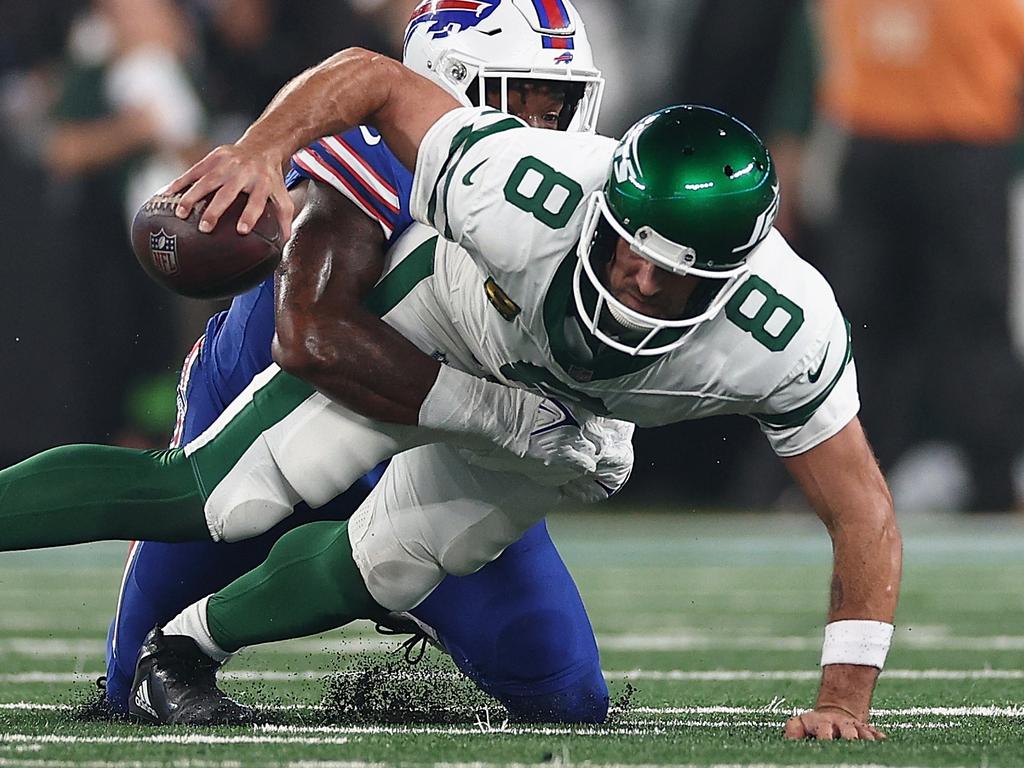
Aaron Rodgers was just a few minutes into his career as a New York Jet when he suffered one of the cruellest injuries in professional sports: a torn Achilles tendon.
He’s done for the season before he ever completed a pass for his new club.
But what about the rest of his career?
The 39-year-old was already testing the limits of age in a notoriously brutal sport as he attempted to follow Tom Brady’s unprecedented path of longevity. Now, Rodgers faces a long road to recovery from an injury that has ended careers far shorter than his.
Doctors who specialise in sports medicine say the recovery after surgery for an Achilles tear can take nearly a year, and that it can take another year after that for athletes to return to full strength — or as close as they’ll ever get to that. Those doctors also caution that not every pro athlete who suffers such an injury makes it back onto the field at all.
Still, they were optimistic that should Rodgers wish to continue his career as a 40-year-old in 2024, his Achilles shouldn’t stop him.
“I would anticipate that he should be able to come back next year,” said Dr. Peter DeLuca, the chair of sports medicine at Cooperman Barnabas Medical Center and a former Philadelphia Eagles physician for more than two decades. “I don’t think it’s going to affect his throwing and arm strength, but I think it’s going to affect his running a little bit — at least the first year back.”
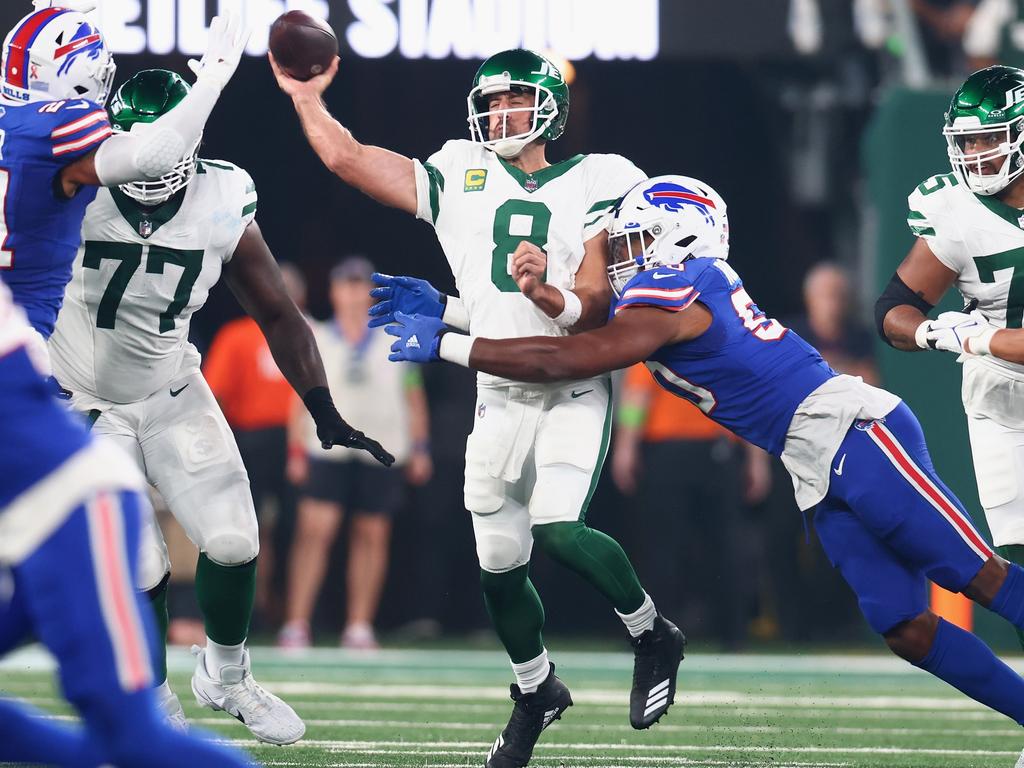
Rodgers has yet to speak publicly since the injury, though before the season he said he envisioned his time with the team as a partnership lasting a few years. Jets coach Robert Saleh said Wednesday he would be shocked if this is the way Rodgers went out.
Rodgers, in August, added that he wants to keep playing as long as it’s fun and “as long as my body feels good.” Now, he’s run headlong into the toughest test his body has faced.
There’s no shortage of research into Achilles tendon ruptures in elite athletes, or even specifically elite athletes who play in the National Football League, and it points to somewhere between a quarter and a third of players never returning at all from their tears.
On the brighter side, though, surgeons say that technological advances in the last 25 years changed the game. In several recent studies, researchers comparing NFL players’ performance before and after the injury have reported that it’s mainly or only running backs and linebackers who have significantly decreased performance following their injury during the rest of their career.
Robert A. Jack II, MD, an orthopaedic sports medicine surgeon at Houston Methodist Hospital, was the first author of a study of 98 Achilles tendon repair surgeries in 95 NFL players between 1958 and 2016. That study included five quarterbacks, and all returned to sport, an average of 11 months from the injury. But Jack had better news than that, about Rodgers’s position specifically.
“We did not find any post injury/surgery differences in QBs as it relates to performance,” Jack said in an email.
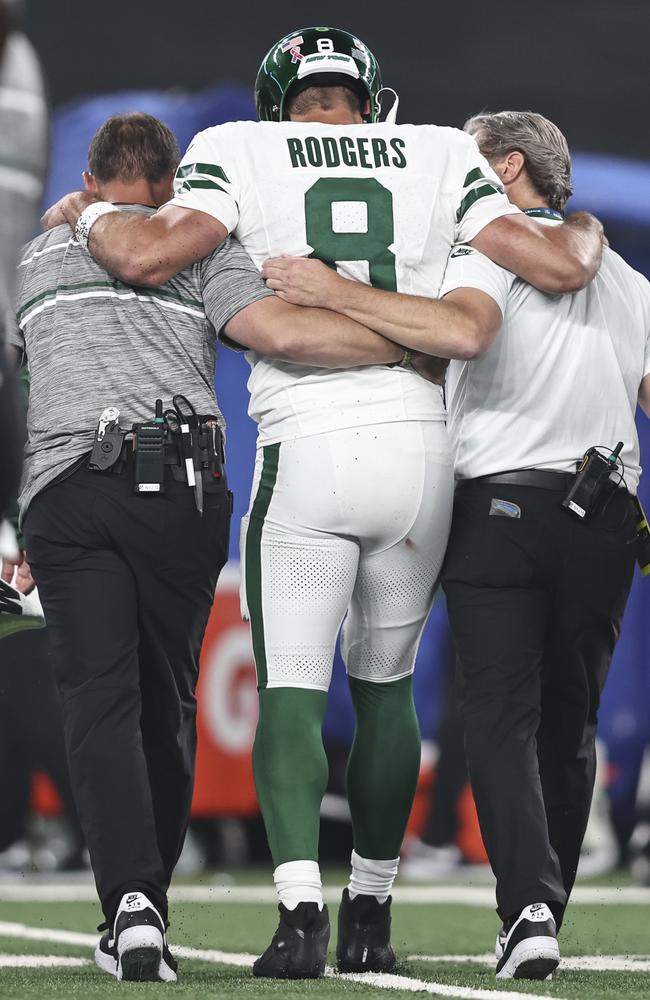
There have been recent examples that show both types of outcomes among high-profile athletes. Kevin Durant waited 18 months to play again after his Achilles tear, an extra lengthy time period owing to some external factors such as the pandemic, but eventually returned as one of the NBA’s best players. The more worrisome comparison for Rodgers is Kobe Bryant, who was 34 years old and nearing the end of his career when he tore his Achilles. He returned to the court, but he was never the same player.
There have also been remarkable turnarounds that count as medical marvels. A Russian gymnast who seemingly anchored his team to an Olympic gold medal in Tokyo in the summer of 2021 three months after his injury and surgery remains to American experts difficult to believe. Rams running back Cam Akers returned in under six months for the team’s Super Bowl run two seasons ago, although he wasn’t especially effective when he first got back onto the field.
Despite the bittersweet situation on Monday night, when Rodgers and Jets fans saw the team’s Super Bowl chances plummet even after the team pulled off an overtime victory in his absence, experts pointed to a couple silver linings. For one, when right-handed quarterbacks drop back to pass, they typically plant with their leg on the same side. Rodgers, though, tore his left Achilles tendon.

The position he plays is also a positive factor. Unlike an NFL wide receiver or an NBA shooting guard, Rodgers doesn’t require bursts of athleticism to be a master at his craft.
“Compared to basketball, which is much more explosive and Achilles dependent, the quarterback is less so,” said Dr. Spencer Stein, an assistant professor at NYU Langone in the department of orthopaedics.
Still, even quarterbacks have to run, and part of Rodgers’s brilliance is his creativity on the field. Scrambling is an inevitability. And the simple act of walking backwards, like Rodgers has to do on most snaps, can put a strain on his leg — just ask soccer legend David Beckham, who in 2010 tore his Achilles taking what appeared to be a routine step backward while readying to kick a ball.
Doctors are also in agreement that his recovery will be more difficult owing to the simple fact that he’s 39 years old. That may be relatively young for the general population, but it also makes him one of the oldest players in the NFL.
“Trying to get your muscle unit to come back is probably harder every year of your life,” said Dr. Andrew Elliott, a foot and ankle surgeon at the Hospital for Special Surgery who works with Major League Soccer’s New York Red Bulls. “He’s not 30. He’s almost 40.”
“But you look at him,” Elliott added, “and he’s in great shape.”

Part of what makes predicting a precise outcome is that there isn’t a terribly large sample size of NFL quarterbacks who have suffered an Achilles tear. And even some of the prominent examples that exist occurred decades ago, and doctors say medical advancements since then are significant.
One prominent instance was another one of the best quarterbacks ever. Dolphins great Dan Marino tore his Achilles during the team’s fifth game of the year in 1993, and when he first returned in the 1994 pre-season he struggled — leading to questions about whether the injury would doom his career.
Marino has said the surgery didn’t work properly and that he didn’t move the way he had previously, but when the regular-season came around he proved his doubters wrong. He threw five touchdowns in the season opener to beat the New England Patriots in a shootout.
More Coverage


Jets fans don’t need to be reminded of a slightly more recent Achilles tear. Vinny Testaverde led them to the AFC Championship after the 1998 season, and they hoped to take the next step a year later. Then Testaverde, like Rodgers, tore the same tendon in the first half of the first game of the season. Testaverde returned the next year, though his numbers showed a marked decline.
Moments before Rodgers’s debut as a Jet on Monday night, he was joined at midfield by an honorary team captain for the coin toss. It was none other than Testaverde.

NFL rocked by superstar’s devastating injury

Injury crisis forces NFL franchise to turn to 44-year old grandfather

Halftime rappers, nightclubs: How Aussie footy lags behind US

Mahomes rescue act saves Chiefs as Colts stumble

Sydney? Brisbane? NFL’s Aussie expansion could get even bigger
