
How the Jillaroos transformed physically in five years for the Rugby League World Cup
The women’s game has changed dramatically since the 2017 RLWC, and the physical transformations of the Jillaroos is a direct result of investment, writes PAMELA WHALEY.


Same game, but in five years everything has changed for the Jillaroos.
Leading into the 2017 Rugby League World Cup, Jillaroos coach Brad Donald remembers scrambling trying to find a supporter to offer the Australian squad a gym membership so they could get some preparation done. They managed to wrangle a six month deal with Fitness First for 20 players.
Back then, there was no NRLW, no women’s State of Origin and nowhere near the amount of resources for women’s rugby league. And from their vantage point in York after beating the Cook Islands 74-0 in game one of RLWC on Wednesday night, it’s easy to see how far they have come.
“You think back to 2017, basically we did the selection process in 2016 and had the mid-season Test to see how everyone was tracking,” says Jillaroos coach Brad Donald.
“We’ve got data out of those players and we know how far they’ve come, but we were only having half a laugh about it the other day, when the team was announced, there was a picture of Issy [Isabelle Kelly] from 2017 used for the Jillaroos squad, and she looked at it and wondered who it was, she didn’t even recognise herself.
“It just shows how we’ve been able to train these guys as physically as possible as semi-professional rugby league players.
“What we know now compared to what was around back then in 2016 and 2017 is miles apart.”
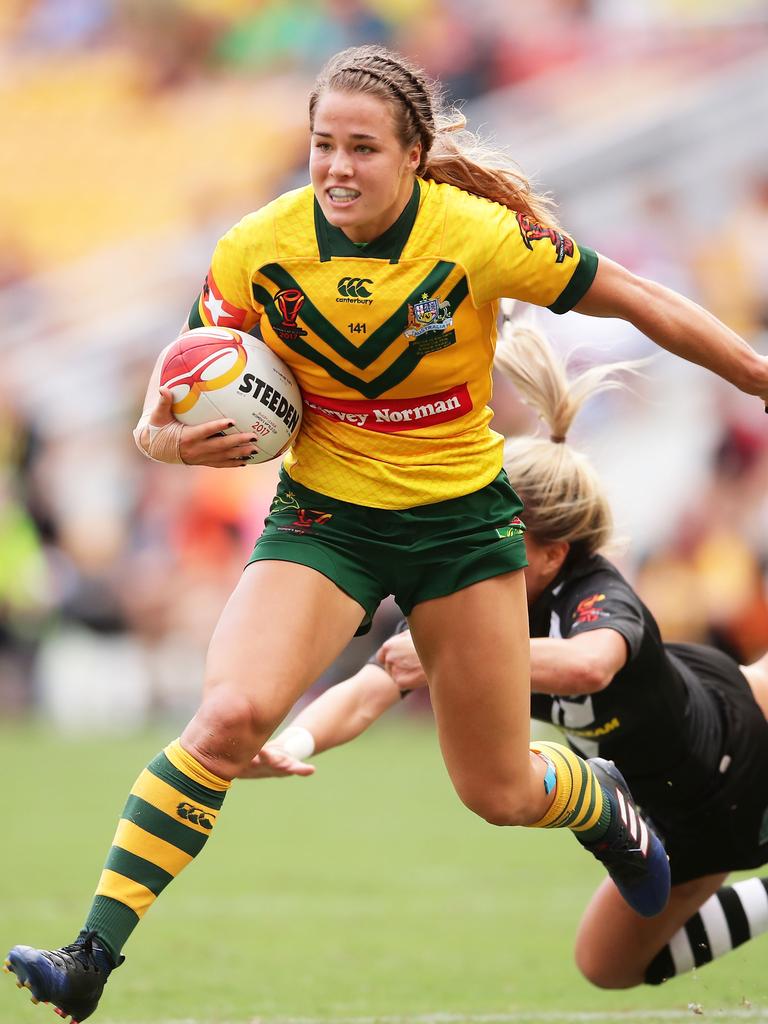

In such a short space of time the physical development of the game’s elite female rugby league players has gone through the roof. Although they are still only semi-professional athletes, for the Jillaroos coming into the RLWC squad with pay parity to their male counterparts, it allows them to be fully immersed in a professional environment.
Physically, they are fitter than they have ever been, as well as stronger, leaner and more agile and it’s due to the elite year-round training they are able to get at both NRLW clubs, Origin and international camps.
On tour in England they’re having daily check-ins with the coaching staff to assess their bodies as well as the highest tech sport science to ensure they’re not over-trained, risking injury.
“It’s a lot different to the remote training programs we sent out in 2016 and basically asked players to do their best until they got to the next camp,” Donald says.
“That’s the changes we’ve seen. I go back to 2016 and we asked 35 of the training squad who was doing the strength program and eight hands went up, but now we walk into the team room and there’s players all over the floor doing stretch and mobility exercises in their own time.
“We do breath work in the morning and some of the girls who have been exposed to the cold water immersion are talking about how it makes them feel better with other players, so they’re turning the dials on themselves in terms of what gets them their best performance.”
From an administration standpoint, small changes, like the rebranding of the Women’s Interstate Challenge to State of Origin, as well as big investments like the NRLW competition from 2018, has changed the future of women’s rugby league.
Now, we’re starting to see a whole new generation of women and girls who won’t know the difficulties of training and playing at second-class facilities.
Donald’s experience coaching Queensland in the 2013 Interstate Challenge draws a grim picture.
“We played at Davies Park, we had a captain’s run in the afternoon and half the girls came in and had paint on them,” he says.
“I go, ‘What’s been going on here, you’re supposed to be off your legs’.
“They said to me they had to paint the changerooms for the game tomorrow because they’re too shitty.
“Here they were painting their own changerooms so the State of Origin fixture, that was played at 10am, about three games before the Queensland Cup game, was taken care of.
“To see how far that’s come in 10 years is next level.”

Just as they did in 2017, Australia opened their RLWC campaign with a big win over Cook Islands, and will next face France on Sunday night in York. Stars including Jess Sergis and Emma Tonegato weren’t named for the opening game as Donald opts for a rotating team to cope with the four day turnarounds for the three pool games, with the final to be played on November 20.
Five players remain from the world-beating squad from five years ago in Kelly, Sam Bremner, Kezie Apps, Simaima Taufa and Ali Brigginshaw, while 13 debutants were named in the squad marking a change in generation for the Australian side. For Donald it was about striking a balance between youth, experience and adaptability to empty the tank of the entire 24-person squad by the end of the tournament.
“We had our jersey presentations [prior to the Cook Islands game] and it was the first time we’ve had the whole family come into that group even though it was on zoom, which was pretty special,” Donald says.
“We just thought it was important with 13 debutants … We probably had 100 cameras in. It was great for the girls.
“We’re getting to the point where we’re two and a half weeks in and missing their families so it was good to touch base as a group and for them to see their families.”
The average age of the team is around 23, and Donald has one eye on the future at all times.
The landscape of women’s rugby league is rapidly changing in Australia and the game is on a precipice of professionalism at the moment. The leap from amateur to semi-professional in the space of the past two RLWCs bodes well for what the next four years looks like.
In 2023 four more NRLW sides will join the competition, while female pathways that were established years ago are now starting to produce players who never had to give up the game at 13. New resources at NRL clubs such as the Wests Tigers and North Queensland centre of excellence giving equal access to their women’s teams means there is a future where players are given the same opportunities to be elite.
The future is now and does not involve scrambling or gym memberships or painting dressing sheds before a captain’s run.

Major move tipped for NRL megastar

Career over? Paps shuts down NRL return despite R360 collapse

Ashes sweep: Walsh issues ‘frightening’ World Cup warning

Broncos bombshell: Maguire linked to England job amid UK trip

Star’s Golden Boot claim, Cleary flops – again: Every Kangaroo rated
