
Selwyn Cobbo, descendant of Eddie Gilbert, breaks new ground on the road from Cherbourg to NRL
Selwyn Cobbo’s family tree boasts some of Indigenous sport’s most celebrated names. Regardless of how far Brisbane’s next big thing goes, he has already made history, and a difference where it matters most.
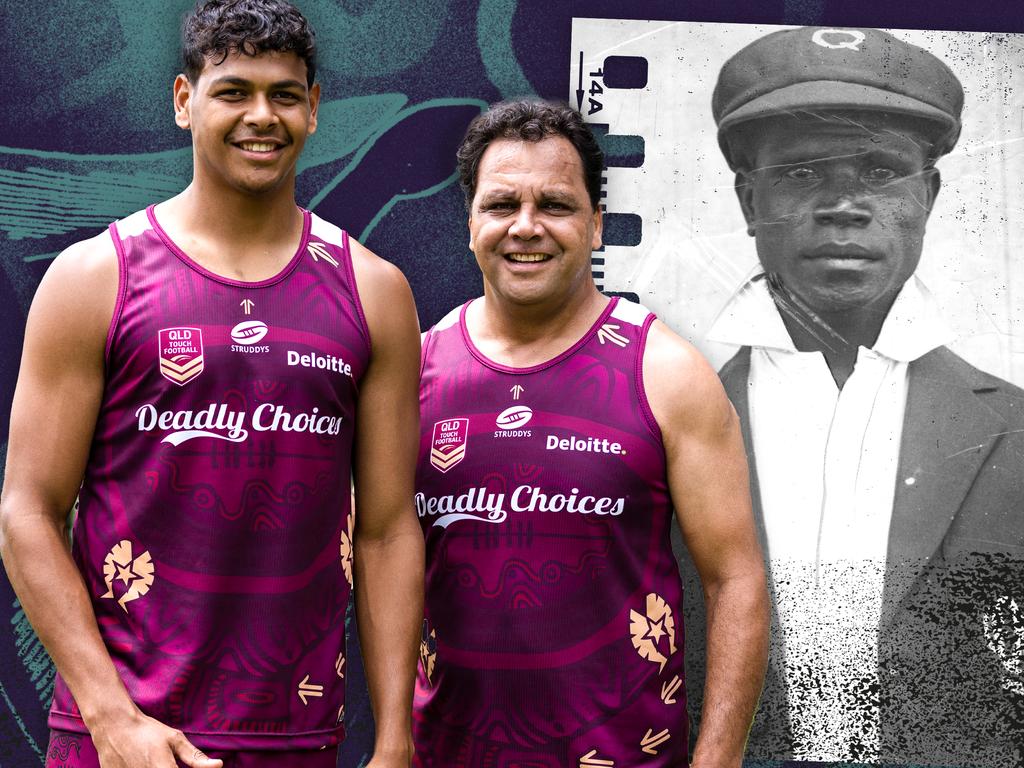
Eddie Gilbert once put Don Bradman on his backside and Cherbourg on the sporting map.
His great-great grandson Selwyn Cobbo has already broken similarly historic ground, first following in the footsteps of several supremely talented relatives and then marching out a new marker for the Aboriginal community with a population below 2000 and a million stories to be told.
Gilbert famously clipped Bradman’s cap and sent him spinning to the turf in a 1931 Sheffield match before dismissing him for a duck, history forever recording his blistering spell as the fastest the Don says he ever faced – Harold Larwood, Bodyline and the rest included.

Regardless of how far 19-year-old Cobbo goes in rugby league, the Cherbourg local will forever be the first Indigenous school captain of nearby Murgon State High, almost 75 years after it was first opened in 1945.
Within two years Cobbo was making his NRL debut for the Broncos, and Murgon already boasts two more Aboriginal school captains since.
Brisbane’s greatest ever tryscorer Steve Renouf is an icon in these parts and attended the same school, and having never put himself up for a leadership role, is well aware of how significant Cobbo’s achievement really is.
“The story of Eddie Gilbert‘s success against the odds has been a great source of strength and pride to me and all our mob and Selwyn is a trailblazer in his own right,” Renouf says.
“I am so proud of him. I went to Murgon High myself and never put myself forward to be captain. As the first Indigenous captain Selwyn is going to open the door for others to follow in his footsteps. It’s a great story.”
Cobbo, with a quiet, understated confidence that rings through most all he does, took up the captaincy challenge and made sure he kept his nose clean once he got the gig.
“At first I didn't really think about going for school captain. I was going to go for sports captain, but all the teachers said I should go for school captain so I did,” Cobbo says with Renouf alongside him at Broncos HQ.
“I was a shy boy growing up and at the start talking in front of big crowds was hard for me, but I just practised and practised it and got a lot of help from my teachers along the way.
“My family helped me and I had rules. I had to get home before the sun went down. If my friends did bad stuff, I just walked away. It is not always easy.
“There is a lot of talent in Cherbourg but it comes down to whether you really want it or not and whether you are prepared to make the sacrifices.”

‘If he can do it, we can do it’
Look no further than Cobbo’s cousin and promising 18-year-old boxer Pharrell Chapman for the effect Brisbane’s latest rising star has already had.
Chapman – who has won two national golden gloves titles, two state titles and represented Queensland at the national titles in 2019 as a member of the Cherbourg Boxing Group – was the second Aboriginal captain of Murgon High in 2021 after Cobbo paved the way.
“When Selwyn became the first Indigenous captain it inspired me to be the next,” Chapman says. “I was already a leader and a role model from my achievements in boxing so I decided to finish off my school years by taking on that extra responsibility.
“When I was younger I was a ratbag but it takes time to mature. Being captain and having my boxing gave me a lot of confidence. The great thing is that now we have a third Indigenous school captain this coming year, Girra Watson.”
Chapman will now move to the Sunshine Coast with the aim of emulating late Cherbourg boxer Jeffrey Dynevor who won a gold medal at the 1962 Commonwealth Games (formerly the Empire Games) in Perth, and joined high jumper Percy Hobson as the first Aboriginal athletes to win gold.

“I look up to Jeffrey Dynevor because he represented himself and our people. He is an inspiration, not just to me, but this community as well,” Chapman says.
Chapman’s mum Linda Georgetown understands how a strong role model, leadership and a sporting dream have transformed her son.
“There are a lot of young fellas that look up to Selwyn and I truly believe that he has opened up all of the kids‘ eyes and now they want to follow. Now they think ‘if he can do it, we can do it’,” she says.
“Selwyn inspired my son, without a doubt, and Pharrell is just a delight now. As he was growing up Pharrell was one of my hardest children. He picked up boxing and it just changed his whole personality and behaviour.”
Family footsteps
As Cobbo’s grandfather Trevor Blair details the list of outstanding athletes Selwyn is related to, the gem in a glittering crown is revealed.
“My wife‘s grandfather was Eddie Gilbert. Selwyn has Eddie’s blood in him. Will Chambers is his uncle too,” Blair says.
Alongside former Storm premiership-winner Chambers, ex-NRL playmaker Chris Sandow also numbers among his cousins, while Selwyn‘s great-uncle was national boxing title holder Adrian Blair, who represented Australia at the 1964 Tokyo Olympics and 1962 Commonwealth Games in Perth.
The Cherbourg trio of Blair, Dynevor and Eddie Gilbert’s son Eddie Barney were all members of the 1962 Australian boxing team that competed in Perth, the first group of Aboriginal athletes to ever contest the Games.

The Cherbourg (formerly Barambah) settlement was formed in 1904 by the Queensland government when Aboriginal people were forcibly relocated there from across Queensland and northern NSW.
Gilbert and his contemporaries like Cherbourg’s rugby league great Frank ‘Big Shot’ Fisher, who was named in the Indigenous rugby league team of the century, achieved great deeds despite being beholden to the Aboriginals Protection and Restriction of the Sale of Opium Act 1897.
“Aboriginal people were restricted in their movement back then … because of the colour bar,” Selwyn’s father Shamus Cobbo says.
Gary Osmond, who co-authored the book Black and Proud, detailing the backstory to the iconic image of former St Kilda AFL star Nicky Winmar standing up to racial abuse in 1993, explains just how restrictive the “colour bar” was.
“The Act gave the right for the government to forcibly move people onto and between settlements like Cherbourg. People couldn’t leave, receive visitors or even marry without permission and any sporting events were controlled and administered,” Osmond says.
“Despite that, settlements like Cherbourg still produced all these top-notch athletes. By the late 1920s white communities asked the government to compete against these Aboriginal teams so you start getting Aboriginal league, cricket teams and boxers travelling around more but they had no personal freedom about where they went.
“Even for Frank Fisher and Eddie Gilbert, the ability to take up those opportunities was limited. It wasn’t until the 1970s that Aboriginal people were given permission to move around.”
In Queensland, Aboriginal people on the settlements were still unable to get passports into the early 1960s. Fisher played five-eighth for Cherbourg and Wide Bay against the British touring sides of 1932 and 1936 and impressed English captain Gus Risman so much that he was invited to play for Salford.
“Frank Fisher didn’t get to the point where he could inquire about a passport because the officials at Cherbourg were not going to consider that, because every movement outside the community was completely controlled,” Osmond, an Associate Professor at The University of Queensland, says.
“It is a nuanced story but the fact is that those guys didn’t have the opportunities white fellas had. There was definite discrimination and definitely examples of them being overlooked.”
Renouf, who was named in the Indigenous team of the century alongside Fisher, has seen enough of Cobbo to know he has the world at his feet, and the opportunity that his forebears were denied.

“Selwyn has qualities that Wayne Bennett would say you just can’t coach,” Renouf says. “He is just starting out but there is so much he can achieve in his career and for his community.
“It was a lot more difficult for Eddie and Uncle Frank to achieve what they did in their time, far harder than the passage for Selwyn and I have had into professional sport.
“They did it tough to reach the heights they did, but they still did it. Uncle Frank was still around when I was a young fella and it was just amazing, a real honour, that two blokes from the same area got named in the team of the century.
“I learned more about Eddie in the mid-2000s when I was working for Sport and Rec Queensland. He had an unmarked grave up there so we organised to get his tomb re-done at the cemetery. Going through that process, and speaking to my uncles, I understood a lot more.”
Ken Edwards, who co-authored the biography of Gilbert, explains how sport has brought the people of Cherbourg together in a powerful way. It is that legacy that Renouf and Cobbo have inherited from the likes of Gilbert and Fisher.
“So many people I interviewed told me how the story of Eddie Gilbert made them feel better. They would have a feature story pinned on the wall and would burst into tears and say how it filled them with pride,” Edwards says.
“That pride has been passed down and a real spirit has developed.
“When I was there a couple of years ago I was driving with one of the local elders and I saw a street game of cricket with 150 kids playing and young mums with their kids under their arms. One of them was bowling while holding this little child and it made me think there is something about Cherbourg and sport that unites people.”
Lessons from GI and Latrell
Cobbo has already worn obvious but unfair comparisons to both Greg Inglis and Latrell Mitchell given his size, speed and skill, and was introduced to the latter’s in one close quarters showdown late last year.
No doubt there are many more to come. As for whether he admires the way Rabbitohs fullback plays the game …
“Yeah, in some areas yeah,” the 21-year-old grins.
“I ran into him in my third game at Suncorp and he put his shoulder into my jaw in the first 10 minutes. They didn't pull the game up because I kept playing, but I had a concussion test and failed.”
Renouf interjects at this point and makes a prediction.

“With Selwyn growing up in Cherbourg he will have that natural aggression and will learn to stand up for himself against Latrell,” Renouf says.
“You see Latrell stand over people. He has grown up doing that. If you are proud, you do it. Selwyn will get his turn.”
Cobbo has already joined Renouf in working with the highly regarded Deadly Choices program promoting healthy lifestyles in Aboriginal and Torres Strait Islander communities, and completed several training courses to do so.
He’s already been picked for the Indigenous side in the upcoming All Stars clash.
“That’s why it was Greg Inglis that I looked up to,” Cobbo says. “He was a beast and a gun footy player. I also really liked what he did and still does off the field for our mob.
“I want to give back to our community and play a role, during and after my career.”
Pride, passion and the Pearl
Selwyn’s father Shamus says his son’s historic school captaincy was “a big achievement”, but one he was also encouraged to embrace with humility.
“His mum and I always get into him,” Shamus says. “We say, ‘Don’t get around thinking you are better than anyone because someone will always come along and sit you on your arse. There are a lot of cocky, big noting fellas out there. Just don’t be like those fellas. Just be yourself’.
“I try to keep him away from being in the shadow of Will [Chambers] and I hate the idea of them saying he is the next GI or the next Latrell. That is a lot of BS.
“I am always onto him not to listen to that. He idolised those guys but he is nothing like them. I want him to be Selwyn Cobbo.”
Cobbo signed a Broncos development contract when he was 16 and is wrapped up at Red Hill until the end of 2023.
“He had the Cowboys trying to snare his signature, but it wasn't my call. It was his call,” Shamus says.
“He always wanted to play with his beloved Broncos since he wrote it on the blackboard. Me and his mum, his nan and pop and all his siblings have just supported him … to keep him on the track of where he wanted to go.
“We used to do a lot of driving. It was a two-hour round trip to Gympie and back and five hours to Kawana.
“Back home he'd get up in the morning and do his daily run, then train with the men in the evening. The dedication was there. The attitude was there. All of the above. He was just a rugby league man.”
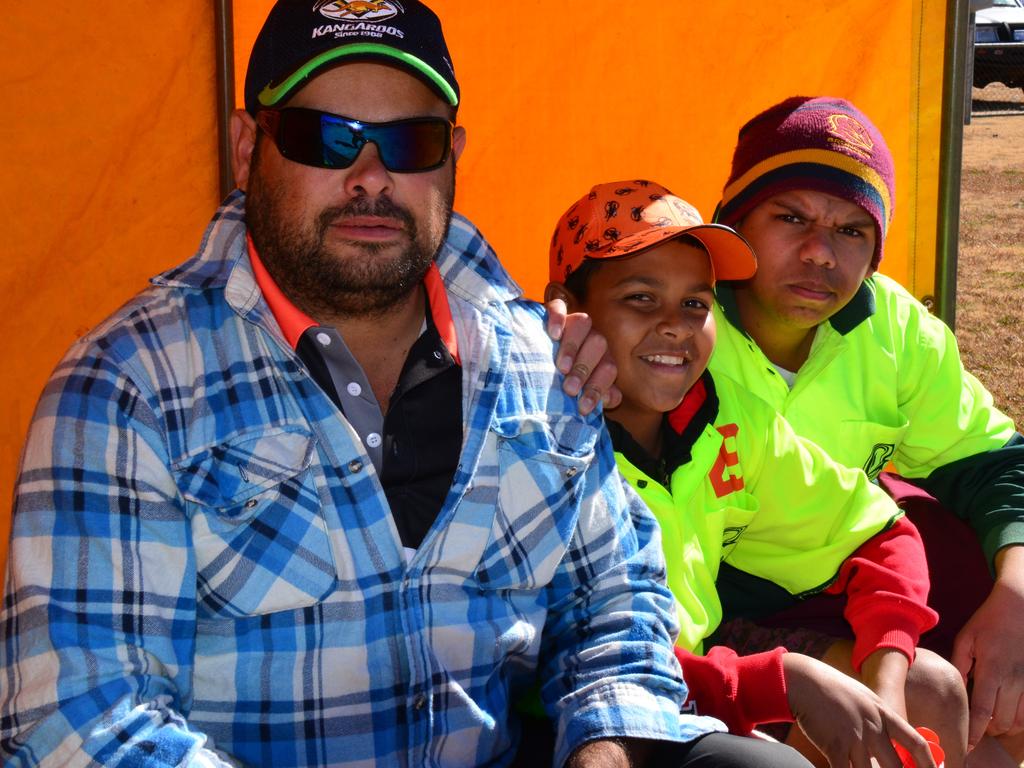
The Broncos flew Shamus and wife Kayleen to Sydney for their son’s NRL debut last year and they presented him with his jersey in front of the team.
“It was a proud moment. It was just the getting there part I didn't like. I don’t like flying,” Shamus says.
Shamus delivered a Churchillian speech about Selwyn’s journey from the Cherbourg Hornets to the Broncos in front of the team.
“The speech was long … and it was pretty touching. He had all the boys crying,” Selwyn says.
That first NRL outing – a heavy, demoralising loss to the Dragons in which Cobbo still impressed – was both the realisation, and just the beginning, of a goal he has targeted for much of his young life.
“When I was in year nine everyone had to write a goal on the blackboard and I wrote that I wanted to play for the Brisbane Broncos, and a couple of years later I achieved it,“ he says.
“This year I just want to make that top 13 and stay in it for the whole year.”
Cobbo prefers centre to fullback or wing. Renouf, the Broncos greatest ever centre, was asked early in his career by Bennett if he wanted to play fullback when there was an injury.
“I said ‘nah’ … and I never played fullback after that conversation,” he grins.
“I played wing a bit to make my way into the side but I couldn't wait to go one-in, but if I was to give Selwyn some advice it would be to stick to what he wants. If you want to be a centre, tell them you want to be a centre.”
Cobbo has already shown the requisite resolve and dedication to get where he wants. Back in Cherbourg as a lad he had a ritual of rising at dawn and tackling the town’s ‘reservoir hill’, a two to three kilometre gradient that sorts men from boys.
Free time was spent on horseback, father and son traversing the nearby Kilkivan Great Horse Ride that attracts people from all over Australia and the globe.
Leaving behind an idyllic country lifestyle wasn’t easy for Cobbo, but like everything else, he’s adapted.
“My dad has been a big influence in my life, the same as my mum, so it was tough when I first moved to Brisbane for a couple of months because I didn't have much family down here,” he says.
“My host family looked after me. Now, I am OK with everything.“
Trevor Blair simply couldn’t be prouder, not having his grandson nearby made up by the strides the youngster is making further afield.
“I just finished watching his clips on YouTube an hour ago,“ Blair says.
“All the black fellas in Cherbourg have natural ability but it takes a certain person to push through … and Selwyn did.
“My wife and I have 16 grandchildren, and that's small compared to other people here I can tell you. My wife and I don’t put Selwyn on a pedestal. We treat them all the same, but what Selwyn has done is good … very, very good.”
Cobbo is still just seven games into his NRL career, but it all lies ahead of him as he bids to make his mark at the Broncos like Renouf, the ‘Pearl’ of the club’s centres.
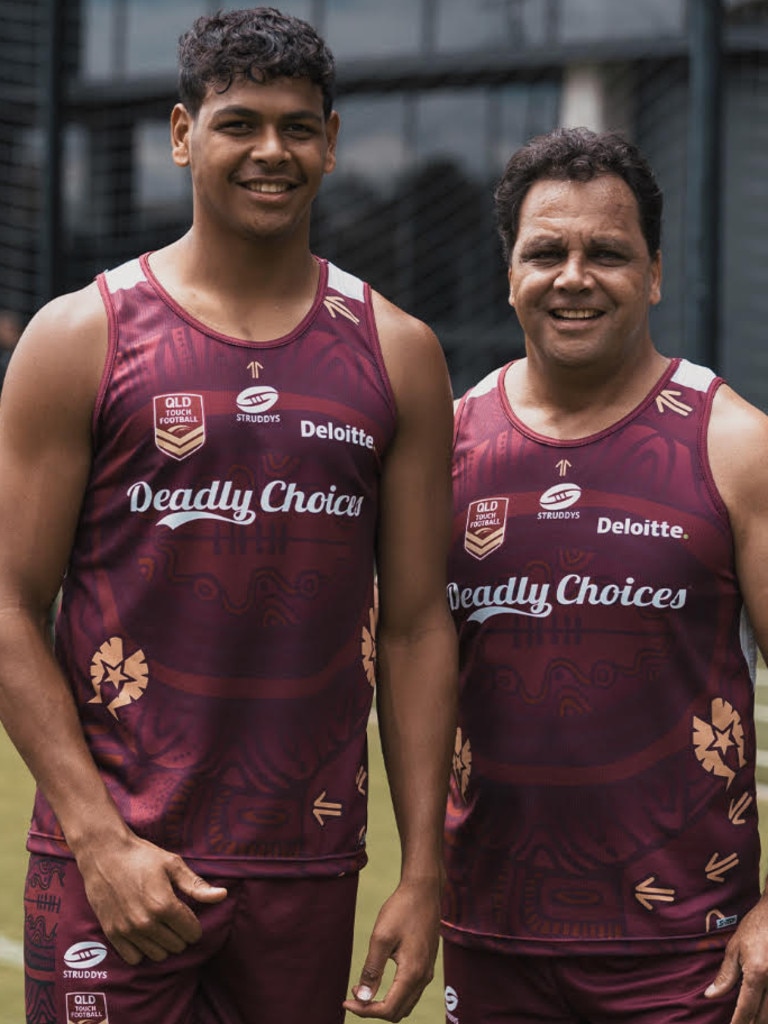
The generation gap ensures their combination is an off-field one, though a lovely moment in a social game of touch footy – in which Cobbo sending Renouf over for a try – was captured for posterity.
“The Broncos CEO Dave Donaghy has brought in the concept at the club of the old and the new, and not to forget the old,” Renouf says.
“He was watching Selwyn put me through a hole at touch and Dave said he hoped someone had got a photo of us together because we are both from the same area. It was a nice touch.”

NRL transfer tracker: Every player signing, exit linked with your club

The many stories behind Ezra Mam’s epic premiership tattoo

Injuries, Pezet signing not enough to guarantee Reynolds’ retirement

Broncos legend’s tribute jersey creates record-breaking interest

Best since Benji: Broncos land generational Kiwi prospect
