
Inside Nina Kennedy’s devastatingly derailed Tokyo Olympics and its silver lining
Flying five metres into the air with a giant bendy stick, Nina Kennedy was killing it, until she wasn’t. Injury, Covid, even the weather brought four years of work undone, and will bring her back again.

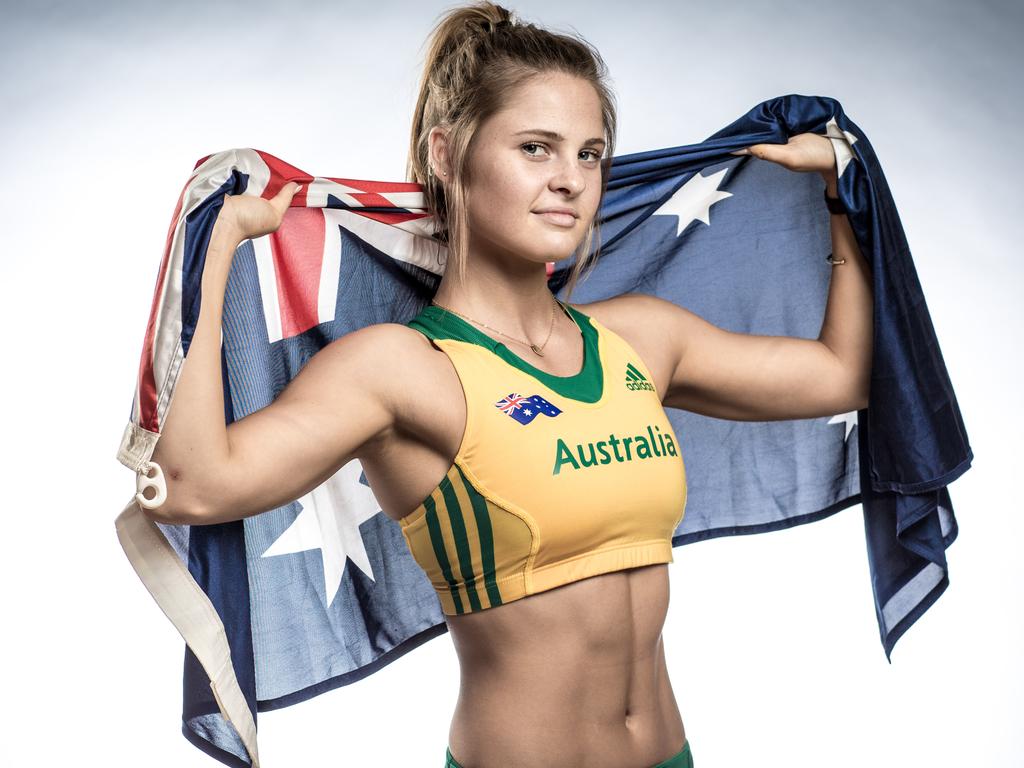
Imagine sitting down for the most important exam of your life after being unable to study for the previous four months. Nina Kennedy compares it with competing in the Olympic pole vault while woefully underprepared. Which sounds even scarier.
On top of the mental apprehension, is the physical jeopardy of being propelled almost five metres into the air by a giant bendy stick. “There’s a fear factor,” Kennedy says. “There’s the weather. There’s a lot of different factors. A lot going on.’’
For Kennedy, too much going on at times in a year that delivered a national record of 4.82 metres just over 100 days out from Tokyo when she was in the midst of 10 consecutive jumps over 4.70m, when her pre-2021 best had been 4.71.
“The start of [2021] was amazing,’’ she says. “I became the best woman pole vaulter Australia has ever seen, so that was just incredible in itself, but then from that nationals everything kind of started to go pear-shaped.’’
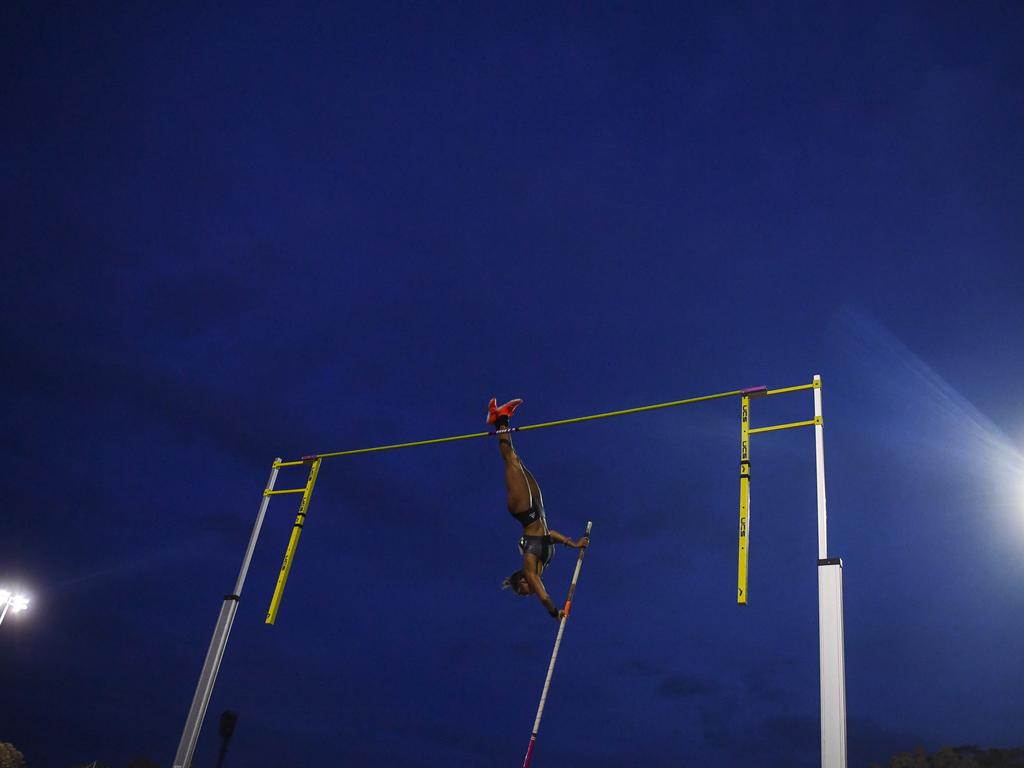
Having torn her calf in the nationals final without initially knowing it, Kennedy returned five weeks later to suffer an eight centimetre adductor tear. Next, while trying to salvage her build-up at the pre-Games camp in Cairns, she ripped her quadricep.
Then, just days after arriving in Japan, having had the misfortune to be deemed a close Covid contact via a brief encounter at the stadium walk-through, she was removed from the athletes’ village and sent to hotel isolation for the duration.
Yikes. This was not the Olympic experience she had imagined during the five years since Rio, where the former junior world record-holder on a seemingly irresistible upwards trajectory had originally been tipped to debut.
Or, to put it in Kennedy’s words: “I was like ‘Are you bloody serious?’ I’d got into the village and I was really not feeling like myself, it was very overwhelming, and I think the nerves at this point were really starting to kick in as well.
“That Covid complication was probably like the breaking point for me. It was like ‘OK, this is beyond a joke now’. It was really hard.
“If the injuries hadn’t happened and I’d had a really good lead-up into the Games, maybe it wouldn’t have seemed like such a big thing in my head. But this was like, ‘Oh my gosh, another hurdle I have to jump’. Being locked in a room with no windows, no normal food for five days before the biggest event of your life was just not ideal. We couldn’t train. It was just horrible.’’
Her WA Institute of Sport coach Paul Burgess and training partner Kurtis Marschall shared the same treatment, having also been greeted by Covid-positive American world champion Sam Kendricks and thus moved away from the Australian team and placed under stricter movement protocols as the clock ticked towards competition day.
“I think for Nina it was the straw that broke the camel’s back,’’ Burgess says. “She had managed to stay so positive throughout so many challenges in the lead-up and she was really doing well to not drop her bundle, and then in Tokyo I think it was just the last piece that broke her a little bit.
“I was really worried about her, actually. She really was struggling when we were in Tokyo.’’
Whether Kennedy would even compete was still in the balance until not long before the evening qualification round. Which was particularly devastating, given the world’s fifth-ranked pole vaulter had announced herself as a genuine medal chance with the March PB that would have won bronze in Rio.
“I was so close to pulling out. My head was a mess, my body was a mess. I was like, ‘Oh, do I even want to go out there and just actually embarrass myself, kinda thing?’
“I did a lot of work with the psych and in the end I was like, ‘Even if I go out there and no-height, I’m happy that I would have done it’. And it was fun. The only way I was gonna get through it and get the best out of myself was just try and put on a positive attitude and just try and enjoy myself.’’

Having passed at 4.25m to help manage the pain, her sole clearance came on her third attempt at 4.40m. Meanwhile, down came the rain, as it was for Incy Wincy Spider, except he managed to climb up again.
Kennedy just got wet.
“That was probably the cherry on top of the cake. It was kind of like, ‘Of course, this would happen’ and at this point I wasn’t even bothered. I’d cleared a bar and I was just kind of trying to enjoy myself. Then it starts raining and I was kind of like, ‘I literally cannot control this, just let it go’.’’
Kennedy finished 12th, thus missing the final.
“I was proud of her for getting out there and giving it a shot, and even though it wasn’t how we’d planned it or how we’d hoped for the year to go, I still was proud of her for just putting herself out there,’’ Burgess says. “A couple of days before I was a bit worried she might not even get out on the track.’’
*****
Kennedy’s star shone bright and early. The former gymnast from the Margaret River town of Busselton moved north to Perth with her family towards the end of primary school and started Little Athletics at the age of 11.
By 12, she had been talent ID’d and fast-tracked in pole vault. At 14, she won silver at the senior nationals. Top five finishes at the IAAF World Youth Championships and then the World Junior Championships followed in 2015, as did three personal bests at one meet that included the world junior record of 4.59m.
She was fast and strong, with elite aerial awareness. The fact that the WAIS was home to Australia’s best pole vault program and coaches meant she could pursue a discipline for which she was so well-suited without needing to leave home.
“The opportunity was kind of handed to me on a silver platter,’’ she says. “So I just fell into it by accident, and before I could really think about if that’s what I wanted to do, I was already a national champion and it kinds just went from there, really.’’
Until it all started to go awry in 2016. With no-heights registered at the senior world championships in Beijing and her follow-up world juniors, Kennedy missed selection for Rio. Still just 18, in her own words, she “just crumbled.”

“I was a shoo-in to make that team, I was really young, I didn’t make it, and that just took a really big toll on me,’’ she says. “At 18 I don’t think you really know yourself that well. Elite sport isn’t easy and then chuck some mental health issues on top of that and it was bloody hard.
“I’d never really experienced adversity. I’d never had to overcome something so serious and hard. It was such a smooth run, breaking records, easy, easy, easy, so when you experience something like that you’re like, ‘Oh wow, I actually have to put in the effort’, and then you start to learn about yourself and you start to understand that elite sport is so much more than the physical, and just jumping high.’’
Five years later, having overcome a preparation that was limited by a foot injury suffered just six weeks out from the 2018 Commonwealth Games to memorably win bronze on the Gold Coast, the young veteran of 24 still considers herself a baby of the sport.
“I feel like I’ve been an elite athlete my whole life, and I’m honestly so exhausted from it all,’’ says Kennedy, who is committed to completing the Paris Olympic cycle but unsure of her future beyond that.
“There’s definitely a lot of unfinished business at the Olympic level and the best girls in the world all medalled at the Olympics, they’re all 31, they’re old girls, so I think I still have a lot of years left in me – if I want to keep going.’’
*****

They’re a different breed, vaulters.
“I would say that all of us have some kind of crazy, and we’re all a bit complicated, but her kind of crazy is an awesome kind of crazy,’’ says Burgess, a triple Olympian and dual Comm Games silver medallist, who first started working with Kennedy in 2014, before taking over as her principal coach in 2019.
“She’s got it all, really. She’s an elite athlete, she’s very athletic, running and sprinting and jumping wise. Her gymnastic ability is unmatched, I would say, and crucial for pole vault, and then — and this is a compliment — she’s an animal, she’s an absolute mongrel, as far as aggression and fight goes.
“I always say she’s an outside cat. She’s just an absolute beast, and she’s got white-line fever. So when you put all that together, that can be a plus and a minus. The minus is that she can sometimes be incredibly hard on herself, so she can use it against herself or for herself.
“She can be unreasonable at times. So we just let her go with it sometimes, let her have her moment, but she usually comes round. She always comes round. And when she gets the balance right, she’s world-class. I would put her up against anyone. I wouldn’t swap her for anyone in the world.’’
Burgess ranks Kennedy with his former teammate and Beijing Olympic gold medallist Steve Hooker as the most talented Australian pole vaulter he has seen.
“I jumped alongside Steve Hooker and although I was a tight competitor with him, I always just saw something a little bit more in him than I did in myself,’’ he says. “Just something extra. And I think Nina’s in that realm.’’

Olympic success is not everything Burgess stresses, noting he doesn’t consider his own career a waste because he failed to finish on the podium in three attempts. Kennedy’s own Olympic experiences – the disappointment of Rio non-selection acute, and Tokyo, unfortunate at best, have ensured the pertinence of his message.
It’s worth remembering Kennedy arrived in Tokyo without having jumped off her full run-up since April. “So I was feeling very, very far from my best level, and pole vault’s such a technical and confidence sort of sport that if you don’t have the confidence you’re like, ‘What the hell am I doing?’ Oh my gosh, It’s hard to put into words how uncomfortable it can be.’’
Still, she competed, and did all she could in difficult circumstances, subsequently referring to her diary for reminders that yes, she did enjoy it, while determined not to sound ungrateful because at least she got there.
“You can choose to just see the negative and see everything that was wrong in that situation — 90 per cent of everything was wrong, and bad, but it’s just stopping yourself and being like, ‘Dude I am at the Olympic Games. I am an Olympian. This is my first Olympics, this is a childhood dream. You bloody did it and you should be so proud of yourself. And you should also be so proud of yourself for the last three months of bloody injuries and tears and everything you’ve lived through’.’’
All of which has fuelled Kennedy for a big year of competition in 2022, starting with the World Indoors in Belgrade in March, then in July, the World Outdoors (for which the qualifying mark is 4.70m) in Oregon and the Birmingham Commonwealth Games.
She wants to find out what her limits are, then push harder, further. “I really want to be the best that I can be, and if that’s 4.82, which I don’t think it is, then fine, I’ve reached my limit, but if it’s 4.80, 4.85, 4.90, five metres, then cool, bring it on,’’ says Kennedy, believing Russian Yelena Isinbayeva’s world record of 5.06m is not necessarily beyond reach.
“You never know! If you’d told me a year or two ago that I was gonna break that Australian record I’d say ‘mate, you’re dreaming’, so if I could be the world record-holder I’m probably gonna say you’re dreaming now, but until it happens you never know.
“I often really surprise myself and really underestimate how good I was a vaulter. Just the surprise that I did break that Australian record this year I think explains it all.’’
Kennedy was exhausted and emotionally burnt out by the time a tumultuous 2021 season had finished, but cleared her head, continued with the latter stages of her behavioural science studies and reacquainted herself with what she calls “the fun side of life”.
By the time training resumed in mid-October, Kennedy was refreshed and ready to work towards once again feeling healthy and prepared.
“The first session that I walked back into I was like, ‘Yes, I love this. There is a reason why I do this. I really love what I do’,’’ she says, with an eye towards an easier test she hopes will come in Paris. “Try and keep me away.’’

From coma to champion: BMX star’s comeback finds a new track

She miscarried last week – now this brave Olympian is taking on a triathlon

1000+ athletes to benefit from revolutionary $50m retirement fund

False start as Ian Thorpe prepares for wild ride in Sydney to Hobart yacht race

‘Definitely reasonable’: Teen Olympian backs social media ban
