
Olympic president signals he wants Russian athletes at Paris Games in 2024
Thomas Bach says the ban imposed after the invasion of Ukraine threatens global sports and is at odds with the Games’ ‘unifying mission’
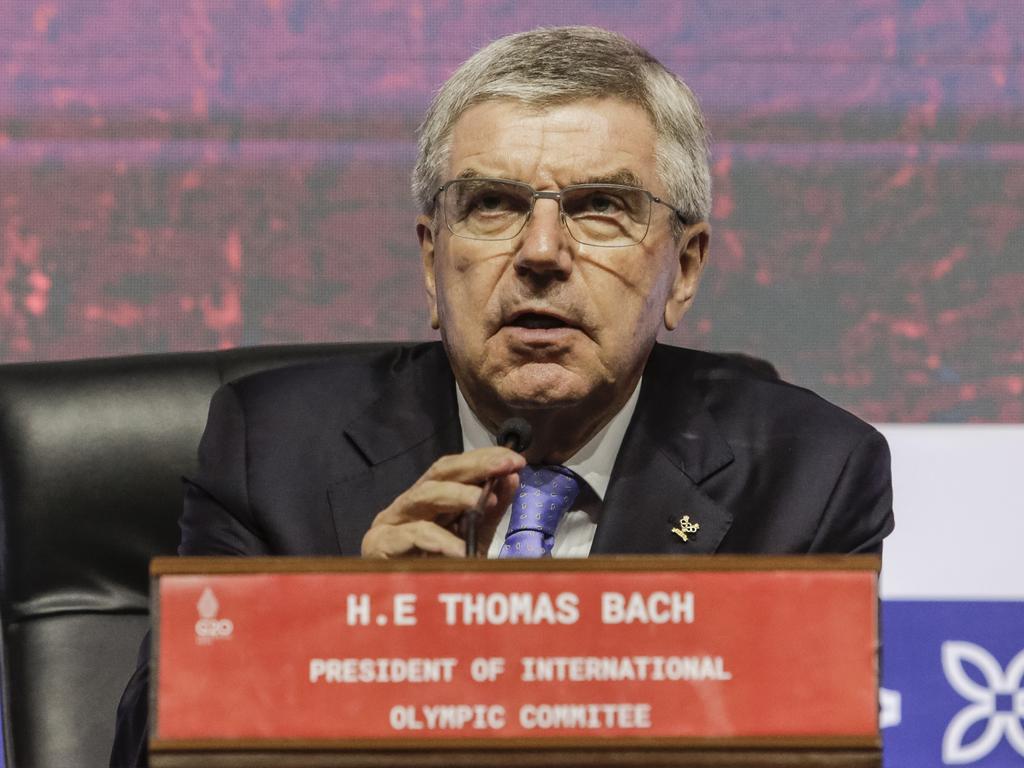
International Olympic Committee president Thomas Bach said he wants Russian and Belarusian athletes to participate in the 2024 Paris Olympics despite Russia’s invasion of Ukraine, his strongest remarks to date on the debate that has divided international sport.
“Participation must happen on sporting merits,” Bach said in a Wednesday news conference.
The IOC’s position could set up a showdown with the international sports federations that determine Olympic qualification for athletes, and with countries that have sought to ostracize Russia in response to the February invasion.
Ten months ago, the IOC encouraged international federations to bar Russian and Belarusian athletes’ participation in international events, citing athlete safety. Most sports federations have maintained that ban. Russia was already barred from competing under state banners at international events because of its epic state-sponsored doping offenses at the 2014 Sochi Olympics, although many Russian athletes were allowed into the last several Olympic Games under names like “Russian Olympic Committee.”

But on Wednesday, Bach said the response to the invasion wasn’t intended to be a blanket ban on athletes from certain nations. He indicated he wants to find ways to lift the restriction, and pointed to support for his position from the United Nations.
“What we never did, and we never wanted to do, is (prohibit) athletes from participating in sports only because of their passport,” he said.
Bach deplored what he characterized as political decisions over Russian and Belarusian participation that he said were not in keeping with the mission of international sports, drawing a sharp contrast between two Grand Slam tennis tournaments for emphasis.
“We had…participation of Russian and Belarusian athletes in the U.S. Open in tennis,” he said. “We have Russian athletes participating in the NHL. They all have, obviously, their working permit. They are playing. They are cheered upon by the fans…everybody (is) happy.”
“On the other hand, we had at Wimbledon the British government interfering and forcing the Wimbledon organizers to exclude the Russian and Belarusian players from play,” Bach said. “And this is the situation we are in, and this is the situation we have to overcome, so that the international competitions you know can really be comparable and can be fair and just for everybody.”

Bach spoke after what he said was a lengthy debate on the issue within the IOC’s executive board. The board was the body that in February called on international sports federations to restrict Russian and Belarusian athletes’ participation.
On Wednesday, Bach said that the board had settled on a mandate that, “as we have always done with regard to the many other conflicts and wars in past and present, the Olympic movement must be a unifying force and not a dividing force.”
He pointed to a recent United Nations resolution that he said supported the political neutrality of the Olympic movement, and the independence and autonomy of sport. Bach portrayed the Russian question as a watershed one, in which the IOC needed to “defend the international sports movement against this full politicization and this division.”
“Today it’s Russia and Belarus, tomorrow it’s the next country, and the other countries coming back with counter-sanctions…Then, there would be no global sports anymore.”
International sports federations run the events and processes through which athletes will qualify for the 2024 Olympic Games. Some of those events have already begun, with the world gymnastics championships in November giving out berths to several countries. Russian athletes, who are the Olympic titleholders in both the men’s and women’s team events, as well as the 2021 women’s all-around champion, were absent.

World Athletics, the international federation for track and field, has taken a hard public line on its ban on Russian and Belarusian athletes, which has been in effect since March. World Athletics president Seb Coe was recently asked what the group was looking for in considering whether to reinstate those athletes, Coe replied: “I think this is fairly simple: Get out of Ukraine.”
Asked Wednesday about the implications of the federations’ ban for Olympic qualifying, Bach indicated that he did not consider it insurmountable.
“What we are doing, is, what I said, exploring ways to accomplish our unifying mission,“ Bach said.
He also suggested his approach would not change even if Russian troops are still in Ukraine in 2024.
“This combination, I do not understand,” Bach said. “Because these are two different areas of our societies.”
The IOC’s message comes despite its own officials’ troubles with Russia. Last March, an IOC spokesman said the organization’s relationship with Russia “dramatically deteriorated” following the revelations about systemic doping in the country. After the IOC imposed a range of punishments on Russia, the spokesman said, “a number of top individuals at the IOC were targets of cyberattacks and personal threats.”
The most recent Games, the 2022 Winter Olympics in Beijing, were upended by a fresh doping scandal surrounding teenage Russian figure skater Kamila Valieva, which remains unresolved.

From coma to champion: BMX star’s comeback finds a new track

She miscarried last week – now this brave Olympian is taking on a triathlon

1000+ athletes to benefit from revolutionary $50m retirement fund

False start as Ian Thorpe prepares for wild ride in Sydney to Hobart yacht race

‘Definitely reasonable’: Teen Olympian backs social media ban
