
The question gripping figure skating: Will the daughter of Russia’s coach come in from the cold?
Everyone’s watching to see whether the US-born daughter of polarising figure skating coach Eteri Tutberidze will try to join Team USA.
LEESBURG, Va. — Four months after she became the most notorious woman in figure skating, the Russian coach at the centre of a doping storm at the Beijing Olympics was sitting in an American rink cafeteria like any other skating mum.
Eteri Tutberidze watched intently as her daughter, an ice dancer, and her daughter’s partner worked with their new choreographer. She was juggling her own responsibilities, looking at her phone for a conversation over FaceTime, moving her shoulders and arms to make a point.
Passers-by were oblivious to Tutberidze and her shock of platinum curls. But in the wake of her turn in a harsh spotlight at the Beijing, Tutberidze has brought one of the wildest intrigues in sports today to the Ion International Training Center, an ambitious new rink complex 40 miles from Washington, D.C.
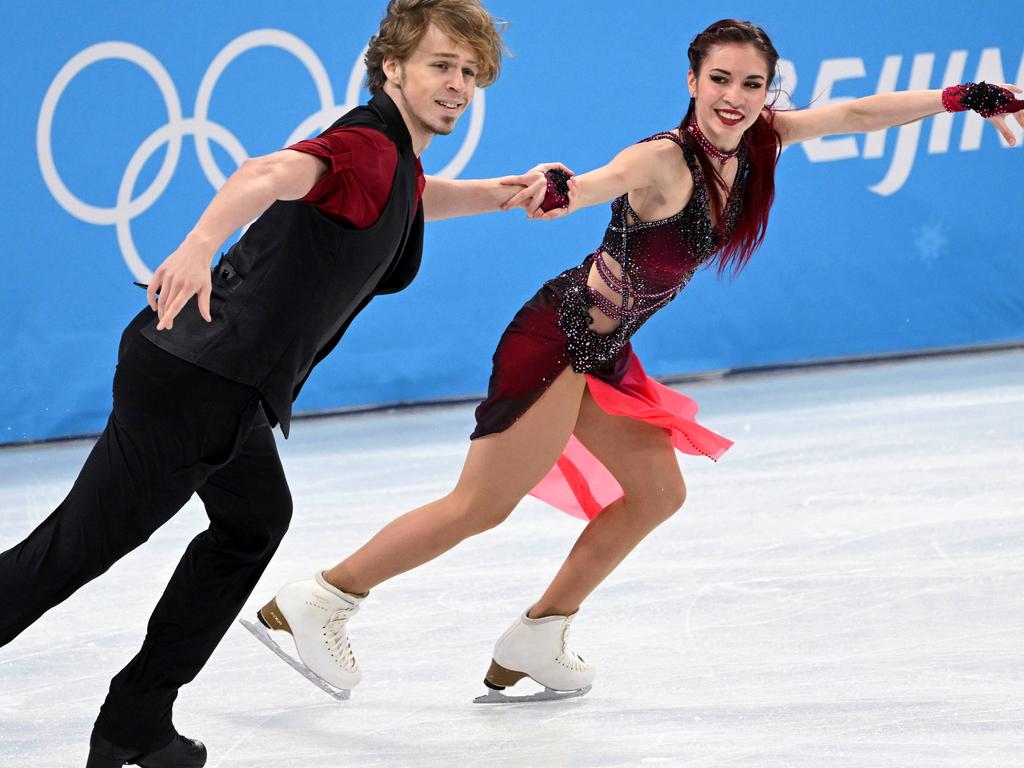
The skating world is watching for clues that Diana Davis, Tutberidze’s ice dancer daughter, might effectively defect as a competitor to the U.S., where Davis is already a citizen. Questions have been fuelled by Davis’ recent marriage to her ice dance partner, a move that could facilitate his acquisition of American citizenship. The Russians say that Davis and her partner have no intention of leaving their team.
However, the fact remains that Davis, like all Russian skaters, is currently working on new programs and training intensely for a road to nowhere.
There is no sign that any Russian skaters will be back in the fold for an international skating season that begins in the fall. The question will become more urgent as the 2026 Olympics approach.
Tutberidze also faces an uncertain future for herself in a sport in which she has churned out Olympic gold medallists, then seen the tide change quickly for her athletes — and her trips from Russia to the U.S. have continued to fuel the guessing game.

Cutting official ties with a federation that is one of the most powerful forces in the sport would require a significant commitment, and potentially require Davis to still sit out of competition for some time. Taking that step would send a strong signal they see Russia’s exclusion as lasting.
Russian skaters face an indefinite lockout from international competition over their country’s invasion of Ukraine. They’re under a microscope after Tutberidze’s top student, the then-15 year-old Kamila Valieva, was cleared to skate at the Olympics after testing positive for a banned heart drug and then stumbled off the podium in unforgettable fashion during an excruciating night for the sport.
The Russian Olympic Committee’s gold medal in the team event remains in limbo during an inquiry into the Valieva affair, which is being handled by the Russian antidoping agency under World Anti-Doping Agency rules, and will include a look at Valieva’s entourage because of her age. The Russian proceedings are expected to continue through August.
While Tutberidze has long been celebrated in Russia, international skating has turned against her teenagers with outrageous jumping feats. In June, the International Skating Union voted to raise the minimum age for senior-level competition to 17, up-ending the development pipeline in clubs like Tutberidze’s.
The U.S. Olympic & Paralympic Committee has cheered the exclusion of Russians from sports over years of doping scandals as well as Ukraine. American skaters finished second to the Russian Olympic Committee in the Beijing team competition, and then had to leave without a medal ceremony.
Davis’s career is separate from her mother, and she has trained in the U.S. for three years already. Yet a backlash is a virtual certainty if Davis and her ice dance partner were to be welcomed into U.S. Figure Skating. U.S. Figure Skating declined to comment.
The situation is a stunning reversal of fortunes for Russian athletes who brought back one gold, three silvers and one bronze medal in figure skating from Beijing in February. Tutberidze had a claim on three of those five individual medals as well as the team result. By the time figure skating held its world championships four weeks later, Vladimir Putin had invaded Ukraine and Russians were banned from a competition where they were defending titleholders in three out of four events.
Now, all of that drama is encapsulated by one mother and daughter.
Davis and her partner, Gleb Smolkin, finished 14th skating for the Russian Olympic Committee at the 2022 Games, a promising start for a young couple that was immediately cut short by the Russian ban.
Davis’s U.S. birth gives her another option. She and Smolkin could seek to be released from the Russian skating federation, and opt to represent the U.S. in competition. To return to the Olympics in a Team USA jacket, Smolkin would also need his own American passport, a process that has become lengthy and burdensome for some athletes.
Davis and Smolkin married March 18, 2½ weeks after sports bodies started banning Russia from international competition, at the office of civil marriages in Las Vegas. She is 19; he is 22.
The affidavit submitted for the marriage license, obtained by The Wall Street Journal along with a copy of the marriage certificate, lists Nevada as Davis’s place of birth and her father as American-born. The marriage could accelerate Smolkin’s possible naturalisation, though not guarantee it would be complete by 2026.
The marriage remained secret until June, when the license was posted online by skating YouTube commentator Dave Lease. By then, rumours were already swirling, after months in which Davis and Smolkin popped up at other rinks around the U.S. for training — sometimes accompanied by Tutberidze.
The posting of the marriage license and other speculation prompted Davis to write on Instagram, in Russian, that the skaters were still members of the Russian national team and would appear at a domestic event in which Russian elite skaters debut their programs. She said she intended to try to keep the couple’s personal life private and did not comment further on the marriage.
Davis also confirmed in the post that the couple had left their previous coach in Michigan and settled at Ion in Virginia, coached by Elena Novak and Alexei Kiliakov, a married team who brought their ice dance school from Wheaton, Md. to the Leesburg rink during the pandemic.
Kiliakov formerly skated with Tutberidze. But her willingness to entrust him with her daughter’s career is likely far more pragmatic: he and Novak have produced two junior world ice dance champions. The rink’s directors declined to comment.
Tutberidze returned to Russia in late June, and was shown on Russian television in July watching her skaters at a pre-season training camp in Novogorsk. She wrote in June that the suggestion she wanted to work in the U.S. was “fake”, and subsequently posting a picture of her with Davis saying only: “Words are not needed #family.”
Her Moscow rink said soon after that she was back coaching there, and referred inquiries about her to the Moscow Sports Department, which did not immediately comment further.
A spokeswoman for the Figure Skating Federation of Russia said that the federation “confirms that the ice dance couple Diana Davis/Gleb Smolkin has no intention of leaving the Russian National team and to start competing for another country. At the same time coach Eteri Tutberidze continues to work in Russia.”
“Each athlete has the right to choose their place of training and their coach and Davis/Smolkin have been training for four seasons in the USA,” Olga Ermolina continued. “We as the national federation have no right to comment on their private life.”
Tutberidze has plenty of experience with the U.S. As an 18-year-old in the early 1990s, she left for the U.S., where she toured for several years in ice shows with other Russian performers. She was in Oklahoma City living in a YMCA when the Alfred P. Murrah Federal Building across the street was blown up.
She remained in America for several more years, including coaching for a time in San Antonio, before returning to Russia. There, she produced a legion of elite skaters who competed mostly with each other at the highest levels of the sport. In Beijing, as a sobbing Valieva stepped off Olympic ice, Tutberidze was seen on camera asking her why she had stopped fighting.
-The Wall Street Journal

From coma to champion: BMX star’s comeback finds a new track

She miscarried last week – now this brave Olympian is taking on a triathlon

1000+ athletes to benefit from revolutionary $50m retirement fund

False start as Ian Thorpe prepares for wild ride in Sydney to Hobart yacht race

‘Definitely reasonable’: Teen Olympian backs social media ban
