
Burraneer Rays: How a revolutionary women’s rugby sevens team beat the world’s best in the same year they were formed
Self-started, self-funded and champions of the world within 10 months. TILLY WERNER shares the remarkable story of the Burraneer Rays.

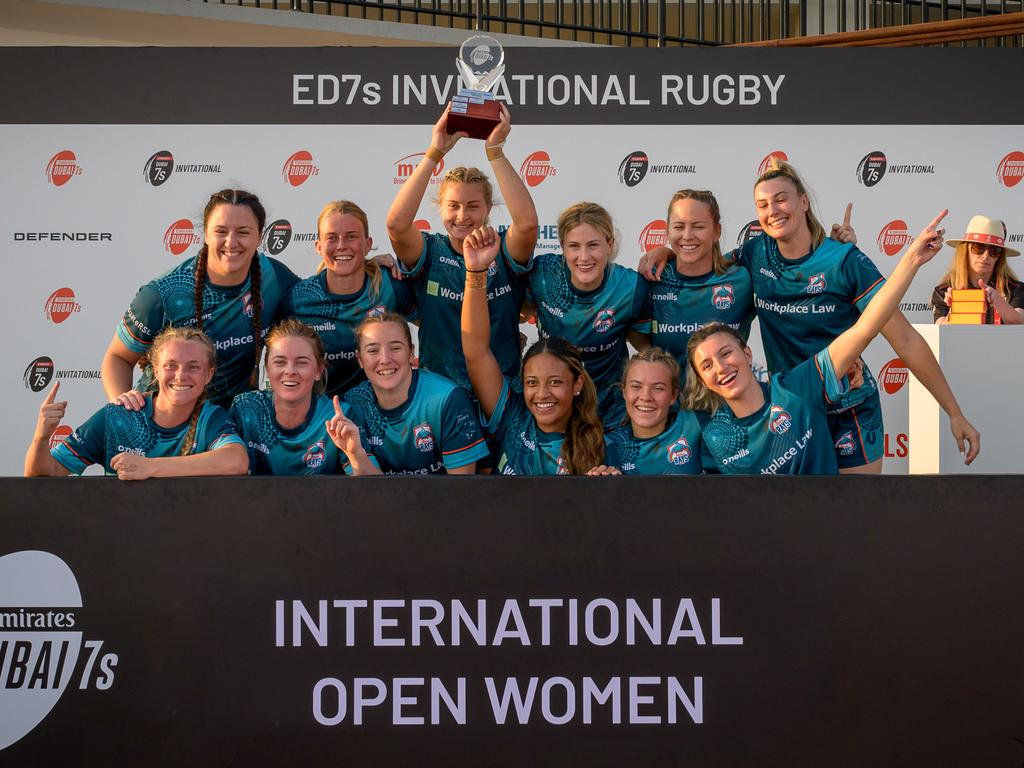
The best team in the world didn’t exist ten months ago.
Indeed, its entire existence is somewhat accidental.
The story of the Burraneer Rays, crowned champions of the Dubai International Open sevens in December, is one of the more unique in Australian sport.
They were conceived after Southern Districts, a Shute Shield team based in Sydney’s south, opted to shift its focus away from its successful women’s sevens line-up - one that had won championships from Kiama to Sawtell and across the Sydney basin - to its 15-a-side program.
The decision might have been made with an eye to the future and the 2029 women’s World Cup, but it was also blind to the club’s successful past.
Confronted with an uncertain future, the sevens program swiftly swung into action.
They formed NSW‘s first women’s rugby club: the Burraneer Rays.

“This was a non-planned change,” says Chris Nay, former Districts fullback and the Rays’ head sevens coach. “Yes, we decided to do it but there was never a plan to begin the Burraneer Rays. It was born from circumstances.
“A lot of our girls wanted to be able to play both [sevens and 15-a-side] and the structure [at Southern Districts] didn’t allow for that.
“We are about developing players and what the Districts proposal meant was that we would have had to cut players and switch to focusing on 15s and that’s not what our values are or where our success was.”
Nay proposed a new team to the players.
They followed, albeit with more than a little trepidation at first.
“It was a scary thing,” says club captain Chloe Saunders.
“We left a club with a foundation and so much success and history to a club that didn’t even have a cent. But it’s testament to those who began it, like Chris. For him to leave the club and have 50 girls follow is incredible and a show of faith for what we know this club can be.”

Funding was an immediate concern. The Rays had no income when they broke away from Southern Districts. Then a sponsor came on board - “Enough to buy the girls some uniforms,” says Nay - and a $10,000 winners’ cheque at the Kiama Sevens soon followed.
All these events took place within three days of the club being registered.
“As our story began to build, we found that commercial partners and revenue streams fell naturally,” Nay continues. “People just became really interested in the story and the club, so much more so than we thought.”
The investment from local Sutherland Shire businesses was such that the Rays were able to offer free registration and kit for newcomers. At an established club, such funds would likely have been earmarked for the top teams.
At the Rays, it was used to build a ground-up legacy.
Nay’s day job is that of chief executive of Wheelchair Rugby Australia and he channelled that experience into establishing governance structures and processes. As for the direction of the club? He left that to the players.
“We now have a motto of ‘good players, better people’,” he says. “We ask a lot of our girls, we want them to contribute to the culture of the club and to rugby beyond just playing.
“We donated our prizemoney from the Samoa Sevens tour back to their under 18s team as they were trying to get to NZ to play. We want to actually make a change in this sport.”

Their approach feels revolutionary.
“Women‘s rugby is growing and it’s doing so in a capacity that, at this point, the game can’t support,” Saunders says. “It feels like what we’re doing is safeguarding the future of sevens with what we’re building, rather than trying to just push up the top team to win trophies.
“We’re offering women an opportunity at all levels. Next year there’s a development tour, one not for the premiership players.
“We’ve built our foundations off rugby sevens but we are a rugby club and will focus across all formats. I think there is a gap that we can step in to fill to create a pathway of progression into the representative programs.”
It is already happening.
Two Rays players - Bridget Clark and Alice Gregory - graduated into the Australian sevens program in 2022.
“For the young girls looking up at Alice and Bridget, they see opportunity and possibility and they see Burra giving them the pathway to it,” Saunders continues. “We started in the twos and worked into the premier division and now they’re contracted players for Australia.
“Every one of my friends, people who compete for other clubs, are all adjacent to or under the men’s 15. Everything the women do has ... to go through the men’s programs. Getting approval or funds or whatever it is.
“Here, all the money that we worked so hard for now goes back into the women’s programs and developing girls as players. It just shows that if you invest in women’s sport it pays dividends.”

****
The Rays players had all heard of the Dubai Sevens. Of course they had. It’s where many young players dream of representing Australia at the HSBC World Series.
Less known is the event that plays out on the pitches outside the main stadium.
It’s there at the International Open tournament that challenger nations like Georgia and Mauritius compete against the world’s best club sides like the Rhinos and Tropics out of burgeoning sevens rugby country United States.
For the second time in a year, Nay asked his players if they would come with him.
Once more, they followed.
“We just had a really successful season, winning practically every tournament we entered, so when the coaches spoke about it we were all in,” Saunders says.
“We were unchanged going in. Our structure was the same playing Manly or Mauritius. We didn’t know our opposition like we do here in NSW but we know our bond is something we can rely on.”

Defeating Uzbekistan’s national team 45-0 was a decent start.
Thrashing English clubside The Cats 47-0 was a strong follow up.
“I remember looking at the team sheet through my fingers, not really wanting to see our opposition,” Saunders says. “It was really intimidating. It was so daunting when we arrived, the thought of playing an entire country. But then we remembered that we know how to win.
“Respect but not fear.”
The Burra Rays took on Rhinos Rugby in the final.
They won 24-7.
They were the best club team in the world.
“Effectively we didn’t exist in January,” Nay says. “And in December, we were the world champions.”

Big battles loom to close out 2025 Darwin Rugby season

Revealed: Ex-Wallaby wants more than $50k from Rugby Australia

‘Surreal moment’: Sunshine Coast teen earns Aussie team call-up

Blue-tal! NSW players smash rival states for Aussie U16 rugby spots

Who’s who? The Qld Reds U17s and Aus 16s set for blockbuster
