
Ireland’s tactical masterpiece was a triumph of planning and execution
Ireland levelled their three-match series against the All Blacks on the back of a tactical masterpiece, writes STUART BARNES.

The history books will tell how Ireland popped, passed and powered their way to their first victory on New Zealand soil. Johnny Sexton was doing the popping and passing. His sublime distribution was central to both Ireland’s tries.
The captain worked in tandem with the magisterial Tadhg Beirne. The lock’s ability to find his way past Kiwi tacklers and over the gainline was the link between the tall, thin fly half and his burly loose-head prop, Andrew Porter, who scored the two tries. Beirne was everywhere, the Munster lock did everything. The 30-year-old’s display eclipsed even Paul O’Connell’s towering effort against England at Croke Park.
Yet the performances by this trio and all the other outstanding individual efforts do not begin to explain Ireland’s series-levelling win.
It was a triumph of planning and execution.

In the past, Ireland have beaten New Zealand with their non-stop work rate, their breakdown brilliance. This was different. This was a far more cerebral victory.
“The right game in the right parts of the field,” is how Andy Farrell, the Ireland head coach, described this tactical masterpiece.
To beat the All Blacks, tempo and territory usually have to be controlled. It is a long time since any side managed proceedings in such a way. The foundations of this game were laid in the first half, especially before Angus Ta’avao was sent off in the 31st minute, as Ireland built up a 10-0 lead.
Ireland had 63 per cent of territory; New Zealand 53 per cent of possession. Sometimes statistics lie, but these two were spot on.
What they do not reveal is the utter territorial monopoly for the first 36 minutes of the match. Why 36 minutes? Because that is how long it took New Zealand to cross the Irish ten-metre line in open play.
Eight minutes into the game, New Zealand had a lineout throw on Ireland’s 22. James Ryan stole possession. Jamison Gibson-Park, the No 9, booted the ball back, into touch, in New Zealand’s half.
The kicking strategy worked wonderfully well. The scrum half started the game with a kick from his own 22 into enemy territory.
Ireland carried on, kicking long and wisely. Yet kicking cannot be analysed as though independent of the rest of the game. In the second half, under more pressure, Gibson-Park and his replacement, Conor Murray, sliced box-kicks into touch, only a few metres from where the kick was made. In the first half, Ireland were nigh-on perfect with their entire kicking structure.
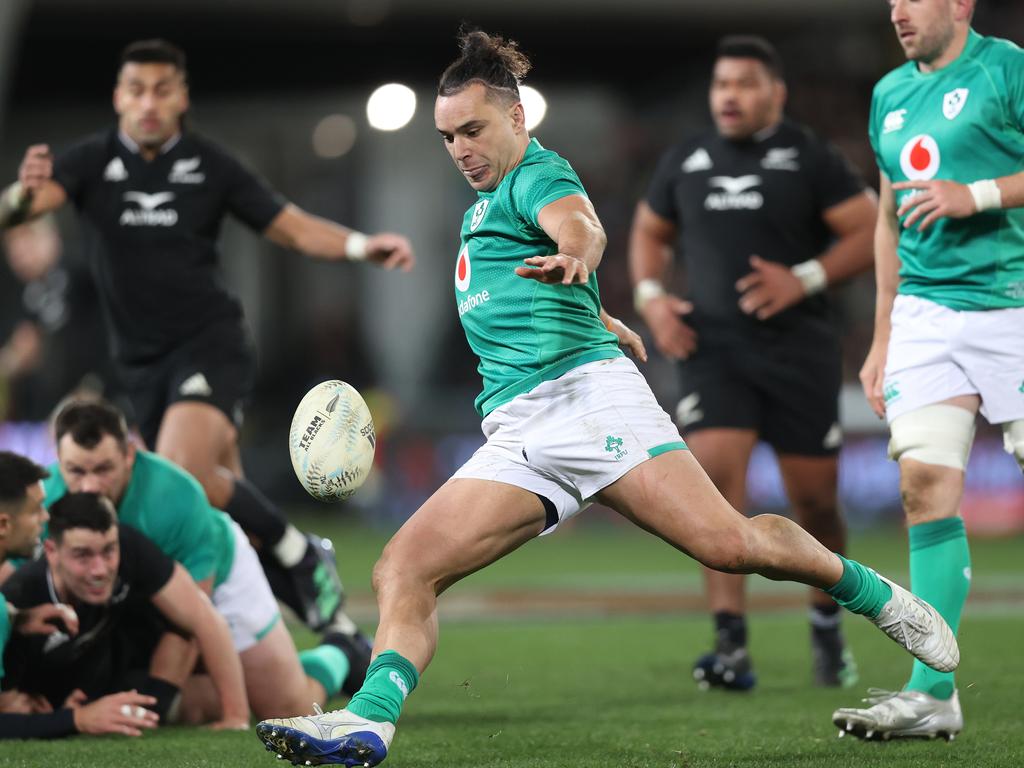
First of all, whatever New Zealand kicked to them, they handled superbly. Whether it was Hugo Keenan at full back or the astonishing Peter O’Mahony at the restart, Ireland were dominant. There was nothing fumbling about anything they did. The scrum half would feed a forward runner, the tackle would be taken, the Irish support players would clear a space, and the kick would be sent on its way upfield.
They passed from their own half for a reason — to kick. Whether it was Sexton to one of the wide men, or Mack Hansen making his way infield off the right wing, into a kicking position, Ireland were drawing Kiwi defenders forward and creating open areas, which were exploited.
Most of the time Sexton passed for others to kick, so that the perceived main threat to the All Blacks took on the secondary role of chief distributor. The home side did not get near the Irish kicking game, either before the ball was kicked or after it landed.
Ireland did not, especially in the first half, take anything like the advantage of territorial control they would have wanted.
That’s the negative way to consider their offence. They will need to sharpen their finishing before the decider in Wellington.

The more positive slant is the manner in which New Zealand ran from their own 22 and were forced into errors, which Sexton turned into points. Ian Foster has some of the world’s best attacking backs, but the All Blacks head coach will not want to see them trying quite so much from their own half. That, however, is what happens when champagne is bottled up. Farrell’s strategy was a trap designed to tempt the All Blacks.
A repeat watch shows a dearth of the usual long kicks between the 15-metre lines. Too much space and a broken field is a threat from anywhere against this lot. But Ireland used the touchline as a mate and pinned the ball into corners from where even New Zealand struggled to escape without taking terrible risks.
When the clearance kicks lost their length as the scrum halves hurried their management, New Zealand threatened. In the first half they stayed on the offence from their initial attack within 40 metres until they scored.
In the dying seconds of the second half Will Jordan, the finest wing in the world and sure to start next week, dived in the corner as the penalties mounted against them.
New Zealand will surely try to counter the Irish kicking game. In the process, they may leave space for runners we didn’t see today. Rugby union is a monstrous game of chess. Farrell outwitted them — Ireland’s grandmaster.

Big battles loom to close out 2025 Darwin Rugby season

Revealed: Ex-Wallaby wants more than $50k from Rugby Australia

‘Surreal moment’: Sunshine Coast teen earns Aussie team call-up

Blue-tal! NSW players smash rival states for Aussie U16 rugby spots

Who’s who? The Qld Reds U17s and Aus 16s set for blockbuster
