
Money where your mouth is: Super W players collect their first paychecks this weekend
An impromptu fundraiser for the Rebels Super W side brought tears and dropped jaws last year. Now history is being made this weekend, as LINDA PEARCE charts both the remuneration road travelled and still to come.

A pub in South Melbourne. A Thursday night in late November.
A celebration of the disrupted year just gone combined with the unofficial launch of the first season where the Melbourne Rebels Super Rugby and Super W teams genuinely combine under the one banner.
In that same upstairs function room, complete with barbecue, beer and bubbly, what started with a statement of support and intent by chair Paul Docherty that the women’s squad would be the first in Australia’s five-year-old domestic competition to be paid, quickly snowballed into an impromptu fundraiser.
They were saying we were going to be the first, but I didn’t believe they were really going to do it,’’ Rebels fullback Annie Buntine recalls.
“But then someone said, ‘I’m going to donate $2000’, and then someone else said, ‘I’m going to donate $2000’, and another and another.
“Then later they said they’d raised $30,000. And that’s when I started to cry.’’
As tears fell, jaws also dropped.
This was happening. It really was.

Foundation coach Alana Thomas, a former seven-Test Wallaroo who earned $600 for a five-week World Cup campaign in Canada in 2006, says Rebels CEO Baden Stephenson had been clear from the outset. Remuneration was an “express goal” from his first meeting with the leadership group after the women had moved out from under Rugby Victoria’s umbrella.
Rebels general manager of rugby, Nick Stiles, also insists the plan was always to introduce player payments in 2022.
Still, the most optimistic expectation among the prospective recipients was that it would be as part of the new Collective Bargaining Agreement to be inked for 2023.
Back to that night at Bells Hotel, though. “I sort of knew that (Docherty) would say, ‘We want to pay our players’, but for them at the end of the night to go, ‘We’re doing it next year’ was a massive shock,’’ Thomas says.
“I thought it would be a couple of years. You know, (the women‘s’) first year with the Rebels, get to understand and work through everything, and then have a plan in place, but they decided, ‘Nuh, we’re gonna pull the trigger, we’re gonna go now’, and I think that’s just started the conversation.
“Sometimes it just takes that to happen, and for the clubs to then go, ‘OK, we’re all gonna have to start to do something now’. That’s the beauty of it, and I think in the market and the environment we’re in in sports that we’re all chasing the talented players coming through… we want to be able to provide a future, be competitive and try to shore up that talent.’’

Back in Thomas’ competitive days, the only domestic competition was a week-long national carnival in which she represented NSW Country. Gratis, of course, and probably after fundraising to get there. This is very different. Or soon will be.
“We’ve got players at the end of their career, players that are starting to hit their peak, and then we’ve got these young 17, 18, 19-year-olds in our squad, and it’s a massive thing for the ones that are towards the end of their career knowing that there’s a legacy and that they’re going to see that start to take place.
“They’re such a hardworking group. I love ‘em to death. Being an ex-player and just seeing the joy and the excitement, just the pure ‘we can’t believe this is happening’, it’s such a reward. These players are the trailblazers and they’re the ones that are creating that future for the next generation to come through.’’
Thomas counts Melbourne Vixens coach Simone McKinnis as a mentor and nominates netball as a sport in which the likes of Liz Ellis and Sharelle McMahon helped to lay the foundations for a national league – where the minimum salary is $43,000 and the average among the 80 contracted players is $74,000.
The older Rebels have a similar grasp of the significance of what’s happening on their own, currently more modest, field of dreams. “It’s something that’s really powerful,’’ Thomas says. “And this group of players deeply understand that and are deeply connected to it.’’

*****
Not big bucks, though. Not yet.
CODE has learnt that the Rebels’ amounts are $1000 per game (there are five rounds and up to two finals) for any member of the match day 23, or a maximum of $500 in reimbursed expenses for those who don’t make it onto the pitch/bench.
On the eve of Saturday’s season-opener against newcomers Fijiana Drua at Endeavour Hills, with AAMI Park unavailable and the Super Rugby men in soggy Queensland, Stiles stresses that to focus on the numbers is to miss the point.
“For us it was about leading the way around saying ‘something has to happen’ and we want to start the dialogue around that and we want to action that with some actual payments for the girls,’’ he says.
“But it’s not around the amount, it’s what we can actually do for the whole program and show the worth of where we see the Super W squad sitting within the Rebels and where we want to take the whole club moving forward.’’
The Waratahs said via email that “as the profile and the commitments of the Super W competition grow, we are endeavouring to be in a position to remunerate our women’s team accordingly. The NSW Waratahs are working with Rugby Australia through the high performance women’s advisory group on potential models which will address the need for consistent compensation across the competition for 2023 and beyond.”

So not this year, it seems, and although the cashed-up Reds did not return CODE’s call, two of the four other Australian clubs have joined the Rebels in making concrete commitments for this season.
In the ACT, real estate company Ray White will fund reimbursements up to $500 of rugby-related expenses including fuel, massages and new boots.
In Perth, the Western Force rather cheekily announced it was “the first Australian Super Rugby club to pay their women players’’ – specifically, a $5000 bonus for players selected for the Wallaroos squad, on top of $1500 for the seven weeks of the regular season, a $300 win bonus and $100 for a loss.
“The objective is to get them into a program where they don’t have to go to work, where we are paying them enough to live off,” Force CEO Tony Lewis says. “We are trying to get to that spot. We are making moves in the right direction.’’
The aim is to find ways to commercialise women’s rugby, he adds, and to facilitate the option of a 10-week window for athletes to be full-time professionals. “We’d like to think we can get there next year but it could be two or three years. If we want to take the game to the next level and make us competitive against AFLW, NRL or soccer, we are going to have to pay our players a fair wage.”
While the Rebels were the first to announce their intentions, if not the detail, the Force’s ‘we were first’ boast is technically true, given their season started on Friday night.
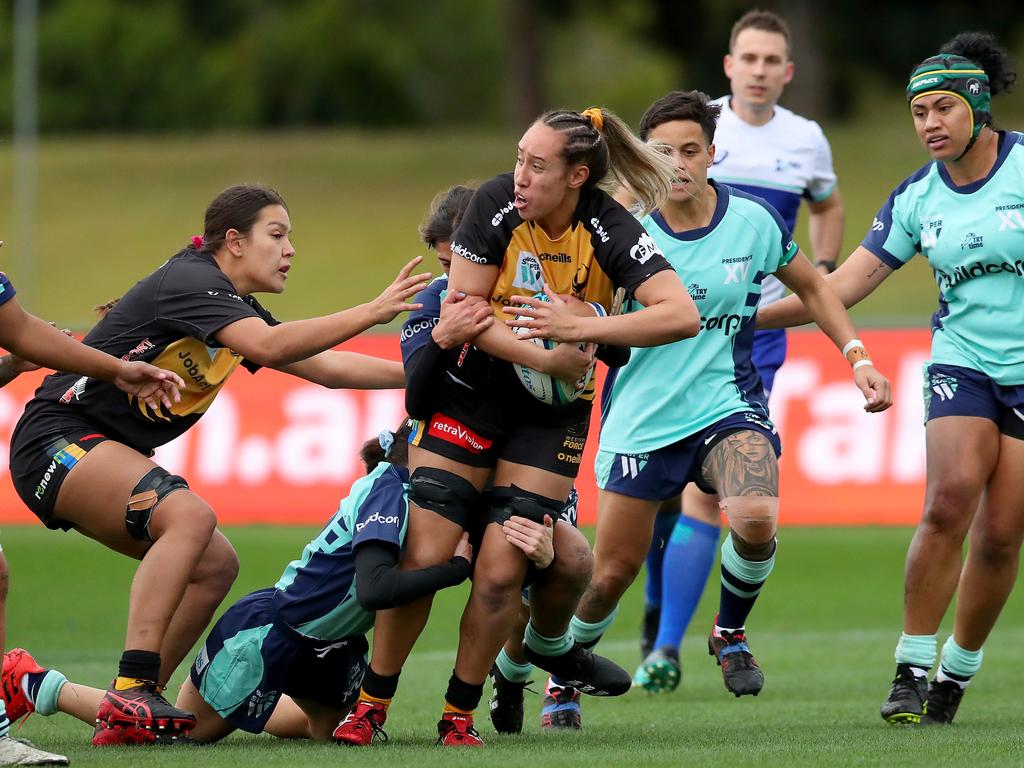
Still, again, probably not the point.
“I’m not sure about that!’’ Stiles laughs of the Force’s proclamation. “Listen, it’s more of an indication that they saw the statements that the Melbourne Rebels made and they’ve obviously agreed around the payments for the Super W players and got on board, and it’s great to see.
“That was one of the things that Paul Docherty wanted to do: get the discussion happening, get the clubs looking at what they were doing, and let’s find as much support as we can. Yes, it’s not full-time professionalism or anything like that, but you’ve just got to start somewhere.”
Adrian Thompson, Rugby Australia’s head of national high performance programs and a member of the women’s advisory panel that includes Rugby Union Players Association CEO Justin Harrison and one delegate from each of the five Australian clubs, believes the best outcomes will come from a co-ordinated and collaborative national approach that achieves consistency across the states.
“The pleasing thing this year is that all the Super W clubs realise the need to make things change,” Thompson says.
“Now they’re trying in different ways and the Rebels are a really good example of that, so I think that’s a starting point, and all five teams are doing something in different forms to try and ease the pressure in some way on the girls.
“It’s a matter of how much can they fund, and then how can they make sure the girls receive it in such a way that it’s not torn apart by tax or other things for this year. That sort of does away with the purpose of it if you’re losing half of it, so we just need to be careful how we do it. But it is exciting that all the clubs realise the importance of having to do something. This year’s a start.’’
It’s also an improvement for the Wallaroos. With the world rugby program expanding, and time and other demands growing, compensation matters more than ever for members of the national team.
This year, a World Cup year requiring over 100 days of commitment from the core group, the pay will be $1400 per week when in assembly. Thompson: “It’s a big step up from what it was. It was really nothing.’’

*****
Halley Derera is about to start her second season at the Brumbies, which she combines with her day job in Canberra as a policy officer for the Federal Department of Health.
The softly spoken but fiercely passionate winger is her club’s representative on Rugby Australia’s aforementioned new women’s advisory group, which held its first meeting last month and will gather in person at season’s end in April.
“Again, that’s a step forward,’’ Derera says. “It would have been nice to see some changes and have some input into this season, but we’ll do what we can.’’
Derera’s story is not unusual. Born into a rugby-loving family, she attended her first game at the age of six weeks, but was discouraged from tackling such a physical game, so took up athletics and netball instead. At university, when decisions were her own, she thought she’d try. Why not? Among the things Derera didn’t fear was being hopeless.
Her dad Nick was the treasurer of the Melbourne University Rugby Club, and had told Halley they were looking for athletes. Didn’t matter where from. “It was a couple of years after the Sevens’ victory in Rio, but people were still really inspired to get into it after watching the golden girls. I was inspired by men growing up, but started to see that female representation was increasing, and I just took the opportunity to try something new.’’
The fact the 24-year-old started at such a high level was challenging. Intense. But here she is. Playing Super W. Loving it. Active in several respects.
Derera’s initial reaction to the Brumbies’ deal was curiosity about why it involved a commercial backer’s reimbursement rather than a cash payment. Her response to the Rebels’ deal was elation, mixed with the more disappointing reality that there is little change among most other clubs.

“Things can happen really slowly in rugby, and it feels like the progress is taking tiny steps, so to see something so big happen so quickly was really great,’’ Derera says.
“I think there is a lot of support for women’s rugby but we don’t always get to see it. So it was amazing a couple of weeks ago when the Brumbies had a fan day and the men and women were there and we got to sign posters – for me that was something I’d never experienced before.
“For all the little girls and the little boys and the families and the people who were chatting to us, I was like, “I can’t believe these people actually care’. And I think it was a really similar feeling for people on that night (in South Melbourne): people putting their money where their mouth is. They’re not just like, ‘Oh, yeah, it’s nice that you’re happy’. It’s ‘we can really see what you’re doing’.’’
And getting more visible all the time. Derera and former Melbourne Uni teammate Buntine were at a hen’s party last weekend when a 40-something caterer serving drinks said he recognised them from somewhere. Just couldn’t quite work out where. Thankfully, it was not a pick-up line.
“He was just a massive rugby fan and he’d watched us play before (on TV). It was just really strange. I didn’t expect that. It was a really good feeling. I was like, ‘Oh, he’s a rugby fan and he’s actually enough of a rugby fan to watch women, too.’’
As for the future: look no further, Derera says, than the landscape of other Australian women’s domestic leagues. Progress elsewhere might just be catching, while history is also present, in the form of a player’s grandma who came to watch recently and spoke of her own history as a competitor.
“People like to pretend that women just woke up one day and decided to play rugby and now think that they should be paid,’’ Derera says. “I don’t think what is happening is entitlement. It’s been a really long road, and people can be grateful for what they have and still want to push for more, and hopefully it happens soon.
“We’ve obviously seen how quickly things can change in just one year. But obviously nothing happens overnight, and this has been decades in the making.’’

*****
As rain continues to tumble down Australia’s east coast, this particular flow-on effect is more of a trickle than a flood.
It has already reached club level — uniquely, it’s believed — via Newcastle’s Hunter Wildfires, with the announcement last week that their female athletes would be paid for the first time since the women’s program started three years ago.
No win bonuses. All 23 squad members rewarded equally. Regardless of whether they start on the field or the bench. Regardless of minutes played.
Wildfires general manager Stuart Pinkerton says the dollar amount is confidential, but the philosophy — championed by chair Nicola Roche, whom he describes as “the driving force behind changing the mentality of the traditional rugby people that make up the Hunter Wildfires” — is transparent.
“We have a culture we want to build that’s based around equality and respect,’’ Pinkerton says. “And while women’s rugby hasn’t always been part of the culture and they just haven’t had participation equivalent to the male side of the game, we had the opportunity to start correctly — right from the start.
“To me there is no difference between our women’s side and our men’s side. They get the exact same facilities as the men. There’s no difference, at all.’’
Meanwhile, back at the Rebels, the exposure to the broader support group is validation to RA’s Thompson. The benefits of Super W operations being folded into the high performance programs at the Super Rugby clubs – with whom they had shared names since the dawn of the league in 2018 – speak for themselves.

It all began in the wake of the 2017 Rugby World Cup; established to help bridge the gap between the local level and the Wallaroos, with the Rio gold medal-winning Women’s Sevens having helped boost participation numbers and attract the likes of Buntine and Derera in the first place.
The fact that the Super W programs have been moved inside the mens’ Super Rugby tents, Thompson says, means that “straight away that gives them some profile and some influence’’. Hence, using the Melbourne example, interest is piqued, because the women are seen as “genuine Rebels’’.
Not that it’s ideal. Any of this. But it’s important. It’s progress.
“And it’s funny, but there’s no point being defensive in this space because the reality is everyone would like to do more,’’ Thompson adds. “I guess our Sevens (due to its Olympic status) is a highly professionalised full-time program with competitive salaries and we need to push the XVs in that direction, but it will take a while to get there.
“So it’s not great. We’d all like it to be better, but it’s a starting point that wasn’t there, say, three years ago. I think it’ll take a long time to get to parity, and we’d be kidding to say it wouldn’t. But in saying that I think it will accelerate pretty quickly.’’

Thus, with fingers poised over the fast forward button, the movement has begun, however modestly. Back at Bells Hotel last November, Stiles said he was prepared for the reaction he knew would come from the players and the long-time local supporters of rugby, women’s rugby, in AFL heartland.
“It was a pretty special night if I can be totally honest,’’ he recalls. “Being there and seeing the girls just totally blown away, how passionate they are about playing rugby and how passionate they are about being the best athletes they can be, and the time they put into chasing those dreams and those goals of being a Wallaroo, and then to hear that this is the sport, this is the beginning, payments will happen.
“Then to see long-time supporters get on board and donate money there and then. Just knowing this is the way forward for the women’s game.’’

Big futures: Who are the Aussie U18 Rugby Sevens golden studs?

Who’s who? The Qld Reds U17s and Aus 16s set for blockbuster

Career over? Paps shuts down NRL return despite R360 collapse

Crystal ball! Meet the teenrugby guns part of a brighter Wallabies future

Son of a gun arrives! Track every NSW Waratahs signing
