
Sydney Swans and Melbourne Storm have established dynasties in cities once considered hostile to their codes
Their paths to greatness were different but the dynasties created by Swans and Storm have many similarities, writes NEIL CORDY.
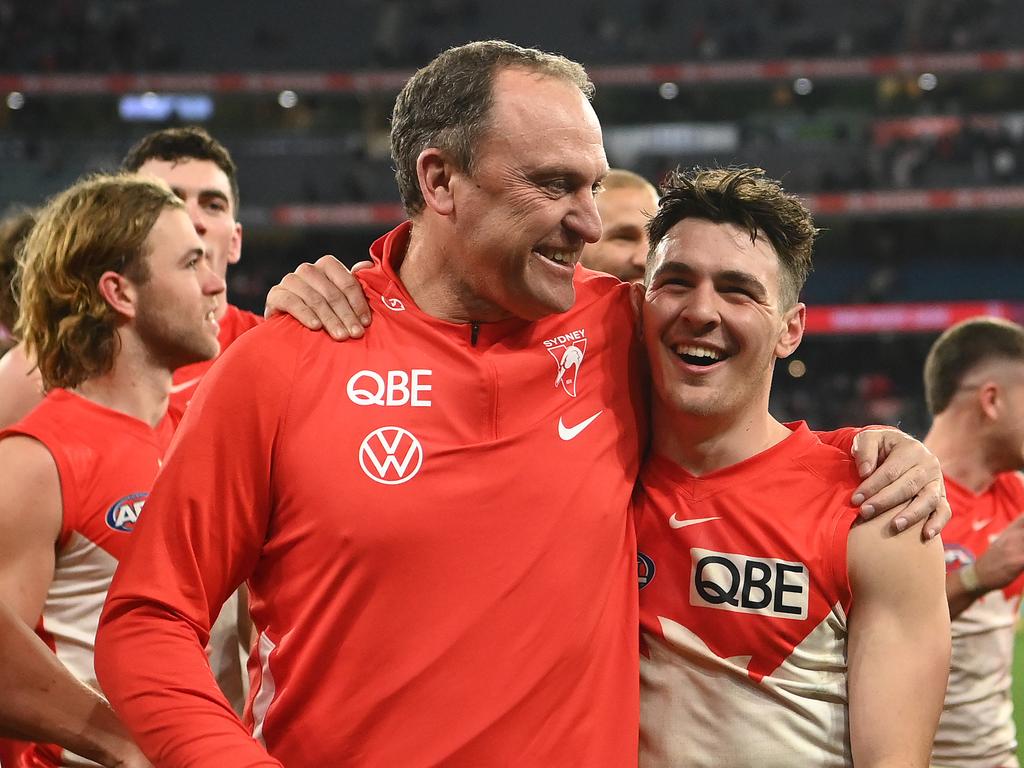
They say the harshest soils produce the best wines, which might well be a metaphor for our two dominant footy codes and the champion teams unearthed in the hostile environments of Sydney and Melbourne.
In the home of the NRL, the Sydney Swans are one win away from their seventh grand final in the last 26 years. Meanwhile, in the AFL mecca of Melbourne, the Storm are contesting their 22nd finals series in 24 seasons.
As the head offices of their respective sports fought for the hearts and minds of the sporting public, the Swans and Storm perfected a winning formula on the field, the envy of their respective rivals.
It’s no coincidence the teams are coached by two of Australia’s great mentors, Craig Bellamy and John Longmire. But neither coach created their winning cultures on their own.
We analyse the factors that made these two clubs so effective.

Different pathways to success
While the Storm hit the ground running 26 years ago winning the premiership in just their second season (1999), it took the red-and-whites 23 years before they claimed their first in Sydney (2005).
The first dozen seasons at the SCG were a little bit of good and a lot of bad. Warwick Capper was flying and the Swanettes were dancing but there was little to show for it on the field.
Their four finals appearances in 1986-87 couldn’t produce a win, although they weren’t helped by having to play them all in Melbourne despite finishing second and third respectively. The lowest ebb came with a three-peat of wooden spoons in 1992, 1993 and 1994. The horror run included a 26-game losing streak.
They also went broke twice in the same time frame.
As the AFL grappled with growing pains in expansion states, the Storm’s first chief executive, John Ribot, was running the overachieving Broncos in Brisbane. An NRL team in Melbourne wasn’t on his radar then, but he was taking note of the miscues the VFL made with their move into Queensland.
“The Brisbane Bears made a big mistake calling themselves Brisbane and setting up on the Gold Coast,” Ribot told CODE Sports.
“The Broncos were going really well and I got to know (Bears’ coach) Peter Knights and we did some cross-training with them. They never had a great engagement with the community. I picked up some of those things in relation to the Storm. When I watched what the Bears did I thought, ‘You wouldn’t want to do that’.”

The Swans change their culture
While Ribot was in Brisbane winning premierships with the Broncos, Richard Colless arrived at the Sydney Cricket Ground as chairman at the Swans in 1993.
It was a pivotal time in Sydney’s history.
Tony Lockett and Paul Roos arrived a couple of years later and the board appointed Brownlow and Coleman medallist Kelvin Templeton as chief executive.
“The Swans were in a tough spot, there were draft penalties for salary cap breaches, it wasn’t in good shape,” Templeton tells CODE Sports. “Tony Lockett had a prime role in changing that. He was the most popular sportsman in Sydney. Once the team started winning it really took off. Rodney Eade was coach and we went through two seasons without losing at the SCG, including the epic 1996 preliminary final.”

Despite the change in fortunes, the Swans were still leaking players – and very good ones. Their three wooden spoons provided them with No. 1 draft picks, but all promptly left: Darren Gaspar to Richmond in 1996, Anthony Rocca to Collingwood in 1997 and Shannon Grant to North Melbourne.
Player welfare became a priority for Sydney. Templeton knew plenty about it after being poorly treated by his first club, Footscray.
“When I had the role of CEO at Sydney, I made a commitment to look after the interests of the players better,” Templeton said. “That was a major objective of mine to get things more player-focussed. It was difficult to recruit players to the Swans, nobody wanted to go there.
“We concentrated on player welfare and worked closely with their parents. Within a couple of years those parents were our greatest advocates. We helped with advice and guidance on a number of levels, education, finance and investment. Eventually it turned and the Swans became a destination club.”
Dual-premiership winner Jude Bolton was one of the players to benefit from the improved welfare and became the first high draft pick from the 1990s to stay at the club.
“I was offered a three-year contract initially but chose two,” Bolton tells CODE Sports. “I remember coming up from Melbourne and there were no Aussie rules goal posts and nothing much about footy in the papers. But we were playing finals most of the time and I really grew to love Sydney. Now I’ve lived most of my life here.”
The Swans’ relatively low profile had its advantages for the playing group.
“We could fly under the radar a bit,” Bolton continues. “It helps being able to go about your work without the glare of media attention players get in Melbourne. That’s something the Storm can do as well with most of the NRL media concentrated in Sydney. I’m a Roosters’ fan but you can’t help but admire what the Storm has done.”
Bolton was drafted to the Swans at No. 8 in 1998, the same year that the Storm entered the NRL.

Storm off to a flyer
Unlike the Swans’ spasmodic start to life in Sydney, the Storm flew out of the blocks in Melbourne. Canterbury Bulldogs’ premiership-winning player and coach Chris Anderson took the reins.
“It was a rare situation because it was brand new and usually when you take over as coach you inherit a team,” Anderson tells CODE Sports. “To go and start a new club was a huge opportunity because I could pick the team I wanted to play my style of football.”
Whereas the Swans arrived in Sydney in 1982 unprepared for their new surroundings, Anderson had a long-standing relationship with Hawthorn through the Bulldogs that helped shape his thinking.
“[We] would often go to Melbourne to pick their brains so we knew the landscape,” Anderson says. “I went with Peter Moore on a number of trips to Melbourne. We were known as a family club and so were they. On one trip I remember going to the Jeff Harding v Dennis Andries fight and the atmosphere was so great I said to Bullfrog [Moore], ‘We have to get a team in Melbourne.’ So the opportunity to coach the Storm was too good to pass up.”

The long association with a powerhouse club like Hawthorn was just one element where the Storm were well ahead of the Swans through their start up phase. Family and player welfare were to the fore. Players with young families grouped near each other in suitable suburbs and the young single men in the inner city suburbs.
The board included corporate heavyweights Ken Cowley (News Corp), Ron McNeilly (BHP), Peter Lawrence (Victoria Racing) and Marcia Griffin (Victorian businesswoman of the year).
They also employed former St Kilda champion and Swans CEO Barry Breen as a consultant.
“Barry was very helpful,” Ribot recalls. “He let us know about the psyche of Melbourne sports fans and how the corporates worked there. The biggest challenge was getting the players on the plane. Once they got to Melbourne they loved it. Chris [Anderson] was a winner and he played an in-your-face style and the fans warmed to it quickly.”

The partnership struck up between Anderson and Ribot was a spectacular success.
Their 1999 premiership shocked everybody but themselves.
“Chris said to me early on, ‘This footy team is going to go a lot better than people think they will.’ He was right,” Ribot says.
The duo created a philosophy and ethos around the Storm. “It was a mix of the Broncos’ [performance] culture and the Bulldogs’ family culture,” Anderson said. “[The Broncos] had some arrogance but it was a good arrogance.”
Super League’s gift to Swans
As successful as the Storm’s start to life in Melbourne was, rugby league didn’t do everything right. A few years earlier, the code had provided the Swans a massive free kick with the Super League war, which Ribot was heavily involved in.
Swans’ premiership coach Paul Roos believes this created a perfect situation for the Swans, who now had the biggest name in the game with Lockett.
“You can’t underestimate the Super League war’s effect and what a positive it was for Aussie rules in Sydney,” Roos tells CODE Sports. “Fortunately, it coincided with when Tony Lockett arrived at the Swans. So many league people told me how they took a look at AFL when that happened and found it was a better game live than on TV.
“The timing was perfect: Super League happened when Rodney Eade and then Plugger came in and we played in the 1996 grand final. It disenfranchised so many rugby league people. I’d meet people all the time who were taking a look at footy for the first time.”
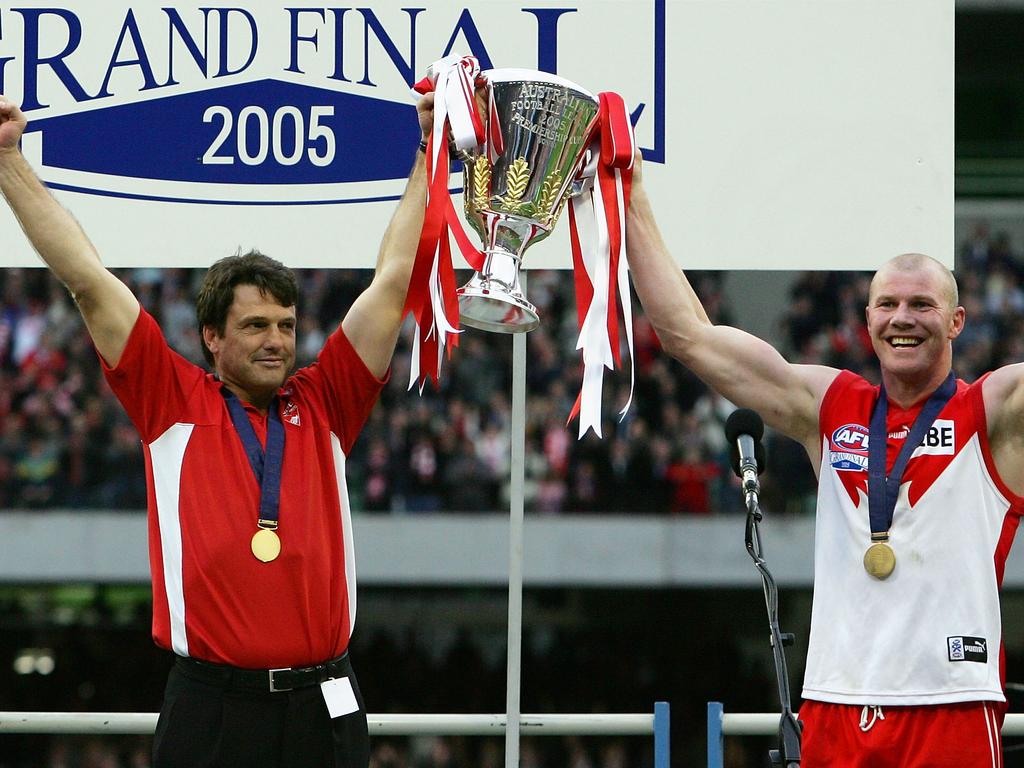
While the Super League war gave the Swans an inadvertent leg up, Roos understood his team were nonetheless on NRL turf.
“We are the guests,” Roos continues.
“The Swans have always respected rugby league in this town. There’s a respect for the game, as we do with rugby union and soccer. We’ve always co-existed well. In some ways, the only clubs that understood what we were going through at the time were the Brisbane Lions and the Storm. The Suns and Giants came later.”

Bellamy and Longmire
After coaching Sydney to their drought-breaking 2005 Premiership, Roos handed the reins to John Longmire in 2011. Along with Geelong coach Chris Scott, Longmire is the longest serving coach in the AFL.
Stability in coaching ranks has also been a hallmark of the Storm, who have the longest serving coach in the NRL in Craig Bellamy.
“Craig Bellamy has been such an enormous influence on their style of football and he hasn’t changed that much,” Anderson says. “He’s expanded their game style but hasn’t changed the principles he started with. He’s had superstars in the spine and can fill the rest with role players. He’s a genius that way.”

While the lack of media spotlight in their respective cities helps, both Bellamy and Longmire are acutely aware of the pressure to perform as the torch bearer for their codes in their competitor’s backyard.
“Missing the [top] eight and crowds go off you in a flash,” Anderson says. “The Swans have been through that and they know it and they have to be competitive to maintain interest. It keeps the pressure on to stay up there.”
As the Storm and Swans saddle up for yet another premiership push, they now have enormous support from their home cities – and probably more in common than many think.

Falcon fought to prove draft value – and the personal turmoil that drove it

‘Pr*ck’: Ill-tempered English cricket team lash out at reporter

Analysis: The Tasmanian AFLW Draft prospects ready to step up

Forgotten hero, snubs reignite rugby league’s greatest debate

‘He’s going to quit again’: Tszyu-Velazquez war of words ignites
